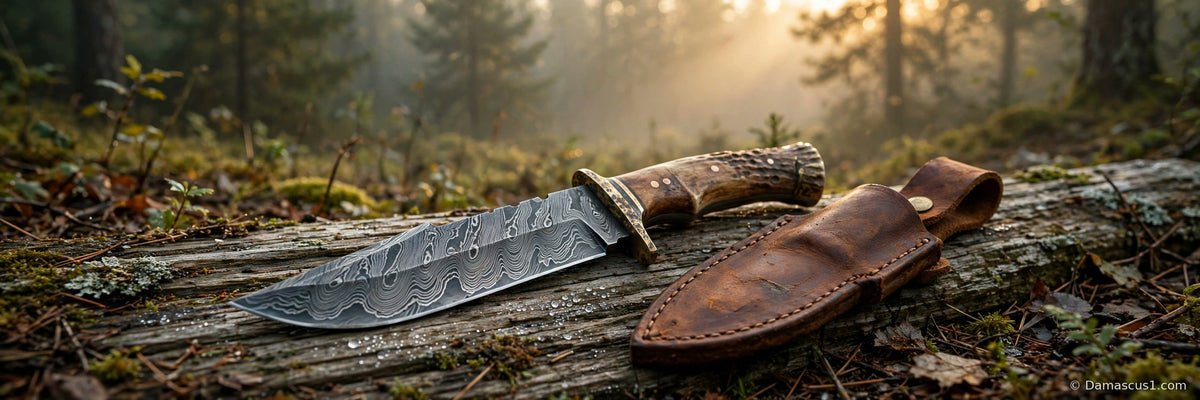
Direct answer: The best Damascus hunting knife for most hunters is the one that matches how you actually hunt: a manageable blade you can control in close work, a handle that stays secure in a wet or gloved hand, and steel you are willing to wash, dry, and oil after the trip. At Damascus1 today, that choice is a folding hunting pocket knife from the everyday EDC collection — the Deer Antler Horn folder at $49.99 for traditional, textured grip, or a 6.5-inch wood-handled Damascus folder at $39.99 for lighter carry — with the larger 7.6-inch scrimshaw models at $59 as the statement option. Bigger and heavier is not better in the field. Control is better.
That answer will frustrate anyone who arrived hoping for a single crowned winner with a fifteen-inch blade. Good. The hunting knife market runs on oversized photography and undersized honesty: knives photographed like swords, sold for work that mostly happens in a space the size of a cutting board, often in the cold, often with tired hands. A hunting knife is a precision tool that occasionally does rough work — not the other way round. This guide slows the choice down. It covers folder versus fixed blade, the blade shapes that matter and the ones that are mostly decoration, handle materials judged by wet grip rather than looks, honest pricing from the live Damascus1 collection, and the care routine a carbon-leaning blade needs after a wet weekend. Browse alongside it in the everyday EDC pocket knives collection, where the hunting folders below actually live.
What makes a Damascus knife a good hunting knife?
A good Damascus hunting knife combines four things: a blade profile you can control at close quarters, an edge that is easy to maintain away from home, a handle that stays put when wet, cold, or gloved, and construction honest enough that the product page tells you exactly what steel you are buying. The Damascus pattern itself is the fifth thing — beautiful, genuinely useful as a sign of layered construction, and no substitute for the first four.
Start with control, because it decides more field outcomes than any specification. Most real hunting-knife work is close and deliberate: opening, trimming, skinning motions, cutting cord, preparing food at camp, whittling a stake, feathering a stick for a fire. All of it rewards a blade that feels like an extension of the hand rather than a small sword. That is why experienced hunters so often carry less knife than beginners expect. The dramatic blade photographs well on the drive out. The manageable blade does the work when you get there.
Edge maintenance is the second test, and it is where Damascus asks a fair question of its owner. A layered blade that dulls two days from the truck needs to be restorable with simple tools — a small whetstone or field sharpener — at the angle it came with, without drama. That is entirely doable, and our how to sharpen a Damascus knife guide covers the pattern-safe technique. But it does mean a Damascus hunter is a knife for someone who maintains edges, not someone who expects a blade to stay sharp by magic from season to season.
Grip and honesty round out the four. Grip gets its own section below because wet-weather handles are where pretty knives fail. Honesty is simpler: the hunting category is full of vague steel language, so the standard from our other guides applies with extra force here — read the individual product's blade-material line, every time. A knife listed as Damascus is a Damascus knife. A knife listed as 420C stainless in the same collection is a stainless knife. Both can be legitimate purchases. Only one of them is the purchase this guide is about.
Folder or fixed blade: which is better for hunting?
A folding knife is better for hunters who value light, discreet, everyday carry and whose field work is mostly general tasks — camp jobs, food prep, cord, and moderate game work where permitted. A fixed blade is better for sustained heavy field dressing, batoning, and users who want the strongest, simplest construction with no moving parts. Many hunters honestly need the folder most of the year and the fixed blade for a few specific trips — which is why buying the folder first is the common, sensible order.
Be precise about what each format gives you. A folder carries safely in a pocket, weighs less in practice because it needs no belt sheath to be secure, and doubles as an everyday knife the other fifty weeks of the year. Its limits are real: a pivot and lock are moving parts that collect grit and moisture, the blade length is capped by the handle, and sustained heavy work is harder on the hand and the mechanism. A fixed blade removes every one of those limits — full tang, no pivot, easy to clean — and adds two costs: it must be carried in a sheath, and it is a single-purpose tool that lives in a drawer or pack between trips.
Damascus1's current hunting-leaning range, as verified on the live collection today, is built around folders: 6.5-inch Damascus pocket knives at $39.99, a deer antler folder at $49.99, and 7.6-inch scrimshaw folders at $59. So this guide's picks are folders, honestly framed — excellent for the hunter whose work is mixed camp and field tasks, and for the outdoorsman who will also carry the knife daily. If your hunting is dominated by large-game field dressing day after day, treat a folder as your camp and backup knife and look for a fixed blade as your primary; do not let a gift-guide format talk you out of the right tool for the heaviest job you do.
There is also a hygiene point folders ask you to respect. Field work gets material into a pivot that a fixed blade simply does not have. Rinse it out, dry the knife open, work the action a few times as it dries, and oil lightly before storage. Two minutes at home. Skip it for a season and the pivot will tell you about it.
Which blade shape is best for a hunting knife — drop point or clip point?

The drop point is the best all-round hunting blade shape: its spine curves gently down to the point, giving a strong tip, a generous curved belly for slicing and skinning-style work, and fine control when you choke up on the blade. The clip point has a straighter, finer tip that excels at detail work and piercing starts, at the cost of a more delicate point. For most hunters doing mixed work, the drop point's balance of strength and control wins; specialists who do a lot of fine caping-style work are the clip point's natural audience.
Blade shape is geometry, and geometry is destiny. The belly — the curved portion of the edge — is what does long slicing work; a knife with almost no belly pushes and chops rather than slices, which is fine for camp wood tasks and limiting for anything delicate. The tip decides how the knife starts cuts and how precisely it works in tight places; a fine tip is a scalpel and a liability in the same object, wonderful in careful hands and fragile under prying. The spine thickness decides how much abuse the blade shrugs off when you twist or lever — something you should still avoid making a habit, because prying with any knife tip or edge is how good blades get damaged.
What about the shapes that dominate gift listings? Gut hooks are a specialised feature some hunters swear by for one specific opening task and others find simply snags and complicates sharpening; they are a preference, not a requirement, and a standard edge in trained hands does the same work. Tanto points are strong and dramatic and poorly suited to the curved slicing most field work involves. Serrations help on rope and fibrous material and hinder clean, controlled cuts and home sharpening. None of these is a scandal. All of them are answers to questions most hunters are not asking. Buy the boring, proven profile first; specialise later, from experience.
Size ties into shape. For folders, the honest working range is the one Damascus1's collection reflects: around 6.5 inches overall for the carry-everywhere knife, stepping up to 7.6 inches when you want more blade and more presence and accept the extra pocket bulk. Judge any knife — folding or fixed — by whether you can imagine controlling it with cold hands at the end of a long day. If the answer needs imagination, it is too much knife.
The Damascus1 hunting shortlist, compared honestly

Every price below was read from the live everyday EDC collection page on October 15, 2026. Prices and compare-at figures can change; the product page on the day you order is the final word.
| Pick | Best for | Size | Handle | Price (verified Oct 15, 2026) |
|---|---|---|---|---|
| Deer Antler Horn Folding Pocket Knife | Best for traditional hunters who want textured wet grip | 6.5" | Deer antler horn | $49.99 (was $139.99) |
| Olive Wood Damascus Pocket Knife Set | Best all-round hunting folder and gift-safe pick | 6.5" | Olive wood | $39.99 (was $89.99) |
| Buffalo Horn Damascus Pocket Knife Set | Best for a dark, dense, dramatic field knife | 6.5" | Buffalo horn | $39.99 (was $99.99) |
| Camel Bone 6.5" Hunting Pocket Knife | Best for the outdoorsman look — pale bone, classic lines | 6.5" | Camel bone | $39.99 |
| Green Wood Damascus Pocket Knife Set | Best for the hunter who wants the uncommon handle | 6.5" | Green wood | $39.99 (was $99.99) |
| Deer Antler Scrimshaw Pocket Knife | Best larger statement knife — hunting heritage and detail | 7.6" | Deer antler, scrimshaw | $59.00 (was $119.99) |
| Blue Wood Scrimshaw Pocket Knife | Best large gift for an outdoorsman with modern taste | 7.6" | Blue wood, scrimshaw | $59.00 (was $99.99) |
Product cards — priced, linked, and framed by the job
Best traditional hunting folder — Deer Antler Horn Folding Pocket Knife, 6.5" — $49.99. Antler is the heritage handle for a reason: naturally ridged, warm in the hand, and secure when smooth materials get slippery. Find it in the EDC pocket knives collection.
Best all-rounder — Olive Wood Damascus Pocket Knife Set — $39.99. The neutral, classic choice that also works as a gift for a hunter whose taste you do not know perfectly. Its product page offers an engraving design quote for a name, initials or short message up to 25 characters, confirmed before any custom order. View the Olive Wood pocket knife.
Best dark field knife — Buffalo Horn Damascus Pocket Knife Set — $39.99. Dense, polished, near-black horn with unrepeatable natural movement. View the Buffalo Horn pocket knife.
Best outdoorsman classic — Camel Bone 6.5" Hunting Pocket Knife — $39.99. The pale, traditional handle that has signalled "hunting knife" for generations. View the Camel Bone pocket knife.
Best statement size — the 7.6" scrimshaw pair — $59.00. Deer antler for heritage, blue wood for a cleaner modern palette; both add hand-detailed etching that makes the knife as much keepsake as tool. Both clear the store's current $50 free-shipping threshold on their own. Find both in the EDC collection.
A shipping note that affects pairing: the site currently shows free shipping & returns above $50. A single $39.99 or $49.99 knife sits just under that line; either $59 scrimshaw model clears it alone, as do any two folders together. Confirm the offer at checkout.
Which handle material is best for a hunting knife in wet conditions?
Deer antler is the best traditional handle for wet hunting conditions because its natural ridging gives a wet or gloved hand something to hold onto. Wood handles — olive, green, and multi wood at Damascus1 — are comfortable and classic but smoother, so they reward a deliberate grip in the rain. Buffalo horn sits between: dense and polished yet substantial in the hand. Whatever the material, keep natural handles out of prolonged soaking, dry them after wet trips, and remember that grip in the field is also technique — a secure, unhurried hold beats a slick handle squeezed in a hurry.
Handles deserve more suspicion than blades when you shop from photographs, because a photo shows colour and grain and tells you nothing about friction. Reason it through from the material instead. Antler's surface is genuinely irregular — that is not styling, it is anatomy — and irregularity is grip. Bone, like the camel bone model on the shortlist, is smoother than antler but still a natural, slightly textured material with a traditional field pedigree. Woods vary: all of them are pleasant in dry hands, all of them get slicker when wet, and all of them prefer owners who dry them after a wet day rather than sealing them damp into a pack pocket.
Gloves change the calculation in the antler's favour again, because a gloved hand loses fine friction first; texture you can feel through a glove is texture that keeps working in January. Cold does the same thing to bare hands that gloves do — numb fingers grip by shape and texture, not by subtle pressure. If your hunting is late-season and cold, weight handle texture heavily. If it is early-season and dry, buy the handle you simply like looking at, because you will like carrying it — and the knife that gets carried is the knife that is there when you need it.
Care for natural handles is light but non-negotiable: never soak them, dry them after wet use, and do not store them damp. A wood handle that looks dry and pale after a season can be refreshed with a tiny amount of oil on a cloth. Horn and antler mostly ask to be kept dry and out of sustained heat. None of this is fragile treatment — it is the same respect you give a leather boot, and for the same reason: natural materials last for decades when they are dried, and deteriorate when they are not.
Is Damascus steel actually good for a hunting knife?

Yes — Damascus steel is good for a hunting knife when the underlying construction is sound and the owner keeps a basic care routine: a layered blade takes a keen edge suited to field work, the cladding and pattern make the knife satisfying to own and easy to identify as yours, and the maintenance — wash, dry, light oil — is a few minutes after a trip. It is a poorer choice for hunters who will not dry a blade or sharpen an edge; for them, a plain stainless knife is the more honest tool, and there is no shame in choosing it.
Steel honesty matters here because hunting listings abuse specifications more than most categories. Layer counts, hardness numbers, and exotic steel pairings are quoted everywhere and verified almost nowhere. This guide deliberately assigns no layer count, hardness, or steel pairing to the individual Damascus1 folders above, because those figures were not verified per product on the day of writing. That is not a gap in the knives; it is discipline in the guide. If a specific figure matters to your decision, find it on that knife's own product page or ask the seller — and apply the same scepticism, doubled, to any listing that prints heroic specifications with no way to check them.
What can be said generally, without inventing specs: traditional Damascus in pocket and hunting knives is commonly built from carbon-leaning layered steels, which is why the care section below leans toward the carbon routine — prompt drying and light oil. Stainless constructions behave more forgivingly. Your knife's own product page tells you which family you own; your routine should follow the page, not the category. And before any purchase, the five checks in how to spot a fake Damascus knife will protect you from paying layered-steel money for a printed pattern — a risk in hunting listings most of all, because dramatic blades photograph dramatically whether they are real or not.
Edge behaviour in the field is the last steel question, and it is refreshingly undramatic: a well-made layered blade sharpens on the same whetstones and field stones as any comparable knife, at the angle it was ground with. Keep the stone on the bevel, keep it off the patterned flats where you can, and touch up little and often rather than regrinding rarely and heavily. A knife maintained in small doses never becomes a big sharpening project the night before a trip.
How do you care for a Damascus hunting knife after a trip?
Care for a Damascus hunting knife the same evening you get home: rinse off field residue with warm water and a little soap, dry the blade and handle completely — opening a folder so the pivot can dry — work the action a few times, add a thin film of oil to the blade if it is carbon-leaning or heading into storage, and store it dry outside its leather sheath. Never seal a damp knife in a sheath, a pack pocket, or a vehicle for the week; that single habit causes most hunting-knife rust.
Expand that into the trip rhythm and it becomes second nature. In the field, wipe the blade after messy work rather than letting residue sit for days; a cloth in the pack is enough. At camp, keep the knife dry overnight rather than in a wet sheath on a belt by the fire. At home, do the full wash-dry-oil once, properly, and the knife is ready to store. Leather sheaths are for carry — they protect the blade and everyone around it in transit — but leather holds moisture against steel, so home storage belongs in a dry drawer, roll, or box, with the sheath alongside rather than sealed around the blade.
Sharpening slots into the same rhythm: touch up the edge at home, on a proper whetstone, rather than fighting a dull blade in the field. Check the pivot and lock on a folder while you are at it — grit in a pivot is a field souvenir you do not want to keep. And check your local rules before the trip, not at the trailhead: knife carry law, blade-length limits, and hunting regulations vary widely by jurisdiction and by land type, and this guide offers no legal advice. Official local sources are the only reliable answer, and a confiscated knife is the most expensive outcome in this entire category.
How much should a good Damascus hunting knife cost?

A good Damascus hunting folder costs $39.99 to $59 at Damascus1's current verified pricing — $39.99 for the 6.5-inch wood, horn, and bone models, $49.99 for the deer antler folder, and $59 for the larger 7.6-inch scrimshaw pair. Well above that band, you are usually paying for bespoke, made-to-order work and a maker's name; well below it, check the blade-material line with extra care, because genuine layered steel at novelty prices is where printed imitations concentrate.
Translate price into use, as with any tool. The $39.99 tier is a real, carryable Damascus knife for daily and field use — cheap enough to use without ceremony, which is a genuine virtue in a hunting knife. The $49.99 antler folder buys the best wet grip in the line. The $59 scrimshaw pair buys size plus hand-detailed work that pushes the knife toward keepsake — the tier to choose for a milestone gift for a hunter, or for your own once-a-decade purchase. None of these tiers needs apologising for. What needs scrutiny is not the price but the silence around it: no blade material stated, no construction described, no seller willing to name the steel. Silence, at any price, is the expensive part.
Compare fairly against the wider market and the picture stays sensible. Mass-produced stainless hunting knives from big outdoor brands cluster in a similar band, without layered steel or natural-handled individuality. Custom fixed blades from individual makers run far higher, reflecting bench time. Damascus1's folders sit in the honest middle: real layered construction and natural handles at working-knife prices. Our broader best Damascus pocket knife guide compares these same models as everyday carries if your hunting knife will also be your daily knife — for many buyers, it will be.
What should you check before buying a Damascus hunting knife?

Before buying, check five things on the product page: the stated blade material for that exact knife, the size — and whether the figure given is overall length or blade length — the handle material, what is included (sheath and accessories vary by model, so confirm the set contents), and the current price. Then check your local carry and hunting rules from an official source. If the blade material line is missing or vague, ask the seller before you pay.
That checklist catches nearly every disappointment in this category. Size confusion is the quiet giant among them: a "6.5-inch knife" whose 6.5 inches is its overall length is a very different object from one with a 6.5-inch blade, and listing conventions vary — Damascus1's own Olive Wood page, for example, describes a "6.5-inch model" and advises asking for the blade and closed measurements if fit is important. Take that advice literally whenever fit matters to you. Included contents are the second trap: sets and accessories differ between handle variants of what looks like the same knife, and the Olive Wood page says plainly to check the exact set contents before ordering for a gift and to ask about sheath and accessory fit for the current set. Sellers who write sentences like that are telling you how to buy from them successfully. Listen.
Finally, buy for the work you will do in the next twelve months, not the expedition you daydream about. A knife matched to real trips gets carried, maintained, and trusted. A knife bought for an imaginary safari sits in a drawer developing exactly the storage rust our care writing warns about — cleaned and dried being a fate reserved for knives that actually go places.
Frequently asked questions
What is the best Damascus hunting knife under $50?
The Deer Antler Horn Folding Pocket Knife at $49.99 is the strongest hunting-specific pick under $50, because its ridged natural handle gives the most secure grip in wet or cold conditions. The 6.5-inch Olive Wood, Buffalo Horn, Camel Bone, and Green Wood Damascus folders at $39.99 are the alternatives — choose among them by handle preference. All prices verified on the live Damascus1 collection on October 15, 2026.
Is a folding knife really enough for hunting?
For general field and camp work and moderate tasks, yes — a well-made folder is the knife most hunters actually carry daily. For sustained heavy field dressing as your primary work, a fixed blade is the stronger primary tool and a folder becomes the backup and camp knife. Match the format to your heaviest regular job, not your lightest, and be honest about how often that job actually happens.
How long should a hunting knife blade be?
For folding hunting knives, the practical range is the one that carries and controls well — the 6.5-inch class for everyday field carry and the 7.6-inch class when you want more blade and presence. Always confirm whether a listed size is overall length or blade length on the product page, and ask for both measurements if fit matters. Control with cold or gloved hands matters more than any headline length.
Will a Damascus hunting knife rust in the field?
It can if it is left wet — carbon-leaning Damascus especially — which is why the routine is wipe in the field, wash and dry at home, oil lightly, and store dry outside the sheath. Stainless constructions forgive more. Rust on a hunting knife is almost always a storage story rather than a field story: the damage is done in the damp week after the trip, not during it.
Are Damascus hunting knives good gifts for hunters?
Yes, when the hunter will use and maintain a knife — a layered blade with a natural handle is a gift with genuine daily presence, and the 7.6-inch scrimshaw pair at $59 is the milestone tier. Add personalisation carefully: Damascus1's Olive Wood page offers an engraving design quote for a name, initials or short message up to 25 characters, with proof and timing confirmed before a custom order. Confirm the exact set contents before ordering for a gift.
Can you sharpen a Damascus hunting knife in the field?
Yes — touch it up little and often on a small whetstone or field stone at the angle it was ground with, keeping abrasives on the edge bevel rather than the patterned flats. Do the thorough sharpening at home on a full whetstone. A blade maintained in small doses in camp never needs a heroic rescue the night before the next trip.
The bottom line: which Damascus hunting knife should you buy?
Buy the knife that matches your real hunting: the Deer Antler Horn folder at $49.99 for wet-grip traditional work, a 6.5-inch Damascus folder at $39.99 for the light all-rounder you will also carry every day, or the 7.6-inch scrimshaw pair at $59 when the knife is also a keepsake. Read the blade-material line, confirm the size convention and the set contents, and commit to the wash-dry-oil routine — a controlled blade, honestly bought and dryly stored, will out-hunt every oversized ornament on the internet.
Ready to choose yours? Browse the Damascus1 everyday EDC pocket knives collection, pick the handle your hand will trust in the rain, and order the knife that will actually be in your pocket when the season opens.
Prices verified against the live damascus1.com collection and product pages on 2026-10-15 and subject to change. DRAFT — not yet published.
Leave a comment: