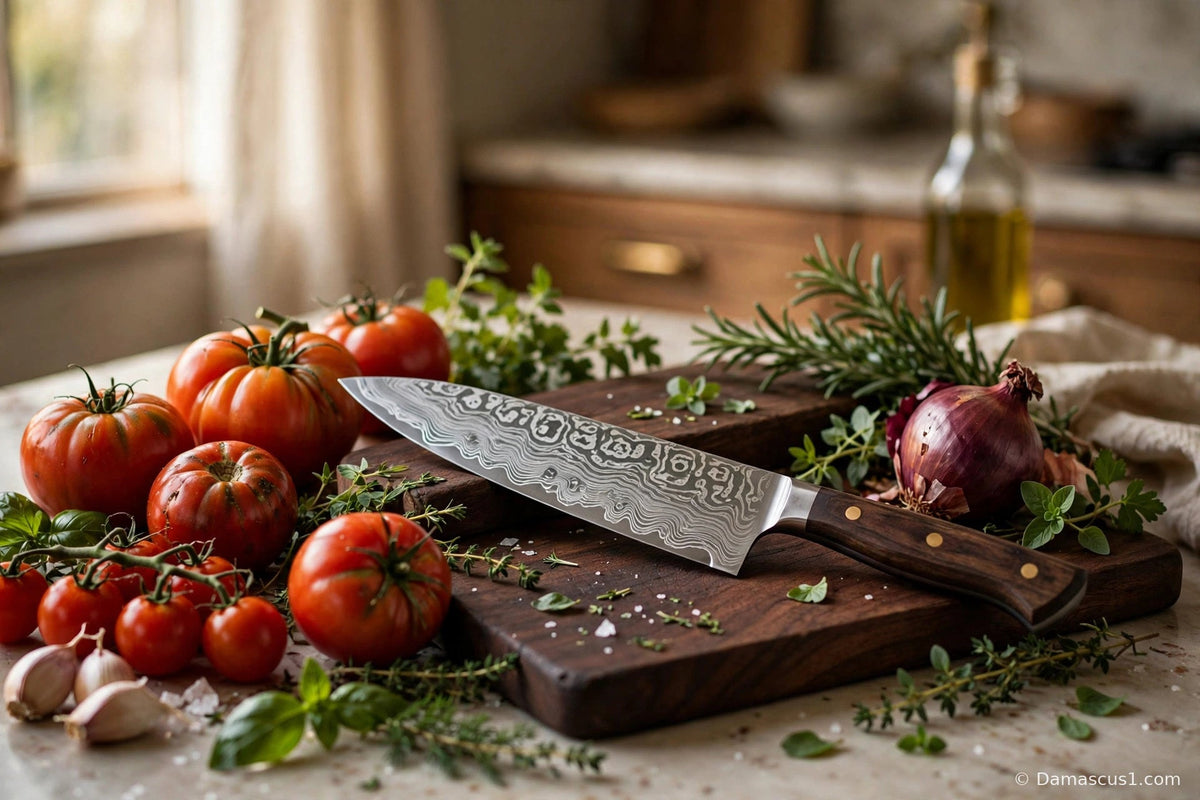
Direct answer: The best Damascus kitchen knife is the one whose shape fits your cooking, whose construction its seller describes clearly and consistently, and whose edge you will maintain. In practice that means: a chef knife first for most kitchens, a nakiri added for vegetable-heavy cooking, and a set when you are equipping a whole kitchen at once. At Damascus1 today, verified prices run from a G10-handle chef knife from $34.99 and a VG10 nakiri at $44.99 up to sets at $169.99–$399.99 — with one honest warning: the cheapest set's own product page contradicts itself about its steel, and this guide says so instead of repeating either version.
This page has carried the title "Best Damascus Kitchen Knives and Chef's Knives" since 2020, and for most of that time it did not deserve it. The old version ranked products that could not be verified, quoted specifications that contradicted themselves, and wrote "pros and cons" in the voice of someone who had handled knives there is no record of anyone handling. This rewrite starts over. What follows is what an honest flagship can actually offer: what Damascus steel does and doesn't do, the handful of shapes that matter, how to check a listing before trusting it, and the real Damascus1 range at prices checked today — the chef's best kitchen blades collection is the shelf everything below is drawn from.
It also serves as this cluster's second pillar, alongside the best kitchen knives hub, which compares the working sets head-to-head. This page is the wider lens: the steel, the shapes, the buying discipline. Read both and there is very little left about buying a Damascus kitchen knife that nobody has told you straight.
What makes a kitchen knife "Damascus" — and does it matter?

A Damascus kitchen knife has a blade built from layered steels, folded or stacked and forge-welded so the finished blade shows flowing patterns and — when a hard core steel is used — pairs that core's edge performance with more forgiving outer layers. It matters, but not magically: what decides your daily experience is the core steel, the edge geometry, and the heat treatment, with the pattern as evidence of the layered construction rather than a performance feature by itself.
Strip the romance away and three honest claims remain. First, layered construction is real engineering with a long history: combining steels lets a maker put hardness where the edge is and toughness where the spine is. Second, the visible pattern is a by-product of that layering, revealed by etching — which is also why the pattern can be faked with a laser or a print, a problem serious enough to have its own guide on this blog, how to spot a fake Damascus knife. Third, none of it substitutes for the basics: a Damascus knife with a bad grind cuts badly in a beautiful pattern, and a plain knife with a good grind and a decent steel cuts well. Damascus is a construction to choose with open eyes, not a spell that makes any knife "the best."
So why choose it at all? Because when the construction is genuine and the core steel is named — VG10 and AUS-10 are the two cores named across this store's Japanese-style range — you get a hard, fine edge with a distinctive blade you will enjoy using daily, and enjoyment is not a trivial factor in a tool you hold every day. Cooks use the knives they like more, maintain them better, and cook more because of them. That is the real, unglamorous case for Damascus, and it does not need a single invented statistic to stand up.
The terminology deserves one clarifying pass, because the product pages you'll read next use it loosely. "Damascus" describes the layered construction. "VG10" and "AUS-10" name specific Japanese stainless steels often used as the core. The comparison between the Damascus approach and a single-steel VG10 blade is covered properly in Damascus vs VG10 — read it if you are choosing between a layered blade and a mono-steel one, because the honest answer is "it depends," and that page explains on what.
Which Damascus kitchen knives should you actually buy?

Buy shapes in the order your cooking demands them: a chef knife as the foundation, then a nakiri or santoku for vegetable work, a paring knife for detail, and a bread knife for crusts — as singles, or together in a set whose contents you have audited. The table below is this store's real range, at prices verified on October 16, 2026, with each item's role stated plainly.
| Pick | Best for | What its own page states | Price (verified Oct 16, 2026) |
|---|---|---|---|
| Damascus Chef Knife with G10 Handle | Best for the first Damascus knife — the everyday foundation | G10 handle per its title; check its page for today's price | From $34.99 |
| Nakiri Knife, Japanese VG10 | Best for vegetable-heavy kitchens | VG10 core and rosewood handle as described on its page | $44.99 |
| Premium Knife Block Set, 7 pieces | Best for the lowest-cost full block set — ask about its steel first | Contents as listed: 8" chef, 7" santoku, 8" bread, 8" slicing, 6" boning, 5" utility, 3.5" paring, with block. Its page gives two conflicting steel descriptions — see the warning below | $169.99 |
| Japanese Damascus Knife Block Set, 9 pieces | Best for a full 9-piece block at the middle price | 9-piece block set as titled; read its current contents list on its page | $339.99 |
| AUS-10 Damascus Knife Set, 9 pieces, G10 | Best for the AUS-10-titled 9-piece option at a reduced price | AUS-10 and G10 as titled on its page | $349.99 (was $499.99) |
| VG10 Core Japanese Kitchen Knife Set, 6 pieces | Best for the most specifically described construction | Per its page: VG10 core, 67 layers, 58–62 HRC, 11° edge, G10 handles; 8" chef, 7" santoku, 8" bread, 6" boning, 3.5" utility, 7" cleaver | $399.99 |
Notice what the table refuses to do: rank these by a score, crown an overall "winner," or quote a single review. The right pick is conditional — on your cooking, your counter, your budget — and the "best for" column is the honest form of a recommendation. A single cook in a small flat who mostly makes salads, stir-fries, and eggs needs the first two rows and nothing else. A household equipping a kitchen from bare drawers needs one of the bottom four. Anyone who tells you one product is best for both of those people is selling, not advising.
The warning promised in the table, stated in full: the Premium 7-piece set's product page describes its blades as German high-carbon stainless in one passage and as Japanese AUS-10 Damascus in another. Both cannot be the clean truth about the same steel. The set remains legitimately interesting — seven classic shapes with a block at the store's lowest set price, $169.99 — but its steel is a question to put to the store before ordering, not a fact any guide should assert. If you take one habit from this entire page, take that one: a product page that contradicts itself gets its prices and contents believed, and its adjectives questioned.
The set-by-set analysis — piece counts audited, storage weighed — lives in the best Damascus chef knife set guide and the kitchen knife set piece count guide. This pillar's job is the map; those pages are the street view.
Chef knife, santoku, or nakiri — which shape comes first?

A chef knife comes first for most kitchens: its curved belly rocks through herbs, its point trims and scores, and it handles the widest range of ingredients without complaint. A santoku comes first only for vegetable-and-slicing cooks working on smaller boards. A nakiri never comes first — it is the best second knife a vegetable-heavy kitchen can buy, and a frustrating only knife for anyone else.
The full three-way comparison — motions, weak spots, and the important shopping fact that this store sells no standalone santoku, only sets listing a 7-inch santoku among their contents — is laid out in the dedicated chef knife vs santoku vs nakiri guide. The short version for this page: shape beats steel as a daily-experience factor. A mid-priced chef knife you reach for constantly outperforms, in every real sense, a premium specialist that fits your cooking twice a month. Buy the shape your week asks for; upgrade the steel within that shape when budget allows.
Length is the shape detail beginners underestimate. An 8-inch chef knife is the standard for a reason — long enough for cabbage and melons, controlled enough for onions — but it is not a moral obligation. Smaller hands and boards often settle happier with the santoku's roughly 7 inches, and a cook who finds a big knife intimidating will simply cook less with it. Handle fit runs a close second: a handle should fill the hand without forcing it, wet or dry. G10 — the handle in the title of the $34.99-entry chef knife and stated on the VG10 set's page — is a fibreglass laminate chosen for grip and water resistance; wooden handles like the nakiri's rosewood feel warmer and need drier habits. Neither is "best"; they are different contracts with your washing routine.
Weight and balance complete the fit picture, and here the honest advice is humility about photos. No listing can tell you where a knife's balance point falls in your grip or whether its weight reads as "reassuringly solid" or "tiring by the third onion" to your wrist. This is why reputable guidance tells you what to check rather than what you'll feel — and why any page that announces a knife "feels perfectly balanced, we tested it" without evidence deserves the same scepticism as the old version of this page earned.
How can you tell a Damascus knife is genuine before you buy?

You can screen for genuine Damascus before buying by checking four things: the pattern should vary organically and continue over the spine and into the edge bevel, not sit on the flat like a print; the seller should name the core steel plainly; the product page should describe the knife consistently, top to bottom; and the price should be plausible for layered, forge-welded construction rather than suspiciously trivial.
The pattern test is the one you can do from photographs, and it is worth learning properly in how to spot a fake Damascus knife, which shows what real pattern behaviour looks like in window light and under magnification. Real layered steel has depth: the pattern shifts with the grinding, waves distort where the blade geometry changes, and the design runs continuously because it is the blade, not a coating on it. Printed and laser-etched imitations sit flat and repeat too neatly, and they stop at edges instead of flowing over them. No photograph proves construction the way handling the knife would, but a pattern that behaves like a surface decal is telling you everything it can.
The consistency test is the one this store's own catalogue teaches best. Read a product page the way an editor reads a manuscript: does it describe one product, or two? The $169.99 set's page fails that test on steel; the VG10 6-piece set's page passes it, committing to one core steel, one layer count, one hardness range, one edge angle, one handle material. Consistency doesn't guarantee quality, but inconsistency guarantees carelessness somewhere in the chain — and in a purchase you cannot handle first, the seller's care with words is a usable proxy for their care with steel. Where a page conflicts, ask. A straight answer is a good sign; evasion is an answer too.
Price is the bluntest screen. Genuine layered construction takes time, material, and reject-prone forge work, and the market prices it accordingly — which is why this store's range, from $34.99 for a single chef knife to $399.99 for its most specified set, reads plausibly, while the wider internet's "Damascus" knives at pocket-change prices are telling you, in numbers, that the pattern is a picture. Cheap is not automatically fake, and expensive is not automatically real. But when the price and the story disagree wildly, believe the arithmetic.
Should you buy a set or single knives?

Buy a set when you are starting from poor knives or an empty kitchen, want storage included, and have audited the contents so every piece has a job. Buy singles when you already own a knife you love, cook a focused repertoire, or want to choose each shape deliberately. Most kitchens end up hybrid: a core set or a foundation chef knife, plus one specialist single — often the nakiri — added when the cooking asks for it.
The economics favour sets more than purists admit. Storage bought separately, handles that match, a discount baked into the bundle — the best kitchen knives hub works through the current set comparison in detail, and the piece-count audit method in the piece count buying guide is the tool that keeps a "9-piece" headline honest. What sets cannot do is know your cooking; a set's designer guessed at an average kitchen, and your kitchen is not average in at least three ways you could name right now. Audit against your meals and the guesswork mostly washes out.
Singles favour the deliberate. The two singles in this guide — a chef knife from $34.99 and a nakiri at $44.99 — combine into the classic two-knife kitchen for under $80 before shipping, with orders above $50 shipping free as shown on the site: a generalist that does everything reasonably and a specialist that does vegetables brilliantly. For a great many home cooks that pairing, plus whatever bread knife they already own, is not a starter kit. It is the finished answer, and everything beyond it is enthusiasm. Enthusiasm is a fine reason to buy a knife. It is just a different reason, and it should be labelled as one.
Whichever route you choose, plan the storage in the same purchase — a block, a strip, or guards — because a Damascus blade's first enemy arrives before its first meal, in the form of a drawer. The care system that keeps these knives at their best is short and non-negotiable, and it is the next section.
How do you care for a Damascus kitchen knife?
Care for a Damascus kitchen knife by hand washing it in warm soapy water, drying it immediately and completely, storing it in a block, on a magnetic strip, or in a sheath, and sharpening it on a whetstone rather than a pull-through sharpener. Oil carbon-rich blades lightly with food-safe mineral oil before longer storage. Never put a good knife in the dishwasher.
That paragraph is the whole routine, and the full version — drying technique, storage trade-offs, honing versus sharpening, board choice — lives in the kitchen knife care, cleaning and storage guide, which this page leans on deliberately rather than repeating. The rust questions get their own treatment in can Damascus steel rust?: short answer, yes, the carbon-rich members of the family can spot if left wet, and no, a spot caught early is not a ruined knife.
It is worth ending this section with the perspective the 2020 version of this page lacked: care is not a burden Damascus imposes on you in exchange for beauty. It is the same care any good knife asks — the dishwasher and the drawer were always enemies; Damascus merely makes the consequences visible sooner, in a pattern that shows every sin. Owners who learn the four habits on one of these blades keep them for life, on every knife that follows. The steel teaches the cook. That may be the most underrated thing it does.
What is it actually like to live with a Damascus knife?
Living with a Damascus knife is mostly ordinary, in the best way: it cuts dinner, gets washed, gets dried, goes back in the block. Two things differ from owning a bargain knife. The edge, when the core steel is a named one like VG10 or AUS-10 and the grind is thin, stays usefully sharp through noticeably more cooking between whetstone sessions — and when it does dull, it responds to a stone quickly and predictably. And the blade asks you to look at it. The pattern makes moisture, residue, and the first freckle of a spot visible immediately, which quietly enforces the care habits that keep any good knife alive.
The value question deserves the same plain treatment. A Damascus knife does not repay its price in measurable cutting superiority over a well-made mono-steel knife of similar geometry; anyone who cooks seriously knows the cook matters more than the cladding. What it repays is willingness — to cook, to maintain, to keep the knife for the decade-plus its construction allows instead of cycling through disposable blades. Amortised over that life, the difference between the $34.99 entry chef knife here and a supermarket knife is small; the difference in daily experience is not. That is a legitimate reason to buy beautiful tools, and it needs no invented performance statistics to prop it up.
There are cooks for whom Damascus is the wrong choice, and a flagship guide should name them. If your kitchen reality is a dishwasher, a shared drawer of loose utensils, teenagers cooking unsupervised, and sharpening that happens never — buy a sturdy, inexpensive mono-steel knife and spend the difference on ingredients. The Damascus blade in that environment will spot, chip, and dull into a reproach, and the failure will be the match's, not the steel's. Equally, if you are outfitting a rental property or a workplace kitchen, matched mid-range sets beat treasured blades every time. The best knife is the one matched to the life it will actually live — that sentence governed every section of this guide, and it is the one to carry into the store.
One last expectation to set honestly: your first good Damascus knife will probably not be your last purchase, and not because it fails. It teaches you your own preferences — the grip you favour, the length that suits your board, whether your cooking leans vegetable or protein — with a clarity cheap knives never provided. The second purchase, made with that knowledge, is usually the one cooks describe as "finally right." Budget for the lesson, enjoy it, and let the first knife become the beloved backup it was always destined to be.
The Olive Wood Damascus Pocket Knife Set — $39.99
Real Damascus steel, an olive wood handle and a genuine leather sheath included — the knife our readers ask about most.
Shop the Olive Wood Damascus Pocket Knife Set — $39.99 · Free US shipping on orders over $50.
Frequently asked questions
What is the best Damascus chef knife for a beginner? One that fits your hand, your board, and your budget, in the 8-inch chef shape. In this store the accessible starting point is the G10-handle Damascus chef knife from $34.99 (check its page for today's price). A beginner gains more from the forgiving curved edge and daily practice than from any premium specification.
Are Damascus kitchen knives worth it over plain stainless? They are worth it when the construction is genuine, the core steel is named, and you enjoy the blade enough to maintain it — which most owners do. They are not worth it as a magic performance claim: grind, geometry, and core steel decide how a knife cuts, and the layering's honest advantages are construction and character. The mono-steel alternative is compared in our Damascus vs VG10 guide.
How much should a good Damascus kitchen knife cost? In this store's verified range: singles from $34.99 to $44.99, sets from $169.99 to $399.99 (October 16, 2026). Market-wide, any price is possible, but a "Damascus" knife priced like a toy should be assumed printed until proven layered. Price is a screen, not a proof — use the pattern and consistency checks too.
Can Damascus knives rust? Yes — blades containing carbon-rich steel can spot or rust if left wet, which is why the wash-and-dry-immediately habit and light oiling before storage exist. Stainless-cored examples resist far better but are not immune to abuse. The full guide to spots, stains, and fixes is on this blog.
Is the $169.99 set a real Damascus set? Its product page claims two different constructions in different paragraphs — German high-carbon stainless and Japanese AUS-10 Damascus — so this guide states neither as fact. It is a 7-piece block set with the classic contents at a verified $169.99; ask the store to confirm the blade material before ordering, and treat any source that states its steel confidently as unreliable.
Do I need a whole set to cook well? No. A chef knife and a nakiri — under $80 combined here — plus a bread knife you may already own will carry most home cooking for years. Sets make sense for equipping a kitchen at once, with storage solved. Need, in the honest sense, stops at about three knives for most people.
The short version
Shape first, then a seller whose page describes one knife consistently, then the pattern and price screens, then the four care habits. That discipline — not a ranking — is what "best" means on this page, and it is why this 2026 rewrite replaced a 2020 list of unverifiable favourites: the knives above are real listings, at prices checked today, with their warts (including one set's self-contradicting product page) left visible where you can use them.
When you are ready, browse the chef's best kitchen blades collection with this guide's checks in hand, start with the chef knife or the $44.99 nakiri if one of them matches your week, and remember that orders above $50 ship free as shown on the site. Buy the knife your cooking can defend — then wash it, dry it, and let it earn the title in your kitchen, where "best" is actually decided.
Leave a comment: