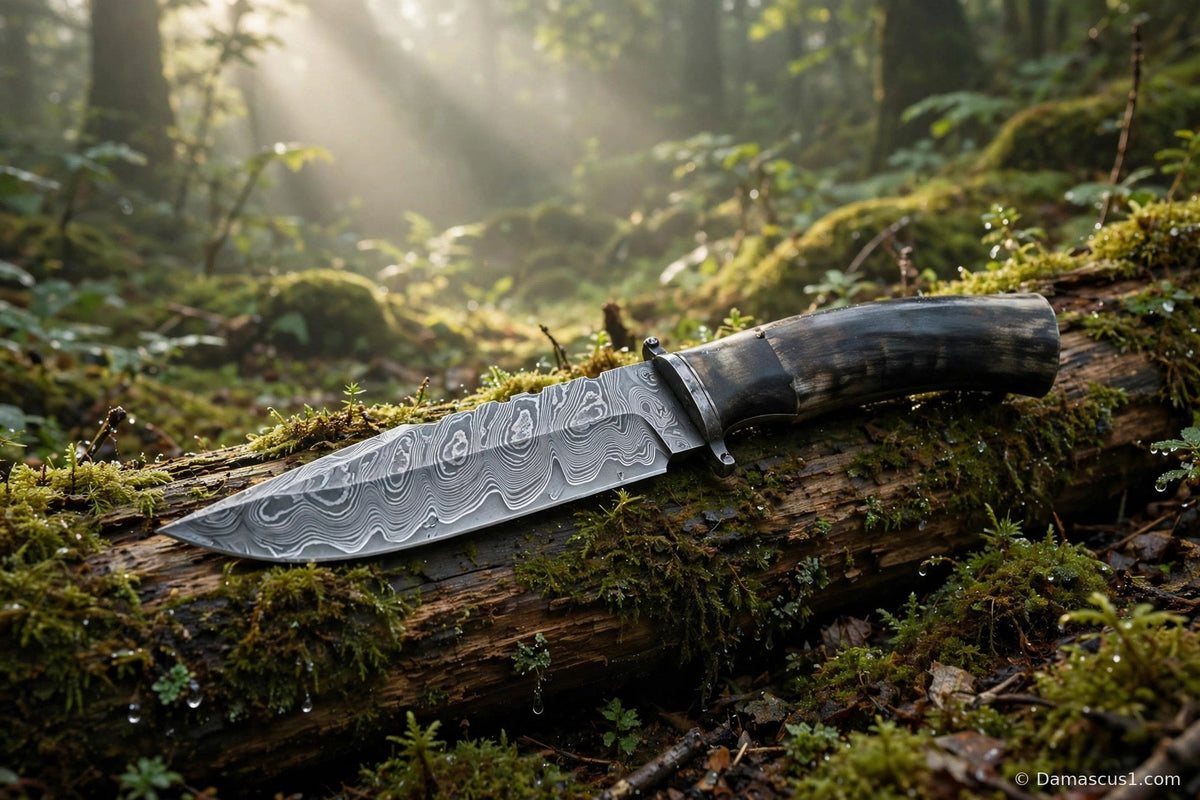
Buying information checked November 6, 2026. The right fixed-blade knife is the model whose documented dimensions, intended use, handle and storage arrangement meet your actual needs. A tracker, kukri or karambit name does not establish those facts by itself. This guide compares current Damascus1 listings and gives you a practical way to resolve missing information before ordering.
Start with the hunting knife collection or the tracker collection, then open the exact product you are considering. The comparison below is based on current catalogue information and item prices. We have not conducted a hands-on comparison, measured cutting performance or established a universal winner. Appearance, blade pattern and price are not substitutes for model-specific evidence.
Choose the job before choosing the shape
Write down what you actually need a knife to do and where it will be stored or carried. A collection purchase, a gift and a tool for an instructed outdoor task can have different requirements. Keep those purposes separate. If you are buying for a recipient, ask what they need and can use rather than assuming an outdoor-looking knife is suitable for almost anyone. Preferences and experience matter, and a surprise should not depend on guessing the recipient’s handling skills.
Be specific about the requirement. “For camping” could mean a knife you intend to keep with a cooking kit, an item for a collection or a tool for a particular activity. Those are different questions for the seller. Identify the actual task and ask whether the exact model is intended for it. Where the maker’s instructions are unavailable, leave suitability unconfirmed. This guide does not authorize wood processing, game processing or food preparation with an undocumented model.
Also record what would make the purchase unsuitable. Examples include an unconfirmed sheath, a handle size you cannot assess, a package that will not fit your storage, or a delivery date that has not been established. Resolve these conditions before comparing decorative details. A knife can be visually appealing and still fail one of your practical requirements.
Four tracker listings: compare facts and open questions
These four products are currently described in the catalogue as tracker-style fixed-blade knives with Damascus steel blades. Their listed handle materials differ. Each uses a 9.5-inch model designation, but the product pages ask buyers to confirm measured overall length, blade length, thickness and weight. Do not convert that designation into a verified blade or overall measurement.
| Current product | Listed handle | USD item price checked | Before ordering |
|---|---|---|---|
| Olive Wood Damascus Tracker Fixed-Blade Knife | Olive wood | $79.99 | Confirm actual dimensions, packing list, sheath fit and intended-use limits. |
| Buffalo Horn Damascus Tracker Fixed-Blade Knife | Buffalo horn | $89.99 | Confirm this model’s handle dimensions and instructions; do not infer grip performance from appearance. |
| Ram Horn Damascus Tracker Fixed-Blade Knife | Ram horn | $89.99 | Ask for current photographs and measured specifications for the supplied model. |
| Camel Bone Damascus Tracker Fixed-Blade Knife | Camel bone | $89.99 | Confirm the included items, protection during storage and model-specific care requirements. |
These prices were checked on November 6, 2026. They are item prices, exclude applicable shipping and taxes, and can change. The $10 item-price difference between the olive-wood listing and the other three does not establish a performance difference. The three equal-priced listings are also not certified to have identical blades or construction. Compare each product against the same set of requirements before deciding.
The table deliberately leaves unconfirmed fields open. Constituent steel grades, layer count, hardness, tang construction, manufacturing location and tested load limits are not established by the product information reviewed here. If one of those features is essential to you, request documentation for the exact item and variant. A patterned blade does not independently verify any of those specifications.

Use a comparison worksheet that can lead to a decision
Record the product identity
Save the product URL, title, selected variant and date of the reply you receive. Similar catalogue names can describe different listings, so keep each answer attached to the correct page. A specification supplied for a folding pocket knife, a different tracker or an older variant should not be transferred to your shortlist without confirmation. Ask the seller to identify which model the answer describes.
Use three columns in your notes: confirmed fact, source and unanswered question. For example, the current product page establishes the listed handle material and current displayed price. Your remaining question might concern blade length or a sheath. Keep the question visible until an appropriate answer arrives. This avoids a common comparison error: treating a missing specification as though it matches the better-documented item beside it.
Measure the actual fit requirements
Ask for blade length and overall length separately, including units. Add blade height, thickness, weight and handle dimensions if they affect your intended storage or assessment. If a measurement is approximate, record it as approximate and ask whether the tolerance matters for a fitted accessory. Do not buy a fitted holder from the title’s size label alone.
Measure the usable space where the protected knife will be stored. Include the holder or sheath and the clearance needed to retrieve it according to its instructions. The storage measurement worksheet can help organize dimensions and clearances, but a worksheet does not certify that a particular holder is suitable for a fixed blade. The holder maker’s compatibility limits still apply.
Ask for the packing list
Confirm whether a correctly fitted sheath is included, what material it uses, and which product variant it fits. Ask about any box, guard, strap or other accessory individually. An image showing an accessory beside a knife does not establish that it is supplied. A description of another model’s package also does not settle the contents of this order.
If a sheath is included, request its instructions and compatibility information. Do not assume that an accessory pictured on a belt is approved for every carry position or belt width. The safe fit and retention of the actual supplied combination cannot be established from this article’s editorial images. If the seller offers a custom arrangement, obtain the agreed design, fit, price and timing before treating it as part of the order.
Tracker, kukri and karambit names need different questions
These names are useful for locating catalogue styles, but they are not universal performance categories. The kukri collection and karambit collection contain distinct listings that should be checked independently. Do not assume that every product in a collection shares the same steel, construction, dimensions or included accessories.
A large or forward-curved blade should not automatically be recommended for repeated chopping, clearing brush or processing wood. Ask for the exact model’s intended-use limits. The same evidence standard applies to a tracker: a broad profile does not establish permission for batoning, prying, twisting, striking the spine or holding the blade for draw-knife work. Choose a tool specifically intended for a job instead of assigning that job to a knife because of its silhouette.
A ring or unusual curved profile also does not establish that a knife will be easy for a beginner to control. This guide does not teach specialized grips or deployment techniques. If a shape is unfamiliar, seek model-appropriate instruction and clarify the purpose of the purchase. For a collection, appearance can be an explicit preference without being rewritten as a functional advantage.
When comparing these styles, use the same questions: which exact item is supplied, what measurements are confirmed, what work does its maker permit, what is included, and how will it be protected? A style that cannot yet answer your required questions is an unresolved candidate. It does not become the best choice simply because the description uses “survival,” “hunting” or another broad term.

Handle choice: separate appearance, dimensions and evidence
The current tracker listings identify olive wood, buffalo horn, ram horn and camel bone handle options. Compare their current photographs for appearance. Ask for photographs of the supplied piece where surface variation is important to your decision. Do not treat variation in an image as proof of manufacturing method, origin or a claim that no two examples can match.
Handle material by itself does not establish wet-grip performance, comfort or control for every hand. Ask for handle length, width and thickness and any instructions that affect its use. A recommendation based only on dark versus pale color cannot tell you how a tool will fit. If gloves are relevant, raise that requirement specifically rather than assuming the pictured model works equally well with every glove.
For a gift, ask the recipient about the tool they already use and the storage they have. You may discover that a confirmed dimension or sheath requirement matters more than the handle’s appearance. Do not infer that a horn or bone handle is automatically more suitable for hunting, or that a wood handle is automatically the budget or camp option. Those are performance assignments that need evidence beyond the material name.
Review evidence should stay attached to the exact model
Read reviews on the exact product page. Check whether the reviewer is discussing delivery, appearance, fit, included contents or an actual use experience. These observations answer different questions. A review of a folding knife does not validate a tracker, and a customer’s satisfaction does not independently establish steel composition or a tested load limit.
This guide does not assign ratings or review counts to the four trackers. It also does not claim to have tested them. Where a review raises a question that matters to your purchase, ask for a current answer for the selected variant. A historical delivery report is useful context, but it is not today’s shipping quote or a promise that your destination has the same costs.
Keep the original review wording and context in view. Do not turn a first impression into a long-term durability result or a complaint about postage into a claim about cutting ability. When evidence is limited, a precise pre-purchase question is more useful than a confident ranking assembled from unrelated products.

Model-specific review context, checked November 6, 2026: The olive-wood tracker page displayed a 4.6/5 summary from eight reviews. Its available text included a customer who liked the knife but found the sheath impractical, while another described the belt fastening positively. These are individual customer experiences, not sheath-retention tests or proof of universal fit. The page also reported that the complete review list could not be loaded; read the available entries and ask about the exact supplied sheath before ordering.
Work out the delivered cost before comparing value
Start with the current item price, then add the actual checkout shipping quote and applicable taxes or other charges. If you require an accessory that is not included, obtain its confirmed price separately. Keep optional additions separate from requirements so a low item price does not conceal the cost of making the purchase usable for your plan.
The tracker table shows $79.99 and $89.99 item prices in this dated check. Neither price guarantees a delivered total below $100. The shipping policy notes that estimates depend on availability and the option chosen, destination restrictions can apply, and many rates are weight-based. Use your actual order quote rather than a generic example or a customer’s earlier charge.
Value also depends on whether the product meets the requirement you wrote down. A cheaper knife with an unresolved sheath or dimension may not be a better choice for your situation. A more expensive handle option is not automatically an upgrade in strength or service life. This guide does not calculate cost per year because it has no measured lifespan data for these models.
For a deadline, ask what estimate applies to the actual item and destination. Do not interpret a seasonal article or a banner as a guaranteed arrival date. If the timing is essential and remains unconfirmed, keep that issue open in the worksheet before ordering. That is a practical purchasing condition, not a reason to invent urgency.
Read the return conditions before inspecting or using the knife
The current refund policy describes returns within 30 days of purchase to the original payment method. Eligibility requires an unused product in original condition, with tags intact, original packaging and proof of purchase. Shipping fees are non-refundable. This is not an unconditional outdoor trial or a promise of free returns.
Clarify the permitted inspection process before using, sharpening, modifying or carrying a newly delivered knife. Do not assume you can use it on a trip and return it because the handle did not suit you. Retain packaging and order records while resolving an issue. If the item appears incorrect or damaged, contact the store before further use or alteration.
The order inspection checklist helps you compare the model and contents against your receipt and agreed packing list. It does not replace the actual return conditions or authorize unsafe handling. Record concerns clearly and ask what the store needs to assess them; do not put private order or contact information into a public review.
Read the shipping policy alongside the refund policy. Sending an order and returning it are different processes. A general shipping phrase does not establish free return postage, and the stated 30-day period runs from purchase rather than an assumed later milestone. If any condition decides your purchase, clarify it before checkout.

Care and storage: obtain instructions for the supplied model
Ask for care instructions that match the confirmed blade and handle construction. Damascus wording alone does not establish corrosion resistance or one universal cleaning method. Do not select a sharpening angle, oil, abrasive or maintenance tool from an illustration. The exact edge, materials and maker’s instructions determine what is appropriate.
Plan a protected storage location and a way to follow the confirmed cleaning and drying instructions. If an included sheath has its own care requirements, ask for those too. A knife and a holder can require different treatment. Where the available information does not settle compatibility, contact the seller or an appropriate service provider instead of experimenting on the newly purchased tool.
If your existing maintenance routine depends on a particular sharpener or cleaning process, raise that requirement before choosing the knife. Ask whether the process is suitable for the exact model and whether it affects any applicable terms. This guide does not promise a lifespan or say that a simple routine makes any model reliable in a survival situation.
A concise enquiry you can adapt
Identify the product link and selected variant, then describe the task or collection purpose. Ask for measured blade and overall length, thickness, weight and handle dimensions; the current packing list; confirmation of a correctly fitted sheath; and the maker’s intended-use and care instructions. Request model-specific documentation for any steel or construction feature essential to your decision.
Lead with the unanswered fact that would rule the item in or out. For a fitted storage problem, ask for the relevant dimensions first. For an accessory requirement, ask whether it is included and compatible. A focused question makes it easier to assess the reply than a broad request for “the best knife.” Keep a dated copy of the answer with the product identity.
Use the store contact page for purchase questions. This guide does not submit an enquiry or create an order. Once the required information is confirmed, reopen the exact product page, review the current price and variant, and check the delivered total before deciding.

Frequently asked questions
Which fixed blade is best for everyone?
No universal winner is established by this comparison. Start with your task, confirmed dimensions, supplied contents and model-specific instructions. A tracker label, price or attractive handle does not demonstrate suitability for every user or activity.
Does the 9.5-inch tracker label confirm blade length?
No. These listings use a 9.5-inch model designation and ask buyers to confirm measured overall length, blade length, thickness and weight. Obtain the actual measurement you need, with units, before comparing working size or buying a fitted accessory.
Are all four tracker blades identical?
The catalogue establishes a tracker-style fixed-blade format and listed Damascus blades, but identical steel grades, heat treatment, geometry and construction are not confirmed here. Do not assume that a common size label or equal price makes the models technically identical.
Is a sheath definitely included?
The current tracker descriptions ask buyers to confirm the packing list and whether a correctly fitted sheath is included. Ask for confirmation for the exact variant. An editorial picture of a sheath is not an itemized packing list.
Can I use a kukri or tracker for heavy chopping?
This guide does not establish permission for chopping, batoning, prying, twisting or striking any listed knife. Obtain the maker’s intended-use limits and choose a tool specifically intended for the task. Blade size or style alone is not a tested rating.
Does the handle material guarantee secure grip?
No material name establishes comfort or control for every hand and condition. Confirm handle dimensions and follow appropriate instructions. Do not infer wet-grip performance from color, texture or a photograph.
Are the listed prices the final delivered totals?
No. They are USD item prices checked November 6, 2026. Applicable shipping, tax and other charges can change the total. Review the current product page and actual checkout quote for your destination.
May I use the knife outdoors and then return it?
Do not assume that. The current policy requires an eligible return to be unused and in original condition with tags, packaging and proof of purchase, within 30 days of purchase. Shipping fees are non-refundable. Clarify permitted inspection before use or alteration.
Compare current tracker listings with this worksheet, or ask about the exact model before ordering. For further buying questions, use the existing 100-answer knife FAQ.
Leave a comment: