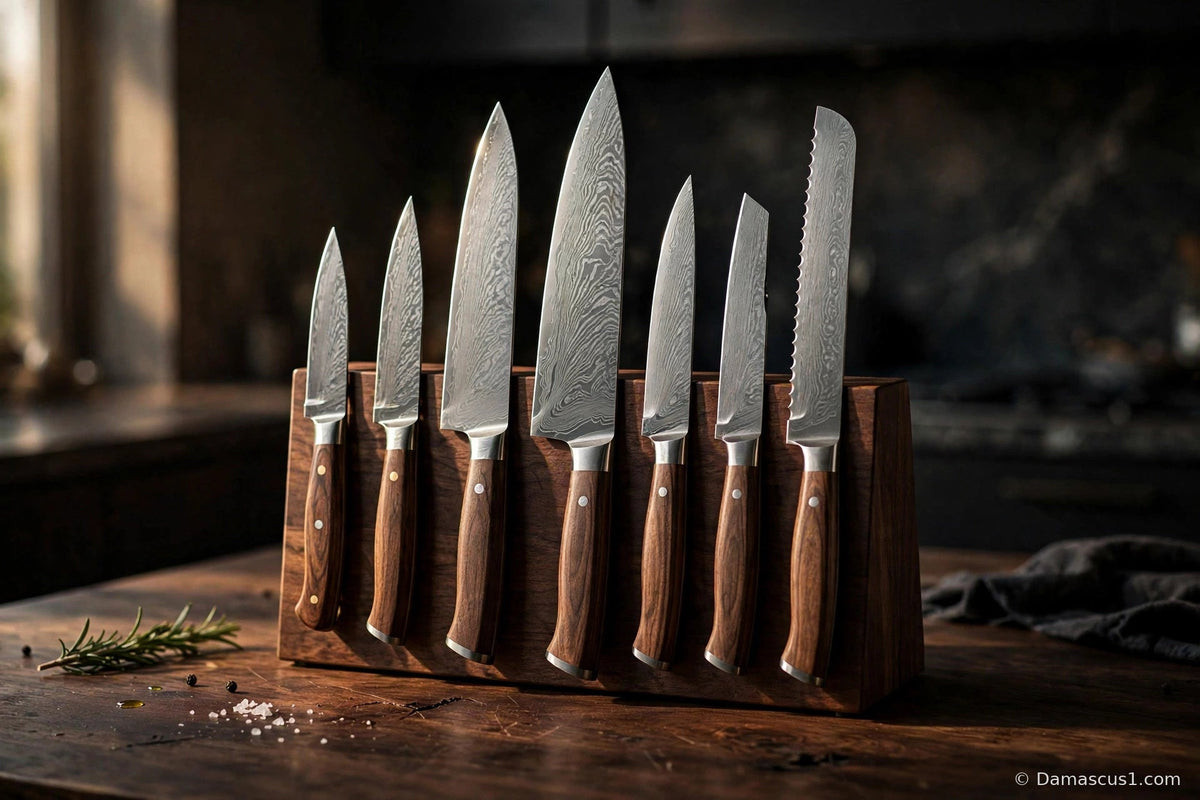
Direct answer: The best knife set for most home cooks in 2026 is a complete, honestly priced block set built around a proper 8-inch chef's knife — and at Damascus1 right now, that is the Premium 7-Piece Knife Block Set at $169.99. It covers every core job in a home kitchen in one purchase and costs less than many single big-brand chef's knives. Buy the right set first, add specialists later, and skip the bloated 20-piece boxes entirely. The full range lives in the Kitchen Knife Sets & Chef Knives collection.
That is the short version. The honest version takes longer, because "best knife set" might be the most gamed phrase in the entire kitchen aisle. Sets are padded with steak knives and scissors so the piece count looks heroic next to a competitor's. Listicles crown winners nobody cooked with. Brands describe the same blade three different ways on one page — and yes, that includes a page of ours, which this guide will flag when it matters rather than polish over. So this hub does something plainer: it explains which knives a kitchen actually needs, how to read a set's contents like a skeptic, where the Damascus1 range honestly fits from $169.99 to $449.99, and which sets — at any price — you should walk past. It is the hub for the whole kitchen cluster: our narrower guide to the best kitchen knives as individual blades, and our dedicated best Damascus chef knife set breakdown, both hang off this page.
What is the best knife set for most home cooks?
For most home cooks, the best knife set is a matched core set — an 8-inch chef's knife, bread knife, slicing knife, santoku, boning or utility knife, and paring knife — in steel that holds an edge yet sharpens at home, with consistent handles and honest pricing. One good set beats a drawer of mismatched singles bought at random.
Why a set first, when so much advice says buy knives one at a time? Because the one-at-a-time advice assumes you already know your own cooking in knife terms. Most home cooks don't. You know you cook. You don't yet know whether you're a rock-chop person or a push-cut person, whether you break down chickens twice a month or twice a year, whether bread is a daily job or a holiday job. A sensibly priced set answers those questions by living in your kitchen. Six months in, the worn knives tell you who you are as a cook. The one that never leaves the block tells you what not to upgrade.
There's a second, duller reason: money. A set prices its blades as a bundle, and the per-knife cost drops hard. The core pick below works out to roughly twenty-four dollars a blade before you count the block — a number no reputable single-knife purchase touches. The trade-off is real and we'll name it: a set gives you the manufacturer's chosen mix, not yours. That's exactly why the sections below grade the pieces individually, so you can see which blades do the heavy lifting and which are along for the ride.
And a third reason, the one nobody puts in listicles: consistency. Knives from one set share a handle shape, a weight language, an edge style. Your hands learn them as a family. Switching mid-recipe feels like changing gears in the same car, not borrowing a stranger's. For a home cook building speed and confidence, that familiarity is worth more than a spec-sheet win in any single category.
How many knives do you actually need in a set?

Most home cooks genuinely need six blades: a chef's knife, a santoku or second prep knife, a bread knife, a slicing knife, a utility or boning knife, and a paring knife. Everything beyond that core — steak knives, shears, extra specialists — is convenience, not necessity, and should never be the reason you chose one set over another.
Let's earn that claim blade by blade, because "which knife for what" is where home kitchens quietly go wrong. People force one knife — usually the chef's — through every job, then blame the knife when the job feels awful. Slicing a crusty loaf with a chef's knife crushes the crumb no matter how good the blade is. Trimming a chicken with a paring knife takes forever. The tools aren't failing. The matching is.
The chef's knife (8 inch) is the anchor: roughly eight of ten cutting jobs — vegetables, proteins, herbs, fruit. Its curved belly lets the blade rock, tip near the board, heel rising and falling, and a pile of onions becomes mince in a steady rhythm. Eight inches is the home-kitchen sweet spot: long enough for a cabbage, short enough to control in ordinary board space.
The santoku (7 inch in our core set) trades the rock for a flatter profile. Push-cutting — straight down, slight forward glide — is its home territory, and for dense vegetables and neat, even slices it often feels calmer and more predictable, especially for smaller hands. Owning both isn't duplication; it's two dialects of one language.
The bread knife (8 inch) earns its slot with serrations — a row of points that start the cut through hard crust without the force that squashes soft interiors. The same mechanism glides through tomato skin. The slicing knife (8 inch) is the quiet specialist: long, narrow, built for single-pull strokes through roasts and salmon sides. You won't use it daily; on the days you need it, nothing else substitutes. The boning knife (6 inch) travels around joints and under silverskin in spaces a wider blade can't enter — whole-chicken buyers feel the difference in the first bird. The utility knife (5 inch) covers the in-between jobs, and the paring knife (3.5 inch) finishes the core: hulling, segmenting, peeling, work done in the hand where control beats power.
Count that set again: chef, santoku, bread, slicing, boning, utility, paring. Seven blades is not a marketing number here — it's the core six-plus-one that covers a real kitchen. When a competitor's box says fifteen or twenty pieces, ask what the extra pieces are. Usually: steak knives counted one by one, a pair of shears, a sharpener, and the block itself. None of those cut your dinner prep in half.
Is a knife set or individual knives the smarter buy?
For most households, a set is the smarter first buy: it covers every core job at a far lower cost per blade, keeps handles and sharpening consistent, and reveals — through real use — which single knife deserves an upgrade later. Individual knives make sense as targeted replacements or specialist additions once you know exactly which job your current blades handle badly.
The maths is worth doing slowly, because it's the strongest argument in this whole guide. Our core set at $169.99 prices seven blades at about $24 each. A single Damascus chef's knife bought alone — our own G10 Handle Chef Knife is unusually cheap at $34.99 (was $59.99) — still costs more per blade, and Japanese single chef's knives elsewhere on this site run to $399.99. Neither fact makes singles foolish. It makes them second purchases. The cook who has lived with a set for a year knows precisely which upgrade earns its money: maybe a finer chef's knife, maybe a nakiri for a vegetable-heavy kitchen, maybe nothing, because the set turned out to be enough. "Enough" is a legitimate outcome, and any guide that won't say so is selling, not advising.
Singles also win in one specific first-buy case: the cook who already owns most of a working kit. If your drawer holds a good bread knife, a paring knife you love, and a utility knife that behaves, then a set duplicates three slots to sell you four. Buy the missing blades individually and spend the difference on a whetstone. Everyone else — new kitchens, wedding registries, the drawer-of-regret upgrade — starts with the set.
There's a gift angle here too, and Q4 makes it timely: a block set is the rare kitchen gift that looks generous, prices honestly, and gets used the same week. Our seasonal Black Friday Damascus knife deals guide tracks how these sets are priced through the holiday window — check it before buying any set in November, including ours.
The Damascus1 knife set range, compared honestly

Every price below was verified on the live Damascus1 site on October 17, 2026. Prices can change; the product page on the day you order is the final word. One honesty note that applies to the whole table: set descriptions on this store — again, including ours — sometimes mix construction language, so where a detail would decide your purchase, confirm it on the product page or ask the seller. Piece lists and prices are what's verified here.
| Pick | Best for | Pieces | Price (verified Oct 17, 2026) |
|---|---|---|---|
| Premium Knife Block Set | Best knife set for most home cooks — the core pick | 7 pcs + block | $169.99 |
| German 1.4116 Kitchen Knife Set | Best non-Damascus value alternative on the store | 5 pcs (title) + block | $189.99 (was $249.99) |
| 9-pc Japanese AUS-10 Damascus Set, Blue G10 | Best Japanese-style upgrade under $350 | 9 pcs | $334.00 (was $499.99) |
| 9-pc Japanese Damascus Sets | Best larger Japanese sets, two listings | 9 pcs | $339.99 / $349.99 (was $499.99) |
| Japanese VG10 Damascus Sets | Best VG10-core upgrade tier | 6–7 pcs | $399.99 |
| 7-pc Wooden Block Damascus Set | Best premium block presentation | 7 pcs | $449.99 (was $599.99) |
| G10 Handle Chef Knife | Best single-blade addition, not a set | 1 pc | $34.99 (was $59.99) |
Product cards — priced, linked, and framed by the job
Best for most cooks — Premium Knife Block Set, 7 pcs — $169.99. The set's page lists an 8-inch chef's knife, 8-inch bread knife, 8-inch slicing knife, 7-inch santoku, 6-inch boning knife, 5-inch utility knife, and 3.5-inch paring knife, with block and sharpener as listed. That is the exact core this guide argues for, with nothing padded. The honest warning, repeated from the checklist because it matters: that page's description mixes two different construction descriptions, so confirm the blade construction with the store before ordering if that detail decides your purchase. The piece list and the $169.99 price are what's verified here. View the Premium 7-Piece Block Set.
Best value alternative — German 1.4116 set — $189.99 (was $249.99). A German high-carbon stainless route for buyers who prefer that steel tradition and lower-maintenance care. Note its naming varies between title and listing — another reason the product page, read carefully, outranks any headline.
Best Japanese upgrade — 9-pc AUS-10 Blue G10 set — $334.00 (was $499.99), with sibling 9-pc sets at $339.99 and $349.99. More pieces, Japanese profiles, G10 handles that shrug off water in a way natural handles don't. This is the tier for the cook who already knows the $169.99 set would leave them wanting — or for the gift that has to land as the gift. The steel-name question behind this tier — what AUS-10 and VG10 actually mean next to generic "Damascus" labelling — is exactly what our Damascus vs VG10 explainer untangles; read it before spending upgrade money anywhere.
Best premium tier — VG10 sets at $399.99 and the 7-pc wooden block set at $449.99 (was $599.99). VG10-core Japanese sets for edge-focused cooks, and a wooden-block presentation set for buyers who want the countertop statement. At this level, buy for a named reason — a core steel you chose on purpose, a profile you cook with daily — not for a bigger number on the box.
Which knife sets should you skip?

Skip any set whose piece count depends on steak knives, shears, and the block itself; any set with no proper 8-inch chef's knife; any set that leads with "dishwasher safe" as a virtue; and any set whose steel is described only with adjectives — "premium," "surgical," "high-carbon" — and never with a name you can look up.
Each of those tells is a small confession. Piece-count padding confesses the blades alone couldn't justify the price. A missing or undersized chef's knife confesses the set was designed for a photograph, not a kitchen — the chef's knife does most of the work, so a set that short-changes it short-changes every meal. Dishwasher-first marketing confesses the maker expects the set to be treated as disposable: dishwashers bang edges against racks, blast handles with heat and detergent, and dull good blades fast, whatever the box claims. Hand-wash and dry — it takes twenty seconds a knife.
Adjective-only steel is the subtlest skip signal. Named steels can be checked; our VG10 and AUS-10 listings name theirs, the German set names 1.4116, and where a Damascus1 page's language conflicts with itself, this guide says so out loud instead of repeating the adjectives louder. Hold every seller — including this store, on its other pages — to that same standard, and walk away from any listing that won't meet it.
Also skip the false economy at the very bottom: the unbranded sub-$60 mega-set. At a few dollars a blade, something was not paid for — steel quality, heat treatment, handle fitting, or all three — and a dull, badly balanced knife is not merely unpleasant, it's the knife that slips. The honest budget route is fewer, better blades: a core set at a real price, or even a single good chef's knife like the $34.99 G10 model plus a paring knife, built out over time.
What steel and handles should a good knife set have?
A good knife set names its steel — VG10, AUS-10, a numbered German stainless like 1.4116, or honestly described Damascus layering — and pairs it with handles suited to your kitchen: G10 for wet, low-maintenance grip, wood and natural materials for warmth and balance. Adjectives are not a steel; if a listing won't name it, ask or walk away.
Steel decides two things you'll feel every day: how the edge behaves and how much care it asks. Stainless-leaning steels forgive a wet counter and a slow dry. Carbon-leaning Damascus blades reward a wipe-and-dry habit with edge character and that layered pattern — and punish neglect with spots, which is why our explainer can Damascus steel rust? should be required reading before any Damascus set purchase. Neither family is "better" in the abstract. The better steel is the one matched to the cook's actual habits, and a household that knows it won't hand-dry knives should buy the forgiving set and enjoy it without guilt.
Handles are the same argument in a different material. G10 — the composite on the Japanese upgrade sets and the $34.99 chef's knife — is dense, water-indifferent, and grippy, the low-maintenance professional choice. Wooden and natural handles feel warmer, balance beautifully, and ask for the same dry-storage habit as the blades. In a set, handle consistency matters as much as material: your hands learn one shape and every blade inherits the fluency.
Balance and weight close the section. A set's knives should feel like relatives — similar heft language, no feather-light paring knife beside a club of a chef's knife. You cannot judge balance from a listing, which is one more reason to buy sets whose return terms you've actually read, from a store you can actually ask questions of, at prices that don't require the purchase to be perfect to be worthwhile.
How do you care for a knife set so it stays the best you own?

Hand-wash and dry each knife right after use, store the set in its block or on a magnetic strip — never loose in a drawer — hone lightly and often, sharpen on a whetstone when honing stops working, and keep Damascus blades dry with an occasional light oil if they sit unused. Twenty seconds a knife, a few minutes a month.
The block your set arrives in is doing more than looking tidy: it keeps edges from meeting each other, cutlery, and drawer walls. Loose-drawer storage is how good sets become chipped sets, and it's the entire reason the clutter photograph in this guide looks the way it does. A magnetic strip is the equal alternative for small kitchens — with the small discipline of placing knives spine-first so the edge never drags.
Sharpening is the skill that separates a set that's still excellent in year five from one that's "gone dull" by Christmas. Dull is rarely a steel verdict; it's a maintenance gap. The full routine — grit progression, angle consistency, stropping, and the pattern-safe technique Damascus blades want — is laid out step by step in how to sharpen a Damascus knife. Learn it once and every set in this guide, from $169.99 to $449.99, holds its side of the bargain.
Frequently asked questions
What is the best knife set under $200?
The Premium 7-Piece Knife Block Set at $169.99, verified October 17, 2026. It covers the full core — chef, bread, slicing, santoku, boning, utility, paring — at roughly $24 a blade with the block, under the $200 line with room to spare. Confirm its construction description on the product page before ordering, as this guide flags in its checklist.
Are Damascus knife sets worth it?
They are worth it when the set names its construction honestly, prices per blade sanely, and matches a cook who'll hand-wash and dry the blades. A Damascus set buys pattern, edge character, and gift-level presence on top of the same core jobs any good set does. Bought for adjectives alone, or by a household that will dishwasher it, the same set is money misdirected — buy the German stainless tier instead and enjoy it.
How many pieces should a knife set have?
Six to seven blades cover a home kitchen: chef, santoku, bread, slicing, boning or utility, and paring. Count any set's blades, not its box total — steak knives, shears, sharpeners, and the block inflate "piece counts" without adding a single cutting job. A set advertising fifteen-plus pieces is usually selling arithmetic, not knives.
Is it better to buy a knife set or individual knives?
A set first for most households: lower cost per blade, consistent handles, every core job covered at once. Individuals after: targeted upgrades and specialists bought with a year of real cooking knowledge behind the choice. The exception is the cook replacing one failed blade in an otherwise working kit — that buyer should buy the single knife and skip the duplicates.
Can you put a good knife set in the dishwasher?
You can, and you shouldn't. Dishwashers dull edges against racks, and heat plus detergent punish handles — natural materials most of all. "Dishwasher safe" on a box describes survival, not condition. Hand-washing and drying a knife takes about twenty seconds and is the single cheapest performance upgrade in this entire guide.
What is the best knife set to give as a gift?
The Premium 7-Piece Block Set at $169.99 for most recipients — complete, handsome, honestly priced. The 9-pc Japanese AUS-10 Blue G10 set at $334.00 when the gift has to be the big one, and the VG10 tier at $399.99 for the serious cook. Buy early in Q4, read the store's shipping and returns policies on the day you order, and ask the store directly about any hard deadline rather than assuming a delivery date.
The bottom line: buy the core, skip the padding

The best knife set is not the biggest box or the loudest adjective. It's seven honest blades — a real chef's knife at the centre — in named steel, with handles your hands can learn, at a price that survives per-blade maths. At Damascus1 today that set is the Premium 7-Piece Knife Block Set at $169.99, with the Japanese AUS-10 and VG10 tiers waiting at $334–$399.99 for cooks who know exactly why they're upgrading, and the wooden-block set at $449.99 for the full presentation.
Start where your kitchen actually is. Browse the Kitchen Knife Sets & Chef Knives collection, read the product page of the set you choose — construction notes included — and order the core set with confidence. Then cook with it for a year before you buy another blade. The set will teach you what, if anything, deserves upgrading. That's not a sales pitch. It's how a knife drawer becomes a knife kit — and it's the whole point of this hub.
Leave a comment: