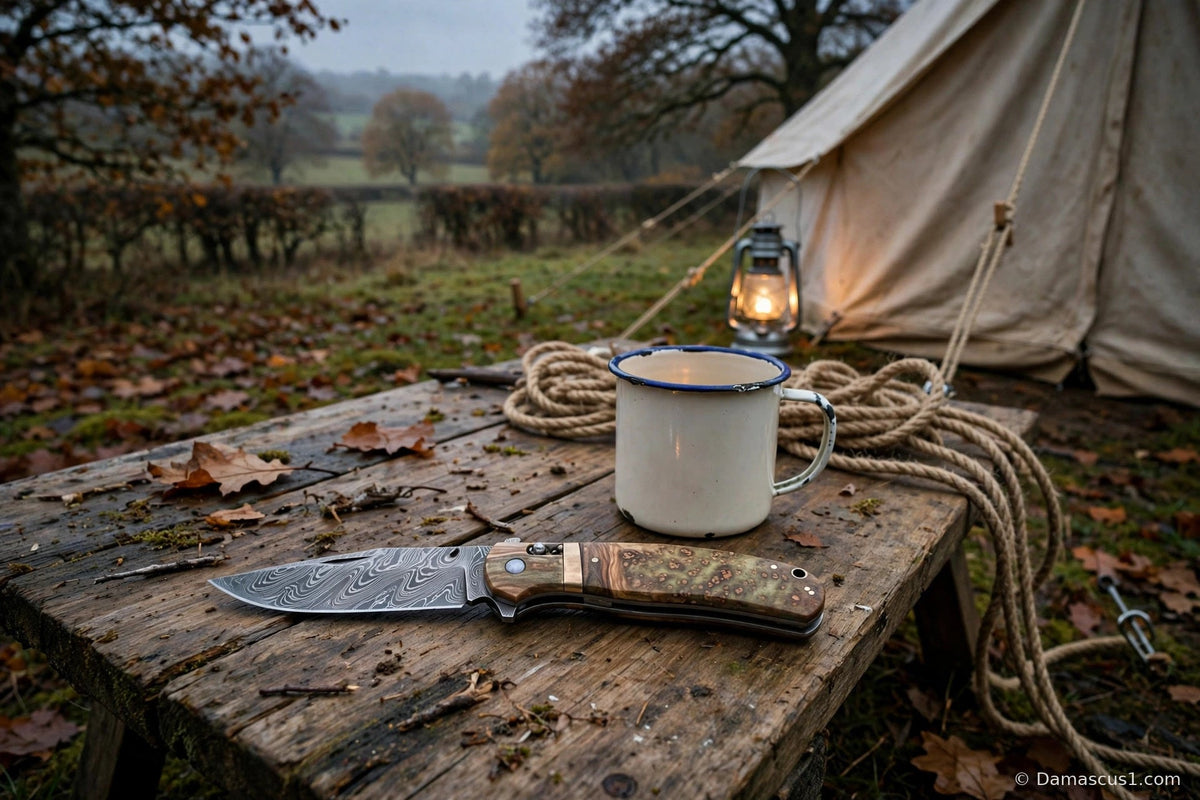
The short answer: There is no single best pocket knife for camping in the UK, because there are two different legal journeys to the same campsite. A non-locking folder with a cutting edge of 3 inches or less may be carried without needing a reason. A locking folder — the stronger tool for camp work — may be carried only with a genuine good reason, such as a camping trip actually in progress, and packed away in transit.
That two-track answer is the honest one, and it is the answer almost nobody selling camping knives in Britain will give you plainly. Most camping roundups take one of two shortcuts. The cautious ones list only non-locking knives, mention the law in a nervous sentence, and leave you wondering whether a locking blade at a campsite is somehow forbidden. The careless ones list locking knives under a cheerful "UK legal" banner, as if the lock made no difference at all. Both shortcuts cost you something: the first costs you the better tool for the job; the second could cost you a great deal more than money.
This guide takes neither shortcut. It separates the two tracks completely — what you may carry freely, every day, with no reason needed, and what you may carry on a genuine trip, with the trip itself as your reason — and it is just as careful about the space between the two: the journey. A locking knife that is entirely sensible on a Lake District campsite on Saturday afternoon is a different legal object in a coat pocket in a town centre on Saturday night. The difference is not the knife. It is where you are, what you are doing, and whether the knife is packed away as part of a trip or carried as part of an outfit.
One note that applies to everything below: this is general information about how the rules are generally understood, not legal advice. Knife law turns on circumstances, and if your situation is unusual, check the current official guidance or take proper advice before relying on anything here.
What does UK law actually say about a camping knife?


It says, in section 139 of the Criminal Justice Act 1988, that having a bladed article in a public place is an offence unless you have a good reason or lawful authority — and then it carves out one exception: a folding pocketknife that does not lock, with a cutting edge of 3 inches (7.62cm) or less, needs no reason at all. Everything else with a blade needs the reason. That is the whole framework, and camping sits inside it in a specific and, once you see it, rather reassuring way.
A genuine camping trip in progress is the classic good-reason scenario the law has in mind. You are travelling to, from, or between places where the knife has an obvious job — cutting guy-line cord, preparing food, whittling a tent peg, opening packaging — and the knife is part of the equipment of an activity that is actually happening. The same logic covers a fishing trip, with the knife among the tackle, and a work trip where the job needs a blade. What the law is looking for is a connection you can point to: the trip, the kit, the task. Our definitive explainer, UK legal pocket knife, works through the rule itself in full, including the court cases that decided why a lock knife is not a "folding pocketknife" for this exception at any length.
What is not a good reason is just as important, and the honest list is short. "Just in case" is not a reason. Self-defence is not a reason. "I forgot it was in my pocket" is not a reason — and that last one matters enormously for campers, because the commonest way a perfectly lawful camping knife becomes a problem is not at the campsite at all. It is the Monday afterwards, in the jacket it was left in, in a place that has nothing to do with camping. The burden of proving a good reason sits with the carrier, so the reason has to be one you can articulate, connected to something you can point to. A trip you are actually on passes that test comfortably. A trip you went on last weekend does not.
Penalties for getting this wrong are serious — stated in hedged, general terms, up to four years' imprisonment and an unlimited fine — which is precisely why this guide spends so long on a distinction that marketing pages skip. The law here is not a trap for campers. It is a filter that rewards the camper who thinks for ten seconds about where the knife travels, and this guide is built to make those ten seconds easy.
Which knives can you carry to camp without needing a reason at all?
The non-locking, sub-3-inch family — and if your camping style is light, sociable and close to home, this family may genuinely be all you need. The traditional slipjoint penknife, held open by spring tension alone, is its heartland. The familiar Swiss patterns belong here too, provided the blade does not lock — check, because some larger models in famous ranges do lock their main blade, and the moment a blade locks, the whole tool steps outside the carry-without-reason exception. Simple friction folders sit in the same world. What unites the family is the two-condition test: does not lock, and cutting edge of 3 inches or less. Both conditions, on the same knife, at the same time.
Choose inside this family on the spring and the technique. A firm spring and a sensible half-stop — the pause point midway through closing — make a non-locking knife markedly pleasanter to use, because the discipline is real: a blade that cannot lock can close, so you cut in a way that keeps the load holding the blade open, you keep fingers clear of the closing path, and you never pry, twist or bear down as you would on a locked blade. For the jobs this family is honestly good at — cord, packaging, feather sticks, food prep on a board, whittling by the fire — that discipline is no hardship at all. Generations of campers worked exactly this way.
Be honest, though, about where the family's limits show at camp. Camp work includes jobs that load a blade sideways or ask it to hold under pressure: battening kindling is a fixed-blade job and no folder of either track should be asked to do it, but even ordinary heavier cutting — thick rope, frozen guy-line, stubborn packaging strapping — is where a non-locking blade asks more of your technique and gives you less margin. That is not a flaw in the slipjoint. It is the trade the law's exception embodies: the knife that may travel without a reason is, by design, the knife that cannot lock. If your trips are gentle and your knife work is light, take the trade and enjoy the simplest legal position in British camping. If your trips involve real camp work, read the next track before you decide the trade is worth it.
When is a locking folder the right camping knife — and what makes its carry lawful?
When the trip is real, the work is real, and the transport is disciplined. A locking folder — back-lock, liner-lock or any other mechanism — cannot fold onto your fingers while you work, and at a wet, cold, tired end-of-day campsite that is not a luxury; it is the difference between a tool that forgives a clumsy moment and one that does not. The law does not forbid you that tool. It asks that the tool travel as what it is: equipment for an activity in progress.
So the lawful shape of a locking-knife camping trip looks like this. The knife is packed with the camping gear — in the rucksack, in a pouch, among the kit — for the journey. At camp, it works: food preparation, cord and guy-lines, tackle if you are fishing, the small hundred jobs a campsite invents. When the trip ends, it is packed away again for the journey home, and when you get home it comes out of the rucksack and goes back to its drawer, its box, its place. At no point in that shape does the knife sit in a town-centre pocket "just in case", ride to the pub mid-trip as an everyday carry, or linger forgotten in a jacket for a fortnight. The trip is the reason; the packing is the proof; the drawer at the end is the discipline that keeps next week's ordinary life separate from last week's outing.
That is the honest position of the Olive Wood Damascus Pocket Knife: a handmade folder in real pattern-welded Damascus — forge-welded 1095 and 15N20 steels, around 276 layers, 58–60 HRC on the maker's specification — with an olive wood handle, a manual two-hand nail-nick opener and a back-lock, single-edged, at $39.99 USD against a compare-at $89.99, verified on the store on 6 November 2026. It locks. This page will never call it "UK legal carry", because those words belong to the other track. What it is, is a strong, beautiful, honestly priced tool for the good-reason track: the campsite, the riverbank, the work trip — and, between trips, the home, the garden and the collection, where no reason is needed at all because private premises are not a public place. The companion explainer are locking knives legal in the UK busts the "lock knives are banned" myth in full; they are not banned, they are reasoned, and there is a world of difference.
You will find roundups on the internet that place locking knives on a "UK legal" list without that reasoning. Do not name-and-shame them; just notice that accuracy is a feature you can shop for. A seller who is careful about the law is usually careful about the steel as well, and a seller who is careless about the law has told you something about everything else on the page. Our UK buyer's guide, Damascus pocket knife in the UK, applies the same standard across the whole UK shelf.
How should you choose between the two tracks? The Camping Decision Table
This is the table to screenshot before you buy anything. It is organised by the only question that decides the purchase honestly: what will your trips actually look like?
| Your camping reality | Buy this track | Why | Carry and transport note |
|---|---|---|---|
| Light weekends, campsite cooking, cord and packaging, knife also lives in your everyday pocket | Non-locking slipjoint, cutting edge ≤3in | The only shape the carry-without-reason exception covers | No reason needed — both conditions (non-locking + ≤3in edge) must hold at once |
| Proper camp work: guy-lines under tension, food prep on the board, wet and cold hands, fishing tackle jobs | Locking folder — Olive Wood Damascus Pocket Knife, $39.99 USD | A lock that cannot fold on your fingers under real work; pattern-welded steel at an honest ticket | Good reason only: the trip in progress. Packed in the rucksack in transit, never a town pocket knife |
| The same trip, warmer-toned handle preferred | Locking folder — Orange Wood 6.5" Hunting Pocket Knife, $39.99 USD | Same own-and-good-reason world, different wood and mood | Identical rule: trip in progress, packed away in transit |
| Mixed life: everyday pocket plus occasional heavy trips | One of each, honestly assigned | The slipjoint owns the everyday; the locker owns the trip | Never let the locker drift into the everyday role — that drift is the whole risk |
| A gift for an adult camper | Handmade Damascus locking folder ($39.99 USD class) | Individual pattern, useful for decades; engraving available on request | Recipient must be 18+; delivery is age-verified — hand it over in person, with the two-track talk included |
| Heavy splitting, battening, shelter building | Neither folder — a fixed blade owned for the purpose, or campsite tools | Folders of either track are the wrong tool for impact work | Same good-reason logic, larger scale: activity in progress, packed in transit |
Two mistakes account for nearly every bad outcome in this market, and the table is built to prevent both. The first is buying a locking knife while believing — because a listing let you believe it — that it travels like a slipjoint. It does not, at any blade length, and the belief is the risk, not the knife. The second is the opposite overcorrection: buying a slipjoint for heavy camp work out of a vague fear that locking knives are forbidden, then spending every trip fighting a tool that keeps trying to close on the jobs that matter. Neither mistake survives the where-will-it-live question asked honestly before the which-one-is-prettier question. Ask it in that order and the right track selects itself.
What is transport discipline, exactly? The Packed-Away Checklist
If the decision table is the asset for buyers, this checklist is the asset for owners — the original, citable routine this guide adds to the conversation. Print it, screenshot it, tape it inside the rucksack lid.
- Packed, not pocketed, in transit. On the journey to and from camp, the locking knife travels inside the rucksack or kit bag, ideally in its pouch — not in a trouser or jacket pocket. In town, in transit, it is luggage, not carry.
- The trip must be the trip you are on. The good reason is the camping, fishing or work activity in progress — travelling to it, doing it, travelling back from it. A knife packed for a trip that ended yesterday has no reason today.
- At camp, it works at camp. Use it for the activity's jobs, keep it with the kit between jobs, and do not carry it into the village pub or the town shops mid-trip as an everyday pocket knife. The reason covers the activity, not the holiday generally.
- Home means out. On return, the knife leaves the rucksack and goes back to its drawer, box or pouch at home. The forgotten-knife-in-the-jacket is the commonest failure in this whole subject; the unpacking routine is the fix.
- You can say the sentence. If stopped, the honest sentence is short and pointable: "I am on my way to / back from camping at [place], and the knife is packed with my camping gear." If you cannot say a sentence like that truthfully, the knife should not be with you.
- Adults only, always. Sales of knives to under-18s are banned, and camp kit is adult kit. A younger camper's knife is a separate, supervised conversation — not a hand-me-down of your locking folder for their pocket.
None of this is onerous. It is, almost exactly, how most British campers already treat their kit — the stove, the gas, the axe where one is carried — because camping culture understands that tools travel as equipment. The checklist simply makes the knife's version of that understanding explicit, and explicit is what the law's burden of proof rewards.
What should a camping knife actually be good at?
Strip away the law for a moment — only a moment — and the campsite asks a short, practical list of any folder. It must open food packaging and prepare food on a board without drama. It must cut cord, guy-line and the occasional strap cleanly, first time, with cold hands. It must cope with being wiped rather than washed, dried on a cloth rather than in a rack, and used again at breakfast. It should be findable in a dim tent — a warm wooden handle beats a black synthetic one more often than spec sheets admit — and it should be a pleasure to own around a fire, because camping is one of the places where a beautiful tool is not an indulgence but part of the point of being there.
On steel, the honest camping answer for a traditional pattern-welded Damascus blade is this: it sharpens readily on a whetstone, holds a working edge through a weekend of ordinary camp jobs, and asks in return that you treat it as the non-stainless steel it is. Wash or wipe it after food prep, dry it properly — including around the pivot, where a folder hides moisture — and keep a whisper of food-safe mineral oil on the blade if it will sit in a damp tent overnight. That is not fragility; it is the same care a carbon-steel kitchen knife has asked of British cooks for a century. What it will not forgive is being put away wet in its pouch for a fortnight, which is a storage failure, not a steel failure. The full routine lives in our Damascus folding knife care guide, and the companion UK sharpening guide in this series goes deeper still [PLANNED: how-to-sharpen-a-damascus-knife-uk, sibling draft in this series, link at publish].
On size, be suspicious of drama in both directions. A camping folder does not need a blade like a small sword, and the 6.5-inch class of folder — overall, in the maker's naming — is the ordinary working size generations of campers have used: enough edge for food and cord, small enough to pack without thinking. What matters more than headline length is the opening and the lock for the work at hand: a two-hand nail-nick opener is slower to deploy than a one-hand stud, and at a campsite that slowness costs nothing — nobody is racing a guy-line — while the back-lock's solidity pays out on every loaded cut. Match the mechanism to the place. The campsite rewards solidity over speed every single time.
Does the same track cover fishing trips and work trips?
Yes — the good-reason track was never only about tents, and many readers will use it most often away from a campsite. A fishing trip is the same legal shape as a camping trip: an activity in progress, a knife among the activity's ordinary equipment — for line, for bait, for the jobs a riverbank sets — travelling packed with the tackle and returning with it. A work trip where the job genuinely needs a blade — the fencing contractor, the gardener moving between clients, the warehouse hand whose employer expects a personal cutting tool — follows the same pattern, with the employment itself as the pointable fact. In each case the discipline is identical and worth repeating because repetition is what makes it a habit: the knife travels as equipment for the named activity, works during the activity, and goes home to its drawer afterwards. What none of these trips licenses is the residue — the knife that stays in the van glovebox for a month, or migrates to a jacket for the school run. The reason attaches to the activity, not to the owner. Keep the knife attached to the activity, in time and in place, and the track holds for every legitimate version of the trip. Let it drift, and you have left the track without ever buying a different knife.
How do you buy a camping knife online in the UK without a doorstep problem?
As an adult, straightforwardly — provided you plan the handover before you order. Sales of knives to under-18s are banned outright. For online and other remote sales, the Offensive Weapons Act 2019 pattern applies: the seller must run a real age-verification system — a self-declared date of birth alone is not enough — and the parcel must be delivered, marked as a bladed-product parcel, into the hands of an adult of 18 or over. It cannot be left in a locker, at a click-and-collect point, or on the doorstep while you are out. Our step-by-step guide, can you buy knives online in the UK, walks the whole process, and it is worth ten minutes before any first online knife purchase.
On price, the clarification this guide owes you, stated once and plainly: the Damascus1 store prices in US dollars, always. The hero folder is $39.99 USD (compare-at $89.99). No exact GBP store price exists and none should be invented — exchange rates move, and checkout is in dollars. Judge the dollar figure against what British specialists charge for pattern-welded folders, where three-figure tickets are the norm, and the value case makes itself without any currency dressing. The store banner offers free shipping and returns above $50: one folder at $39.99 sits under that line, while two — the classic "one for the rucksack, one for the gift drawer" order — come to $79.98 and cross it. Engraving is available on request — quote-based, up to 25 characters — so ask before you order rather than assuming a checkout box. For the sceptic who wants the steel itself examined before any camping claim, our best Damascus pocket knife guide and the UK real-vs-fake companion in this series do that work [PLANNED: how-to-tell-if-damascus-steel-is-real-uk, sibling draft in this series, link at publish].
The Olive Wood Damascus Pocket Knife Set — $39.99
Real Damascus steel, an olive wood handle and a genuine leather sheath included — the knife our readers ask about most.
Shop the Olive Wood Damascus Pocket Knife Set — $39.99 · Free US shipping on orders over $50.
Frequently asked questions
Is camping a good reason to carry a locking knife in the UK?
Yes — a genuine camping trip in progress is the classic good-reason scenario: travelling to, from, or at a campsite where the knife is part of the activity's ordinary equipment for food preparation, cord work and camp tasks. The reason must be specific, current and provable by you. Having the same knife in a town centre "just in case" is not covered. This is general information, not legal advice.
Can I carry a non-locking pocket knife camping without any reason?
Yes. A folding pocketknife that does not lock, with a cutting edge of 3 inches (7.62cm) or less, sits inside the section 139 exception and needs no reason at all — camping or otherwise. Both conditions must hold together: a non-locking knife with a longer edge, and a locking knife of any length, both need a good reason in public.
How should I transport a locking knife to a campsite?
Packed away with the camping gear — inside the rucksack or kit bag, ideally in its pouch — for the whole journey, and unpacked to its home drawer on your return. In transit it is luggage, not a pocket knife. The Packed-Away Checklist above is the full routine this guide recommends.
Is a Damascus knife a good choice for camping?
For the good-reason track, yes — with one honest condition. A traditional pattern-welded Damascus blade sharpens readily, works well through a camping weekend, and its individual pattern makes it a pleasure to own — but it is not stainless, so it must be wiped, dried and lightly oiled rather than put away wet. If your camping style is forgetful and your kit lives damp, choose stainless and no hard feelings.
My multi-tool has a locking blade. Which track is it on?
The good-reason track. The exception is tested on the blade, not the brand: if a multi-tool's main blade locks, the whole tool needs a good reason in public, however innocent its screwdrivers and scissors look. Check the tool itself before assuming it travels freely.
Can I take my camping knife into the pub or shops during a trip?
That is exactly the drift this guide warns against. The good reason covers the activity — the campsite, the riverbank, the journey to and from them — not every place you visit while on holiday. Leave the locking knife packed with the kit at camp or in your accommodation when you head into town.
Can someone under 18 use a camping knife?
Sales of knives to under-18s are banned, and this guide's buying advice is for adults. A younger person's introduction to knife skills is a supervised, family decision with appropriate tools — never an unsupervised pocket carry of an adult's locking folder, and never at school.
Does the same law apply in Scotland?
Scotland has its own provision — section 49 of the Criminal Law (Consolidation) (Scotland) Act 1995 — in materially similar terms, and the lock-and-edge logic works the same way in practice. Check the Scottish wording for your own situation; this page is general information, not legal advice.
The bottom line
The best pocket knife for camping in the UK is the one whose legal track matches your real life. If your knife lives in your pocket every day and your camp work is light, buy the non-locking, sub-3-inch folder and travel in complete peace. If your trips involve real work and cold, wet, tired hands, buy the locking folder, pack it like equipment, use it like equipment, and put it away when you get home — the trip is your reason, and it is a good one. What you should never buy is a locking knife sold to you as if the lock did not exist. If the good-reason track is yours, the Olive Wood Damascus Pocket Knife at $39.99 USD is waiting for its next trip — handmade, locking, and described exactly as it is.
Planned sibling links at publish (not yet live — do not link until verified 200): how-to-tell-if-damascus-steel-is-real-uk; how-to-sharpen-a-damascus-knife-uk.
Leave a comment: