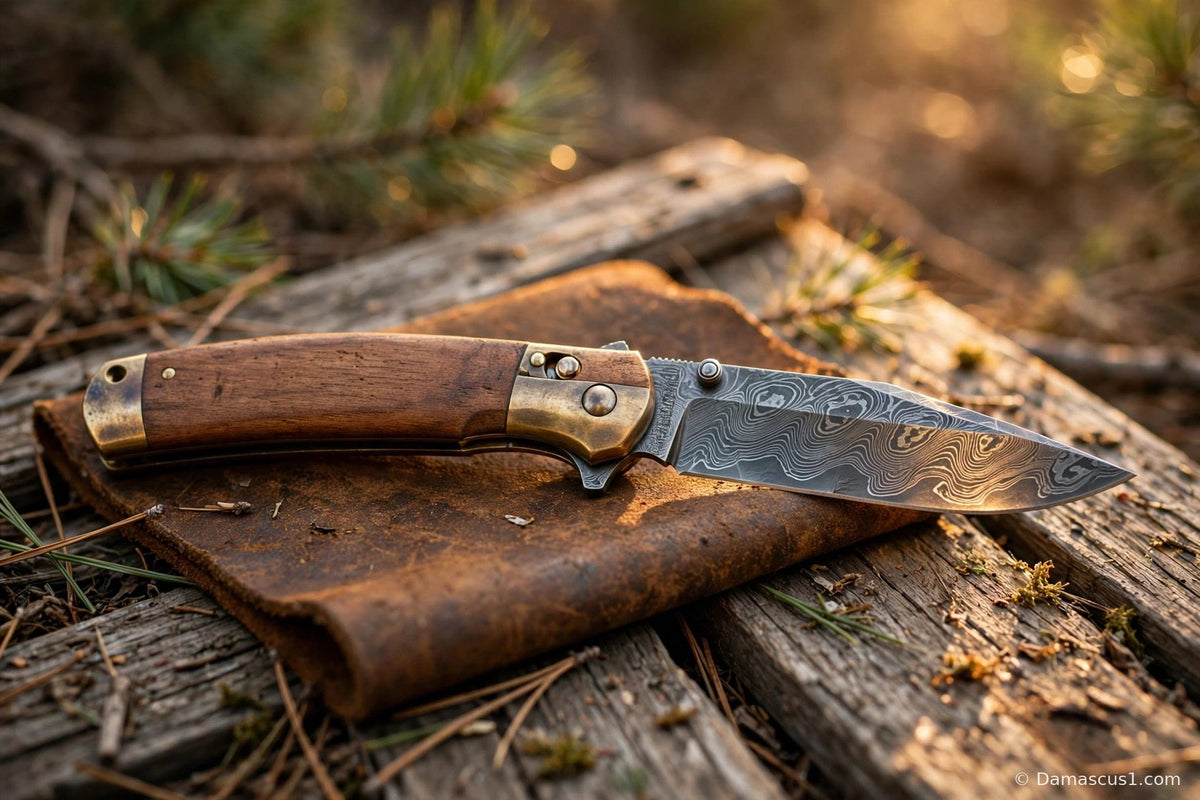
Direct answer: The best pocket knife for men for most buyers is the Olive Wood Damascus Pocket Knife Set at $39.99 (was $89.99) — a handmade, traditional back-lock folder with real presence in the hand and on the eye, at a price that works equally well as a first carry and as a gift. Men who want the collector end of the range should look at the $49.99 stag and scrimshaw folders.
Notice what that answer does not claim. It does not claim this folder out-flips a $150 tactical knife, opens with one hand, or disappears on a pocket clip. Damascus1's folders are traditional knives: two-hand opening, back-lock, carried in the leather pouch their listings describe. Whole review sites exist for the tactical category, and they do their job well. This guide does a different job: it is for the man — or the person buying for him — who wants a pocket knife with weight, warmth, and a blade pattern no two examples share, and who would rather spend $39.99 well than $150 automatically.
That is a bigger audience than the tactical roundups admit. Amazon's own search history for "pocket knife for men" runs into the tens of thousands of searches a month, spiking far higher in December — demand driven as much by gifts as by carry. This page serves both halves honestly: carry picks, work picks, and a full gift-edition section, because for this keyword the two intents are braided together and any guide pretending otherwise is missing half its readers. If you want the category without the "for men" framing, our best pocket knife hub is the parent guide.
What is the best pocket knife for men for everyday carry?
The best pocket knife for men for everyday carry is the Olive Wood Damascus Pocket Knife at $39.99 for the traditional carrier: a 6.5-inch-class folder with a warm wood handle, a back-lock, and pouch carry. Men who need one-hand opening or a pocket clip should honestly choose a modern tactical folder instead.
Carry style is the fork in this entire category, and it should be decided before steel, before handle material, before price. There are two carry cultures. Modern EDC culture wants light, clipped, one-hand, deep-carry — a tool optimized for speed and invisibility. Traditional carry wants an object: something with heft that rides in a pouch or a pocket, opens deliberately with two hands, and feels like it belongs to someone. Neither culture is wrong. They are buying different things that happen to share a name.
Damascus1's folders live entirely in the second culture, and this guide will not pretend otherwise to win a comparison it would lose on honesty. What the traditional folder offers in return is real: a handle shaped for grip instead of thinness, materials — olive wood, horn, bone, stag — that age with character, and a layered blade pattern that makes the knife recognizably yours. For the man whose daily cutting is packages, rope, food, whittling, and work around a home or a property, that trade is not a compromise. It is the point.
Size deserves a practical word. The folders in this guide are mostly listed in the 6.5-inch class — that is overall open length class as the listings present it, and you should confirm the current stated dimensions on the product page before ordering, because carry comfort and local rules both turn on exact blade length. A 6.5-class traditional folder carries like the pocket knives generations carried: present, reassuring, and sized for real work rather than watch-pocket minimalism.
Which Damascus1 pocket knives for men should you compare first?

Compare six folders first, all verified on October 20, 2026. At $39.99: olive wood, buffalo horn, camel bone, blue wood, and green wood — the handle is the decision. At $49.99: the stag horn folder and the camel bone scrimshaw folder, where the extra ten dollars buys collector character. Every one undercuts modern tactical prices by a wide margin.
Read the table by buyer, not by spec. The striking fact about this range is that the price barely moves while the personality changes completely — same class of handmade folder, five different handle materials at one price. That makes the honest comparison a materials comparison, and the sections after the table take each material seriously: how it feels, how it ages, and who it suits.
| Pick | Best for | Handle / character | Price (verified Oct 20, 2026) |
|---|---|---|---|
| Olive Wood Pocket Knife Set | Best for most men — first carry or all-round gift | Olive wood, warm grain, classic | $39.99 (was $89.99) |
| Buffalo Horn Pocket Knife Set | Best for a darker, dressier traditional look | Buffalo horn, deep tones | $39.99 (was $99.99) |
| Camel Bone Folding Pocket Knife | Best for the light, old-world look | Camel bone, pale and distinctive | $39.99 (was $99.99) |
| Blue Wood Pocket Knife Set | Best for the man who wants color | Blue-dyed wood, unmistakable | $39.99 (was $99.99) |
| Green Wood Pocket Knife Set | Best for outdoors character in a folder | Green wood, field-toned | $39.99 (was $99.99) |
| Stag Horn Folding Pocket Knife | Best for collectors and milestone gifts | Stag horn, textured, traditional | $49.99 (was $139.99) |
| Camel Bone Scrimshaw Pocket Knife | Best for hand-worked detail as a gift | Camel bone with scrimshaw-worked bolsters per its listing | $49.99 (was $99.99) |
Priced product cards — what each dollar actually buys
Lead pick — Olive Wood Pocket Knife Set — $39.99 (was $89.99). The default recommendation, for buyer and gift-giver alike. Olive wood has the grain that photographs beautifully and ages honestly, the shape sits comfortably for real cutting, and the price leaves room in any budget for the occasion around the gift. If this guide had to keep one knife, it keeps this one. View the Olive Wood Pocket Knife Set.
The dark option — Buffalo Horn Pocket Knife Set — $39.99 (was $99.99). Horn reads dressier and more serious than wood: deep, varied tones, a smooth finish, the traditional material of a gentleman's folder for a century. Same money, different man. Choose it for the buyer who wears his tools the way he wears his watch — understated and deliberate. View the Buffalo Horn Pocket Knife Set.
The light option — Camel Bone Folding Pocket Knife — $39.99 (was $99.99). Pale bone against a patterned blade is the most visually striking contrast in the $39.99 row, and the most obviously "not another black tactical knife" gift in the range. Bone handles are a heritage material with a feel no synthetic copies. View the Camel Bone Folding Pocket Knife.
The color options — Blue Wood and Green Wood Pocket Knife Sets — $39.99 each (each was $99.99). Dyed wood is the extrovert's traditional folder: all the warmth and shape of the classic form, in colors that make the knife findable in a bag, a truck cab, or a workbench drawer — and instantly personal as a gift, because nobody's generic. Blue for the bold, green for the outdoorsman. View the Blue Wood Pocket Knife Set · View the Green Wood Pocket Knife Set.
The collector step — Stag Horn Folding Pocket Knife — $49.99 (was $139.99). Stag is the handle material collectors reach for first: natural texture, no two pieces alike, the classic material of the heirloom folder. Ten dollars over the lead pick buys the knife most likely to be kept, shown, and handed down. View the Stag Horn Folding Pocket Knife.
The hand-worked step — Camel Bone Scrimshaw Pocket Knife — $49.99 (was $99.99). A larger 7.6-class folder whose listing describes hand-done scrimshaw work on its bolsters — decoration made by a person, visible up close, and the strongest "he will not already own one of these" argument in the guide. Confirm its current listed details on the product page. View the Camel Bone Scrimshaw Pocket Knife.
The full range lives in the Everyday EDC Pocket Knives collection and the Damascus Folding Knives collection — browse there once the table has narrowed you to a material.
How do you choose a handle material he will actually like?
Choose the handle material by the man's habits and wardrobe of objects, not by your own eye. Wood suits warm, traditional tastes and ages with visible character. Horn suits the dressier, understated carrier. Bone and stag suit collectors and gift occasions. Dyed wood suits the man who loses black gear and likes color.
Handles are where a pocket knife becomes personal, and personal is the whole reason this category exists separately from "best pocket knife" in the abstract. Two men can agree on blade, size, and price, and still want completely different knives — because the handle is the part he holds, sees closed in his palm, and associates with the person who gave it to him.
Olive wood is the safe genius pick: universally handsome grain, warm in winter, grippy enough in real use, and forgiving of scratches — they blend into the figure instead of announcing themselves. Buffalo horn is the connoisseur's safe pick: darker, smoother, more formal, with depth in the material itself. Camel bone is the conversation pick — pale, distinctive, unmistakably natural. Stag is the occasion pick: texture you feel before you see, and the strongest heirloom signal. Dyed woods are the personality picks, and they carry a practical bonus nobody mentions — visibility. A blue or green folder gets found. A black folder in a black bag is a small daily tax.
One honesty note on natural materials: they vary. Grain, tone, and figure differ from knife to knife because the material grew rather than being molded. Product photos show the character of the material, and the individual knife that arrives will have its own figure within that character. For most buyers of handmade knives, that variation is not a defect to warn about so much as the substance of the purchase — his knife is the only one that looks exactly like his. If exact uniformity matters to the man, a synthetic-handled modern folder is the honest alternative, and this guide says so without flinching.
What makes a pocket knife a good work knife for men?

A good work pocket knife for a man has a blade sized for real tasks rather than novelty, a lock that engages positively, a handle that fills the hand under load, and an edge he can restore in the field or at the bench. Traditional folders meet those needs for property, farm, trade-adjacent, and household work — with deliberate, two-hand operation.
Match the knife to the work honestly. The daily work of most men is unglamorous: opening feed and freight, cutting cord and hose, trimming, whittling, food on a tailgate, a hundred small rescues of other tools. A 6.5-class traditional folder does all of it with a blade long enough to matter and a handle long enough to push. Where it does not compete — gloved one-hand deployment, clip access in a harness, serrations for synthetic rope under load — say so, and let the tactical category serve those men. Guides that claim one knife for every job are selling, not guiding.
The back-lock deserves its plain defense. It is one of the oldest locking mechanisms in folding knives because it works: a positive lock, a deliberate close, no springs to amaze or fail. Two-hand closing reads as slowness to the tactical eye and as safety to everyone who has closed a folder one-handed against their leg a thousand times. For a knife that will also be lent — to a son, a hand, a neighbor — deliberate is a feature.
Edge care at work-knife level is simple and non-negotiable: keep it dry, touch it up before it is dull rather than after, and never pry with the tip. That last rule breaks more good folders than any steel question ever asked. A pocket knife is a cutting tool that folds; treated as one, a $39.99 handmade folder will work for decades. If budget is the binding constraint, our best pocket knife under $50 guide works the same range with a harder cap.
Why is a handmade Damascus folder such a strong gift for men?
A handmade Damascus folder is a strong gift for men because it solves the three classic failures of men's gifts: it is useful daily, it is visibly not mass-produced — the layered pattern differs on every blade — and it arrives at $39.99 to $49.99, a serious-gift look at a price that needs no occasion inflation. Engraving by quote can personalize it further.
Take the failures in order. The useless gift — the novelty, the gag, the thing shelved by January — fails because it has no job. A pocket knife has a job every day, including the day it is given, when it opens the other boxes. The generic gift fails because he has seen it before; a Damascus blade's pattern is formed in the steel itself, so the exact figure on his blade exists on no other knife, and a natural-material handle doubles that uniqueness. The overpriced gift fails the giver; at $39.99, this one does not ask the giver to prove anything with money.
Occasions map cleanly onto the table. Birthdays and Christmas: the olive wood lead pick, safe and handsome. Father's Day: stag, for the heirloom signal, or buffalo horn for the understated father. Groomsmen: matched olive or rose-toned folders, one per man, each blade's pattern individual — a set that is a set without being identical. Retirement and milestones: the scrimshaw folder, where hand-worked detail carries the weight of the moment. Our dedicated knife gift for men guide builds the full occasions table, and the engraved pocket knife gift guide covers the personalization route in depth.
About that personalization, plainly: engraving at Damascus1 is a quote-based service for up to 25 characters. It is not free, it is not instant, and no date is promised here — ask for the quote through the product page and let the quote set the terms. A name, initials, or a date on a blade turns a strong gift into the gift. Just plan the occasion around the quote, not around a promise nobody made you.
What should you check before buying a pocket knife for a man?

Before buying, check four things: his carry style — pouch and pocket traditional, or clipped and one-hand modern; local carry rules for blade length and lock type where he lives; the exact dimensions and materials on the product page as listed today; and, for gifts, whether engraving by quote fits your timeline. Those four checks prevent nearly every return.
Carry rules need their honest paragraph. Pocket knife law in the United States is a patchwork of state and sometimes city rules covering blade length, lock types, and how a knife may be carried — and it changes. This guide is buying guidance, not legal advice, and it will not summarize fifty states it cannot keep current. The buyer's habit that never fails: check the current rules for where the knife will actually be carried before ordering, especially when the knife crosses a state line as a gift. A two-minute check protects the whole purchase.
The product-page check matters for a handmade range in particular. Dimensions, materials, and what's included — these folders are listed as sets, with the pouch their product pages describe — are stated per knife and can be updated by the store. Prices in this guide were verified on October 20, 2026; the page you order from is the final word on price and contents alike. Read it the way you'd read any contract you're happy to sign: completely, once.
And the carry-style check is really a knowledge check about the man. Watch what he carries now. If his current knife is clipped to a pocket and opens with a flick, a traditional folder is a second knife for him, not a replacement — gift it as such, framed for the truck, the desk, the weekend. If he carries his father's old folder or nothing at all, the traditional folder can become the knife. Same product, two honest framings — and the framing is what makes a gift land.
How does a traditional Damascus folder compare with a modern tactical EDC?
A traditional Damascus folder wins on materials, character, price, and gift-worthiness; a modern tactical EDC wins on weight, one-hand opening, pocket clips, and glove-friendly deployment. They are different tools sharing a name. Most men who love knives end up owning one of each — the honest question is which one he needs first.
Lay the trade bare, because both sides deserve it. The tactical folder is an engineered appliance: lighter in the pocket, faster into action, built around modern steels and locks, priced from around $50 to well past $300 for the names the review sites crown. Carry one daily in a work environment and its advantages are not marketing. They are ergonomics.
The traditional handmade folder is an object with a job. It is heavier because its materials are real. It opens deliberately because its lock predates the flipper era and has outlived every fashion since. Its blade carries a pattern formed by layering steel — visible, individual, and the reason a man who owns forty knives still picks this one up. And it costs $39.99, which in the tactical world buys a gas-station knife, not a handmade one.
This guide's recommendation follows from that honesty. For a first pocket knife, a gift, a traditional carrier, or any man whose cutting is daily life rather than deployment — the Damascus folder, and it is not close. For the man whose job demands one-hand speed — the tactical folder, bought from the sites that test them, and no shame in it. What this guide refuses to do is dress either knife as the other. If you want the modern-EDC framing of the wider category, our best EDC knife guide takes that angle directly.
How do you care for a Damascus pocket knife?


Care for a Damascus pocket knife with five habits: wipe the blade dry after use and before pouch storage, keep the pivot clean and lightly oiled per the product page's guidance, touch up the edge before it goes fully dull, store it dry — never sealed damp in its pouch — and never pry or twist with the tip.
The leather pouch these folders are listed with is a carry solution, not a long-term storage vault. Leather and damp steel are enemies over time: a knife put away wet in a closed pouch is a knife being seasoned for trouble. The routine that prevents all of it takes under a minute — cut, wipe, dry, then pouch. In humid climates or after wet work, a light food-safe oil film on the blade, as care guidance for layered steel generally suggests, is cheap insurance. Check the product page for any care instructions specific to your knife and follow those where they speak.
Sharpening a traditional folder is bench work, not field drama: a whetstone at a consistent angle, patience over pressure. The layered blade rewards the same little-and-often rhythm as any fine edge — touch it up while it still cuts and you will rarely face a real regrind. Keep the pivot free of pocket lint, which is the true daily enemy of every folding knife ever made, tactical or traditional. A blast of air and a drop of appropriate oil, occasionally, is the whole ceremony.
Treated this way, the arithmetic of the traditional folder completes itself: $39.99, handmade, carried daily, maintained in minutes a month, and — in stag, bone, or figured wood — genuinely likely to be handed to a son or grandson who will ask where it came from. That is the purchase this page exists to make easy to get right.
Frequently asked questions
What is the best pocket knife for men?
The best pocket knife for men for most buyers is the Olive Wood Damascus Pocket Knife Set at $39.99 (was $89.99): a handmade traditional back-lock folder with a warm wood handle and a layered blade pattern unique to each knife. Men who carry one-hand tactical folders for work should keep that tool for work — and this folder covers carry, weekends, and gifting better.
Are Damascus pocket knives good for everyday carry?
Yes, for traditional everyday carry: daily cutting jobs like packages, cord, food prep away from the kitchen, and property work. Damascus1's folders are two-hand-opening back-locks carried in a pouch, not clipped one-hand EDC. If your carry depends on a pocket clip or gloved one-hand opening, a modern tactical folder is the honest better tool for that job.
What is a good budget for a man's pocket knife gift?
A good budget is $39.99 to $49.99 in this range, because the whole handmade folder line lives there: five handle materials at $39.99 and the stag and scrimshaw collector picks at $49.99. That buys a serious, lasting gift without occasion inflation. Engraving, if you want it, is quoted separately — up to 25 characters — so request the quote before you set the gift date.
Which handle material is best — wood, horn, bone, or stag?
Each suits a different man. Olive wood is the all-rounder: warm, handsome, forgiving. Buffalo horn is dressier and understated. Camel bone is pale and distinctive. Stag horn is textured, traditional, and the most heirloom-like. Dyed blue or green wood adds color and findability. Natural materials vary in grain from knife to knife — that individuality is part of a handmade purchase.
Are pocket knives legal to carry?
It depends on where you live and carry. U.S. rules vary by state and sometimes by city, covering blade length, lock type, and carry method, and they change over time. This guide is not legal advice. Before buying — especially a gift crossing state lines — check the current rules for the place the knife will actually be carried. It takes minutes and protects the purchase.
How were the prices in this guide verified?
Every Damascus1 price here was checked against the live store catalog on October 20, 2026. Prices can change, and the product page on the day you order is the final word on price, dimensions, materials, and what's included. No personal testing, review, or ownership claims are made in this guide; product details are stated only as the product pages themselves state them.
The bottom line: buy the knife he will actually carry
Everything in this guide reduces to one match: the man, and the Olive Wood Damascus Pocket Knife — $39.99 (was $89.99) for most of them. The dressier man gets the Buffalo Horn — $39.99; the collector gets the Stag Horn — $49.99 or the Scrimshaw — $49.99; the man who loses black gear gets blue or green wood and finds his knife again. Check his carry style, check the local rules, check the product page — then buy the handmade folder and let a patterned blade do what no gift card ever did.
Start with the lead pick's product page: confirm today's price and details, add the engraving quote if the occasion calls for it, and give — or carry — a knife with a story in its steel.
Leave a comment: