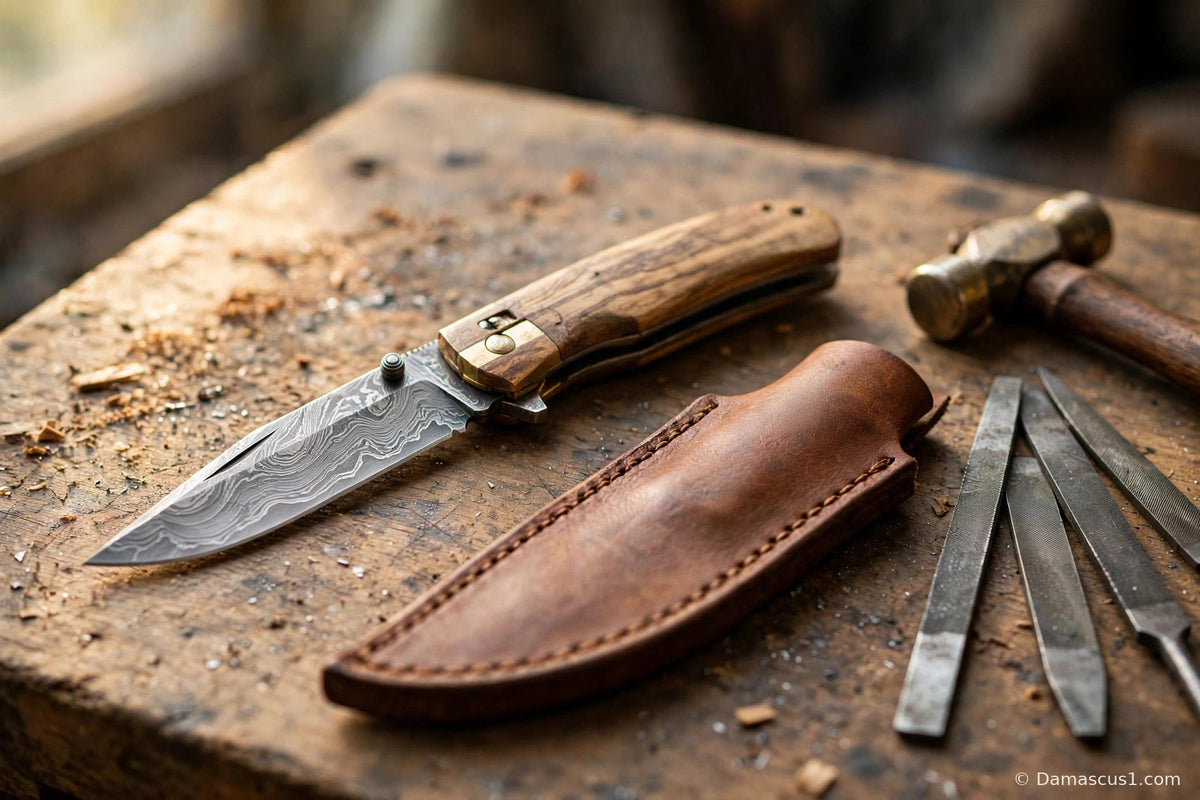
"Custom" is the most stretched word in the knife business. On one page it means a bladesmith spent three weeks forging a one-off knife to your drawing, and the bill runs into four figures. On another it means a factory folder with your name lasered on in ninety seconds, for the price of a pizza. Both sellers use the same word, both are technically telling the truth, and the gap between what the two buyers receive is enormous. This guide separates the levels, prices each one honestly, and shows what you can genuinely choose — pattern, handle, size, sheath, engraving — when you buy a handmade Damascus knife, including the configured, maker-direct route this store sells, where a handmade Olive Wood Damascus pocket knife starts at $39.99 with its leather sheath included.
What does "custom" mean on a Damascus knife?
It means one of three different things, and the price follows the level. Level one is handmade variation: a knife made by hand, whose pattern and natural handle make it one of a kind without anyone designing it for you. Level two is configuration: you choose the model, pattern family, handle material, size and sheath, and add engraving. Level three is a bespoke commission: a maker builds your drawing from raw steel. Most knives sold as "custom" are levels one and two.
| Level | What you actually get | Who does the work | Typical price picture | Best for |
|---|---|---|---|---|
| 1. Handmade variation | A handmade knife whose forged pattern and natural handle are unique by nature | The maker's standard process | Standard handmade prices — no premium for "custom" | Anyone who wants a knife that is theirs, not a clone |
| 2. Configured + personalised | Your choice of model, pattern, handle, size and sheath, plus your words engraved | The maker builds/finishes to your selections; engraving quoted per piece | The knife's price, plus an engraving quote confirmed before work | Gifts, groomsmen sets, milestone knives — most "custom" buying |
| 3. Bespoke commission | A knife designed with you: blade shape, steel, grind, fittings, materials | One maker, one knife, weeks of bench time | Commonly high hundreds to thousands of dollars | Collectors and buyers who want a design that does not exist yet |
Here is this page's honesty line, stated once and plainly: Damascus1 sells levels one and two. The knives are handmade, so no two patterns or natural handles match exactly, and you configure yours — model, handle material, size, sheath, and engraving by quote. What this store does not offer is a from-a-drawing bespoke commission, and if that is what you are shopping for, a one-maker workshop that quotes by the piece is the right door, at the level-three prices in the table. Pages that blur the levels are usually selling level one at level-three language. The rest of this guide assumes you want a knife that is genuinely yours without paying commission prices — which is most people who search this term, and it is a perfectly respectable thing to want.
What can you actually customise on a Damascus knife?

Six things, in the order they change how the knife looks and works: the pattern in the steel, the handle material, the knife type and size, the fittings, the sheath, and the engraving. Pattern and handle decide the knife's face. Type and size decide whether it suits the hand and the work. The sheath decides how it is carried and stored. Engraving is the only choice that is purely about meaning — which is why it is usually the one buyers remember.
Pattern. Pattern-welded Damascus is not one look. Ladder, raindrop, twist and random patterns are made by working the layered billet differently before the etch, and each reads differently on a finished blade — tight and orderly, pooled like water, or bold and flowing. You do not choose the exact figure; nobody can, because the forge decides the final flow. You choose the family, and accept the variation inside it. The families are compared, with the manipulation that makes each one, in the basics of Damascus knife patterns, and the forge work itself is walked through in how pattern-welded pocket knives are made.
Handle material. This is the choice your hand and your eyes live with daily, and it is where natural variation is widest. Olive wood is warm and grippy, buffalo horn dark and polished, camel bone pale and traditional, stag and ram horn textured for wet or gloved hands, coloured woods personal in a way natural tones are not. The full comparison — ageing, humidity, grip, weight — is in the pocket knife handle materials comparison, and the handle section below gives the short version.
Type and size. A 6.5-inch folding knife is the configured-custom default for a reason: it carries daily, gifts well, and sits in the size band most hands expect. Fixed blades — trackers and hunting knives — suit field use and display. Kitchen knives and sets are the third family, and the configured choice there is the set's piece count and block, covered by the Damascus chef knife set guide and the kitchen knife collection.
Fittings and sheath. Bolsters on the handmade folders here are plain brass — no button on the blade, no decoration doing structural work — and the sheath is genuine leather, included with the pocket knives rather than sold as an afterthought. A sheath fitted to a fixed blade or a folder you carry daily is also a custom decision in its own right; the measuring and fit questions are in the custom leather pocket knife sheath guide.
Matching and sets. One configuration question deserves its own line, because it decides wedding parties and family gifts: how closely must several knives match? Forged patterns cannot be matched at all — each billet flows its own way — but handles can be selected from the same material batch, engraved in the same hand and presented in identical sheaths, which reads as a set to every eye that matters. If close matching matters to you, say so when you order or request the engraving quote, not after the knives arrive: selection for closeness is easy at picking time and impossible afterwards. Buyers who need true identicality — same figure, same shade, knife after knife — are asking for a manufactured product, and a factory line will serve them better than any handmade range honestly can.
Engraving. Your words, on the knife, arranged through a quote and a proof before anything is cut. That gets its own section below, because it is where custom orders most often go wrong — and where a careful process protects both sides.
How much does a custom Damascus knife cost?
It depends entirely on the level. Basic personalisation on a mass-produced knife commonly runs about $20 to $50 all-in. A quality production knife with engraving typically lands somewhere between $75 and $400. Handmade and premium work starts in the high hundreds, and a true bespoke commission or collector-grade hand engraving runs to $1,000 and well past it. Configured handmade knives sit in their own band: the Damascus1 folders below start at $39.99, because the customisation is selection and engraving rather than a one-off build.
Why are Damascus knives so expensive at the top of that range? Because the hours are real. Steels are stacked, forge-welded, folded, shaped, heat treated and etched before a handle is ever fitted; natural handle materials are cut, shaped and finished by hand; and a commission adds design time and one-off setup to all of it. Prices range widely because the work ranges widely, so compare the construction and the level — not the word "custom" and not the layer count, which describes how fine a pattern reads, not how good a knife is.
Below are the configured picks most relevant to this guide, with prices checked on the live store on November 19, 2026. Prices and compare-at figures can change; the product page on the day you order is the final word. The full folder range lives in the everyday carry pocket knife collection.
Priced picks, verified November 19, 2026:
- Olive Wood Damascus Pocket Knife Set — $39.99 (compare at $89.99). Best for: the first configured custom — the balanced default handle, 6.5-inch lockback, genuine leather sheath included, and the natural first choice for engraving.
- Buffalo Horn Damascus Pocket Knife Set — $39.99 (compare at $99.99). Best for: the darker, polished look at the same entry price.
- Camel Bone Damascus Folding Pocket Knife — $39.99 (compare at $99.99). Best for: the pale, traditional handle — the classic groomsman and milestone-gift face.
- Blue Wood Damascus Pocket Knife Set — $39.99 (compare at $99.99). Best for: colour as the personal statement, at the entry price.
- Ram Horn Damascus Folding Pocket Knife — $44.99 (compare at $99.99). Best for: texture you can feel, at a small step up.
- Stag Horn Damascus Folding Pocket Knife — $49.99 (compare at $139.99). Best for: the strongest grip in the 6.5-inch line, and the boldest handle figure.
- Buffalo Horn Scrimshaw Damascus Pocket Knife, 7.6 inch — $49.99 (compare at $99.99). Best for: the larger, display-leaning gift size, where the worked handle is the point.
- Olive Wood Damascus Tracker Fixed Blade Knife, 9.5 inch — $79.99 (compare at $119.99). Best for: a configured fixed blade for field and camp, when a folder is the wrong tool.
- Premium Kitchen Knife Block Set, 7 pieces — $169.99. Best for: the kitchen version of the same decision — one configured set instead of a drawer of singles.
Shipping, stated plainly: the store offers free US shipping on orders over $50, so a single $39.99 folder does not clear the threshold on its own. It clears with a second folder, a stag horn knife plus a small add-on, or a folder paired with its sheath and care basics — and two folders, one to keep and one to give, is how many readers do it.
How does engraving work, and what should you put on the knife?

Can I get a knife engraved? Yes — many of the pocket knives here can be engraved with a name, initials or a short message of up to 25 characters. You request an engraving quote from the product page, and you receive a proof, the price and the timing before any work starts. Nothing is cut until you have seen the proof and agreed the price. That sequence — quote, proof, approval, then work — is the whole protection, for a gift deadline above all: an engraving confirmed in writing cannot arrive spelled the way nobody wanted.
What reads well at 25 characters? A name and a date. Initials and a year. A place that means something to two people. Short beats clever: the engraving will be read at arm's length, in changing light, for years, and a line that needs explaining has already failed. What to avoid: long quotations squeezed small, jokes with a shelf life, and anything you would not want the recipient's grandfather to read aloud — because at some point, he will. The complete walk-through — character counts, placement, what a proof should show, and ordering for a wedding party — is the personalized pocket knife engraving guide.
One honest caution that applies across the whole market, not just here: personalised goods are commonly treated as final sale by knife sellers, because a knife with your name on it cannot be resold. Check the returns page before you order any engraved knife, from anyone, and treat the proof as the contract it is.
Which handle material should you choose?

There is no best handle — there is a best handle for a hand, a climate and an occasion. Olive wood is the balanced default: warm, grippy enough, and forgiving. Horn and stag give the firmest grip, bone the most traditional look, and coloured woods the most personal gift. All of them are natural materials, and all of them vary — the figure in the wood, the marbling in the horn, the pores in the bone. The knife that arrives will be a sibling of the photographed knife, not its twin, and for a handmade knife that is the point rather than the flaw.
| Handle material | Best for | The honest trade-off |
|---|---|---|
| Olive wood | The first custom knife and the safest gift | Shows scratches honestly; wants dry storage, like the blade |
| Buffalo horn | A darker, polished, formal look | Natural variation is widest here — no two handles match |
| Camel bone | The pale, traditional pocket-knife face | Smoothest of the group; the least grippy with wet hands |
| Coloured woods (blue, red, green, multi) | Gifts where the colour carries the meaning | Dyed finishes vary batch to batch; judge by the product photos |
| Ram horn | Grip you can feel, rustic character | The least formal finish; not the wedding-party choice |
| Stag horn | Wet, cold or gloved hands; the strongest grip | The boldest texture and the highest price in the 6.5-inch line |
If the knife will be carried daily, choose for the hand: texture for wet work, smooth for a pocket that also holds a phone. If it will be given, choose for the person: the colour they wear, the material with a story attached, the traditional face for a traditional man. And if two groomsmen sets have to match closely, say so when you ask — natural materials can be selected for closeness, but only if the maker knows matching matters before the knives are picked. The wedding-party version of this whole decision is the groomsmen knife gift guide, and the folder-specific choices are compared in Damascus folding knives: locks, sizes and handles.
How do you order a custom Damascus knife without getting burned?
Use the same five checks whatever the level and whoever the seller. First, the spine test for the steel itself: on a genuine layered blade the pattern runs through the metal, so it shows on the spine too; a figure that sits only on the flat faces and stops dead at the spine is decoration on plain steel. Second, the variation test: a forged pattern flows and pools like wood grain, while a printed one repeats — and repetition is a tell no forge produces. Third, ask what the blade is made of and how it is hardened; a real maker answers plainly, and a listing that leans on a huge layer count instead of an answer is telling you something. Fourth, agree the natural-variation expectation before money moves: pattern flow and handle figure will differ from the photos, and a seller who promises an exact match is promising what handmade cannot do. Fifth, for engraving, get the quote, proof, price and timing in writing before work starts — and check the returns position on personalised goods before, not after.
The complete version of the steel checks, including what to do when a knife arrives and fails them, is how to spot a fake Damascus knife. Apply the same five checks to this store: the listings describe handmade layered-steel knives with natural handles and a sheath included, at maker-direct prices, and this page has told you exactly which levels of custom are and are not on offer. A seller who survives his own checklist is the one to buy from.
Is a custom Damascus knife a good gift?

It is one of the strongest knife gifts there is, because configuration turns a product into a decision someone made about a person: this pattern, this handle, this name, this date. What is the best pocket knife for a gift? A 6.5-inch Damascus folding pocket knife with a wood, horn or bone handle — popular because it carries daily, suits most hands, and arrives with its sheath — and adding an engraved name or initials is what makes it personal rather than merely nice. Order engraved gifts earliest of all: the quote-and-proof step is quick, but it is a step, and a wedding date does not move.
One tradition worth knowing: an old superstition says a gifted knife severs a friendship, and the customary fix is for the recipient to hand back a coin, turning the gift into a symbolic purchase. Tape a penny inside the box and explain it in the card — it takes ten seconds, it always gets a smile, and it quietly signals that the giver chose this knife on purpose. For matched sets — groomsmen, a father's sons, a team's milestones — the configured route is the practical one: the same model in the same handle, each engraved differently, at a per-knife price a commission could never meet.
How do you care for a custom Damascus knife?

The same way you care for any Damascus knife, with one addition: protect the parts you chose. Wash by hand and dry straight away — never the dishwasher, whose heat and detergent punish natural handles as much as steel. Oil the blade lightly, keep the pivot and lock area of a folder clean and dry, and store the knife dry in its sheath rather than loose in a drawer. Engraving needs no special care beyond the same rule: keep it dry, and do not scrub the lettering with abrasives.
Sharpen on a whetstone at a shallow, steady angle when the edge dulls, and strop in between; aggressive gadgets cost you etched figure near the edge as well as metal. The rust science — why high-carbon layers spot, and how to recover a blade that has — is in can Damascus steel rust?, and the folder-specific routine is the Damascus folding knife care guide. A configured knife asks for perhaps ten minutes of care a month; in exchange it stays the knife you chose, rather than becoming a knife that merely resembles it.
Frequently asked questions
What is a custom Damascus knife?
A Damascus knife that is made or finished to an individual buyer's choices rather than pulled unchanged from a production line. The word covers three levels: handmade knives that are unique by nature, configured knives where you choose the pattern family, handle, size and engraving, and bespoke commissions built to your drawing. The levels differ enormously in price and wait, so the first buying skill is knowing which level a listing is really selling.
How much does a custom Damascus knife cost?
Basic personalisation on a mass-produced knife commonly runs about $20 to $50. A quality production knife with engraving typically sits between $75 and $400. Handmade and premium work starts in the high hundreds, and bespoke commissions and collector-grade hand engraving run from $1,000 upward. Configured handmade knives are the exception to the ladder: the handmade Damascus1 folders in this guide start at $39.99, with engraving quoted separately and confirmed before work begins.
Can I get a Damascus knife engraved?
Yes. Many pocket knives can be engraved with a name, initials or a short message of up to 25 characters. Request an engraving quote from the product page and you will receive a proof, the price and the timing before work starts — nothing is engraved until you have approved the proof. Short texts read best: a name and a date, initials and a year, or a place that matters.
How long does a custom Damascus knife take?
A configured knife chosen from handmade stock ships as a normal order, because the knife already exists — your choices select and finish it rather than create it. Engraving adds the quote-and-proof step, and its timing is confirmed with your quote before you commit. A true bespoke commission is the slow route: makers commonly quote weeks for a one-off build, which is exactly why the configured level exists for gifts with dates attached.
Why are Damascus knives so expensive?
Damascus takes extra work: steels are stacked, forge-welded, folded, shaped, heat treated and etched. Natural handle materials and hand finishing add cost too, and a one-off commission adds design and setup time on top. Prices range widely because the work ranges widely, so compare the steel, the construction and the level of custom — not only the price, and never the layer count alone.
What is the best pocket knife for a gift?
A 6.5-inch Damascus folding pocket knife with a wood, horn or bone handle is one of the most popular gifts, especially as a set with its leather sheath included. It carries daily, suits most hands, and sits at a price that works for milestones and wedding parties alike. Adding an engraved name or initials makes it personal — and ordering the engraving first, with its proof approved, is what makes the gift arrive right.
Is a custom Damascus knife worth it?
At the configured level, yes for most buyers: you pay standard handmade prices and receive a knife whose pattern and handle exist once, chosen by you, with the option of your words on it. At the bespoke level, worth is a collector's question — you are paying for a design that does not exist until you commission it. What is never worth it is level-three language at level-one substance: a printed pattern and a lasered name sold as a maker's custom work.
Make it yours
Start with the level that matches the job. For a knife that is genuinely yours — or genuinely his — at a handmade price, configure it: pick the Olive Wood folder for the balanced default, the Stag Horn for grip and figure, or the 7.6-inch Scrimshaw when the gift should feel like an occasion, then request the engraving quote from the product page and approve the proof. Browse the whole range in the everyday carry pocket knife collection, and if a commission is truly what you want, take this guide's checklist with you to the maker who quotes it — a good one will welcome every question on it.
Leave a comment: