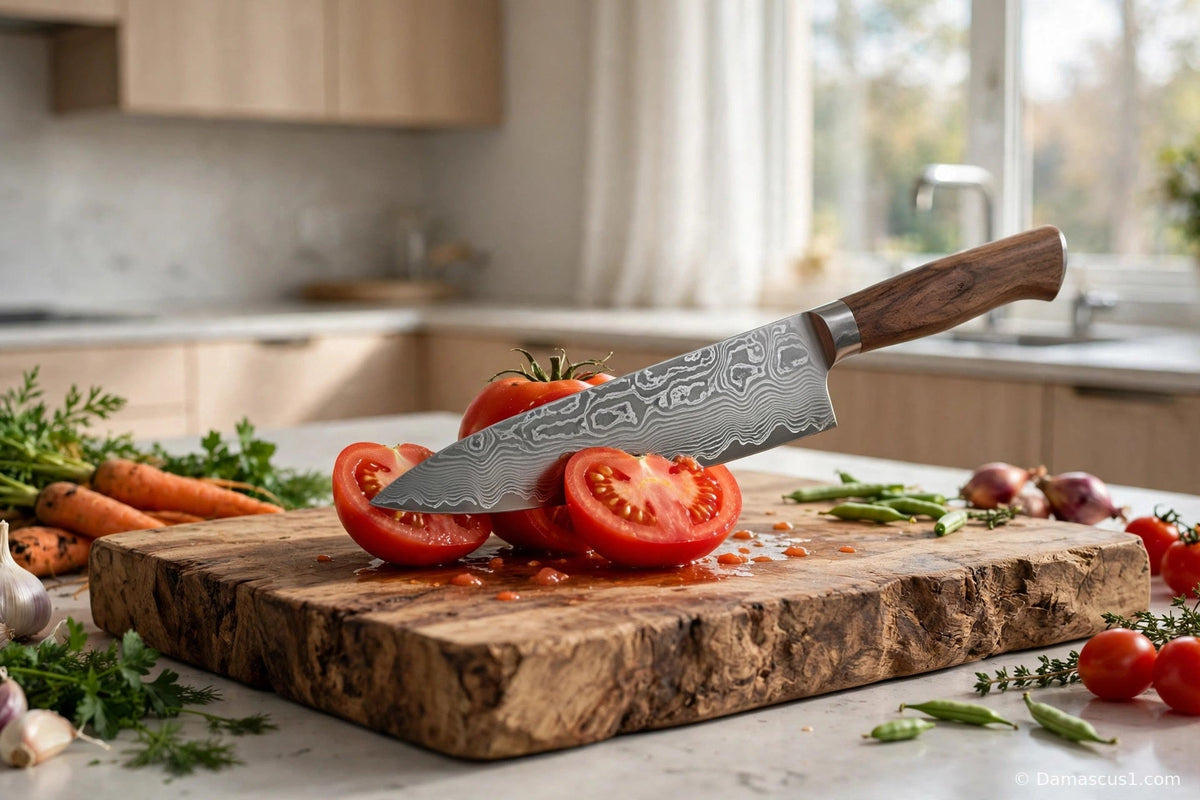
The short answer: A Damascus chef knife costs $99.99 to $649 on the first page of Canadian search results for a single knife or a set — and the steel story is nearly identical at every price: a VG-10 core with 67 layers. The store's kitchen route is not a single expensive knife but the Premium 7-pc Kitchen Knife Block Set at $169.99 USD (seven knives for roughly the price of one premium single) with the VG10 nakiri at $44.99 USD as the single-knife entry. Kitchen care differs from folder care in one way that matters: a kitchen knife meets water and food acid every single day, so it is washed and dried after every use, never left in the sink, and never put in a dishwasher.
If you own the Damascus folder already — the olive-wood pocket knife this whole Canada series is built around — then you already know what Damascus looks like, how it feels in the hand, and what its care contract is. The kitchen is the next room. It is also, for most Canadian buyers, the room where the Damascus question gets asked for the first time: not "should I buy a Damascus pocket knife?" but "should my kitchen knives be Damascus?" And the search results for that question are, frankly, a wall of product listings. Six of the seven holders on page one for "damascus chef knife" are storefronts, not guides. They will sell you a knife — at $99.99, at $150, at $159.99, at $339.97, at $649 — but none of them will tell you whether to buy one knife or a set, what size to buy, what the steel means, or how a kitchen Damascus blade is cared for differently from the folder in your pocket. That is the gap this guide fills, and it fills it with the numbers on the page: every holder's price, in one table, and then the store's kitchen route beside them. The full teardown is in the research brief beside this draft.
One honesty note before we start: the photographs in this post are editorial scenes made for this guide — kitchens, cutting boards, knife blocks, hands washing blades — not photographs of the specific knives sold further down the page. The knives themselves are described exactly as the store describes them, and the prices are the store's own listed prices in US dollars. Nothing here is converted into Canadian dollars, because a conversion the store did not make would be an invention. The competitor prices in Canadian dollars in this post are the holders' own listed CAD prices, quoted as theirs, and they are never compared numerically with USD prices — a dollar figure in one currency and a dollar figure in another are not the same number, and this guide does not pretend they are. And one more honesty note that runs through the whole post: the block set's steel is not stated anywhere in this guide, because the store's listing for it names no steel grade, and this guide does not borrow the nakiri's VG10 label to fill the gap. If the store page names a steel on publish day, it can be added then, with a fresh verification.
What does a Damascus chef knife cost in Canada?


The whole page, in one table. Every holder below is a live page-1 result for "damascus chef knife" on 2026-11-09, and every price is the holder's own listed price, in the holder's own currency. Read the USD column and the CAD column separately — they are not the same money, and this guide does not convert between them.
| Holder | What it is | Listed price (holder's currency) | Ships to Canada |
|---|---|---|---|
| Kanngou | VG10 Gyuto, single knife | $99.99 USD | Yes, 3–9 days |
| Yakushi | 8" VG-10 Damascus chef knife, single | $150 USD | Yes, 5–10 days |
| Imarku | Japanese kitchen knife, single | $159.99 USD | Yes |
| Imarku | Kitchen knife set | $189.99 USD | Yes |
| Takumiya (.ca) | 67-layer Gyuto 20 cm, single | $159.90 CAD | Canadian storefront |
| Takumiya (.ca) | 67-layer Gyuto 24 cm, single | $269.90 CAD | Canadian storefront |
| Kasumi (Quincaillerie Dante, Montreal) | Damascus chef 20 cm, single | $339.97 CAD | Canadian retailer |
| Seido | Titan 6-pc chef knife set | $649 USD | Yes, free shipping |
| Damascus1 — Premium 7-pc Kitchen Knife Block Set | 7-pc block set | $169.99 USD | (store's kitchen route — see buying section) |
| Damascus1 — VG10 Nakiri | Nakiri, single | $44.99 USD | (store's kitchen route — see buying section) |
Three things jump out of that table, and they are the whole buying guide in miniature. First, the price spread for a single knife is more than threefold — $99.99 to $339.97 — for what is, on the steel, nearly the same knife. Second, the sets are where the money goes: $189.99 at the low end, $649 at the high end, and the store's $169.99 set sits below both. Third, and most important, the single-knife prices cluster around $150–$160 for an 8-inch chef knife, which means a buyer who buys one good knife at a time will spend $150, then $150 again for the next shape, then $150 again — and will have spent the price of a set before they own a set. The set is not the expensive option. Buying singles, one at a time, is the expensive option, and the table proves it without any sales language at all.
There is a fourth thing the table shows, and it is the one Canadian buyers should notice first: every holder that mentions Canada ships there. Yakushi in 5–10 days, Kanngou in 3–9 days, Seido with free shipping, Imarku without a stated time. The Canadian storefronts — Takumiya and Quincaillerie Dante in Montreal — sell in CAD, which is the only CAD pricing in this post, and it is theirs, not ours. The cross-border picture for a US order into Canada is the standard one, and this guide states it the same way every post in this series does: possible GST/HST and a carrier handling or brokerage fee on arrival, prices in USD exactly as listed, convert at the day's rate yourself. No delivery date is promised anywhere in this post.
What is a Damascus chef knife, and what is VG-10 with 67 layers?
A Damascus chef knife is a kitchen knife whose blade is pattern-welded Damascus steel: two or more steels forge-welded in layers, folded, and etched so the layers show as a flowing pattern. The pattern is the steel itself — the edges of the layers showing through after the etch — not a print or a coating. Our Canada guides to real versus fake Damascus steel and how to spot a fake Damascus knife cover the authentication checks in full; the short version is the spine test (the pattern continues over the back of the blade), the edge test (the pattern runs into the cutting edge), and the seller-names-the-steels test.
On a chef knife, the steels have a specific job, and the spec that repeats across this whole page — VG-10 core, 67 layers — is worth understanding rather than just repeating. VG-10 is a Japanese stainless steel, high in carbon and chromium, known for taking a very keen edge and holding it: it is the core of the blade, the steel that actually does the cutting. The 67 layers are the Damascus cladding wrapped around that core: alternating layers of softer stainless steels, folded and forge-welded, etched to show the pattern. The core cuts; the cladding shows. That is the whole division of labour, and it is why the steel story is nearly identical from the $99.99 Gyuto to the $649 set: they are all, in effect, the same construction — a VG-10 core in a 67-layer Damascus jacket — with the price difference coming from the handle, the fit and finish, the brand, and the number of pieces, not from a different steel.
That also answers the question the layer-count myth raises in the kitchen, just as it does for folders: more layers does not mean sharper. Layer count sets how fine the pattern looks, not how the knife cuts — the heat treatment and the core steel decide cutting, and the core steel is VG-10 at every price on this page. A 67-layer blade and a 33-layer blade with the same VG-10 core and the same heat treat will cut identically; the 67-layer one will show a finer pattern. Our patterns guide — a companion Canada post on Damascus patterns, planned as a follow-on — covers the chooser in full, including the arm's-length test for picking a pattern you can actually see. For the kitchen, the practical version of that test is simpler: on a chef knife the blade is long enough that even a fine pattern reads clearly, because there is eight inches of steel for it to repeat across. The visibility problem that matters on a three-inch folder barely exists on an eight-inch chef knife.
One more steel note, because the folder owners reading this series will ask it: the hero folder's steels — 1095 and 15N20 — are high-carbon, not stainless, which is why the folder needs its wipe-dry-oil routine. A VG-10 Damascus kitchen knife is stainless-clad around a stainless core, which is why it tolerates the kitchen's daily water and acid far better than a carbon folder tolerates a wet pocket. The pattern looks the same. The care does not, and the care section below is written around that difference.
Which size should you buy: 8-inch chef, nakiri, or 24 cm gyuto?
Size is the question the product listings never answer, because a listing sells one size and a guide has to compare them. The holders on this page sell three sizes between them — an 8-inch chef knife, a 20 cm gyuto, and a 24 cm gyuto — plus the nakiri shape, which is a size and a job at once. Here is how they actually differ in a Canadian home kitchen.
The 8-inch (20 cm) chef knife is the default, and it should be your first Damascus kitchen knife. It is the all-rounder: long enough to slice a roast and rock-chop herbs, short enough to control on a standard cutting board, and the size every holder on this page sells as its flagship single. Yakushi's is 8 inches, Takumiya's is 20 cm (the same thing, in metric), and Kasumi's is 20 cm. If you buy one Damascus kitchen knife, buy this size. It does 90% of kitchen work, and the other 10% is the reason the set exists.
The nakiri is the vegetable specialist, and it is the smartest single-knife entry point. A nakiri is a Japanese vegetable knife: a straight, rectangular blade with a flat edge, designed to push straight down through vegetables rather than rock through them. It chops onions, carrots, and greens faster and more evenly than a chef knife, because the flat edge meets the board along its whole length. It does not rock, it does not slice roasts well, and it is not a general-purpose knife — but for the cook who preps vegetables every night, it is the knife that gets used most. That is why the store's $44.99 USD VG10 nakiri is the entry point in this guide: it is the cheapest way into a real Damascus kitchen blade, and it is the shape that earns its keep daily.
The 24 cm gyuto is the big knife, and it is for big boards and big jobs. A 24 cm blade (about nine and a half inches) is a professional size: it slices large roasts, breaks down a watermelon, and works through a pile of prep with fewer strokes. It also needs a large cutting board, a confident grip, and counter space — and on a small board, in a small kitchen, it is more knife than the job needs. Takumiya's 24 cm at $269.90 CAD is the premium single on this page for a reason: it is a lot of knife. Buy it second, after the 8-inch chef, not first.
The set, of course, solves the size question by not asking it: a 7-pc block set contains the chef knife, the utility shapes, and the small knives, and the cook reaches for whichever size the job needs. That is the set's real argument, and it is not about price at all — it is about never having the wrong size in your hand.
Set or single: the value math
Here is the arithmetic the product-led page never does, because a listing that sells a single knife has no reason to do it. A single 8-inch Damascus chef knife costs $150 (Yakushi), $159.99 (Imarku), $99.99 (Kanngou), $159.90 CAD (Takumiya 20 cm), or $339.97 CAD (Kasumi 20 cm). Call the mid-price single $150 USD. A cook who buys singles, one at a time — a chef knife, then a utility knife, then a paring knife, then a bread knife — will spend roughly $150 four times, which is $600, and will still not own a block to store them in.
| Route | What you get | Price | Price per knife |
|---|---|---|---|
| Single premium chef (Seido-style single) | 1 knife, 8" chef | ~$150 USD (mid-price single) | $150.00 |
| Imarku set | Set (maker's set) | $189.99 USD | Depends on piece count — ask before comparing |
| Seido Titan set | 6-pc set | $649 USD | ~$108.17 |
| Takumiya 24 cm single | 1 knife, 24 cm gyuto | $269.90 CAD (holder's own CAD price) | $269.90 CAD |
| Damascus1 Premium 7-pc block set | 7-pc block set | $169.99 USD | ~$24.28 |
| Damascus1 VG10 nakiri | 1 knife, nakiri | $44.99 USD | $44.99 |
The table's point is not that the cheapest per-knife figure wins — a per-knife figure across different steels, handles, and piece counts is a rough guide, not a verdict. The point is the shape of the decision: the store's set costs $169.99 USD for seven pieces, which is roughly the price of one mid-price single knife from the same page, and the nakiri costs $44.99 USD, which is less than a third of the cheapest single chef knife on the page. A buyer who starts with the nakiri learns whether they like Damascus in the kitchen for $44.99; a buyer who starts with the set covers the whole kitchen for $169.99; a buyer who starts with a single premium chef knife spends $150–$340 and still needs the rest of the kitchen. The set is not the expensive option. The single, bought repeatedly, is.
There is a second, quieter argument for the set, and it is about the block. A block set stores the knives edge-protected, handle-up, in one place on the counter — which is where kitchen knives live, and where they stay sharp, because they are not rattling in a drawer against other steel. A drawer of loose Damascus knives is a drawer of chipped edges and faded patterns. The block is not furniture. It is care, built into the purchase.
What is the store's kitchen route?
The store's kitchen route is two products, and this guide names them plainly because the whole post is built to answer the question "where do I start?" The Premium Kitchen Knife Block Set — a 7-pc block set — is $169.99 USD. It is the kitchen in one purchase: the chef knife, the supporting shapes, and the block to keep them in. The VG10-Labelled Nakiri Knife is $44.99 USD. It is the single-knife entry: a Japanese vegetable knife with a VG10 label, for the cook who wants to try Damascus in the kitchen before committing to a set, or for the cook who already owns a chef knife and wants the vegetable specialist.
Neither price is a conversion, and neither is an estimate: both were verified live on 2026-11-09 from the store's own product data. The block set's steel is not stated in this guide — the store's listing for it names no steel grade — and this guide does not borrow the nakiri's VG10 label to describe it. What the guide can say, honestly, is what the listings do say: seven pieces, a block, $169.99 USD; a VG10-labelled nakiri, $44.99 USD. The rest — the pattern, the handle, the weight — is for the product page, and the product page is where the buyer should look before ordering.
The folder is still the anchor of this series, and it belongs in this post for the reason the kitchen buyer is usually a folder owner first: the Olive Wood Damascus Pocket Knife Set at $39.99 USD (compare-at $89.99) — forge-welded 1095 and 15N20 Damascus at roughly 276 layers and 58–60 HRC, an olive wood handle, 6.5 inches overall, single-edged, with a manual two-hand nail-nick opening and a back-lock. It is the knife the reader already knows, and the kitchen route is the expansion from it: the same pattern, the same maker-direct price logic, in the room where the cooking happens. The Orange Wood 6.5" Hunting Pocket Knife, also $39.99 USD, is the same family with a warmer handle. And the Rolling Knife Sharpener at $39.99 USD — a diamond sharpening kit with 15- and 20-degree angle guides — is the tool that keeps both rooms sharp: the folder's edge and the kitchen knives' edges, at a fixed angle, without a stone ever lying flat across a pattern.
For the wider picture, our Canada hub guide to the Damascus pocket knife in Canada covers the folder side, the field guide to the best pocket knife under $50 in Canada puts the $39.99 price class in context, our guide to the best Damascus chef knife set is the live US set guide to read alongside this Canada edition, and our guide to whether Damascus steel can rust covers the care contract. A set at $169.99 plus a nakiri at $44.99 comes to $214.98 USD — the honest arithmetic for a kitchen that starts with the set and adds the specialist. Prices are in USD exactly as listed; convert at the day's rate yourself, and expect the standard cross-border picture on any US order into Canada — possible GST/HST and a carrier handling or brokerage fee on arrival. No delivery date is promised anywhere in this post.
How is kitchen Damascus care different from folder care?
The care contract is the same sentence — clean after use, dry at once, oil lightly, store dry — but the kitchen changes every word of it, because a kitchen knife meets water and food acid every single day, and a folder meets them on weekends. A folder's rust story is a storage story: a wet pocket, a damp sheath, a winter in a cold garage. A kitchen knife's rust story is a use story: it is washed twenty times a week, it cuts tomatoes and lemons and onions, and it sits in a sink while dinner is served. The routine has to fit that life, or it will not happen.
Wash it by hand, every time, and dry it at once. Warm water, a drop of mild dish soap, a soft cloth — the same wash as the folder, but after every use, not after every trip. The washing image in this post shows the right moment: the blade under a running tap, hands holding it by the handle, a towel and an oil bottle on the counter beside the sink. What the image does not show, and what matters most, is the next ten seconds: the blade dried completely, immediately, with the towel — not left in the drying rack, not left in the sink, not left on the board while the cook eats. A Damascus kitchen blade left wet on a board for the length of a meal will spot. A blade dried at once will not.
Never the dishwasher, never the sink soak. The dishwasher is the single most destructive thing a home cook can do to a Damascus knife: hot water, harsh detergent, a long wet cycle, and the blade rattling against other steel for an hour. A sink soak is the same mistake in miniature: a blade left standing in soapy water while the cook clears the table is a blade rusting in slow motion. The rule is short and absolute: a Damascus knife is washed by hand, dried by hand, and put away by hand, every time, and it never goes in the dishwasher and never sits in the sink.
Oil it, but lightly — and with food-safe oil. A kitchen knife touches food, so the oil must be food-safe: food-grade mineral oil, the same oil used on wooden cutting boards. A few drops on a clean cloth, wiped thinly over the blade after drying. The blade should look oiled, not wet. On a stainless-clad VG-10 kitchen knife, the oiling is lighter and less frequent than on a carbon folder — the stainless cladding does much of the work — but the habit is the same, and the habit is what keeps the pattern bright.
Mind the acids, and mind the board. Tomatoes, lemons, onions, and vinegar are the daily acids of a kitchen, and they are the reason a kitchen Damascus blade needs its wash more urgently than a folder does. Cut the acidic food, wipe the blade, carry on — do not leave the blade sitting in tomato juice while you answer the phone. And cut on wood, not on glass, stone, or ceramic: a hard board dulls the edge and chips the pattern's edge line, and a dull edge needs sharpening, and sharpening is where patterns get damaged by the careless.
Sharpen at the right angle, and never flat across the face. Kitchen knives are sharpened at 15–20 degrees, and the rolling sharpener's angle guides exist for exactly this: hold the angle, work the edge, never lay the stone flat across the blade face, because a stone laid flat across the pattern will cut a bright, patternless stripe through the etch in one pass. A companion Canada guide to sharpening a Damascus pocket knife is planned as a follow-on to this post and will cover the folder technique when it publishes; the kitchen version of the same rule is simpler — the angle guides do the work, and the pattern never meets the stone.
Store it in the block, not in the drawer. A knife block stores each blade edge-protected, handle-up, in moving air. A drawer stores blades rattling against each other, edge to steel, in the dark — which is how edges chip and patterns scratch. The block that comes with the 7-pc set is not furniture. It is the storage half of the care contract, and it is the reason the set's value is not just arithmetic.
The checklist, for the fridge:
| Habit | Folder (pocket knife) | Kitchen knife (chef / nakiri) |
|---|---|---|
| After use | Wipe, dry, oil — after every trip | Wash by hand, dry at once, oil lightly — after every use |
| Never | Never in a wet sheath for storage | Never the dishwasher, never a sink soak |
| Acids | Wipe off food acids when noticed | Wipe off tomato/lemon/onion juice immediately |
| Storage | Dry box, out of the sheath, silica packet | Knife block, edge-protected, in moving air |
| Sharpening | Rolling sharpener, angle guides, edge only | Rolling sharpener, 15–20° guides, edge only, never flat on the face |
| Check | Monthly in the off-season | Weekly — it is used daily, so check it daily |
A companion Canada guide to removing rust from a Damascus knife is planned as a follow-on to this post and will cover the full rescue — patina, surface rust, and pitting — when it publishes. Until then, the kitchen rule is the folder rule with the frequency turned up: the knife that is washed and dried after every use does not need rescuing.
Can you buy a Damascus chef knife in Canada — and what about the border?
Yes, and the page proves it: every holder that mentions Canada ships there, and two of the holders are Canadian storefronts selling in CAD. Yakushi ships in 5–10 days, Kanngou in 3–9 days, Seido with free shipping, and Imarku without a stated time. The Canadian storefronts — Takumiya and Quincaillerie Dante in Montreal — sell in CAD, which removes the conversion question entirely for a buyer who prefers to pay in their own currency.
For a US order into Canada, the picture is the standard cross-border one this series states in every post: the store's prices are in USD exactly as listed, the buyer converts at the day's rate, and the order may attract GST/HST and a carrier handling or brokerage fee on arrival. That is not a hidden cost; it is the normal cost of ordering across the border, and a buyer comparing a $169.99 USD set with a $159.90 CAD single should compare them as two different currencies, not as two numbers on the same scale. This guide does not convert, and it does not rank a USD price against a CAD price, because that comparison would be an invention.
One more Canada note, because the folder series has trained its readers to ask it: a kitchen knife is not a pocket knife, and the law that governs the folder — the Criminal Code's mechanism rules, the CBSA flick test, the carry rules — does not govern a chef knife in a kitchen. A chef knife is a kitchen tool, used in a kitchen, and the only rule that matters is the ordinary one: it is a sharp tool, it is kept in its block, and it is never carried in public without a lawful purpose. Our guide to whether pocket knives are legal in Canada covers the folder law in full; the kitchen needs no equivalent, because the kitchen is where the knife belongs.
What is actually on page one for "damascus chef knife" — and why it leaves the door open
First, it is products, not guidance: six of seven holders are storefronts, and none of them is an editorial guide. Second, no set-versus-single comparison exists anywhere on the page — the value math in this post is the first time the $169.99 set and the $150 single have been put in the same table. Third, no care content at all: not one holder explains how a kitchen Damascus blade is cared for differently from any other knife. Fourth, no Canadian editorial angle: the Canadian storefronts sell in CAD, but nobody writes the Canada buying guide. Fifth, no citable asset: no price ladder, no value table, no care checklist. That is the gap this post fills: the guide the product page never was, in one place. The full teardown is in the research brief beside this draft.
The Olive Wood Damascus Pocket Knife Set — $39.99
Real Damascus steel, an olive wood handle and a genuine leather sheath included — the knife our readers ask about most.
Shop the Olive Wood Damascus Pocket Knife Set — $39.99 · Free US shipping on orders over $50.
Frequently asked questions
How much does a Damascus chef knife cost?
On the first page of Canadian search results, a single Damascus chef knife costs $99.99 to $339.97, with most 8-inch VG-10 knives clustering around $150–$160 USD. Sets cost $189.99 to $649 USD. The store's kitchen route is the Premium 7-pc Kitchen Knife Block Set at $169.99 USD — seven pieces for roughly the price of one mid-price single — and the VG10 nakiri at $44.99 USD as the single-knife entry.
Does a Damascus chef knife ship to Canada?
Yes. Every holder on page one that mentions Canada ships there: Yakushi in 5–10 days, Kanngou in 3–9 days, Seido with free shipping, and Imarku without a stated time. Two Canadian storefronts (Takumiya and Quincaillerie Dante in Montreal) sell in CAD. For a US order into Canada, expect the standard cross-border picture — possible GST/HST and a carrier handling or brokerage fee on arrival — and no delivery date is promised in this post.
What steel is a Damascus chef knife made from?
Most Damascus chef knives on this page use a VG-10 stainless core with 67 layers of Damascus cladding: the VG-10 core does the cutting, and the 67-layer jacket shows the pattern. The store's VG10 nakiri is labelled VG10. The store's 7-pc block set is described by piece count and price only in this guide — its listing names no steel grade, and this guide does not invent one.
What size Damascus chef knife should I buy?
An 8-inch (20 cm) chef knife first — it does 90% of kitchen work. Add a nakiri for vegetables: its straight, flat edge chops onions, carrots, and greens faster and more evenly than a chef knife. A 24 cm gyuto is the big knife for big boards and big jobs, and it is a second purchase, not a first. A 7-pc block set covers all three sizes at once.
Is a Damascus chef knife set or a single knife the better buy?
A set, for most kitchens. A single mid-price chef knife costs around $150 USD, and buying singles one at a time — chef, utility, paring, bread — costs roughly $600 before you own a block to store them in. The store's 7-pc block set costs $169.99 USD for seven pieces, roughly the price of one mid-price single. A single is the better buy only if you already own the rest of the kitchen and need one shape — and then the $44.99 USD nakiri is the cheapest way into a real Damascus kitchen blade.
How do you care for a Damascus chef knife?
Wash it by hand after every use, dry it at once with a soft cloth, wipe a thin film of food-safe mineral oil over the blade, and store it in its block. Never put it in the dishwasher, never leave it soaking in the sink, wipe off tomato and lemon juice immediately, cut on wood rather than glass or stone, and sharpen at 15–20 degrees with the edge only — never lay a stone flat across the pattern. Kitchen care differs from folder care in frequency, not in kind: a kitchen knife meets water and acid daily, so it is washed and dried daily.
Is a Damascus chef knife worth it?
For the cook who will use it daily and care for it after every use, yes: the VG-10 core holds a keen edge, the pattern is the steel itself rather than a coating, and the set route makes the price comparable to a single premium knife. For the cook who will put it in the dishwasher, no — a Damascus blade in a dishwasher is a pattern being erased, and a cheaper stainless knife would serve better. The honest answer is about the habit, not the knife.
The last word: the kitchen is where the pattern earns its keep
A pocket knife's pattern is seen at arm's length, across a campfire, in the seconds after a box opens. A chef knife's pattern is seen every night, in the kitchen, in the cook's own hands, in the light over the cutting board — and it is seen while the knife is doing its real work, slicing a tomato so thin you can see through it, chopping a pile of greens in half the strokes. That is where a Damascus pattern stops being a gift reveal and starts being a daily pleasure, and it is the reason the kitchen is the right expansion for a folder owner: the same steel, the same pattern, the same maker-direct price logic, in the room where the cooking happens.
Start with the nakiri if you want to try it for $44.99 USD. Start with the set if you want the kitchen done for $169.99 USD. Either way, wash it by hand, dry it at once, and put it in the block. The pattern will still be there in ten years — and so will the dinners it made.
Leave a comment: