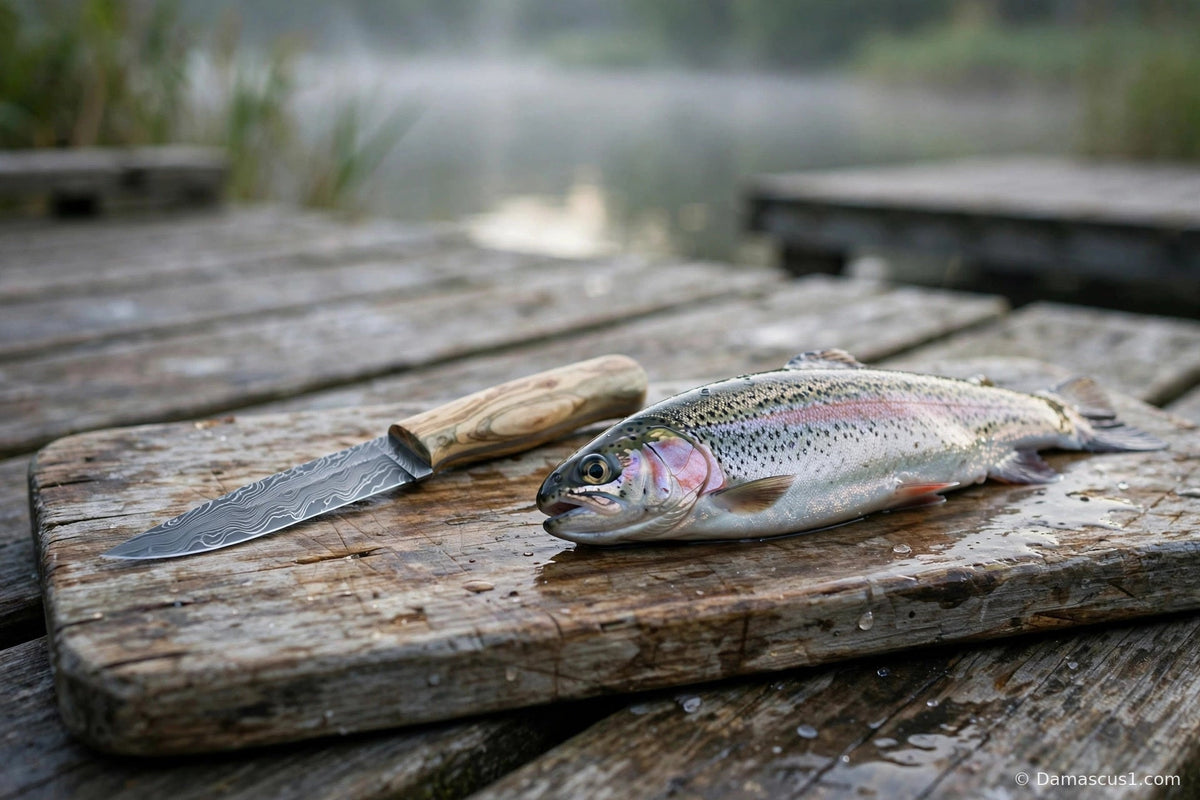
Direct answer: A Damascus fillet knife is a long, thin, flexible fish knife — usually 6 to 9 inches of blade — whose steel carries a layered pattern: either a hard core clad in folded stainless layers, or a fully pattern-welded carbon blade. The pattern itself does not fillet anything. What does the work is the geometry — a spine near 1.5 mm, real flex along the ribs, and a fine, narrow edge — and the steel form decides the care contract that comes with it. This handbook explains each part in order, settles the fillet-versus-boning question properly, and states plainly, before any product appears, that the store publishing it sells no knife listed as a fillet knife.
That last sentence is not a disclaimer tucked at the bottom. It is the organising fact of the page. A handbook a reader can trust has to separate three things that most fillet content mixes together: what the knife is, what the steel does and does not do, and what a particular store actually sells. The first two are covered completely below, for any brand, on any listing, anywhere. The third is answered in its own short section, and the priced knives that appear later are labelled for the work they genuinely do around fish — dockside tasks, camp work, portioning and prep — never dressed up as the specialist blade this page is about.
For the buying decision itself — which length and flex to purchase for which species, freshwater against saltwater, manual against electric, and a seven-point checklist to run on any listing — the companion buying guide on this blog, how to choose a fish knife, does that job in full. The type-by-type comparison of fillet, boning, deba and yanagiba knives lives in the guide to the four fish-knife types. This page is the handbook underneath both: the anatomy, the steel, and the care.
What is a Damascus fillet knife?

A Damascus fillet knife is a fillet knife — long, narrow and flexible, built to separate flesh from frame and skin from flesh in single strokes — made with layered steel somewhere in its construction. Most are 6 to 9 inches in the blade, thin enough to bend along a rib cage, and finished with the flowing surface figure that layered steel shows after etching. Everything else about the knife is ordinary fillet-knife anatomy, and that anatomy matters more than the pattern.
Start with the parts, because each one earns its shape. The blade is long so one stroke can travel the side of a fish; every stop and restart leaves a step in the fillet, and steps are waste. It is narrow — a deep blade drags against the frame and turns badly in the tight work behind the gills. Its spine is thin, around 1.5 mm in the comparisons that publish the number, because thickness is what resists bending, and a fillet blade must bend. The edge is ground fine and usually straight to gently upswept at the tip, so the point can start a cut behind the gill plate and the edge can lie almost flat for the skinning pass. The handle is full-length and shaped to fill a palm, because filleting is a guidance job done with wet hands, and a small or slick handle turns guidance into gripping — effort spent holding on is control taken from the cut.
Flex is the property everything else serves, and it is worth defining exactly. A fillet blade flexes in a smooth, even curve along its length when pressed flat against a board, and springs straight when released. That curve is what lets the edge follow a rib cage it cannot see, riding over the bones instead of digging into them or slicing away above them and leaving flesh behind. A blade that bends only at one hinge point, or that stays bent after pressure, is not flexible in the useful sense; it is soft, which is a different and worse thing. The distinction sounds fussy and is not: yield — how much of the fish ends up as fillet — is decided by exactly this behaviour, fish after fish, season after season.
Length classes follow the fish, in brief, because the buying guide owns the full matching table. Six inches and under suits panfish, perch and small trout, where control around a small rib cage beats reach. The 7-inch class is the all-rounder for trout, bass, walleye and most inshore fish. Eight to nine inches suits salmon and larger saltwater fish, where the side of the fish is longer than a short blade's single stroke. None of these numbers is a quality grade. A 9-inch blade on a small trout is clumsy rather than dangerous, and a 6-inch blade on a salmon simply makes more, shorter strokes and a rougher fillet.
Does Damascus1 sell a fillet knife?
No. No knife in the Damascus1 catalogue is listed as a fillet knife: there is no thin, flexible, fillet-profile blade with stated length and flex on the store, and this handbook will not pretend a neighbouring product is one. What the store sells sits beside the category — folding pocket knives for the dockside work of a fishing day, a fixed-blade tracker for heavy camp and cleaning-station jobs, and kitchen knives for portioning and prep once the fish is home. Those knives appear later in this page, priced and labelled for exactly that work.
The disclosure protects the reader in both directions. Someone shopping for the specialist blade itself — the bending-along-the-ribs tool this handbook describes — should buy it from a listing that sells one, with length, flex and steel stated on the page; the checks in this handbook travel to any listing on any site. Someone whose fish days are wider than the cleaning board — cutting line and bait, breaking down a catch at camp, portioning fillets at a kitchen counter — may find the adjacent tools cover the real workload, and the priced section below exists for that reader. Either way, the store's own kitchen blades collection and the best kitchen knives guide show the kitchen end of the range in full.
Fillet knife vs boning knife: what is the actual difference?

Flex is the dividing line. A fillet knife is longer, thinner and far more flexible — 6 to 9 inches of blade ground thin so it bows along a fish's backbone and slips under its skin. A boning knife is shorter and stiffer — usually 5 to 7 inches — built to separate meat from bone on poultry, pork, beef and game, working into joints and through connective tissue without the blade wandering. They look like cousins on a rack and behave like opposites at work.
The old version of this handbook tried to make this distinction and fumbled the numbers, quoting rigid boning blades at lengths no current source supports. The corrected comparison, matching the ranges the current page-1 guides publish, is this:
| Boning knife | Fillet knife | |
|---|---|---|
| Best for | Separating meat from bone, breaking down poultry, trimming roasts and game | Filleting and skinning whole fish |
| Typical blade length | 5–7 inches | 6–9 inches |
| Spine and build | Thicker spine, more backbone; narrow blade with a pointed tip | Thin spine (around 1.5 mm in published comparisons), ground thin from spine to edge |
| Flex | Stiff to semi-flexible, by protein: stiffer for beef and game, semi-flex for pork and lamb, flexible for poultry | Flexible to full-flex; bends on purpose, in a smooth curve |
| Working stroke | Short, controlled strokes around joints and bones | Long, single strokes along the frame; flat passes under the skin |
| Weak spot | Too stiff to follow a fish's ribs without sawing | Too thin and floppy for joints, cartilage and heavy meat |
Inside the boning family, the flex split the old page reached for is real — it just runs the other way on size. Rigid boning knives are the joint-and-heavy-meat tools: a firm blade that can be pressed into a shoulder joint or worked around a shank without deflecting. Semi-flexible boning knives trade a little of that firmness for the ability to follow smaller, softer work — poultry, game birds, trimming — and sit at the shorter end of the family. Flexible boning knives bend furthest toward the fillet knife's job, which is why a flexible boning knife is the one genuine overlap between the families: it can fillet a small fish respectably in a pinch. The reverse barely works at all. A long, thin fillet blade asked to work a pork shoulder or a leg of lamb deflects, chatters and risks its edge on every joint — the geometry refuses the job, however sharp the edge is.
So the household answer is unsentimental. A kitchen that mostly handles meat and poultry should own the boning knife first; it works every week and covers small fish adequately. A household with an angler, a weekly salmon habit or a freezer that fills with trout should own the fillet knife first, because no boning knife follows a rib cage the way a bending blade does. Owning both is not duplication — it is two tools that share a silhouette and split a workload cleanly down the middle: stiffness for bone, flex for fish.
Why are true Damascus fillet knives uncommon?
Genuinely flexible, fully layered Damascus fillet knives are uncommon because the two properties the category celebrates pull against each other: hardness holds an edge but resists bending, while flex needs thin, springy steel. The market's honest answer has been three different constructions — a hard stainless core clad in softer layered steel, a fully pattern-welded carbon blade that accepts a stricter care routine, and volume imports whose layer counts are marketing first and specification second. Knowing which form a listing sells is the whole game.
The clad form is the premium factory answer, and the Japanese makers state it most clearly: a hard core steel does the cutting, and dozens of softer stainless layers wrap it, supporting the core, adding stain resistance and carrying the pattern. Shun's boning-and-fillet knives are the page-1 example — a proprietary hard core under 68 layers of stainless Damascus cladding, ground at a fine angle — and the form explains itself: the blade can be ground thin and stay durable because the soft cladding absorbs what a hard, thin, fully layered blade would chip on. When a listing says "Damascus" and names a core steel plus a layer count for the cladding, this is almost always the construction on offer, and it is a legitimate one.
The carbon form is the handmade answer: steels such as a high-carbon grade forge-welded with a nickel-bearing grade, folded to hundreds of layers, ground thin, and etched so the pattern shows. It can be made genuinely flexible, and small makers sell exactly that. Its contract is carbon steel's contract — rinse, dry, oil, expect the blade to take a patina and to spot if it is put away wet — which is a heavier promise at a fish-cleaning station than in a kitchen, and the reason this form stays a maker's niche rather than the market's default. The third form, the volume import, mixes the two stories at a low price: a named core, a large layer count, a very hard claimed edge. Some are honest clad knives at honest prices. Some are pattern-printed. The buyer's defence is never the layer count, which costs nothing to print, but the construction questions a real seller can answer — what the core steel is, whether the pattern continues over the spine and bevel, and what the returns route is when the knife in hand disagrees with the page.
Two older claims deserve retiring while the steel is on the table, because the previous version of this handbook made both. Layered steel is not flatly "superior" to other steels, and it was not "invented" in a single datable moment: pattern-welding is an old, widespread technique for combining steels with different properties, and the famous historical blades associated with Damascus were a separate story of crucible steel and trade routes. Modern layered blades perform the way their constituent steels and heat treatment perform — a good one is a good knife, a poor one is a poor knife with a beautiful face. The full pattern library, from raindrop to ladder to feather, is covered in the guide to Damascus knife patterns, and the authenticity test — pattern flowing over the spine, because layers run through the metal — is set out step by step in how to spot a fake Damascus knife.
How do you fillet a fish with a flexible blade?
Filleting with a flexible blade is a sequence of flat, unhurried strokes, not a sawing contest: the first cut starts behind the gill plate and angles toward the head so no flesh is stranded, the blade then turns and travels along the backbone in one or two long strokes with the edge riding the bones, and the freed fillet is finally laid skin-down so the blade can run flat between skin and flesh. Pressure stays light throughout — the flex does the following, the hand does the steering.
In a little more detail, because the details are where yield is won. The fish lies flat and still; a fish sliding on a wet board makes every later step worse, which is why cleaning boards have grip, texture or a damp cloth underneath. The opening cut behind the gill goes down to the backbone and no further — depth is found by feel, the tip touching bone. From there the blade turns flat, and the stroke that separates the fillet runs the length of the fish with the edge angled fractionally down toward the frame, close enough to hear and feel the ribs. Lifting the fillet as it frees, rather than pulling it, keeps the stroke honest. The skinning pass reverses the geometry: fillet skin-side down, a grip on the tail end of the skin, and the blade held almost flat, working away with the same long strokes while the skin, not the flesh, takes the tension.
The flexible blade earns its keep in the middle step and is wasted by the two common errors. The first is pressing hard to make up for a dull edge; a dull flexible blade under pressure wanders and tears, where a sharp one under light pressure tracks. The second is sawing — short back-and-forth strokes that shred the surface of the fillet and leave the stepped texture that cooks unevenly. Both errors are really the same one: asking force to do what sharpness and geometry were hired for. The mechanical companion to this section — length, flex and handle choice worked out fish by fish — is the explainer on choosing a fish knife by length, flex and handle.
What handle works when hands are wet and slimy?

The handle that works in fish slime is the one chosen for the wettest moment of the job, not the driest moment of the photograph: a full-length grip that fills the palm, some texture or contour for the fingers to register, and a shape — guard, bolster or choil — that stops the hand sliding forward onto the edge when everything is slick. On pure friction, moulded synthetic handles lead the category, which is why commercial fish houses standardise on them; natural materials trade a little of that grip for feel and durability, and the trade should be made knowingly.
That trade, stated fairly, is this. Textured synthetic grips keep the most friction when wet and ask nothing in care, and for a dedicated fillet knife used at volume they are the sensible default — the big tested roundups rank them at the top for exactly that reason. Wood with open grain keeps reasonable friction and improves slightly as it absorbs the hand's warmth; polished horn is the slickest of the natural materials when wet and asks for a firmer, more deliberate grip; antler's natural ridging is the exception among naturals, holding texture that no polishing put there. None of this disqualifies a natural handle on a fish-day knife. It assigns each material its honest conditions, and it explains why the natural-handled knives in the priced section below are framed for dockside, camp and kitchen work — cutting line, bait, packaging and portions — rather than for the skinning pass itself.
How do you sharpen and care for a Damascus fillet knife?

Sharpen a fillet knife little and often, on a fine whetstone, at a narrower angle than a heavy kitchen knife, with light pressure that respects the flex: a flexible blade pressed hard against a stone bends and grinds unevenly, producing a wavy edge that cuts worse than the dull one it replaced. Care is the saltwater discipline applied everywhere — rinse in fresh water, wash with mild soap, dry completely, store dry, and keep a thin film of food-safe oil on carbon blades. No fillet knife of any steel belongs in a dishwasher.
The sharpening sequence in full — soaking the stone, setting the angle, working both sides evenly, finishing on the fine grit and testing on paper — lives in the whetstone sharpening guide, and the fillet-specific adjustments are the two that matter: a finer finishing grit, because a polished edge glides under skin with less tearing, and patience with the flex, supporting the blade close to where it meets the stone so the bend works for the angle instead of against it. A honing steel between sessions keeps the edge standing; it does not replace the stone once the edge is genuinely gone.
Rust deserves its own plain paragraph because fish work is the wettest work a knife does. Fish residue is salty and acidic; left on a blade it stains carbon steel within hours and pits even stainless over repeated neglect. A sheath that traps brine against a blade overnight defeats any steel choice at any price. Stainless-clad Damascus forgives the most, carbon Damascus the least, and neither is immune — the pattern is a structure, not a coating, and it grants no rust protection by itself. The complete explanation, including how to deal with early spotting before it sets, is in the guide to whether Damascus steel can rust, and the wider kitchen routine — washing, drying, storage and what never to do — is in the kitchen knife care guide.
Which Damascus1 knives fit the work around fish?

Six knives carry this section, under the disclosure already given: none is a fillet knife, and none is described as one. Two kitchen blades cover portioning and prep at home, two folders cover dockside and pocket work, one fixed-blade tracker covers heavy camp and cleaning-station jobs, and one block set covers the household that wants a single purchase. Every price was verified against the live catalogue today, and the free-shipping line matters to the arithmetic: shipping is free above $50, so the three knives under that line carry a shipping charge alone and clear it when paired, while the AUS-10 knife, the tracker and the set clear it on their own.
| Model | Price today | Form | Best for |
|---|---|---|---|
| G10-Handle Chef Knife | $34.99 (was $59.99) | Fixed kitchen blade | The entry-priced kitchen blade for portioning and general prep beside fish cookery |
| Olive Wood Damascus Pocket Knife Set | $39.99 (was $89.99) | Folding pocket knife set | Dockside line, bait, packaging and pocket tasks in a carryable set |
| Nakiri Knife 8" Japanese VG10 | $49.99 | Nakiri, fixed kitchen blade | Flat, straight vegetable cuts and tidy portioning on a board at home |
| AUS-10-Labelled Kitchen Knife | $59.99 | Fixed kitchen blade | The general kitchen knife whose listing history mixes boning and chef references — judged as a kitchen knife, not a fillet |
| Olive Wood Damascus Tracker Fixed-Blade Knife | $79.99 (was $119.99) | Tracker, fixed blade | Heavy cleaning-station and camp work around a catch: cord, wood, rough breaking-down |
| Premium Kitchen Knife Block Set | $169.99 | Kitchen block set | One purchase covering the main kitchen jobs around fish meals |
G10-Handle Chef Knife — $34.99 (was $59.99). The lowest-priced fixed kitchen blade in this section: a G10-handled chef-profile knife for the board work a fish meal generates — portioning cooked or raw fillets, trimming, and the vegetables that go beside them. It is a chef knife, not a fillet knife, and its stiffer blade should never be asked to bend along a rib cage. View the G10-Handle Chef Knife.
Olive Wood Damascus Pocket Knife Set — $39.99 (was $89.99). The dockside support tool: line, bait bags, packaging, rope and the small cuts of a fishing day, in a pocketable folding set. Described as exactly that — a support knife for a fishing day, never as a fillet knife. View the Olive Wood set, or browse the wider range in the everyday EDC pocket knives collection.
Nakiri Knife 8" Japanese VG10 — $49.99. A flat-profile Nakiri for clean, straight vegetable cuts — cucumbers, herbs and garnishes beside grilled or cured fish — and for tidy portioning on a board. A Nakiri is the opposite of a fillet knife in geometry: tall, flat and rigid, built to go straight down through vegetables, and it should never be bent along a frame. The three-way distinction is spelled out in the chef knife vs santoku vs nakiri guide. View the Nakiri.
AUS-10-Labelled Kitchen Knife — $59.99. Included with its history stated, because the history is the honest description: this listing's older catalogue text mixes references to a boning knife, a chef knife and a block set in a single description, so no single specialist identity can be claimed for it from the page. It is sold today as an AUS-10-labelled kitchen knife at $59.99, and it should be judged — and bought, if at all — as a general kitchen blade, with the listing checked on the day of ordering. It is not sold as a fillet knife and is not one here. View the AUS-10-Labelled Kitchen Knife.
Olive Wood Damascus Tracker Fixed-Blade Knife — $79.99 (was $119.99). The heavy end of the fish-day kit: a fixed-blade tracker for cord, wood, packaging and rough work at a camp or cleaning station. Fine filleting belongs to a flexible fillet blade; a tracker's thick spine cannot follow a rib cage, and this handbook does not pretend otherwise. View the Olive Wood tracker.
Premium Kitchen Knife Block Set — $169.99. The one-purchase kitchen option for households that cook fish often and want the main jobs covered from a block. One honesty note, carried from the listing itself: the exact current packing list needs confirmation before ordering, because the older listing text combines conflicting descriptions. View the Premium Block Set.
Shop handmade Damascus hunting knives
Prices checked November 21, 2026. The product page on the day you order is the final word.
- Camel Bone Damascus Fixed Blade Hunting Knife, 8.2 in.: $69.99
- Olive Wood Damascus Tracker Fixed Blade Knife, 9.5 in.: $79.99
- Rose Wood Damascus Fixed Blade Hunting Knife, 9.5 in.: $89.99
- Buffalo Horn Damascus Tracker Fixed Blade Knife, 9.5 in.: $89.99
- Stag Horn Damascus Folding Pocket Knife, 6.5 in.: $49.99
- Camel Bone Scrimshaw Damascus Folding Pocket Knife, 7.6 in.: $49.99
- Buffalo Horn Damascus Pocket Knife Set, 6.5 in.: $39.99
All Damascus hunting knives · Damascus tracker knives · Damascus pocket knives
Frequently asked questions
What is the difference between a fillet knife and a boning knife?
Flex is the difference. A fillet knife is longer (6–9 inches), thinner and flexible, built to bend along a fish's ribs and slide under its skin. A boning knife is shorter (5–7 inches), thicker in the spine and stiff to semi-flexible, built to separate meat from bone and work joints on poultry, pork, beef and game. A flexible boning knife can cover small fish in a pinch; a fillet knife cannot cover heavy meat work.
What length fillet knife should a first-time buyer choose?
Around 7 inches, in medium flex, is the safest first purchase: long enough for the common freshwater and inshore fish — trout, bass, walleye — in one or two strokes, short enough to steer around a rib cage, and forgiving of the angle errors every learner makes. Shorter blades suit panfish and small trout; 8–9 inches suits salmon and large saltwater fish. Buy for the fish cleaned most often, not the biggest fish caught once.
Is Damascus steel good for a fillet knife?
It can be, in the right construction. A stainless-clad Damascus blade — hard core, softer layered cladding — grinds thin, holds a fine edge and resists the wet work well. A fully pattern-welded carbon Damascus fillet is genuinely flexible and beautiful, and asks for carbon steel's care: rinse, dry, oil, no wet storage. What never helps is the pattern alone; judge the construction and the named steels, not the figure on the flat.
Can a boning knife be used to fillet fish?
A flexible boning knife can, for small fish and occasional work, and it is the standard pinch-hitter. The compromises are length and flex: at 5–7 inches it makes shorter strokes on larger fish, and even a flexible boning blade bends less than a true fillet blade, so it leaves a little more flesh on the frame. For regular fish, the dedicated fillet knife earns its place; for occasional fish, the boning knife already in the drawer is a rational answer.
How do you sharpen a fillet knife without ruining the flex?
On a fine whetstone, at a narrower angle than a heavy kitchen knife, with light pressure — and with the blade supported close to the stone so it does not bend away from the angle being set. Pressing hard makes a flexible blade grind unevenly. Little and often beats rare and heavy: a few light passes between sessions keep the edge alive, and a honing steel handles the in-between days.
Can Damascus kitchen knives go in the dishwasher?
No. Hand-wash and dry Damascus kitchen knives right after use. Dishwashers can rust the steel, dull the edge against racks and other cutlery, and damage natural handles with heat and detergent. This applies with extra force to fillet knives, whose thin edges are the easiest of all to knock out of true in a machine.
Is Damascus better than stainless steel for fish work?
Neither is better for everyone. Stainless and stainless-clad blades resist the salt and acid of fish work with the least routine. Carbon and carbon-leaning Damascus takes a very keen edge and shows the pattern most dramatically, and asks to be rinsed, dried and oiled in return. Pick by the care routine that will actually happen after a day on the water — that routine, not the steel name, decides how the blade looks in a year.
Does Damascus1 sell a fillet knife?
No knife in the Damascus1 catalogue is sold as a fillet knife, and this handbook states that plainly rather than stretching a neighbouring product into the category. The store sells folding pocket knives, a fixed-blade tracker and kitchen knives covering the work around fish — dockside tasks, camp cleaning stations, portioning and prep — at prices from $34.99, each linked in the comparison section with its role described honestly.
The short version
A Damascus fillet knife is a geometry first and a pattern second: 6 to 9 inches of thin, genuinely flexible blade, in one of three steel forms — stainless-clad for the easiest care, carbon pattern-welded for the handmade route and its stricter routine, or a volume import to be judged by its construction answers rather than its layer count. It is not a boning knife, however similar the silhouette; flex is the dividing line, and the boning knife's stiffness is a feature on meat exactly as the fillet blade's bend is a feature on fish. Choose length by the fish cleaned most often, sharpen lightly on a fine stone, rinse and dry after every wet session, and the knife will repay the small discipline for years.
For the purchase itself, the fish knife buying guide turns this handbook into a decision, species by species. For the work around the fish, the six knives above cover the dock, the camp and the kitchen honestly, from the G10-Handle Chef Knife at $34.99 to the block set — none mislabelled as a fillet knife, every price checked today.
Leave a comment: