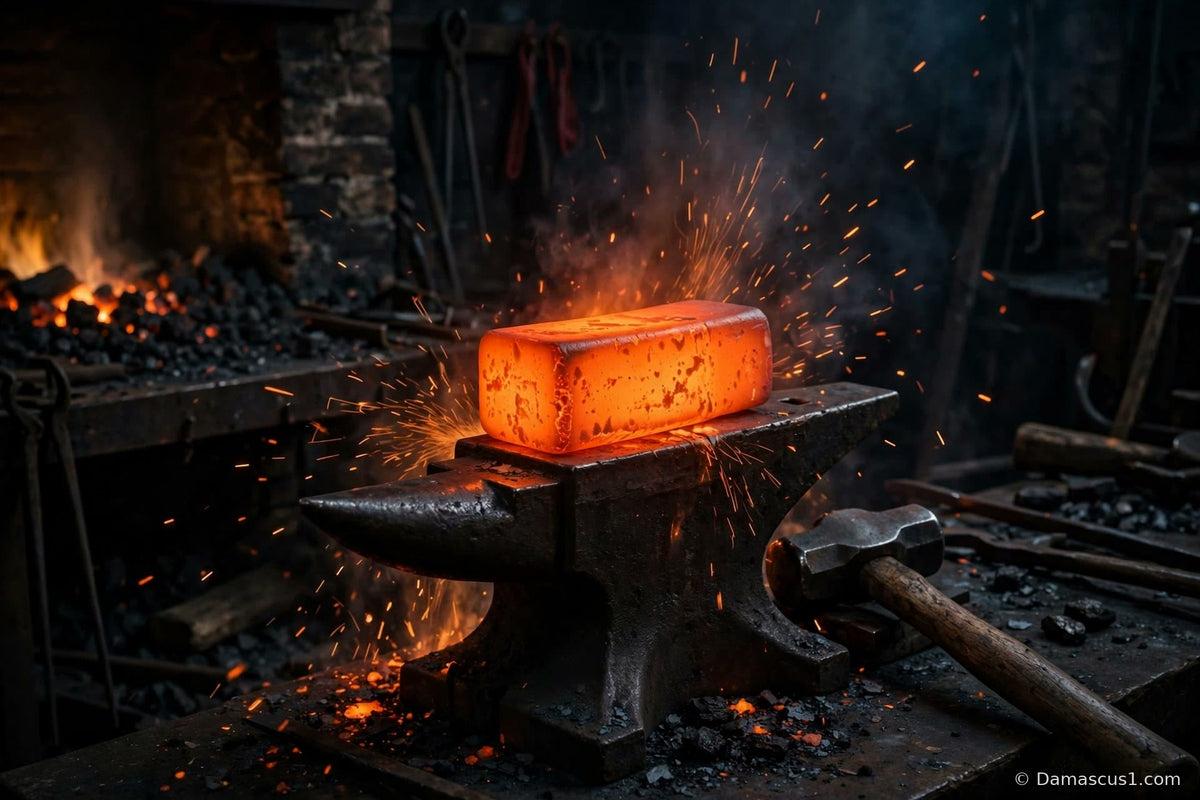
The short answer: Modern Damascus steel is made by stacking two different steels — most often 1095 high-carbon steel and nickel-bearing 15N20 — forge-welding the stack into one solid billet at around 2,300°F, then drawing it out, folding and re-welding it until the layers number in the hundreds. The blade is shaped, hardened, tempered and finally etched in acid, which darkens one steel and leaves the other bright: that contrast is the pattern.
Notice what that short answer does not say. It does not say the pattern is applied, printed or painted on at the end — on a genuine blade the pattern is the structure, running through the metal from face to spine. It does not say the steel is an ancient secret rediscovered — the historic material, wootz, was a different thing made a different way, and every honest maker in the research behind this guide says so. And it does not say more layers make a sharper knife, because they do not: layers decide how fine the pattern looks, while the steels, the heat treatment and the grind decide how the knife cuts. This guide walks the whole journey slowly — billet, weld, folds, shaping, hardening, etch and handle — because a UK buyer who understands the making can never again be sold a photograph of it. Each stage explains what can go wrong as well as what should happen, since the failures are where real and fake Damascus part company.
A word on sources and honesty before the forge is lit. The temperatures, sequences and layer mathematics in this guide are drawn from working bladesmith sources — a master-bladesmith guide from an American knife company, a step-by-step forge account from a Canadian bladesmith, and abrasives-industry process writing — all recorded in the research brief beside this draft. Where those sources give ranges, this guide gives ranges. Where the Damascus1 folder is concerned, only its listed specification is used: forge-welded 1095 and 15N20, about 276 layers, 58–60 HRC, olive wood handle. This page describes how such a blade is made in general; it does not claim to be a film of that particular knife's birth, and no photograph here depicts a specific product. That distinction — process explained honestly, product specified exactly — is the whole ethic of the page.
Is modern Damascus the same steel as the historic Damascus of legend?
No, and a making guide that will not say so in its first section cannot be trusted with the rest. Historic Damascus — wootz — was a crucible steel made in India and Sri Lanka from around 300 BC, smelted as a single ingot whose internal carbide structure produced the watered pattern when forged. Blades made from it were traded through Damascus, which gave the steel its name, and the original crucible technique was lost by roughly the mid-1800s, despite generations of attempts to reverse-engineer it. Modern Damascus is something else, and its proper name is the honest one: pattern-welded steel. Two or more steels are layered, forge-welded, folded and etched so that their contrast draws flowing patterns deliberately, by construction, rather than by the accidents of a crucible. The resemblance is real and the lineage is one of inspiration rather than identity.
Why does the distinction matter to a buyer in Britain deciding between two knives on a screen? Because "ancient technique" is doing heavy marketing work in this market, and it collapses the moment it is examined. A pattern-welded blade is not a lesser thing for being modern — it is a demanding, skilful, genuinely handmade process, as the rest of this guide will show — but it should be bought for what it is: layered steel made well, with named steels and a stated hardness. The makers worth buying from are the ones who volunteer the distinction themselves. The bladesmith sources behind this guide all do: one opens by separating the single-ingot crucible process from the layered forge-welded one in a table; another states plainly that most modern Damascus knives use pattern-welded steel and that the visual contrast comes from layering alloys and revealing them by etching. When a seller instead leans on crusader romance and lost secrets while naming no steels at all, you have learned something important about the seller, and nothing at all about the knife.
What goes into the billet — and why 1095 and 15N20?

Every Damascus blade begins as a stack, not a bar. Thin bars of two steels are laid in alternating layers — bright, dark, bright, dark — and bound or tacked together into what smiths call a billet. The pairing is not arbitrary, and the same two names recur across almost every serious source: 1095 and 15N20. The reasons are practical chemistry. 1095 is a simple high-carbon steel: it hardens well, takes a keen edge, and — crucially for the pattern — it darkens strongly in the etching acid. 15N20 is a nickel-bearing steel: the nickel resists the acid's darkening, so those layers stay bright. Put the two together, etch the finished blade, and the layers announce themselves as flowing light and dark lines. Other pairings exist — the sources mention VG10 where a stainless construction is wanted, and 52100 or L6 combinations where extra toughness is the aim — but 1095 with 15N20 is the industry's standard carbon pairing, and it is the pairing in the folder this guide will follow to the handle: the Olive Wood Damascus Pocket Knife Set | Handmade Folding EDC, listed at $39.99 USD (compare-at $89.99, checkout in USD).
Preparation at this stage is unglamorous and decisive. The bars must be clean — ground bright, free of scale and contamination — because anything trapped between the layers will be trapped inside the finished blade as a flaw. Flux is applied between and around the layers: its job, as the forge sources describe it, is to keep oxygen away from the hot steel so the surfaces can bond cleanly instead of oxidising, scaling and flaking apart. A billet is a small object at this point, a handful of steel strips that look like nothing. Everything that makes a Damascus blade beautiful or worthless is decided by how carefully the next hour treats it. That is worth remembering when a listing promises "1,000 layers" at a giveaway price: layers are not a number typed into a page; each doubling is a weld that had to be made, at temperature, by someone who knew what a good weld looks like.
How does forge-welding turn a stack into one piece of steel?

The bound billet goes into the forge and is brought to welding heat — around 2,300°F in the master-bladesmith account, with the process sources giving a working range of roughly 2,300–2,500°F, the steel glowing bright orange-yellow. At that heat the layers are soft enough to bond under pressure: the smith takes the billet out and welds it with hammer blows or under a hydraulic press, working quickly because the piece sheds its welding heat fast. Done right, the stack stops being a stack. The layers fuse into a single solid bar in which the steels remain distinct as strata but behave as one material — the defining act of the whole craft, and the one from which the name pattern-welded comes.
Done wrong, it fails in ways that only appear later, which is why the honest sources dwell on them. Too cool, and the layers never truly bond: the billet carries hidden unwelded seams that can open as black lines or delamination when the blade is ground, or worse, separate in use. Too hot, and the steel can burn — damaged at the grain level in ways no amount of later work repairs. Spend too long at heat across repeated cycles and a subtler failure creeps in: carbon migrates between the layers, softening the contrast the whole exercise exists to create, so the etched pattern comes out duller than the steels promised. A careful smith checks the billet at every stage rather than at the end, because catching a bad weld early costs minutes and catching it in a finished blade costs the blade. When you read that a maker's pattern runs cleanly through the spine of a finished knife, this is the stage being testified about: welds that held, all the way through, hundreds of layers deep.
How do the folds multiply the layers — and where does "about 276 layers" come from?
Once the first weld is solid, the billet is drawn out — hammered longer and thinner — then cut or folded back on itself and welded again. Each fold doubles the layer count, and the arithmetic is the one piece of mathematics every source agrees on because it is not a matter of opinion. Start with seven layers and fold five times and you have 7 × 2⁵ = 224 layers; fold again and you pass 400. Start with eight and the same folds give 256, then 512. Real billets are also cut into pieces and restacked rather than simply folded, trimmed at the edges, and built from starting stacks of varying counts, which is why honest finished counts are so often stated as approximate and land on numbers that are not neat powers of two. The folder in this guide is listed at about 276 layers — squarely inside the range the bladesmith sources describe as normal for a folding knife, where most makers work between roughly 150 and 300 layers to get a clean, visible pattern without wasting steel and time on folds nobody can see at arm's length. Larger straight blades commonly run higher, into the 300–500 region, and one American certifying body is widely quoted as requiring at least 300 layers in the Damascus blade a smith submits for its master grade — a benchmark about demonstrated forge control, not about cutting.
What the count does — all it does — is set the fineness of the pattern. More layers draw finer, tighter lines; fewer layers draw bolder, more open ones. Neither is better; it is a style choice made at the anvil. What the count does not do is sharpen anything. The sources are unusually united on this, including the ones selling the knives: layer count changes how the pattern looks, not how well the blade cuts; performance comes from the steels at the edge, the heat treatment and the grind. A UK reader should hold that sentence tightly, because the home market's kitchen pages revolve around 67-layer VG10 constructions — a clad construction, counted differently, in which the layers are stainless cladding around a core — while a forge-welded carbon folder's few hundred layers describe the whole blade. Comparing "67" with "276" as though they were scores in the same game is the layer-count fallacy in its commonest form. They are two honest numbers about two different constructions, and each belongs to its own knife.
How is the blade shaped, hardened and tempered?
With the layer count reached, the billet is drawn out into a bar long enough to become a blade blank, and the smith's attention turns from multiplication to shape. The bar is forged toward the blade's profile and then ground: the outline, the bevels and the edge geometry take form, and it is here — not in the layer count — that much of the finished knife's cutting character is decided, because geometry is what meets the material being cut. Pattern manipulation also belongs to this middle act of the making. Before the final shaping, the billet can be twisted, or cut with grooves and flattened so the layers reappear as ladder or raindrop figures; the flowing, watered look of a straightforward folded billet is simply the layers following the fold. Those pattern names describe what was done to the billet at this stage, and a buyer choosing between them is choosing a drawing, not a performance tier.
Heat treatment follows, and it is the stage a specification sheet reports as a single number. The shaped blade is heated and quenched — cooled rapidly — to harden the steel, then tempered: reheated more gently to draw back brittleness while keeping hardness, trading a little theoretical hardness for the toughness that stops an edge chipping or a blade snapping. The result is expressed as a Rockwell hardness figure, and the folder in this guide is listed at 58–60 HRC — the range in which a carbon edge takes a fine finish, holds it through honest work, and still sharpens willingly on a whetstone. The kitchen VG10 ranges in the UK market sit a touch higher, around 60–61 HRC, which suits their thinner, harder-edged cooking geometry. Neither figure is a boast in itself: hardness without tempering judgment is brittleness, and the number only means something alongside the steels it describes — which is, for the third time in this guide, why named steels matter more than adjectives.
The citable asset for this guide is the journey itself, set out as one table — every stage, what happens, and what can go wrong — built only from the steps the bladesmith sources describe.
| Stage | What happens | What can go wrong |
|---|---|---|
| 1. Stacking the billet | Alternating bars of 1095 and 15N20 are cleaned, stacked and bound; flux keeps oxygen off the surfaces | Dirty or scaled surfaces trap flaws inside the finished blade |
| 2. Forge-welding | The billet is heated to ~2,300–2,500°F and welded under hammer or press into one solid bar | Too cool: seams never bond (delamination). Too hot: the steel burns |
| 3. Folding and restacking | The bar is drawn out, folded or cut and restacked; each fold doubles the layers (7 layers × 5 folds = 224) | Every fold is another weld that must hold; long heats let carbon migrate and dull the contrast |
| 4. Patterning and shaping | The billet is twisted or grooved for ladder/raindrop figures, forged to profile and ground to shape and bevel | Poor geometry cuts poorly whatever the layer count |
| 5. Heat treatment | The blade is quenched to harden, then tempered for toughness — 58–60 HRC on the folder in this guide | Under-tempered: brittle. Over-tempered: soft edge that will not hold |
| 6. Etching | The finished blade is bathed in acid (usually ferric chloride); 1095 darkens, nickel-bearing 15N20 stays bright | On a fake, the "pattern" is only this stage — printed or etched onto plain steel with no layers beneath |
| 7. Handle and finishing | The blade is fitted with its handle — olive wood on the folder here — sharpened and finished | A soaked or dishwashed wooden handle swells and splits; carbon steel left wet spots |
Read the right-hand column as a buyer's checklist in disguise. Almost every test in our explainer How to spot a fake Damascus knife is a way of asking whether stages one to three ever happened: pattern on the spine means layers run through the metal; pattern in the bevel means they survive grinding and sharpening; variation between knives means billets were folded, not printed.
What does the etch actually do — and why is it the most misunderstood step?

The etch is where the pattern becomes visible, and it is routinely misdescribed as where the pattern is made. The truth is the reverse, and it is the most useful single fact in this guide. The finished, hardened blade is immersed in an acid bath — ferric chloride in most of the sources — and the acid reacts differently with the two steels it is made from. The high-carbon 1095 darkens; the nickel-bearing 15N20 resists and stays bright. What emerges, after the blade is neutralised, cleaned and oiled, is the flowing contrast every buyer recognises. But the acid has created nothing. It has revealed a structure that was built at the forge, fold by fold, and that runs through the whole thickness of the blade. Without etching, the layers would be nearly invisible, because polished 1095 and polished 15N20 look much alike; with etching, the inside of the steel becomes legible on its surface.
That is also precisely how the fake works, and why the fake eventually betrays itself. A printed or laser-etched imitation applies a pattern to the surface of a single piece of plain steel — sometimes using the same acid trick on one homogeneous metal — so the design sits on the flat face and nowhere else. It cannot appear on the spine, because there are no layers at the spine. It fades at the bevel and under sharpening, because sharpening removes the surface it lives on. And it repeats identically across a whole production run, because printing is repetition, while folding is variation. So the etch is both the glory and the audit of a Damascus blade: on the real thing it is the final, revealing step of a long process; on the imitation it is the only step there ever was. A UK buyer who understands that one paragraph understands the market.
How does the olive-wood handle complete the knife?


A folding knife is finished by hand work of a quieter kind. The blade — in the folder's case, a single-edged blade on a 6.5-inch model — is fitted to its mechanism and handle: here, a manual two-hand nail-nick opener with a back-lock, and scales of olive wood. Olive wood earns its place on handling as much as looks. It is dense and naturally oily, it takes a warm polish from the hand itself, and its grain is unrepeatable — the streaked, marbled figure differs on every piece, so two folders from the same batch are cousins, not twins, exactly as their blades are. The wood is shaped, fitted, pinned and finished so the knife sits closed as a smooth, hand-sized object and opens with the deliberate two-handed action the law sections of this site describe without embarrassment: never one-hand, never a flipper, never assisted, never automatic.
Ownership of the finished object is part of its making, because carbon Damascus and olive wood both ask for the same temperament: dry, oiled, unhurried. The blade is not stainless — 1095 and 15N20 will spot if left wet — so it is washed by hand, dried straight away and given a light wipe of oil if it will sit, developing a calm grey-blue patina with honest use rather than the orange freckles of neglect. The handle asks for the same dry respect and an occasional feed of oil or wax rather than a soak or a dishwasher cycle. In return, the knife at the end of this long journey — stack, weld, folds, quench, etch, wood — is the Olive Wood Damascus Pocket Knife at $39.99 USD, rated 4.9/5 in buyer reviews on its own product page, with engraving available on request (quote-based, up to 25 characters, proof, price and timing confirmed before custom work starts) for buyers who want the making personalised. The same construction appears in the Orange Wood 6.5-inch Damascus Folding Pocket Knife at $39.99 USD and the Green Wood Damascus Folding Pocket Knife at $39.99 USD, and the store banner "Free Shipping & Returns above $50!" applies as listed — two folders, at $79.98, cross it. For a kitchen-bound reader, the Premium Knife Block Set (7-pc) at $169.99 USD is the household expression of the same layered idea. And because a beautiful object still lives under British law: the folder locks, so owning and collecting it at home is legal, public carry needs a specific, current good reason, it is never "UK legal carry", sales are adults-only, and delivery is age-verified into an adult's hands — the framework our explainers UK legal pocket knife, Are locking knives legal in the UK? and Can you buy knives online in the UK? set out in full, with Damascus pocket knife UK placing the finished knife in its home market.
The Olive Wood Damascus Pocket Knife Set — $39.99
Real Damascus steel, an olive wood handle and a genuine leather sheath included — the knife our readers ask about most.
Shop the Olive Wood Damascus Pocket Knife Set — $39.99 · Free US shipping on orders over $50.
Frequently asked questions
How many layers does a good Damascus knife need?
Most folding knives look their best between about 150 and 300 layers; larger blades sometimes go higher. There is no single correct number — only a range that balances pattern detail with practical forging time. The folder in this guide is listed at about 276 layers, inside that folding-knife range.
Does more layers mean a stronger knife?
No. Strength and edge performance come from the steels, the heat treatment and the grind, not from the number of layers. More layers mean a finer pattern; they also mean more welds that each had to be made well.
What steels are used to make Damascus?
The most common pairing is 1095 high-carbon steel with 15N20 nickel-bearing steel — the pairing used in the folder in this guide. Some makers use VG10 where a stainless construction is needed, or 52100 and L6 combinations for extra toughness.
How long does it take to forge a Damascus billet?
It varies with layer count and blade size, but a full billet, from stacking to a finished blade, is measured in hours of hands-on forging time, not minutes — one process account puts a single knife at roughly 8–20 hours of an experienced smith's work.
Why does the acid etching step matter?
Because the acid reveals the pattern that is already inside the steel. The two steels react differently — the carbon steel darkens, the nickel steel stays bright — so the layers become visible. Without etching they would be nearly invisible; without real layers beneath, an etched pattern is only a surface print.
Can layer count be faked?
Not in a forged billet — but products marketed as Damascus can be printed or laser-etched onto plain steel with no layers at all, and a layer claim can be typed onto any listing. Check whether the pattern runs through the blade itself: spine, bevel and variation between knives are the tells.
The honest close: Damascus steel is made slowly, in the open, by a process any buyer is allowed to understand: two steels, one weld, patient folds, a quench, an etch, a wooden handle. If that journey is the kind of making you want in your pocket or your collection, the Olive Wood Damascus Pocket Knife at $39.99 USD, checkout in USD and delivered to an adult's hands, is its finished form — about 276 layers of it, hardened to 58–60 HRC, and ready to be kept dry, oiled and honestly carried. DRAFT — awaiting Faisal's word before anything is published.
Leave a comment: