Being a useful potluck guest starts before you reach the front door. The host needs to know what is arriving, how it should be served and whether it requires refrigerator space, an oven or extra preparation. A covered dish with a clear handover is often more helpful than an elaborate contribution that arrives with several unexpected jobs attached.
This guide follows a guest's contribution from the first conversation to the trip home. It covers planning, packing, serving utensils, whether to bring a kitchen knife, and the questions to ask before buying equipment for the occasion. It is intended for ordinary home gatherings; venues and organizers may have additional requirements. Food-handling references and linked Damascus1 listings were checked on October 20, 2026.
Start here: agree on the contribution, plan food transport, decide which tools belong in the bag, make the handover, then use the departure checklist. If you are hosting rather than visiting, read our Thanksgiving kitchen preparation plan.
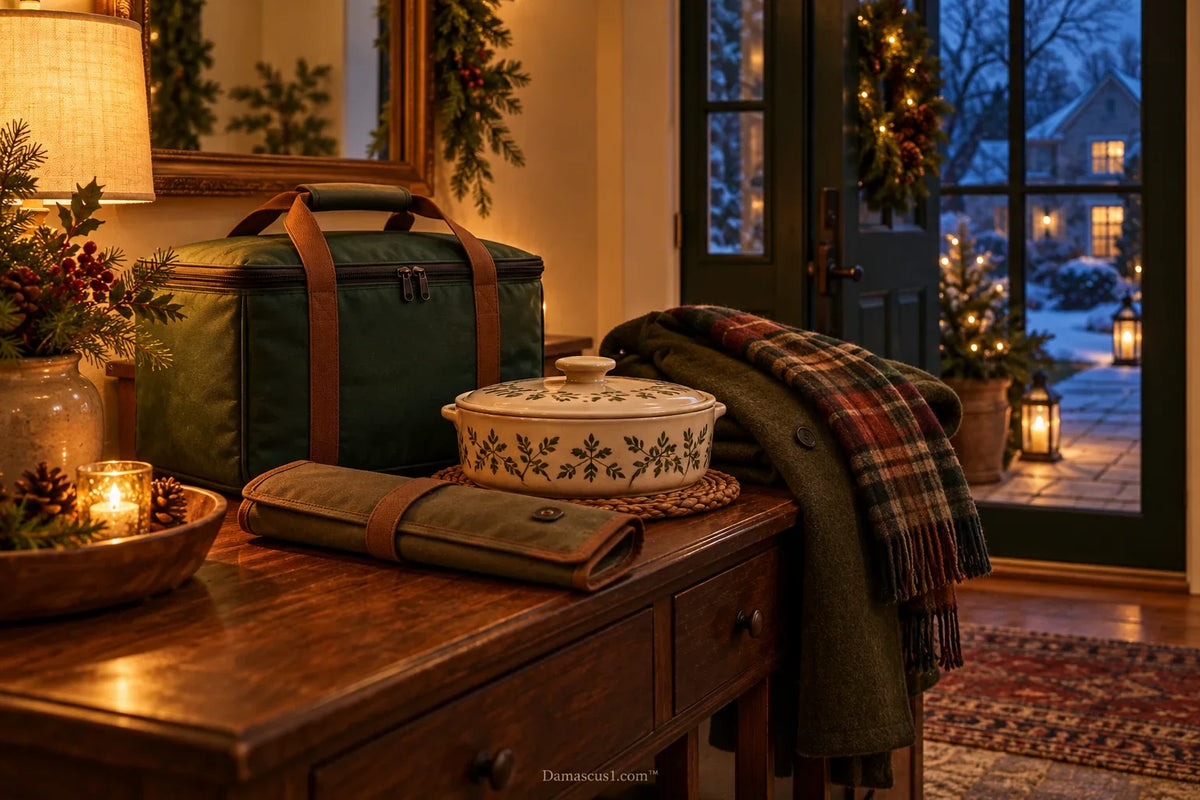
The cover and five interior images are AI-generated editorial illustrations. They depict planning ideas, not Damascus1 products, verified carrier performance, a packing certification or photographs of a real event.
1. Agree on what arrives, not just the name of a dish
Ask the host what would be useful and describe the contribution in practical terms. “I can bring a vegetable side, ready to serve in its own dish with a serving spoon” answers more questions than “I will bring vegetables.” Specify whether the food arrives ready to eat, needs reheating or requires final preparation. Those choices affect the host's kitchen long before anyone sits down.
Confirm the expected arrival time and serving time separately. A gathering that begins at four may not serve the main meal until six. Ask where your contribution will be held during the gap and whether there is space for its container. Do not assume the host's oven will be free or that a decorative bowl will fit in a crowded refrigerator.
Offer a contribution that fits the available arrangement. If the host cannot provide reheating space, choose a suitable alternative and plan its transport and holding requirements. If the kitchen will be crowded, finish appropriate preparation at home rather than arriving with groceries and a request for a board. A smaller contribution that arrives with its requirements resolved can be easier for everyone to manage.

Write a short contribution note
Record the dish name, the quantity or intended contribution, arrival time, serving requirements and utensils you will bring. Include ingredients or packaging information the host has requested. If someone has a food allergy or other specific requirement, discuss it directly and preserve accurate ingredient information; do not describe a homemade dish as suitable for them based only on a familiar recipe name.
Keep the note factual. “Contains walnuts; packaged ingredient labels attached” gives the host useful information. “Safe for everyone” makes a promise you cannot support. If you cannot reliably answer a question about ingredients or preparation, say so early enough for the host to arrange an alternative. The same principle applies to equipment: tell the host what you can actually supply.
2. Choose a serving format that can survive the whole journey
Think through preparation, packing, the drive, unloading, waiting, serving and returning home. A dish that looks attractive on your kitchen counter may need a different container for transport. Check that the lid belongs to the container, closes as intended and does not depend on someone holding it in place. Keep any decorative serving bowl separate if the food will be transferred on arrival.
Measure the usable space in a carrier before assuming a casserole will fit. Include protruding handles and the lid, and allow for the cooling or insulation arrangement your plan requires. A carrier's external dimensions do not describe the internal space. If the dish sits at an angle or keeps the bag from closing, choose a different container rather than treating the problem as something to solve in the car.
Prepare ownership labels for dishes, lids and reusable utensils. Use a method appropriate for the material and intended washing instructions. A small record on your phone can list what you took. The aim is to help the host return the correct items later without asking them to remember which of several similar serving spoons belongs to you.
Pack for the serving task as well as the meal
A casserole may need a serving spoon, a cake may need a suitable server, and a salad may need tongs. Choose the utensil that suits the finished dish and bring a clean place for it to rest if the serving arrangement needs one. Do not substitute a personal preparation knife for a serving utensil simply because it happens to be in the kitchen.
Consider the likely number of people using the serving area. A large platter requiring repeated cutting at the table may create a queue. Ask whether a contribution prepared into suitable portions at home would be more useful. Make any change in a way consistent with the recipe, safe handling and the host's plan, rather than improvising in the doorway.
3. Make a temperature plan for food transport
An insulated bag is equipment, not a temperature reading. Choose a dish and transport method that let you keep the food under appropriate conditions throughout the journey and waiting period. Include delays in the plan: collecting another guest, unloading the car or waiting for the host to clear space can extend the time between your kitchen and the serving table.
FDA's food-transport guidance recommends keeping cold food at 40°F or below in a cooler with ice or frozen gel packs, limiting opening, and preventing raw-food juices from contaminating prepared foods. Although written for outdoor meals, its transport checks are relevant to a trip to a gathering. Use a suitable thermometer and follow the instructions for your food and equipment.
If hot transport or reheating is part of the contribution, agree on the exact arrangement with the host. Do not assume that a warm bag or a bowl wrapped in a towel has maintained a safe food temperature. If you cannot support the required conditions for a proposed dish, select another contribution with a manageable transport and serving plan.

Keep a simple timeline with the food
Write down preparation or packing information that will matter at handover. Note when the dish leaves controlled storage and what should happen on arrival. Keep the information with the contribution rather than assuming the host will remember a conversation from several days earlier. This is especially useful when one person prepares the dish and another person delivers it.
The timeline should reflect what actually happened. If the journey changes or temperature control is uncertain, tell the host before the food is served. Reaching the destination does not erase earlier handling. A record helps people make a sensible decision; it does not certify the dish or extend a food-safety limit.
4. Decide whether any knife needs to travel at all
Ask the host before bringing a knife. Many potluck contributions need only a serving utensil because preparation can be completed at home. A host may prefer to provide familiar equipment, may lack space for extra preparation or may have a venue rule that affects what can be brought. A surprise knife is rarely a useful addition to a crowded arrival area.
If a knife is genuinely needed, identify the task and the person who will use it. “A suitable bread knife for the unsliced loaf, used by me at the kitchen board” is more specific than “I will bring my knives.” Confirm the host has a suitable working area and agrees with the arrangement. Bring only the equipment required for that agreed task.
Use storage designed to protect the exact blade and prevent unintended access or movement. Check fit with the actual knife and follow the storage manufacturer's instructions. A roll or case can have several slots without fitting every blade length, width or handle shape. Do not pack a loose blade among food containers, towels or general utensils.

A kitchen trip is not a reason to substitute a pocket knife
A pocket knife is a separate product category with its own design, cleaning, handling and carry considerations. Do not assume it is an appropriate shared food-preparation tool because it is convenient to carry. A host's request for a bread knife or kitchen utensil should be answered with equipment suited to that specific task, or an explanation that you cannot provide it.
This guide does not determine whether transporting or carrying a particular knife is permitted on your route or at a venue. Check the applicable rules and organizer's requirements before deciding to take one, especially where security screening or travel restrictions apply. If there is uncertainty, agree on a contribution that does not require bringing a blade.
5. Buy equipment only when the task and fit are clear
For an occasional gathering, borrowing a suitable utensil or preparing a different contribution may be sufficient. If you are buying for regular cooking as well as the event, compare the purchase against your ordinary meals. A full block set may occupy permanent counter space to solve a task that only occurs once. A confirmed individual tool may fill a more useful gap.
Before buying a set, request a current itemized list: individual knives by profile, measured blade and overall dimensions, the storage item and each accessory. Count knives separately from the block, sharpener or shears. Ask for the blade and handle materials for the actual current model. A familiar product photograph and an old piece-count label do not establish the contents of today's package.
Two Damascus1 listings you can examine are the Premium Kitchen Knife Block Set and the German-labelled kitchen block-set listing. Their current descriptions explicitly flag conflicting legacy contents and material claims. Confirm those details before buying; neither listing is represented here as a portable potluck kit or as including a travel case.
Use the kitchen set comparison and piece-count guide to organize the decision. Read reviews for the exact model where available. This guide does not supply customer testimony, borrow a review count from another listing or claim that we tested a linked set at a gathering.
Measure storage compatibility before adding a case
If a suitable knife will travel regularly, record its blade length, maximum blade width, overall length and handle shape before comparing storage. Ask the storage supplier which measurements determine fit and whether additional edge protection is required. A kitchen block is normally a different storage arrangement from a closed transport case; do not assume the former solves the latter's job.
Check whether the case is sold separately and whether the product page actually includes it. Lifestyle images can show props, and a gift box may protect an item for delivery without being intended for repeated transport. A useful purchase decision needs the confirmed storage instructions, rather than a guess based on the shape of the packaging.
6. Resolve shipping and return questions before an event purchase
For Damascus1 orders, the shipping policy bases estimates on availability and selected options, with destination restrictions possible and many rates weight-based. Check the actual charges and estimate for your destination. A date on a party invitation is not a delivery guarantee. If the event depends on the purchase, ask the store about the exact item and keep an alternative plan.
The refund policy requires unused original condition, intact tags, original packaging and proof of purchase for eligible returns within 30 days of purchase; shipping fees are non-refundable. Do not plan to use a set for a gathering and return it as a trial. Read the current terms before ordering and resolve any question about inspection or timing with the store.
7. Give the host a complete, short handover
On arrival, ask where the contribution should go before opening it. Keep the doorway and main preparation counter clear while the host identifies a landing place. Hand over the serving utensil, the contribution note and any requested ingredient information together. If the dish needs immediate controlled storage or another action, state that first rather than beginning a long explanation about the recipe.
A useful handover might be: “This is the finished salad we discussed. The tongs are in the clean pouch, the ingredient list is attached, and it needs its agreed refrigerated space until serving.” Describe the actual handling and any changes to the journey. If a different person will manage serving, make sure the relevant information reaches them too.
If you brought an agreed knife, keep its storage closed until the host directs you to the working area. Account for it yourself and tell anyone helping with cleanup where it is. Do not leave unfamiliar tools on a side table or put them into the host's dishwasher without permission and confirmation that the care instructions allow it.

Manage serving with the host's plan
Ask before rearranging dishes or replenishing a buffet. The host may be tracking holding times or keeping particular utensils with particular dishes. FDA's buffet guidance calls for hot food at 140°F or warmer, cold food at 40°F or colder, and discarding perishables left at room temperature beyond two hours, or one hour above 90°F. Keep the food's earlier journey in mind as well.
Offer a specific job that helps the event: clearing empty drink glasses, finding a clean replacement serving dish or taking used packaging out of the kitchen. Avoid taking over preparation or giving instructions about unfamiliar equipment. The most helpful contribution may be reducing the number of decisions the host has to make at once.
8. Plan the return journey before the gathering ends
Check your equipment list before leaving. Match every dish with its lid and account for the serving utensil and any agreed tools. If an item needs to stay with the host, agree on its return rather than searching through the kitchen while food is being served. A simple photograph of the empty equipment before departure can make the inventory easier to remember.
Keep used equipment separate from clean items and follow its care instructions before storage. If appropriate cleaning cannot be completed at the event, use a suitable closed arrangement for the return trip and deal with it promptly at home. Do not treat a used towel as an all-purpose cleaning method or assume that an item is ready for long-term storage because it looks dry in dim light.

Take leftovers only when their handling and transport can be managed appropriately. Ask about their history and follow current food-safety guidance; do not assume another drive creates a fresh period of safe room-temperature holding. If you cannot establish the conditions, declining the leftovers is more useful than making an unsupported promise that they will be fine.
The potluck guest's departure checklist
These temporary checkboxes do not save information or submit a form. Use them alongside your own contribution note and the host's instructions, and repeat the equipment count before leaving the gathering.
Potluck packing and equipment questions
Should I bring my own knife to a potluck?
Ask first. Many finished dishes need only a serving utensil. Bring a knife only for an agreed task, with suitable storage and a suitable working area, after checking the organizer's requirements and applicable rules.
Does an insulated food bag guarantee safe temperature?
No. The bag must be part of an appropriate handling and temperature-control plan. Check food conditions with a suitable thermometer and follow relevant guidance rather than judging by the outside of the carrier.
Can I assume the host has oven space?
No. Confirm reheating, holding and serving needs before choosing the contribution. If the host cannot provide the required arrangement, agree on a different dish instead of arriving with an unexpected kitchen task.
Do the linked block sets include travel storage?
This guide does not confirm a transport case for either linked listing. Request an itemized current packing list, and buy separate suitable storage only after checking fit and the instructions for your actual equipment.
How do I compare a set with one individual knife?
List the tasks you need to cover at home and at the gathering. Compare confirmed profiles and dimensions with those tasks. Count storage and accessories separately and consider whether a familiar tool or borrowed utensil already solves the problem.
What should I tell the host at handover?
State what the dish is, what action it needs next, where its serving utensil and ingredient information are, and any change to the agreed transport plan. Keep the message short enough for the host to use immediately.
Can I use an event purchase and return it afterward?
Do not assume that. Damascus1's current policy specifies unused original condition and other eligibility conditions within 30 days of purchase, with non-refundable shipping fees. Read the current policy before ordering.
What is the most useful thing to do now?
Confirm the contribution and its requirements with the host. Pack from that agreement. If a genuine equipment gap remains, compare the relevant listing and ask about the exact current contents before paying.
Leave a comment: