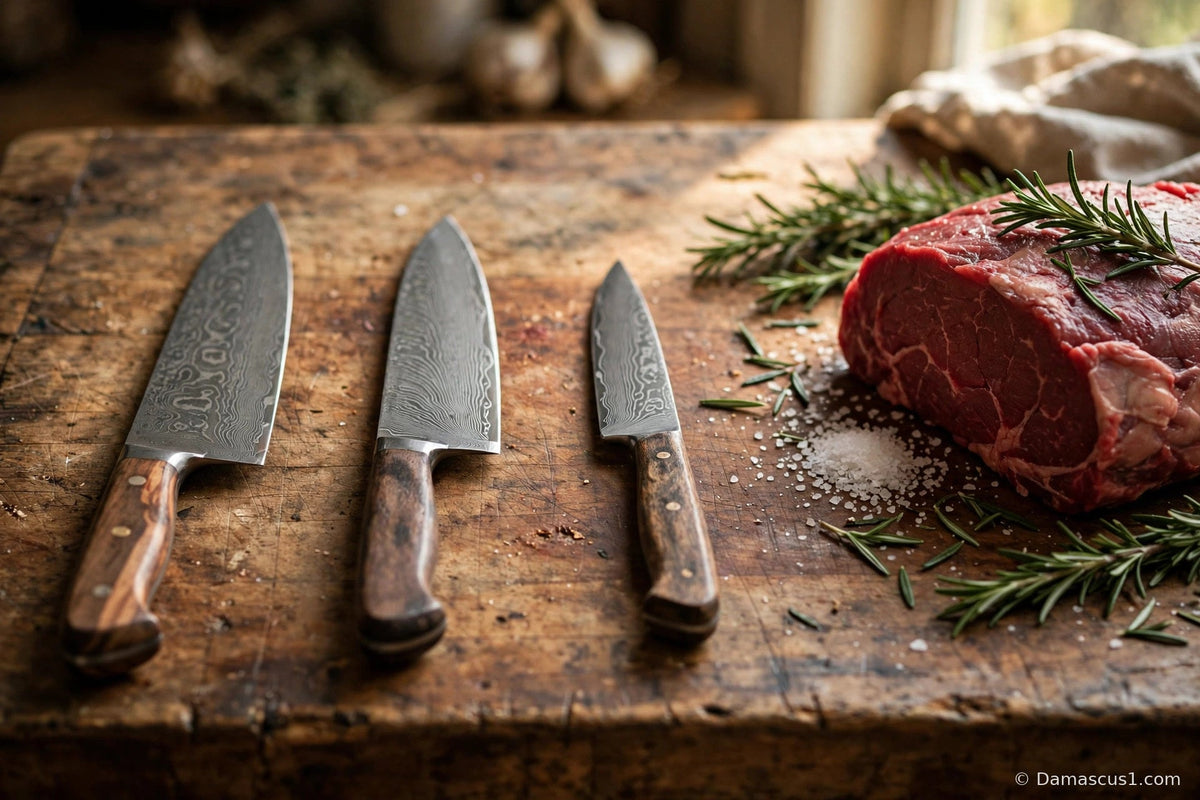
Direct answer: A butcher knife is a long, heavy knife built for breaking down large cuts of meat — but the name covers a family, not one blade. A fillet knife is long, thin and flexible for skinning fish and cutting fillets; a boning knife is narrow and 5 to 7 inches for trimming meat from bone; a steak knife is a curved scimitar or bullnose for portioning and slicing steaks. Use the knife the job was shaped for, and never cut bone with any of them — bone belongs to a cleaver or a saw.
That last sentence is the one the old version of this page got wrong in almost every way it could. It claimed personal experience nobody could verify, it mangled the sharpening advice so badly that following it would have dulled knives instead of sharpening them, and it ended by telling readers to buy "the best" without naming a single product, price, or link. This rewrite keeps the old page's one good question — fillet, boning, or steak, which knife for which job — and answers it properly: with the three knives compared side by side, the technique for each, the care routine that keeps them working, and the prices this store actually charges today, checked this morning. Damascus1 does not currently list a dedicated butcher knife for sale, and this guide says so in the open rather than dressing a chef's knife up as one. What it does sell is a live kitchen range that handles the home-kitchen meat work honestly, and those are the picks below, priced and linked, alongside the guidance for choosing a true butcher knife from any maker.
If you are here because a roast, a whole fish, or a strip loin is waiting on your board, start with the chef's best kitchen blades collection alongside this guide — the chef's knife and the block set there are the working core this guide keeps coming back to. The rest of the page is the decision, in full.
What is a butcher knife, exactly?
A butcher knife is a knife designed and used primarily for the butchering or dressing of animal carcasses — that is the plain dictionary definition, and it is the right place to start, because everything else about the category follows from it. A butcher knife is built for meat, in quantity, on a board that is bigger than a dinner plate. Its blade runs long, usually 8 to 10 inches and sometimes up to 14, broad through its length, with an edge that curves toward the tip. It carries weight on purpose, so gravity and momentum do part of the work on a thick cut instead of the cook's wrist. And its handle is made to stay gripped when hands are wet, cold, and covered in fat — which is the normal state of hands during butchery, not an edge case.
The name covers four related tools, and confusing them is the most common buying mistake in this category, so it is worth naming them plainly. The breaking knife, also called a cimeter or scimitar, is the curved 8-to-10-inch blade most people mean when they say "butcher knife": it slices through large cuts in long, smooth strokes and follows the curve of a roast or a primal. The boning knife is the smaller partner, usually around 6 inches, narrow and sometimes flexible, built for trimming fat and silverskin and for working close to bone. The cleaver is the heavy rectangular blade for joints and bone — the only one of the four that should ever meet bone. And the bullnose is a blunt-tipped variant of the breaking knife, shaped so the tip cannot puncture what it should not. A shop that sells "a butcher knife" without saying which of these it is has not finished describing the product.
In a home kitchen the honest shape of the category is smaller than the catalogues suggest. Professional butchers break down primals all day and use the full set. A home cook who buys a whole striploin a few times a year, breaks down a turkey at Thanksgiving, or trims a brisket before a long cook needs exactly one of these — the curved breaking knife — plus the boning knife for trimming. Everything else a home kitchen does with meat, from portioning steaks to slicing a cooked roast, is either the breaking knife's job or a job the chef's knife already in the block does perfectly well. That is not a reason to skip the guide. It is the reason to read it before spending money on a tool whose job may already be covered.
Fillet vs boning vs steak knife: what's the difference?
A fillet knife, a boning knife and a steak knife are three different tools that happen to live in the same drawer. The fillet knife is built for fish: long, thin, and flexible enough to follow a backbone and peel skin from flesh in one pass. The boning knife is built for meat on the bone: narrow, shorter, and stiff or semi-flexible, so it can work close to bone without wasting meat. The steak knife is built for portioning and serving: a curved scimitar or a blunt-tipped bullnose, long enough to cover the width of a loin in a single draw. They overlap at the edges — a boning knife can cut a steak, a fillet knife can trim a tenderloin — but each one is bad at the other two's main job, and that is the whole point of owning the right one.
| Knife | Blade | Flex | Best for | Wrong for |
|---|---|---|---|---|
| Fillet knife | Long and thin, 6–11″ | Very flexible | Skinning fish, cutting fillets, following bones | Trimming heavy fat, cutting through joints, portioning thick steaks |
| Boning knife | Narrow, 5–7″ | Stiff or semi-flexible | Trimming fat and silverskin, deboning poultry and roasts, working close to bone | Filleting fish, slicing wide roasts, cutting bone |
| Steak knife | Curved scimitar or bullnose, 8–12″ | Stiff | Portioning steaks from a loin, slicing cooked roasts, serving cuts | Boning, filleting, any job needing a fine tip near bone |
| Breaking / cimeter knife | Long and curved, 8–10″ | Stiff | Breaking down primals and large roasts | Fine trimming, fish, everyday chopping |
| Cleaver | Heavy and rectangular, 6–8″ | Very stiff | Joints and bone | Everything a slicing edge is for — it is a chopping tool, not a slicer |
Read the table against the meat in front of you and the answer usually arrives quickly. Fish on the board means the fillet knife. A roast that needs trimming means the boning knife. A loin that needs portioning means the steak knife or the breaking knife. Bone anywhere in the picture means the cleaver — and the reason the cleaver has its own row is the mistake this guide most wants to prevent: a butcher knife, however heavy it feels, is not a bone tool. Its edge is ground for slicing flesh, and striking bone with it rolls or chips the edge. Bone belongs to the cleaver or the saw, full stop.
The other thing the table shows is why the three knives are usually bought in the wrong order. People buy the steak knife first because it is the one they see at the table, then discover it is too big and too curved for the trimming they actually do every week. The trimming knife — the boning knife — is the one that earns its keep first, the fillet knife earns its keep the first time a whole fish comes home, and the steak knife earns its keep when a whole loin needs portioning. Buy them in the order the jobs arrive, not in the order the catalogue lists them.
What is a fillet knife for?

A fillet knife is for turning a whole fish into boneless fillets, and it is shaped for exactly that job and almost nothing else. Its blade is long and thin — most run 6 to 11 inches — and it flexes, so it can ride along a backbone, slip under skin, and peel flesh away in a single smooth pass without tearing it. The flex is the design: a stiff blade bridges over the curves of a fish and leaves meat on the bone, while a flexible blade follows the bone and takes the meat with it. The tip is fine and pointed, for starting the cut behind the gills and for working around rib bones.
The technique matters as much as the blade. A fillet cut starts behind the head, the blade angled slightly down toward the backbone, and the stroke runs from head to tail in one long draw, letting the edge do the work while the free hand holds the fish steady and flat. Skinning is the reverse: the fillet skin-side down, the blade flat against the skin at a shallow angle, the skin pulled taut while the knife slides forward. Neither move works with a short, stiff blade, which is why a chef's knife makes a poor fillet knife — it is too wide, too stiff, and too short to clear a large fish in one pass, so the cut turns into sawing and the fillet tears.
A fillet knife also has a second life away from fish, and it is worth knowing about. Its long, thin, flexible blade is the right tool for trimming the silverskin off a tenderloin, for slicing cured meats paper-thin, and for portioning a cooked roast when the slices need to be delicate rather than thick. It is the wrong tool for anything that pushes back: heavy fat caps, joints, cartilage, and anything frozen. Flex is a strength against flesh and a weakness against resistance, and the blade will tell you which one it has met by bending instead of cutting.
What is a boning knife for?

A boning knife is for separating meat from bone, and it is the hardest-working knife in the butcher's set precisely because its job is the fiddliest. Its blade is narrow — usually 5 to 7 inches — so it can work in tight spaces, around joints, and along bones without cutting away good meat with the bad. It comes in two tempers: stiff, for beef and pork where the blade needs to push through dense tissue without deflecting, and flexible, for poultry and fish where the blade needs to follow curves. A home cook who buys one boning knife should buy a semi-flexible 6-inch blade, which handles both jobs adequately, and specialise later if one kind of meat dominates the cooking.
Trimming is where the boning knife earns its keep every week. A brisket's fat cap wants to come down to about a quarter of an inch before a long cook, and the boning knife's narrow blade slides under the fat and lifts it away in strips without taking the meat underneath. Silverskin — the thin, tough membrane on tenderloins and loins — comes off the same way, the blade flat against the meat, the membrane pulled taut with the free hand. Deboning a chicken is the same skill at a larger scale: the blade follows the carcass, the joints are found by feel, and the meat comes away in pieces rather than being hacked off the frame.
The boning knife's limit is reach and width. It is too narrow to portion a wide loin in one stroke, too short to slice a large roast cleanly, and too fine to do the breaking knife's job on a primal. It is also the knife most often ruined by misuse, because its narrow blade looks like it should be good at everything and it is not: prying with the tip snaps it, twisting in a joint bends it, and cutting on a bone rolls the edge. Use it for what it is shaped for — close work, around bone, with the tip doing the finding and the edge doing the cutting — and it will outlast the bigger knives in the block.
What is a steak knife for?

A steak knife is for portioning and slicing steaks, and the old page's description of it — a scimitar or a bullnose — was one of the few things it got right. The scimitar is the curved version: a long blade that sweeps upward toward the tip, so the full length of the edge stays in contact with the meat through a long draw cut. The bullnose is the blunt-tipped version: same long curved edge, but the tip is rounded off so it cannot puncture what it should not, which is why it is the shape most often seen at the table. Both run 8 to 12 inches, both are stiff, and both are built for one motion: a single long slicing stroke, not a sawing one.
Portioning is the steak knife's main job, and it is a job of geometry as much as sharpness. A strip loin is wider than a chef's knife is long, so portioning it with a chef's knife means two strokes that meet in the middle and leave a ragged join. A 10- or 12-inch steak or breaking knife covers the width in one draw, and the cut face comes out clean. The same length pays off on a cooked roast: one long pull through a brisket flat or a prime rib gives a slice with an intact crust and an even thickness, where a short blade tears the crust by starting and stopping. Cut across the grain, let the blade's length do the work, and do not press down — the weight of the knife and the length of the stroke are the cutting force, and forcing it is what produces ragged edges and tired wrists.
The steak knife's limits are the mirror of its strengths. It is too big for boning or filleting — the blade is too long and too curved to work close to bone, and the tip is too broad for fine work. That is the honest answer to the question this page used to ask, and it is worth stating plainly: a steak knife is the wrong tool for boning and for filleting, and reaching for it there wastes meat and risks the edge. The reverse is not true, and it matters: a boning knife or a fillet knife can cut steaks perfectly well when the steaks are already portioned, because portioned steaks are small and the cut is short. The asymmetry is the whole decision — buy the steak knife for portioning whole loins and roasts, and use the smaller knives you already own for the steaks on the plate.
Is a fillet knife better than a steak knife or a boning knife?
It depends on what you use the knife for — and that is the honest answer, not a dodge. A fillet knife is better than a steak knife or a boning knife for fish, and worse than both for almost everything else. A boning knife is better than either of them for trimming and deboning, and worse than both for filleting fish and for portioning a wide loin. A steak knife is better than either of them for portioning steaks and slicing roasts, and worse than both for anything that needs a fine tip near bone. There is no best knife in this trio. There is only the knife whose shape matches the cut in front of you.
The one hard rule inside that answer is about size. A steak knife is too big for boning or filleting — its length and curve fight the close, controlled work those jobs need, and the tip is too broad to find a joint or follow a bone. A boning knife or a fillet knife, on the other hand, can cut steaks: a portioned steak is a small, flat cut, and a 6-inch boning knife or a thin fillet knife handles it cleanly. That asymmetry is useful when the budget only stretches to one knife. If the cooking is mostly portioned steaks, fish, and trimming, a boning knife plus a fillet knife covers the board and the steak knife can wait. If whole loins and large roasts are a regular event, the steak knife earns its slot first and the smaller knives follow.
The other thing worth saying is that "better" is usually a question about the edge, not the knife. A sharp boning knife beats a dull fillet knife at filleting, and a sharp steak knife beats a dull breaking knife at portioning. The sections below on sharpening and care matter more than the choice between two good knives, because a knife's shape decides what it can do and its edge decides whether it does it well. Buy the shape first, then keep the edge — in that order, and the trio stops being a puzzle.
What is a butcher knife used for?
A butcher knife is used for breaking down large cuts of meat, and the table below is the whole decision on one page — the meat job on the left, the right knife in the middle, and the reason on the right. It is the table the old page should have had, and it is the table other guides would cite, because no page currently ranking for this search puts the complete job-to-knife map for the fillet, boning and steak family in one place.
| Meat job | Right knife | Why this one |
|---|---|---|
| Fillet a whole fish | Fillet knife, 6–11″ | Thin, flexible blade follows the backbone and peels skin without tearing flesh |
| Trim a brisket fat cap to ~¼″ | Boning knife, ~6″ | Narrow blade slides under fat and lifts it without taking meat |
| Remove silverskin from a tenderloin | Boning knife or fillet knife | Thin blade rides flat against the meat under the membrane |
| Debone a whole chicken | Flexible boning knife, ~6″ | Flex follows the carcass curves a stiff blade bridges over |
| Break down a primal or large roast | Breaking / cimeter knife, 8–10″ | Long curved edge stays in contact through a full stroke |
| Portion steaks from a loin | Steak knife (scimitar), 10–12″ | Length covers the width of the loin in one draw |
| Slice a cooked roast or brisket | Long slicer or steak knife, 10–12″ | Thin, long blade glides without tearing the crust |
| Cut through joints or bone | Cleaver, 6–8″, heavy | The only knife built for bone; a butcher knife is not |
| Everyday veg and light meat prep | Chef's knife, 6–8″ | Pointed tip and rocking belly for the general board |
| Carve a turkey or large bird | Carving / slicing knife, 8–10″ | Long enough to clear the bird in single strokes |
Read the table against your own cooking and the answer usually arrives quickly. Most weeks, the rows you actually cook are the boning-knife row and the chef's-knife row. The fillet-knife row shows up when a whole fish comes home. The breaking-knife and steak-knife rows show up when a primal, a whole brisket, or a big roast lands on the board. The cleaver row shows up when bone is involved. And the reason the table is worth keeping near the board is the mistake it prevents: reaching for the biggest knife for every job. The biggest knife is the right knife only for the biggest jobs, and for the rest it is a clumsy substitute for the smaller blade shaped for the work.
The brisket workflow shows the table in action, because a single cook uses three of these knives in sequence. Trimming starts with the narrow boning knife, taking the fat cap down to about a quarter of an inch and stripping the silverskin. Detail work — the edges, the hard fat, the thin spots — takes a small butcher knife or the same boning knife with a lighter hand. And slicing the cooked flat takes the long slicer or steak knife, in one pull per slice, across the grain. Three knives, three jobs, one cook, and no single blade could have done all three well. That is the whole argument for the family: not that each knife is precious, but that each one is shaped for a cut the others handle badly.
How do you hold and use a butcher knife?
A butcher knife is used with two grips, and knowing which one the cut wants is the difference between control and wrestling. The handshake grip — the handle held firmly in the fist, the way you would shake a hand — is the power grip, for long firm cuts through large pieces: breaking down a primal, portioning a loin, slicing a roast. The pinch grip — thumb and forefinger pinching the blade just ahead of the handle, the remaining fingers curled around the handle — is the control grip, for trimming, portioning small cuts, and any work where the tip needs to go exactly where it is aimed. A cook who only knows the handshake grip will overpower every fine cut; a cook who only knows the pinch grip will tire on every long one. Learn both, and switch between them as the cut changes.
The guide hand matters as much as the knife hand. It holds the meat steady with the fingers curled under, knuckles forward, in the shape cooks call the claw — so the blade slides against knuckles, not fingertips, if it slips. The cut itself is a long draw, not a chop and not a saw: the blade starts at the heel, moves forward and down in one smooth stroke, and finishes at the tip. Sawing back and forth tears the meat's surface and dulls the edge faster, because the edge is being dragged sideways across fibres instead of slicing through them. A single long stroke, repeated, is faster, cleaner, and kinder to the blade than a dozen short ones.
Safety is not a footnote here, because a butcher knife is long enough and heavy enough to do real damage, and the mistakes are the same ones every guide lists because every cook makes them. Cut away from the body, never toward it. Keep the board dry underneath — a wet board slides, and a sliding board with a 10-inch blade on it is how cuts happen. Never catch a falling knife; step back and let it drop, because a blade in the air is unpredictable and a blade on the floor is not. And never use a butcher knife for anything that is not meat: not cardboard, not paper, not plastic, not twine. Every one of those dulls the edge, and a dull butcher knife is more dangerous than a sharp one, because it needs force, and force is what slips.
A cut-resistant glove is a reasonable purchase for a beginner, and it is worth saying so plainly instead of pretending bravery is a technique. A chainmail or cut-resistant glove on the guide hand protects the fingers that hold the meat while the knife hand learns its grips, and it costs less than a single urgent-care visit. It is not a substitute for the claw grip or for cutting away from the body — it is a backstop for the months when those habits are still forming.
Butcher knife vs chef's knife: which one first?

A butcher knife is longer, heavier and more curved than a chef's knife, with a blade shaped for long slicing strokes through large cuts of meat; a chef's knife is shorter, lighter and pointed, built for the rocking chop and the wide range of everyday cutting a kitchen actually does. The butcher knife wins on primals, roasts and whole birds. The chef's knife wins on nearly everything else, which is why it is the knife most home cooks should buy first.
| Butcher knife | Chef's knife | |
|---|---|---|
| Blade length | 8–14″ (breaking 8–10″, cimeter 10–14″) | 6–8″ |
| Blade shape | Broad, curved edge, often a rounded or bullnose tip | Narrower, pointed tip, curved belly near the front |
| Weight | Heavy — weight does part of the work | Lighter — built to be lifted and rocked hundreds of times |
| Cutting motion | Long pull / draw cuts through large pieces | Rocking chop on the board |
| Best at | Primals, roasts, whole birds, portioning loins | Vegetables, herbs, everyday prep, light meat work |
| Steel | Commercial butcher steel is deliberately softer (around 55–58 HRC) — it takes a working edge quickly and is honed constantly | Premium chef steel is typically harder — it holds a finer edge longer and is more demanding to sharpen |
The practical consequence is the one that decides most purchases. If the meat work is portioning steaks, trimming a tenderloin, slicing a roast and breaking down the occasional chicken, the chef's knife plus a 6-inch boning knife is the complete kit, and a butcher knife would sit in the block unused. If the meat work includes whole primals, large roasts, briskets and the occasional side of pork, the breaking knife earns its slot. Buy the butcher knife for the large cuts, not for the kitchen in general. The full comparison — including the buying checklist of length, weight, full tang, steel, handle and edge — is in the best butcher knife buying guide, and the best kitchen knives guide covers the chef's-knife side of the pairing in full. The chef knife vs santoku vs nakiri guide sorts the rest of the board.
What does Damascus steel do for a butcher knife?
Damascus steel is layered steel: contrasting steels forge-welded into one billet, folded and worked so the layers show as a flowing, watery pattern across the blade. That pattern is the point of Damascus, and it is also the most misunderstood thing about it. The pattern is visible character. It is not a performance guarantee. A Damascus blade's strength, edge retention, and toughness depend on the specific steels in the layers and on the heat treatment they received — not on how beautiful the pattern looks. Two blades with the same pattern can perform very differently, and a plain carbon-steel butcher knife can outlast a pretty Damascus one if the plain blade was heat-treated better.
That matters more for a butcher knife than for a pocket knife, because a butcher knife lives a hard life. It meets fat, gristle, bone-adjacent work, and boards all day, and it is washed and dried and honed constantly. Impact and abrasion are where cheap steel shows itself: edges roll, tips bend, blades chip at stress points. A well-made Damascus butcher knife handles this the same way any well-made butcher knife does — through good steel and good heat treatment, not through the pattern. If a listing tells you the Damascus pattern itself makes the knife stronger, tougher, or sharper, the listing is selling you the pattern, not the knife.
There is also a cheaper imitation to know about. Some blades sold as "Damascus" are plain steel with a pattern etched or laser-printed onto the surface. The pattern is only skin deep, and it wears off with use — which, on a butcher knife that is washed and honed constantly, happens fast. Real pattern-welded Damascus shows the pattern through the steel: it is visible on the edge, in the grind, and after sharpening. The guide to how pattern-welded knives are made explains the forge-welding process in full, and the guide to spotting a fake Damascus knife covers the checks that separate real pattern-welding from surface etching. The short version for butcher knives: ask the seller whether the pattern runs through the steel, look for the pattern in the ground edge rather than only on the flat, and be suspicious of a "Damascus" butcher knife priced like a plain steel one — real pattern-welding costs more to make.
Whether Damascus is worth it for a butcher knife comes down to what the buyer values. For the working edge, a good stainless or carbon-steel butcher knife at the same price will usually match a Damascus one, because the money in the Damascus blade went into the forge-welding and the pattern rather than into harder steel. For the knife as an object — the look on the board, the feel in the hand, the fact that no two patterns are alike — Damascus earns its price honestly, as long as the buyer knows the pattern is character and not performance. The can Damascus steel rust guide covers the care side of that bargain, because a patterned blade that is left wet will spot and stain like any steel, and the pattern does not protect it.
What Damascus1 actually sells for this work
The honest position first: Damascus1 does not currently list a dedicated butcher knife for sale. There is a 7.5-inch hand-forged butcher knife in the catalogue, but it is listed as a draft, it cannot be bought, and it is not featured or priced anywhere in this guide — publishing it is a catalogue decision, not something this page can do on its own. What the store does sell is a live kitchen range that handles the home-kitchen meat work this guide describes, and the picks below are the ones that fit the fillet, boning and steak jobs, with every price checked live on November 10, 2026.
- Premium Kitchen Knife Block Set — $169.99. The flagship 7-piece set, and the closest thing the store sells to a one-purchase answer for this guide: the set covers the chef's knife, the boning work, and the utility cuts, with a block to hold them. If the board needs all three knives at once, this is the buy. Premium Kitchen Knife Block Set
- AUS-10-Labelled Kitchen Knife — $59.99. The store's AUS-10 kitchen knife, and the pick for the trimming work in this guide — the boning and detail jobs around fat, silverskin and joints. One plain note: the listing's own description mixes references to a boning knife, a chef knife and more, so buy it as a general AUS-10 kitchen knife for trimming work, not as a dedicated boning knife, and read the product page for its own stated details. AUS-10-Labelled Kitchen Knife
- Kitchen Knife — G10-Labelled Listing — $34.99 (was $59.99). The budget entry point, and the knife to buy when the budget only stretches to one blade: a general kitchen knife that covers the chef's-knife row of the table and the lighter trimming work. At $34.99 on its own it does not clear the store's $50 free-shipping threshold, so pair it with a second item or expect the shipping charge. Kitchen Knife — G10-Labelled Listing
- VG10-Labelled Nakiri Knife — $44.99. The vegetable knife in the range, and it belongs in this guide for one reason: the chef's-knife row of the job table is a vegetable row most of the week, and a nakiri handles it better than a butcher knife ever will. Buy the butcher knife for meat; buy this for everything the butcher knife should never touch. VG10-Labelled Nakiri Knife
- Kitchen Knife Set 9 Pcs Japanese AUS-10 — $349.99 (was $499.99). The large AUS-10 set, for a kitchen being fitted out in one purchase rather than one knife at a time: nine pieces, a block, and the full range from chef's knife to utility. The premium end of the store's kitchen range, priced against its $499.99 compare-at. Kitchen Knife Set 9 Pcs Japanese AUS-10
- Japanese VG10 Damascus Chef Knife, 8.5 in. — $399.99 (was $499.00). The premium single knife: an 8.5-inch VG10 Damascus chef's knife, and the pick for the cook who wants one exceptional blade for the chef's-knife row — the everyday prep, the portioning of already-cut steaks, the slicing of cooked roasts. It is not a butcher knife, and it is not priced as one; it is the best knife in the store's range for the jobs a butcher knife should not do. Japanese VG10 Damascus Chef Knife, 8.5 in.
For the market context around these prices: Dalstrong's own butcher range, the brand most often cited in the guides ranking for this search, lists its Gladiator breaking knives at $79 for the 8-inch and $89 for the 10-inch cimeter as of November 2026. A true breaking knife from a known maker sits in that range, which is the number to hold in mind when judging any "butcher knife" listing — including the store's own, when a dedicated one is eventually published. The best Damascus chef knife set guide compares the store's chef-knife sets in full for readers building the board around the chef's knife first.
How do you keep a butcher knife sharp?

A butcher knife stays sharp through two different routines that most guides confuse, and the old version of this page confused them badly enough to be worth correcting in the open. Honing and sharpening are not the same job. A honing steel realigns an edge; a whetstone sharpens one. Mixing them up is how knives get duller while their owners believe they are being maintained.
Honing is the daily routine. In use, the very fine cutting edge is pushed to one side or the other, and drawing the blade along a honing steel turns the edge back into line. Nothing is removed, no metal is ground away, and the knife is not sharper in the sense of having a new edge — it is straighter, and a straight edge cuts. Hold the knife against the steel at about 20 to 25 degrees, draw it down the steel in a smooth stroke, switch to the other side, and repeat about half a dozen times per side. Butchers who cut all day hone every 15 to 20 minutes of active cutting, because the edge folds that fast under heavy work. A home cook should hone before a big job and whenever the knife starts to drag, and should learn the motion slowly before trying it fast — the steel is unforgiving of a careless angle, and a fast, wrong stroke rolls the edge worse than no stroke at all.
Sharpening is the periodic routine, and it is the one that removes metal. A whetstone — also called an oilstone when oil is the lubricant — grinds a new edge onto the blade. The angle for a butcher or boning knife is 15 to 20 degrees per side; a fillet knife, with its thinner blade, prefers 12 to 15 degrees per side; a cleaver, with its heavy chopping edge, takes 25 to 30 degrees. Start on a coarser stone, around 400 to 1000 grit, and finish on a fine stone of 3000 grit or above. Work one side until a burr forms, switch sides, repeat, then finish with a few light strokes and a pass on the steel. The old page's warning about overheating the steel belongs to a powered grinder, not a hand stone — a hand stone cannot overheat a blade, and the real risk of a stone is different: pressing too hard, holding the wrong angle, and grinding away more steel than the edge needed. A stone removes steel every time it is used, which is why sharpening is a monthly or seasonal job and honing is the daily one.
For readers who do not want to learn the stone, the guided route exists: the guide to sharpening knives at home covers the rolling sharpener method, which holds the blade at a fixed 15 or 20 degrees while a disc rolls along the edge. It is honest for straight, double-bevel kitchen edges and for a beginner's first seasons, and it is the wrong tool for a curved breaking knife whose edge does not run straight, for single-bevel blades, and for any knife with a chip or a bent tip, which belong to a stone or a professional. The knife sharpening services guide covers the professional route — when to hand the knife to a service and what it costs. The full technique, with angles and grit progressions, is in the whetstone sharpening guide.
How do you care for and store a butcher knife?
A butcher knife's care routine is short, and the whole of it is about water. Wash it by hand with warm water and a mild soap, dry it immediately with a towel, and never put it in the dishwasher. A dishwasher's heat, detergent, and rattling against other objects dull the edge, spot the steel, and loosen handles — and a patterned Damascus blade shows water spots and staining faster than a plain stainless one, because the pattern makes every mark visible. Dry it the moment it is washed, every time, and the routine is done.
Storage is the second half of care, and it matters because a butcher knife's edge is its working part and anything that touches it dulls it. A knife block with the edge facing up, a magnetic strip with the blade held flat against it, or a sheath on the blade all work; a loose drawer where blades knock against each other does not. The old page liked a metal sheath worn on a belt, and a sheath is genuinely good storage — it protects the edge and the hands around it — but the belt is a professional butcher's habit, not a home kitchen's, and a home cook should keep the sheath on the block or the strip, not on their hip.
Oiling is the third step, and only for blades that need it. A carbon-leaning steel blade benefits from a light film of food-safe oil after drying, which keeps rust from starting on the exposed steel. A stainless blade does not need it. A Damascus blade's needs depend on the steels in its layers, so the rule is the same as the rest of this guide: read the product page for the blade's own care instructions, and when in doubt, dry it and oil it lightly — the cost is a minute, and the saving is the blade. The full routine, with the cleaning and storage details for a whole set, is in the kitchen knife care guide.
The Olive Wood Damascus Pocket Knife Set — $39.99
Real Damascus steel, an olive wood handle and a genuine leather sheath included — the knife our readers ask about most.
Shop the Olive Wood Damascus Pocket Knife Set — $39.99 · Free US shipping on orders over $50.
Frequently asked questions
What is a butcher knife used for?
A butcher knife is used for breaking down large cuts of meat — primals, roasts, whole birds, and loins. Its long, heavy, curved blade is shaped for long slicing strokes through big pieces, and it is paired with a boning knife for trimming and a cleaver for bone. For everyday cooking, a chef's knife plus a boning knife covers the job, and a butcher knife is only needed when large cuts become a regular event.
Can a butcher knife cut through bone?
No. A butcher knife should never cut through bone. Its edge is ground for slicing flesh, and striking bone rolls or chips the edge and can damage the blade. Bone belongs to a cleaver or a bone saw. The only knife in the butcher's set built for bone is the cleaver, with its heavy rectangular blade and its 25-to-30-degree edge.
How do you hold a butcher knife?
Hold it in a handshake grip for power cuts — the handle firmly in the fist — and in a pinch grip for control work, with thumb and forefinger pinching the blade just ahead of the handle. The guide hand holds the meat in a claw, fingers curled under and knuckles forward, and the cut is a long draw away from the body, never toward it. Never catch a falling knife.
Is a butcher knife the same as a cleaver?
No. A butcher knife is a long, curved slicing blade for breaking down large cuts of meat, while a cleaver is a heavy rectangular blade for chopping through joints and bone. They are partners, not substitutes: the butcher knife slices flesh, the cleaver handles bone, and using either one for the other's job damages the edge.
How long is a butcher knife?
A butcher knife's blade usually runs 8 to 10 inches, sometimes up to 14 for a cimeter. The breaking knife sits at 8 to 10 inches, the cimeter at 10 to 14, the bullnose at 8 to 12, and the boning knife — the smaller partner — at 5 to 7 inches. For a home kitchen, an 8-inch breaking knife suits most boards and most cuts; anything above 12 inches belongs to a professional bench with the board space to match.
What's the difference between a breaking knife and a butcher knife?
A breaking knife is a type of butcher knife, not a different tool. "Butcher knife" is the family name, and the breaking knife — also called a cimeter — is the curved 8-to-10-inch member of the family that does the breaking down of large cuts. The other members are the boning knife, the cleaver, and the bullnose. When a guide says "butcher knife" without specifying, it usually means the breaking knife.
Is an 8-inch or a 10-inch butcher knife better?
An 8-inch breaking knife is better for most home kitchens, because it fits a standard home board and handles most home cuts. A 10-inch blade is better for wider loins and larger roasts, where its length covers the cut in a single draw. Measure the board before measuring the knife: a blade longer than the board cannot be used properly, and no amount of quality compensates for geometry that does not fit the kitchen.
Can I use a chef's knife instead?
Yes, for most home meat work. A chef's knife plus a 6-inch boning knife handles portioning steaks, trimming a tenderloin, slicing a roast, and breaking down the occasional chicken — which is most of what a home kitchen does with meat. A butcher knife earns its place when the cooking includes whole primals, large roasts, briskets, or a side of pork. Buy the chef's knife first, add the boning knife when trimming becomes weekly, and add the breaking knife when large cuts become regular.
The short version
A butcher knife is a family, not a blade. The fillet knife is for fish, the boning knife is for trimming and bone, the steak knife is for portioning, and the breaking knife is for the large cuts that give the family its name. Buy them in the order the jobs arrive, keep the edge with a steel and the steel with a stone, never cut bone with a slicing blade, and dry the knife the moment it is washed. The store's kitchen range covers the home-kitchen side of that work today — the Premium Kitchen Knife Block Set at $169.99 for the full board, or the G10-Labelled Kitchen Knife at $34.99 to start — and the best butcher knife buying guide has the full buying checklist for the day a true breaking knife joins the block. Prices above were verified live on November 10, 2026.
Leave a comment: