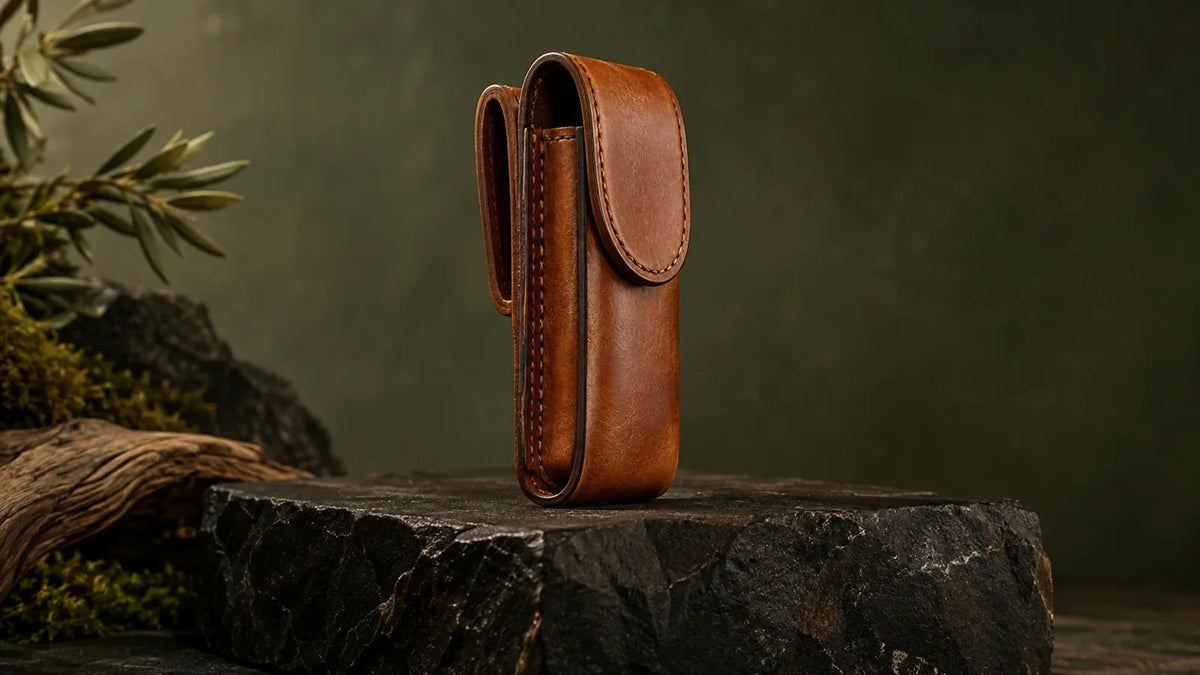
A custom leather sheath begins with a fit problem, not a colour choice. You have a folding knife you like, but the way you carry or store it does not quite suit you. Perhaps it shares a pocket with keys. Perhaps the supplied pouch feels bulky. Perhaps you want a considered gift with a matching accessory. A well-specified custom project can address those needs, provided the maker confirms what can actually be made.
The useful first step is to describe the knife, your normal clothing and the way you expect to use the pouch. That description gives the maker something concrete to assess. Asking for a beautiful sheath without those details leaves the most important decisions unresolved. This guide explains how to turn an attractive idea into a clear enquiry, compare a quotation and avoid buying an accessory whose appearance is more convincing than its compatibility.
The design photographs accompanying this article are editorial concepts. They are not evidence of stock, a completed customer order or a guaranteed Damascus1 service specification. Use the custom sheath enquiry to discuss a project. Materials, fit, price and lead time need confirmation before an order is placed.
The quick answer: what information should you send?
Send the exact knife model or product link, its closed dimensions with units, photographs showing its overall shape and protruding parts, and the belt or storage arrangement you intend to use. State whether a clip will remain fitted. Describe your preferred orientation, colour and closure, but let the maker explain which choices are appropriate. Ask what additional measurements or reference material are needed before approving a design.
Your first message does not need to be a technical drawing. It does need to distinguish a measurement from an estimate and a requirement from a preference. “Must fit my existing belt” is a requirement. “I like dark brown” is a preference unless matching a particular item is essential. Separating those two kinds of information makes it easier for the maker to propose an honest solution and explain any compromise.
1. Decide what the sheath is meant to improve
Write one sentence describing the problem with your current arrangement. For example: “I want to keep my closed folding knife separate from loose objects in my everyday bag.” That is a different project from “I want a belt pouch that suits the belt I wear while camping.” The first may prioritize compact protection and a simple opening. The second may require careful discussion of attachment, position and access.
Avoid combining every possible use into one design brief. A presentation pouch, a pocket organizer and an outdoor belt sheath can have different priorities. If you expect one item to serve all three purposes, tell the maker and ask where compromises arise. A custom order is most useful when it solves your actual problem; adding more decorative or mechanical features does not automatically make the result better.
2. Identify the exact knife and variant
Product names are helpful, but they may cover several sizes or handle variations. Include the product URL, selected variant and any model reference on the packaging. If the knife has been modified, say so. A replacement clip or handle can change the shape that a sheath must accommodate. Do not assume that the maker's experience with a similarly named knife establishes compatibility with yours.
When buying the knife and sheath together, settle the knife choice first. Otherwise, a change of model can invalidate the initial fit discussion. If the knife has not arrived, ask whether the maker can work from an established pattern or needs measurements from your actual item. Treat an answer based on a known pattern differently from an estimate based on a photograph of a broadly similar product.
3. Measure the closed shape, using the maker's method
A folding-knife pouch is normally discussed around the closed tool, not the blade extended for display. Ask which points the maker wants measured and which units they prefer. A useful starting record includes overall closed length, the widest part and the greatest thickness, but that is not a universal manufacturing specification. Curves, bolsters, clips and other projections can make a simple rectangular measurement incomplete.
Record your numbers clearly and repeat the measurement if something seems inconsistent. Do not add your own allowance for leather thickness or a tight fit unless the maker requests it; those are design decisions the maker should control. If you are uncertain about a measurement, mark it as uncertain. A candid question before production is far easier to resolve than a confidently written but inaccurate dimension afterward.

4. Make photographs useful rather than dramatic
A well-lit photograph against a plain background helps communicate shape. Include the complete closed knife and the side carrying a clip or other projection. Ask whether the maker wants a scale reference and how it should be positioned. Perspective can distort apparent size, so photographs should support measurements rather than replace them. The most useful image may be less stylish than a product banner but more informative.
Remove unrelated objects and personal details from the background. Name files so their purpose is clear, such as “closed side with clip” or “handle end.” If the enquiry form does not accept uploads, ask how to send them after the first response. Avoid scattering measurements and photographs across several channels without an order or enquiry reference; the maker needs to know which information belongs to the current design.
5. Describe clips and other protrusions explicitly
A pocket clip can influence the space a sheath needs and the way the knife enters it. Tell the maker whether you want the clip retained, removed or left undecided. Do not remove components simply to make an accessory fit unless the knife manufacturer permits the change and you understand the implications. An attractive pouch is not a reason to improvise changes to a tool's assembly.
The same principle applies to lanyards, decorative attachments and unusual handle ends. Explain what will remain on the knife during normal use. If you sometimes attach a lanyard and sometimes do not, ask whether the proposed design accommodates both arrangements. The maker may recommend choosing one consistent configuration. That is useful information, even when it reduces the number of options you initially imagined.
6. Measure the belt you actually wear
A belt described as medium or standard does not give a maker a dependable fit specification. Measure the belt according to their instructions and include relevant thickness, not just width. If you alternate between a casual belt and a heavier outdoor belt, say so. A loop designed around one arrangement should not be assumed equally suitable for the other without confirmation.
Think about the clothing worn with that belt as well. Belt loops, pockets, jackets and seating can all affect how a pouch feels in daily life. You do not need to predict every movement, but you should describe the normal context honestly. A photograph of an accessory on a display belt tells you little about whether it will be comfortable with your own clothing and routine.
7. Choose orientation through practical questions
Horizontal and vertical layouts are design possibilities, not universal recommendations. Ask which orientations the maker can support for your knife and intended use. Consider the room available on the belt, how the pouch interacts with nearby pockets and whether clothing covers it. Check current rules separately for your destination and manner of carry; a custom accessory does not establish legal permission.
Describe your preference without presenting it as a completed engineering decision. The maker may explain that a different attachment or proportion would suit the knife better. Ask why, and compare that explanation with your original goal. If the proposed orientation solves a different problem from the one you actually have, pause the order and revise the brief instead of accepting a design simply because it looks impressive.
8. Discuss retention without inventing a test
Retention describes how the item stays in place, but a buyer should not invent a universal tightness standard from internet advice. Ask the maker how the design is intended to hold the closed knife and how they check the fit. Request instructions for inserting, removing and inspecting it. A sheath that is difficult to use is not automatically more secure, and a loose fit is not automatically harmless.
If a closure is proposed, ask how it interacts with the knife and what care it needs. Confirm whether the closure is part of the agreed design or an optional change. On delivery, follow the maker's acceptance instructions in a controlled setting. Do not test a questionable fit by carrying the knife in a situation where it could fall, open unexpectedly or create a hazard.
9. Choose leather by documented details
Words such as premium and luxury describe an impression unless the seller explains the material and construction behind them. Ask what leather is proposed, what finish it has and what care instructions accompany it. A dark colour or thick appearance in a photograph does not establish quality. It also does not tell you how the completed pouch will behave in your particular conditions.
You do not need to become a leather specialist to place a sensible order. Focus on information the maker can explain clearly: intended use, maintenance, expected variation and whether the chosen finish suits your preferences. If two material options differ in price, ask what practical difference the maker expects. Pay for a feature you understand rather than a label that sounds expensive but remains undefined.
10. Treat colour matching as a separate requirement
Brown leather can look warm, red, neutral or almost black under different lighting. Screens add another source of variation. If you want to match a belt, bag or gift box, tell the maker how exact that match needs to be. Ask whether a current sample photograph or physical sample is available. A broad colour name alone is not a promise of an exact match.
For many buyers, a coordinated family of colours is enough. For others, a mismatch would defeat the purpose of the gift. Make that distinction before production. Also ask how the finish is expected to change with use and which care products are suitable. A colour decision should include realistic expectations about variation, rather than relying entirely on the most polished image in a gallery.

11. Keep personalization readable and specific
If initials, a logo or another mark are important, provide the exact text and ask for a placement preview. Confirm spelling, capitalization and whether punctuation is included. Do not assume that a small mark shown on a concept image is available in the same form on the final item. The maker needs to confirm the technique, size and suitability for the selected leather.
Personalization can also change the order's return or alteration conditions. Ask about those terms before approving the proof. For a gift, check the recipient's preferred initials rather than guessing from a nickname or account name. A simple, correctly specified mark often communicates more care than an elaborate design whose details were not checked. Keep the approved version with the rest of the order record.
12. Read the quotation as a complete specification
A useful quotation should identify the knife, the agreed design, materials, attachment arrangement, personalization, price and expected lead time. It should also explain any shipping charges and what happens if the fit needs attention. If important details remain only in a casual message, ask for them to be included in the final written agreement. This protects clarity for both buyer and maker.
Compare quotations on the same basis. One may include personalization or delivery while another does not. One may be based on an existing pattern while another involves additional development. Those differences can explain price without proving that either option is better. The right question is whether the proposed work addresses your requirements and whether the terms are clear enough for you to make an informed decision.
13. Plan for timing before promising a gift
Custom work can involve a design discussion, material selection and production before dispatch. Ask for the current lead time for your specific request rather than relying on a general statement elsewhere on the website. Distinguish production time from shipping time. If you have a fixed date, state it early and ask whether the maker can commit to the necessary schedule.
Avoid promising the recipient a delivery date that the maker has not confirmed. A thoughtful alternative is to present the concept and involve the recipient in the final choices, if that suits the occasion. This can improve fit and preference matching while avoiding a rushed decision. Customization is most valuable when there is enough time to resolve questions, rather than when it becomes a race against an assumed deadline.
14. Do not ship a knife without an agreed process
Some makers work from measurements or established patterns; others may need the actual item. Ask which approach applies before sending anything. If shipment is requested, obtain clear instructions and confirm the responsibilities, delivery address and applicable shipping requirements. An enquiry form is not authorization to mail a knife, and a general contact address may not be the correct receiving location.
Keep a record of the item's condition and the agreed process if a shipment is arranged. Discuss what happens if a parcel is delayed or the project cannot proceed. These are ordinary practical questions, not an accusation that something will go wrong. Resolving them beforehand allows both sides to focus on the work instead of trying to reconstruct expectations after an unexpected event.
15. Inspect the completed order before regular use
When the sheath arrives, compare it with the agreed specification before treating it as part of your everyday routine. Check the colour, personalization, attachment and overall condition. Follow the maker's instructions for assessing fit with the correct closed knife. If the item does not appear to match the order or the fit seems uncertain, stop and contact the maker with clear photographs and the order reference.
Do not alter the sheath immediately to solve a problem you have not discussed. Cutting, stretching, soaking or applying an unfamiliar product can change the item and complicate an adjustment request. Explain what you observe without guessing at the cause. A description such as “the clip catches at the opening” gives the maker more useful information than simply saying the pouch feels wrong.
16. Ask for a care routine for both items
The knife and the sheath are different materials with potentially different care needs. Ask for instructions for each, including what to do after moisture exposure and how to store them between uses. Do not assume that a product suitable for leather is also suitable for a blade, or that a blade lubricant belongs on the outside of a pouch. Keep the instructions identifiable so they are easy to follow later.
For longer storage, ask specifically whether the knife should remain inside the leather. Conditions such as moisture and the actual blade material matter. A fitted pouch is not a substitute for cleaning, drying and inspection. If the sheath becomes damaged or its fit changes noticeably, seek advice before continuing to rely on it. Maintenance is part of the ownership decision, not an optional detail added after purchase.
17. A worked example: an everyday bag pouch
Imagine a buyer who owns one folding knife and carries it in a work bag. Their main concern is keeping it separate from keys and small equipment. They do not wear a suitable belt consistently, and they do not need a decorative display case. Their brief should emphasize the closed knife's dimensions, the available bag compartment and the desire for simple, secure storage rather than belt orientation.
In this hypothetical example, adding a large belt loop might solve a problem the buyer does not have while increasing bulk. The useful conversation is about the actual storage arrangement and how the item will be retrieved. The buyer can still choose an attractive colour and restrained personalization, but those choices follow the functional brief. This is how a custom accessory can feel considered without becoming unnecessarily complicated.

18. A worked example: a coordinated gift
Imagine a second buyer choosing a sheath to accompany a knife gift. They know the recipient likes warm brown leather, but they do not know the recipient's belt size or preferred carry position. Ordering immediately from a photograph would leave essential questions unanswered. A better approach is to confirm the knife first and decide whether the gift should be a storage pouch or a carry accessory.
If the recipient's participation is possible, the buyer can present a design direction and let the recipient choose the final fit details. If the gift must remain a surprise, the buyer should ask the maker what can be specified reliably with the information available. This example does not prove one design is universally best. It shows why honest limits are more useful than confident guesses about another person's routine.
19. Questions to resolve before you approve
Can the maker identify the exact knife and configuration? Are the measurements accepted, with units and reference points understood? Has the intended belt or storage arrangement been described? Are materials, colour, closure and personalization confirmed? Does the quotation distinguish included work from optional changes? Are timing, delivery and adjustment terms written clearly? If any answer is still uncertain, resolve it before treating the design as final.
These questions form a practical approval checklist, not a demand for unnecessary paperwork. A small project may be summarized in a concise message, provided it contains the important details. Save that message and the approved images together. When the order arrives, you can compare the result with the actual agreement instead of relying on memory or a collection of unrelated screenshots.
20. Choose the next step that matches your stage
If you have not chosen a knife, begin with the Damascus folding knife collection and compare the model details. If you already own one, record its identification and closed dimensions before making an enquiry. If you are still deciding whether a knife gift is appropriate, read our gift-set guide first. Each stage asks a different question.
For a custom accessory, a useful conversation is a better starting point than an immediate purchase button with incomplete specifications. Tell Damascus1 what you want to improve and what you can confirm about the knife. The enquiry form sends that information for discussion; it does not charge you, reserve materials or promise a finished design. A clear brief gives the next decision a sound basis.
21. A practical enquiry you can adapt
Here is a fictional enquiry structure, intended as a checklist rather than a claim about an available product: “I am interested in a sheath for the folding knife linked below. I already own the knife and will keep its existing clip attached. My measurements are in millimetres, and I can provide photographs showing the closed shape. I would like to use the sheath with my usual belt, whose width and thickness I have recorded. Brown is my preferred colour, but fit is more important than matching an exact shade.”
The next part can make uncertainty explicit: “Please tell me whether these measurements are sufficient and whether you need the actual knife. I would like to understand the available closure and attachment choices before selecting one. Please include the expected production time, delivery costs and the process for addressing a fit problem in the quote. I have not mailed the knife or placed a custom order.” This is more actionable than a message containing only a screenshot and a request for the same thing.
You can shorten this structure for a straightforward project. Keep the essential facts and remove preferences that do not matter to you. If you do not know a dimension or material, write that you do not know. The purpose is not to sound technically sophisticated; it is to help the maker distinguish reliable information from unanswered questions. Clear communication usually begins with ordinary, specific language.
22. Compare the finished idea with your original goal
Before approving the final proposal, return to the sentence you wrote at the beginning. Does the proposed sheath solve that problem? A design can become more elaborate during a conversation as colours, closures and personalization are added. Those choices may be enjoyable, but they should not obscure the reason you wanted the accessory. If the final version is too bulky for the intended pocket or depends on a belt you rarely wear, revise it while changes are still possible.
Consider the complete cost of ownership as well as the quoted price. That includes appropriate care supplies where needed, the time you are willing to spend maintaining the item and the possibility that your knife or carry preferences may change. This is not a reason to avoid custom work. It is a way to choose a project you will actually use rather than an attractive object that stays in its packaging.
A successful custom order is not defined by the number of special features. It is defined by a clear relationship between the chosen knife, the user's routine and the maker's confirmed design. The most satisfying result may be a simple pouch with an excellent fit and carefully chosen finish. Let the specification serve that outcome, and keep unsupported promises out of the decision.
Keep your design record together
Save the approved measurements, reference photographs, quotation and final proof in one place. Give the project a simple name that includes the knife model so it cannot be confused with another enquiry. If a measurement changes after the initial discussion, clearly identify the new version and ask the maker to acknowledge it. Sending a corrected number without explaining what it replaces can leave two conflicting specifications in the conversation.
When the order arrives, use that record to describe any question precisely. A photograph of the relevant area, the original requirement and a concise explanation are more useful than a general complaint about quality. If you order another sheath later, do not assume the old measurements apply to a new knife, even when it has a similar name. Treat the earlier record as a helpful reference, then confirm the new project's actual requirements.
Further reading and source context
The measurement emphasis in this guide is consistent with makers who ask for the exact folded dimensions when discussing custom sizes, including Exodos Copenhagen. Bull Sheath Leather also distinguishes the knife types and size range supported by a particular pouch. These are examples of other makers' published approaches, not specifications or endorsements of a Damascus1 product. Confirm our proposed design separately.
Compare actual models
Start with the details.
Open each listing for its current variants, photographs, price and available reviews. Confirm any unclear specification or included item before ordering.
Browse the pocket knife collection ↗Frequently asked questions
Can a sheath be ordered using blade length alone?
That is not enough to establish fit. A folding-knife pouch usually needs closed dimensions and the exact shape, including any clip or projection.
Are the Western sheath designs available from stock?
The pictured designs are concepts. Ask Damascus1 to confirm what can be made, the compatible model, price and delivery.
Should I add extra allowance to my measurements?
Only if the maker asks for it. Supply the requested measurements accurately and let the maker determine the design allowance.
Leave a comment: