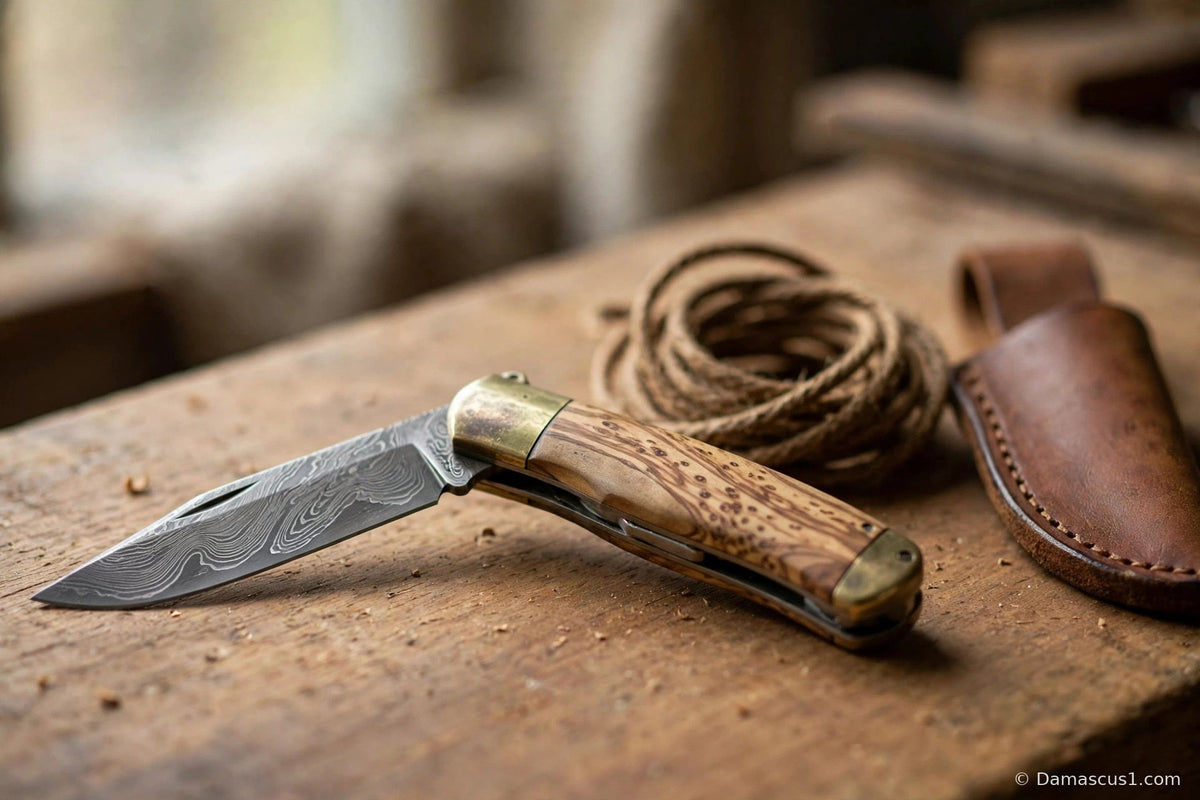
A Damascus steel pocket knife is a folding knife whose blade is made from layered, pattern-welded steel — two or more steels forge-welded together, worked until the layers flow, then etched so the layers show as waves. It does the ordinary jobs of a pocket knife — packages, cord, fruit, small repairs — and it asks a little more care than a stainless folder, because most pattern-welded Damascus is high-carbon steel and can rust if it is put away wet. Everything else about choosing one is ordinary pocket-knife sense: the right size, a lock you trust, a handle that suits your hands, and a seller who states what the knife actually is.
That short version matters because this category collects more nonsense per inch than almost any other in knives. The pattern is beautiful, and beauty invites exaggeration — claims that the layers make the blade rust-proof, self-strengthening or magically sharper. None of that is true, and this guide will not repeat it. What follows is the complete, checkable version: what the steel is, what the pattern does and does not do, how to size and choose a folder, how to spot a fake, what one should cost, and how to look after it. If you want the shortlist first, the ranked folder picks live in the best Damascus pocket knife guide, and the knives themselves live in the everyday EDC pocket knives collection. The range's most-carried starting point is the Olive Wood Damascus Pocket Knife Set at $39.99 — a 6.5-inch folder with a genuine leather sheath included.
What is a Damascus steel pocket knife?
A Damascus steel pocket knife is a folding knife with a pattern-welded blade: alternating layers of two steels are stacked, heated and hammered into one billet, folded or twisted to multiply and arrange the layers, ground into a blade, and acid-etched. The etch bites the two steels at different rates, which is what makes the flowing pattern visible. Closed, the knife is just a handle; open, the blade locks or is held by a spring, depending on the mechanism.
Two honest clarifications belong at the front. First, the name: historical Damascus steel was wootz, a crucible steel from South Asia whose recipe is lost; almost everything sold as Damascus today is modern pattern welding, a different and perfectly respectable process that borrows the look and the name. Second, the construction varies, and the variation matters more than the pattern. A folder's blade may be pattern-welded all the way through — the classic high-carbon construction — or it may be a stainless core steel clad in patterned layers, the san-mai style borrowed from kitchen knives. The first kind cuts like its component steels and needs rust care. The second kind cuts like its core and shrugs off moisture better. A listing that just says "Damascus" without saying which construction, or naming any steel at all, is asking you to buy the photograph. The making process itself, step by step, is covered in how pattern-welded pocket knives are made, and the all-types overview is in the brief, complete guide to Damascus knives.
A pocket knife, in the plain sense, is a knife small enough to live in a pocket — which is why the closed length, not the open length, decides whether you will actually carry it. Damascus1's folders are traditional single-blade folders: one blade, a natural handle, a leather sheath for storage or belt carry. They are not multi-tools, and this guide will not pretend a single-blade folder competes with one. If your daily cutting includes screwdrivers and scissors, you need a different tool as well, not instead.
What does the Damascus pattern actually do on a pocket knife?
The pattern itself does one thing: it looks like that. Cutting performance — how the edge bites, how long it lasts, how it sharpens — is set by the steels in the billet, the heat treatment, and the grind, exactly as it is on a plain knife. A well-made pattern-welded blade performs comparably to a good mono-steel blade of similar steels; it does not outperform it because it is patterned, and independent testing of pattern-welded steel against its own component steels has found the same thing. Anyone who tells you the waves make the knife sharper is selling you the waves.
Three specific myths deserve direct answers, because earlier versions of this very page repeated two of them. The pattern does not prevent rust: in the common high-carbon construction it accompanies steel that rusts readily, and the etched surface can hold moisture if the blade is stored damp. The pattern does not heal or strengthen the blade when it is nicked: a chip is a chip, in any steel, and it is fixed on a stone or not at all. And the pattern does not stop food sticking or keep the edge keen: food release is about how thick the blade is behind the edge, and sharpness is about the edge itself. What the layers genuinely offer is a blade no two of which look alike, made by a process with real labour in it, in a tool you will handle every day. For a lot of owners that is reason enough — it just has to be bought as what it is. The steel-versus-steel version of this argument, including the stainless question, is worked through in the carbon vs stainless pocket knife buying guide, and the rust question gets its own full treatment in can Damascus steel rust?
What size Damascus pocket knife should you carry every day?

Carry the size you forget is there: for most people that is a folder around 6 to 7 inches open, which means roughly 3.5 to 4 inches closed and a blade in the 2.5 to 3.5 inch range. That is enough edge for packages, cord, tape, fruit and the small whittling and trimming jobs of an ordinary day, and it rides in a pocket without printing, digging or weighing the pocket down. Bigger folders exist, and they earn their size outdoors — not in an office pocket.
Learn to read the three numbers, because sellers mix them freely. Overall length is measured open, tip to butt; it is the biggest number and the least useful for carry. Closed length is what your pocket feels. Blade length is what the law usually measures and what does the cutting. A knife advertised as "6.5-inch" — including the Damascus1 folders priced below — is almost always 6.5 inches overall, with a blade around 3 inches. That is squarely in the everyday class, whatever the headline number suggests. Go smaller, toward 5.5 inches overall, if you wear light trousers or want a gentleman's folder for occasional use. Go larger, toward 7.5 inches, only if your hands are large or your daily work is genuinely outdoors — and expect to carry it in its sheath on a belt rather than loose in a pocket. The full measuring method, including how to measure a knife you already own, is in the pocket knife size measurement guide.
Weight deserves one honest sentence: natural handles and traditional construction make these folders heavier than a modern plastic-handled clip knife of the same size. Most carriers stop noticing within a day; if you are counting grams for ultralight hiking, a Damascus folder is the wrong tool and a fixed blade or a modern folder will serve you better.
Which blade shape and edge should you choose?
Choose a drop point or clip point with a plain edge for everyday carry. A drop point's spine curves down to a strong, centred tip with a long slicing belly — the most forgiving all-round shape. A clip point trades a little tip strength for a finer, more precise point, better for detail work. A plain edge slices, pushes and sharpens easily on an ordinary stone. That combination covers nearly everything a pocket knife is honestly for.
The other options have narrower honest uses. A straight-edged sheepsfoot or wharncliffe shape is excellent for controlled cuts on a flat surface and safer around livestock and rescue work, but gives up the belly that makes slicing pleasant. A tanto point is built for piercing and tip strength; for daily slicing it is mostly a style choice, and there is nothing wrong with admitting that. Serrations earn their keep on rope, webbing and fibrous material, and they are a nuisance everywhere else — hard to sharpen at home and grabby on wood and food. A part-serrated edge is the usual compromise and satisfies most people least. One more correction to a common confusion, which an earlier version of this page made: "plain edge" and "straight edge" are not two kinds of edge. Plain describes the absence of serrations; the edge's profile — curved belly or straight — is a separate choice. For a first Damascus folder, plain edge, drop point, done. If the knife is a gift and the recipient's taste is unknown, the same answer holds, which is part of why the folders below make the gift lists in the groomsmen knife gift guide.
How do folding mechanisms and locks differ on a Damascus pocket knife?
Traditional Damascus folders open with a nail nick — a small crescent cut in the blade you catch with a thumbnail — and most are held open by a lockback or kept by a spring. A lockback drops a spine-mounted rocker into a notch on the blade tang; it is strong, ambidextrous and deliberate, and it closes with two hands. A slipjoint has no lock at all: a spring holds the blade open with firm pressure, and it closes the same way, which is traditional, pocket-friendly and legal in more places — and demands you never cut as if it were locked.
Modern folders add liner locks, frame locks and assisted opening, usually with a pocket clip and one-handed thumb studs. Those are real conveniences, and most handmade Damascus folders simply do not have them. Be clear-eyed about the trade before you buy: a traditional Damascus folder is a two-handed, unhurried tool that carries in a pocket or a leather sheath, not clipped. If your work needs one-handed opening ten times an hour, buy the modern folder and enjoy the Damascus knife on weekends. If your cutting is the ordinary few-times-a-day kind, the traditional mechanism's slowness is mostly theoretical — and its lockback, where fitted, is as trustworthy a lock as folders have. Whatever the mechanism, check three things on arrival: the blade opens without grit or side-play, the lock engages fully with no vertical wiggle, and the blade sits centred when closed rather than rubbing a liner. Those are manufacturing checks, not Damascus checks, and they are the ones that predict whether you will still like the knife in a year. The day-one routine is laid out in the first Damascus pocket knife checklist.
Which handle material should you choose?

Choose by grip, weather and taste, in that order. Olive wood is the warm classic — light, comfortable, grippy enough dry, and it darkens handsomely with handling. Buffalo horn and camel bone are denser and smoother, with a polished feel and natural variation no two pieces share. Stag horn is the grippiest of the natural handles, its texture doing real work when hands are wet or cold. Rose wood sits between: dense, smooth, formal-looking, the dressiest of the common options.
| Handle material | Best for | Honest trade-off |
|---|---|---|
| Olive wood | Everyday carry and gifting — the classic first choice | Can dry out; benefits from an occasional wipe of oil |
| Buffalo horn | A smooth, dark, polished carry with natural variation | Slicker than wood when wet; can be brittle if dropped on concrete |
| Camel bone | A pale, traditional look that takes engraving-style detail well | Smooth finish means grip comes from shape, not texture |
| Stag horn | Wet, cold or gloved hands — the working grip | The roughest texture; not everyone likes it against a pocket lining |
| Rose wood | Formal and gift carry — the dressiest finish | Smooth and dense; heavier in the pocket than olive wood |
Natural materials share two rules. They are not dishwasher, soaking or dashboard-in-August materials: heat and water cycling is what cracks and warps them, slowly and then suddenly. And each piece is genuinely individual — grain, colour and figure vary, which is the point of the material and also why you should buy from photographs and descriptions you trust rather than expecting the exact figure in a catalogue shot. The deep comparison, including the synthetic materials this range does not use, is in the pocket knife handle materials comparison. Handles are also where personalisation lives: a name or date on a folder turns a good gift into a kept one, and the options and limits are explained in the personalized pocket knife engraving guide.
Is a Damascus pocket knife better than a regular pocket knife?
It is better looking, more individual and — at the handmade end — better finished in the hand. It is not sharper, stronger or longer-lasting by virtue of its steel, and it needs more care. A Damascus pocket knife is the right buy when you value the object itself alongside the cutting: a daily tool you enjoy handling, a gift that will be kept, a small piece of craft in a pocket full of plastic. It is the wrong buy when you want the absolute most edge retention per dollar, a knife you can abuse, lend freely and never dry.
| Damascus pocket knife | Regular pocket knife | |
|---|---|---|
| Cutting performance | Comparable to a good mono-steel blade of similar steels | Comparable — set by steel, heat treatment and grind, not pattern |
| Rust behaviour | High-carbon versions rust if stored wet; needs drying and oil | Stainless versions are close to carefree |
| Sharpening | Whetstone, as any quality blade; the etch near the edge fades with heavy sharpening | Same, with no pattern to fade |
| Individuality | Every blade's pattern is unique | Identical by the thousand |
| Price for handmade quality | From $39.99 in the range below | Factory knives undercut it; handmade plain-steel knives cost similar |
| Best for | Daily carry you enjoy, gifts, collectors starting out | Hard use, lending, zero-maintenance carry |
That table is the whole honest pitch. Notice what is not in it: no claim that the layered blade out-cuts anything. If a seller's case for Damascus rests on performance miracles, walk away; if it rests on craft, individuality and a fair price for handmade work, it is a case worth hearing. The wider everyday-carry context — how a Damascus folder sits among the best pocket knives generally — is in the best pocket knife hub.
How can you tell a real Damascus pocket knife from a fake?

Check the pattern where grinding would have removed a surface print: on a real pattern-welded blade the figure continues over the spine, through the bevel to the edge, and around the tang area inside the handle line, because the layers run through the steel. On a fake — a plain blade with a pattern laser-etched, printed or acid-stamped only on the flat — the pattern stops dead at the bevel and the spine is bare, uniform steel. That single check, spine and bevel, catches most fakes in seconds.
Then apply the supporting checks. Real patterns vary organically and never repeat identically across a seller's whole range; identical swirls on every photograph mean a print or a stock image. A real blade shows the pattern on both sides with the layers flowing around the tip, not mirrored. The seller should be able to say what the construction is — pattern-welded through, or a clad core — and something about the steels; "genuine Damascus style" is the tell of a surface treatment. Price is a sanity check, not a proof: pattern welding is labour, so a folder priced like a gas-station knife is not pattern-welded, whatever the listing says — though as the cards below show, honest handmade folders start lower than the premium brands suggest. Two popular tests are useless and worth naming: a magnet tells you nothing, since both real and fake blades are steel, and counting layers in a photograph tells you nothing about quality, since layer count is a process detail, not a grade. The full method, with the sand-and-re-etch check for a knife you already own, is in how to spot a fake Damascus knife.
How much should a Damascus steel pocket knife cost?
Expect to pay from about $40 for an honest handmade folder from a maker-direct store, $100 to $500 for big-brand or premium factory Damascus folders, and more for named custom makers. The spread is not mostly about steel — it is about labour, brand and finish. What you should refuse to pay for is a mystery: any price is too much for a blade whose construction the seller will not state. Below are the Damascus1 folders most relevant to this guide, with prices checked on the live store on November 15, 2026. Prices and compare-at figures can change; the product page on the day you order is the final word.
Priced picks, verified November 15, 2026:
- Olive Wood Damascus Pocket Knife Set — $39.99 (compare at $89.99). Best for: the first Damascus folder and the safest gift. 6.5-inch folder, olive wood handle, genuine leather sheath included.
- Buffalo Horn Damascus Pocket Knife Set — $39.99 (compare at $99.99). Best for: a darker, polished carry at the same entry price.
- Camel Bone Damascus Folding Pocket Knife — $39.99 (compare at $99.99). Best for: the pale, traditional look.
- Rose Wood Folding Pocket Knife Set — $39.99 (compare at $99.99). Best for: formal and gift carry.
- Stag Horn Damascus Folding Pocket Knife — $49.99 (compare at $139.99). Best for: grip — wet, cold or gloved hands.
Shipping, stated plainly: the store offers free US shipping on orders over $50, so a single $39.99 folder does not clear the threshold on its own — it clears with a second folder, an accessory, or by choosing the stag horn plus a small add-on. Two folders as a pair of gifts is the common way readers do it. If you are buying for a wedding party rather than yourself, the quantities and presentation are worked out in the groomsmen knife gift guide.
Is it legal to carry a Damascus pocket knife?
In many places, yes — a traditional folding pocket knife is the most widely lawful knife there is — but the rules are local and they turn on blade length, locking mechanism and where you carry, not on the steel. Damascus changes nothing legally. What changes the answer is a longer blade, an automatic opening mechanism (which these traditional folders do not have), and restricted places such as schools, courthouses and aircraft cabins, where no pocket knife belongs.
Treat any single summary, including this one, as a starting point rather than legal advice. In the United States, state law sets the frame and city rules can tighten it; the strictest statewide blade-length limits sit around 3 inches, which is one reason the roughly 3-inch blades on standard 6.5-inch folders are such a common size. In the United Kingdom, a non-locking folder under 3 inches is the everyday-carry standard, and a locking blade needs a good reason in public. Wherever you live, the working method is the same: check the current local rule for blade length and lock type before the knife becomes a habit, and when you travel, check again — the knife that is unremarkable at home can be a problem one state or one border away.
Pocket knife or fixed blade: which do you actually need?
You need the pocket knife for the frequent, light jobs — it lives on you, so it gets used — and the fixed blade for the infrequent, heavy ones. A folder's pivot is a joint, and a joint is where strength ends: never pry, baton or twist with a folding knife, Damascus or otherwise. A fixed blade has no joint, draws instantly from its sheath and cleans in seconds, which is why camp kitchens and field work belong to it. Most outdoors carriers end up with one of each, and the honest sequence is folder first.
| Decision factor | Folding Damascus pocket knife | Fixed-blade Damascus knife |
|---|---|---|
| Best for | Everyday carry, packages, cord, food on the go, gifts | Camp chores, hunting, extended food prep, heavier cutting |
| Carry | Loose in pocket or in its leather sheath | Belt or pack sheath, always full length |
| Strength limit | The pivot and lock — no prying or batoning | The blade and handle themselves; far higher |
| Cleaning | Pivot traps moisture and grit; dry it deliberately | Wipe, dry, done |
| Damascus1 example | Olive Wood folder, 6.5 in. — $39.99 | Olive Wood Damascus Tracker, 9.5 in. — $79.99 (compare at $119.99) |
The side-by-side for camping specifically — including when the folder alone is genuinely enough — is in the folding vs fixed camping knife guide and the best pocket knives for camping guide.
How do you care for a Damascus pocket knife?

Dry it, oil it lightly, and keep the pivot clean — that is nearly the whole discipline. After use, wipe the blade clean and dry; after anything wet or acidic — fruit, onions, rain, a fishing trip — wash it in warm water with a drop of mild soap, dry it immediately and completely, and put the thinnest film of food-safe mineral oil on the blade before it goes away. Open and close it a few times so the pivot dries too, because a folder's favourite place to rust is the one you cannot see, around the pin.
Sharpening is ordinary whetstone work: the layered steel sharpens like the steels it is made from, at the same angles, on the same stones — the full method is in how to sharpen a Damascus knife. Two pattern-specific notes. The etched figure is shallowest near the edge, so years of sharpening will soften the pattern along the bevel; that is wear, not damage, and a maker can re-etch a blade if it ever matters to you. And never use a pull-through sharpener or a coarse power tool on a folder you care about — they tear at the edge and can overheat the thin steel near it. Folding-knife-specific care, including freeing a stiff pivot and dealing with pocket lint, is covered in Damascus folding knife care.
How should you store a Damascus pocket knife?

Store it clean, dry and — for long stretches — out of its leather sheath. Leather is the right way to carry and protect a folder day to day, and the wrong place to leave a high-carbon blade for a season: leather holds moisture and its tannins can mark steel. For daily carry rotation, sheath away. For storage measured in weeks, wipe the blade with oil, wrap it in a dry cloth or keep it in a drawer or roll, and let the sheath air separately. A silica packet in the drawer is cheap insurance in a humid climate.
Keep natural handles in the same moderate world as the blade: out of prolonged damp, out of baking heat, and given an occasional wipe of oil or wax if the wood starts to look thirsty. If a sheath is on your list as an upgrade or a replacement, the fit and leather questions are answered in the custom leather pocket knife sheath guide, and cases, rolls and displays are compared in the pocket knife storage guide.
Frequently asked questions
What is a good blade length for an everyday carry knife?
A blade between 2.5 and 3.5 inches suits most everyday tasks and is legal to carry in more places. Check your local rules before carrying. On a traditional folder that usually means a knife around 6 to 7 inches overall when open — the size class of the 6.5-inch folders priced in this guide.
Is Damascus steel good for a pocket knife?
Yes, with one condition: the care has to suit your life. A pattern-welded folder cuts comparably to a good plain-steel folder and looks like nothing else in your pocket, but high-carbon versions need drying and occasional oil. If you will not do that small work, a stainless folder is the better knife for you — the steel matters less than the match.
Can a Damascus pocket knife rust?
Yes. Most pattern-welded Damascus is high-carbon steel, and high-carbon steel rusts when it is stored wet or left with acidic food residue on it. The prevention is simple and total: wash, dry immediately, oil lightly for storage, and do not leave the knife long-term in a damp leather sheath. Stainless-clad constructions resist rust far better, at the cost of a different construction and usually a higher price.
How can you tell if a Damascus pocket knife is real before you buy it?
Look for the pattern continuing over the spine and through the bevel to the edge — a printed or laser-etched pattern stops at the bevel. Check that the seller states the construction and something about the steels, that patterns vary between individual knives rather than repeating identically, and that the price is plausible for handmade labour. Ignore magnet tests and layer-count claims; neither proves anything.
Is it legal to carry a pocket knife?
In many places, yes, but rules vary by state and country, mostly on blade length, lock type and where you carry. Check your local laws before carrying a knife in public. Traditional non-automatic folders are the most widely accepted type, and restricted buildings and aircraft cabins are exceptions everywhere.
Should I choose a folding or fixed-blade knife?
Choose a folder for everyday carry and light cutting, because it closes safely into its handle. Choose a fixed blade for hunting, camp chores and heavier work, because it has no moving joint and is stronger and easier to clean. Fixed blades need a sheath to carry. If you can only have one and your life is mostly town and desk, it is the folder; if it is mostly field, it is the fixed blade — and the Tracker at $79.99 in the comparison above is this range's version of it.
The short answer, restated
A Damascus steel pocket knife is a traditional folder with a layered-steel blade: beautiful, individual, entirely competent at the light work pocket knives exist for, and honest work to own — dry it, oil it, sharpen it on a stone. Buy it for the craft and the daily pleasure of the thing, at a price that matches handmade labour rather than mythology — from $39.99 in the everyday EDC pocket knives collection — and check any candidate, from any seller, the same way: pattern over the spine and bevel, a stated construction, the right closed size for your pocket. Start with the Olive Wood Damascus Pocket Knife Set if you want the classic first folder, or work through the first Damascus pocket knife checklist if you are still deciding.
Still deciding whether the premium itself makes sense? The honest value guide to Damascus pocket knives works through what the price buys, when it is and is not worth it, and what owning one actually costs.
Leave a comment: