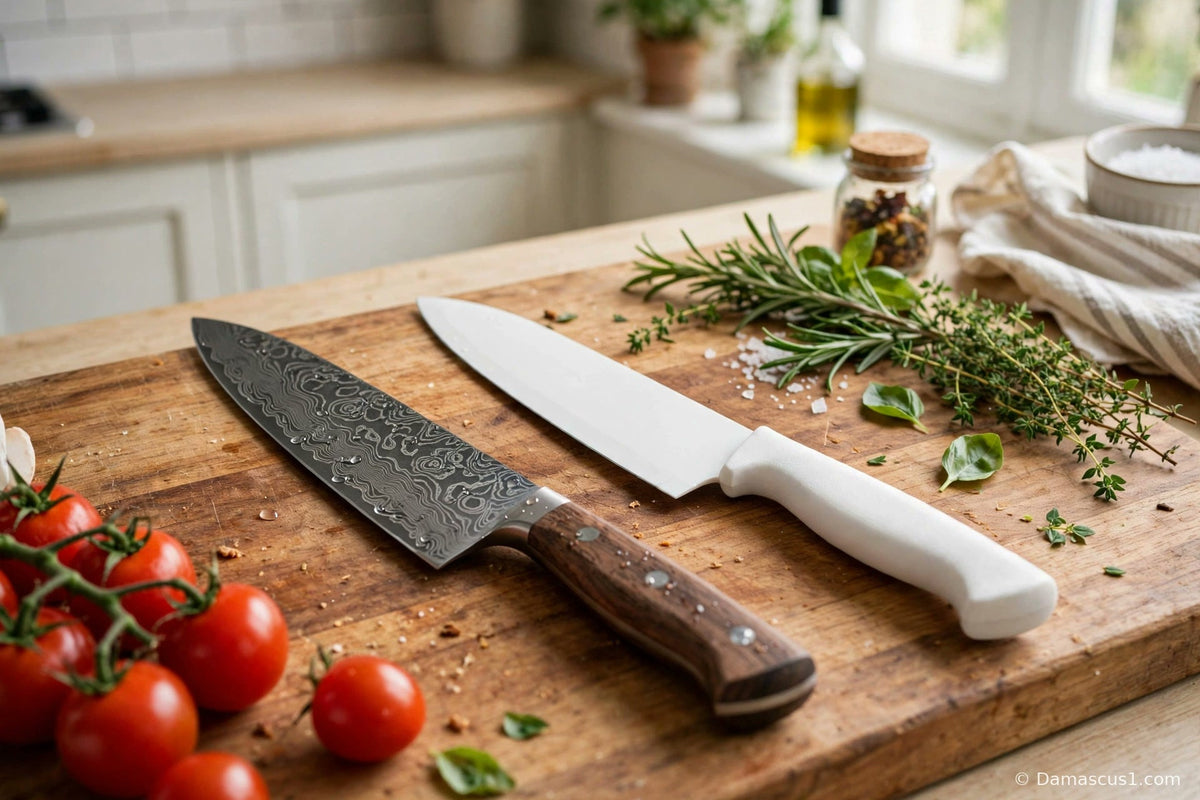
The short answer: A ceramic knife is harder than any Damascus steel and holds its factory edge far longer on soft food, but it chips or snaps where steel flexes, and it can only be sharpened with diamond tools or a maker's service. A carbon Damascus knife dulls sooner, asks for drying and oiling, and in return handles every kitchen job, sharpens at home on an ordinary stone, and survives the accidents that end a ceramic blade's life.
Every few years the same kitchen argument restarts. Someone produces a ceramic knife — feather-light, improbably sharp, its white blade still keen after a year of tomatoes — and asks why anyone persists with steel at all. Someone else produces the same ceramic knife six months later, its edge a sawtooth of chips and its tip missing, and asks the opposite question. Both of them are holding the evidence for the only honest answer: these are not two versions of the same tool competing for one job. They are two materials at opposite ends of the oldest trade-off in blade-making, hardness against toughness, and the comparison that matters is not which is "better" but which failure mode your kitchen can live with. This page makes that comparison properly for a UK buyer: what each material actually is — including the point, made forcefully by a UK Japanese-knife specialist in this teardown, that Damascus is a construction rather than a steel — how the edges behave, why ceramic chips, what sharpening really involves for each, what care each demands in a British home, and where the Damascus1 range honestly sits in the argument, folder and kitchen knives alike. No holder read for this guide sells both sides impartially, so the claims below are attributed as they go, and the verdict is built from the points the holders agree on rather than the ones they advertise.
What are you actually comparing — a material or a construction?

A material against a construction, and getting that straight first prevents most of the confusion in this subject. A ceramic knife blade is a single material: zirconium oxide, usually called zirconia, pressed from powder into a blade shape, fired at very high heat until it fuses solid, then ground to an edge with diamond wheels — the account given by KnivesAdvice's ceramic-versus-steel comparison, opened and read in full for this page, and echoed by every other holder. There is no core, no cladding and no variation along the blade: zirconia all the way through, harder than any knife steel, and — the fact that governs everything else — incapable of bending. Damascus, by contrast, is not a steel at all. Santoku Knives, the UK specialist whose blade-construction guide appears in this teardown, states it as a heading: Damascus is a cladding, not a steel. Modern Damascus is pattern-welding — many layers of contrasting steels forge-welded together, folded and acid-etched so the boundaries show as rippling waves. On most Japanese kitchen knives that patterned material wraps a hard core steel, commonly VG10 or AUS-10, and it is the core that cuts. The Damascus1 blades discussed on this page are the older, simpler construction: a solid billet of forge-welded 1095 and 15N20 carbon steels, around 276 layers, hardened to 58–60 HRC, where the layered material is the blade throughout, edge included. Either way, "Damascus" names how the blade was built. "Ceramic" names what the blade is. Comparing them is therefore really comparing layered carbon steel against zirconia — which is a fair and useful comparison, so long as nobody pretends a layer count is a performance figure. Santoku's guide is blunt about that too: a 67-layer Damascus knife and a plain laminated knife with the same core and heat treatment will hold an edge equally well. The pattern buys beauty, a slight release benefit on the flat of the blade, and nothing else. Hold on to that honesty; it is the standard this page applies to both sides.
One more confusion is worth clearing at the start, because the holders flag it and British supermarket shelves are full of it: a "ceramic-coated" knife is not a ceramic knife. It is a stainless steel blade wearing a coloured non-stick coating, it behaves and sharpens exactly like steel, and the coating wears off. A true ceramic knife has a solid zirconia blade, usually white or black. If the comparison in this page is to mean anything, it is the solid blade it describes.
Which stays sharp longer — and what does "sharp" mean here?

Ceramic, on the work it is meant for, and by a wide margin — with a condition attached that changes the practical answer. Zirconia's hardness is the whole story: KnivesAdvice cites Kyocera, the maker that popularised ceramic kitchen knives, putting zirconia at 8.2 on the Mohs scale against steel's 5 to 6, with diamond at 10. An edge that hard abrades very slowly against soft food, which is why the holders agree ceramic holds its edge far longer than steel — Kyocera's own claim, quoted by KnivesAdvice, is up to ten times longer, a figure that page itself advises treating as marketing while accepting the direction. Knife Depot's comparison, drawing on published testing, makes the same point more cautiously: ceramic performs considerably better on edge retention under typical home use, staying keen for months where a steel edge needs regular attention. Set against that, a Damascus edge at 58–60 HRC is a genuinely hard, fine steel edge — it will out-cut and out-last soft stainless comfortably — but it is steel, and steel edges roll and dull microscopically with use. The Damascus owner hones and touches up; the ceramic owner, for a long time, does nothing at all.
The condition is the word "dulls". Steel and ceramic do not lose sharpness the same way. A steel edge degrades gradually and visibly: it rolls, it drags, it gives you weeks of warning and responds to a honing rod in seconds, because honing pushes a rolled edge straight again without removing metal. A ceramic edge, as Knife Depot's analysis puts it, does not just dull slowly — it fails suddenly. The wear that matters on zirconia is micro-chipping: tiny fragments leaving the edge on anything harder than the food it loves, each chip invisible until the blade starts tearing rather than slicing, and none of them answerable by honing, because there is nothing rolled to straighten — material is simply gone. So the honest sharpness verdict has two halves. In a careful kitchen, on boards of wood or plastic, cutting produce and boneless protein, a ceramic knife will feel sharper for longer than any steel knife in the drawer, Damascus included. In an ordinary kitchen — the kind with a bone in the chicken, a pit in the avocado, a frozen edge on the peas and a housemate who twists the blade in a squash — the ceramic edge's advantage is spent on damage, while the steel edge's disadvantage is cured at the honing rod. Sharpness you can restore beats sharpness you can only lose.
Why does ceramic chip — and can Damascus chip too?
Because hardness and toughness are different properties, and zirconia has all of one and very little of the other. Hardness is resistance to scratching and denting. Toughness is resistance to fracturing. KnivesAdvice states the mechanism plainly: zirconia does not bend, so when a ceramic blade meets too much sideways force, it chips or breaks instead of flexing back — and Knife Orbit's comparison, built around Kyocera's own technical pages, adds the maker's admission that ceramics are characterised by hardness as well as a lack of toughness. The stress in a ceramic has nowhere to go: it gathers at the smallest flaw and a crack runs. The practical triggers are so consistent across every holder that they amount to a list of prohibitions: bones and joints, frozen food, hard winter squash and its stem, fruit pits, twisting or prying with the blade, dropping the knife onto tile or into a steel sink, cutting on glass, stone or ceramic boards, and scraping food across the board with the edge. KnivesAdvice's verdict on real-world failures is that when ceramic owners describe what went wrong, it is nearly always a snapped tip, usually from prying or a drop. A chipped ceramic edge is not a sharpening job, either — restoring it means grinding back past the chips on diamond abrasives, which shortens and reshapes the blade.
Damascus chips too, and this page will not pretend otherwise — but differently, less often, and reparably. A carbon Damascus edge at 58–60 HRC is hard steel, and hard steel can chip on bone, frozen food or a twisted cut, particularly with a finely ground edge. The differences are degree and consequence. Steel flexes before it fractures, so the load that shatters a ceramic edge usually rolls or dents a steel one; the chip, when it comes, tends to be small; and the repair is an ordinary sharpening session at home, taking the edge back a fraction on a stone you already own. Yakushi's Damascus-versus-materials comparison makes the versatility point from the steel side: ceramic's brittleness rules it out of tasks requiring flexibility or force, such as boning meat or cutting hard vegetables, while Damascus offers a balance of hardness and flexibility that suits the whole kitchen. The citable table below gathers the full comparison in one place.
| Property | Carbon Damascus (e.g. 1095 & 15N20) | Ceramic (zirconia) |
|---|---|---|
| What it is | Pattern-welded layers of carbon steel, forged and etched | Zirconium oxide powder, pressed, fired and diamond-ground |
| Hardness | 58–60 HRC in the Damascus1 range | ~8.2 Mohs — harder than any steel |
| Edge life on soft food | Good; needs honing and touch-ups | Excellent; holds its edge far longer |
| How it dulls | Gradually — rolls and drags; warns you | Suddenly — micro-chips; material lost |
| Toughness | Flexes; survives drops and twisting loads that break ceramic | Brittle; chips or snaps on bone, pits, frozen food, drops |
| Sharpening | Any whetstone, rod or system, at home | Diamond abrasives only, or the maker's service |
| Rust | Yes — carbon steel; must be dried and oiled | Never rusts; non-reactive with food |
| Weight | Heavier; momentum helps on dense food | Very light; kind to tired hands, less momentum |
| Forbidden work | Glass boards; dishwasher; soaking | Bone, frozen food, hard squash, prying, glass or stone boards |
| Failure repair | Sharpening at home restores the edge | Professional diamond grinding; tip loss is permanent reshaping |
| Character | Patterned, individual, develops patina | Plain white or black; unchanged by use |
What does sharpening each one really involve?

A stone and ten minutes, against diamond tools or a parcel to the maker — and this is the section where the comparison stops being close. A Damascus blade sharpens like the steel it is. Any whetstone, honing rod, guided system or competent pull-through works; the edge responds to the same technique every steel knife responds to; and the owner can maintain the knife for life with equipment costing less than the knife did. The etched pattern is no obstacle: sharpening acts on the edge bevel, and while years of sharpening gradually move the bevel up into the patterned flats, that is true of every knife ever sharpened and is measured in years, not sessions. A ceramic blade inverts every term of that. Ordinary whetstones, honing steels and most pull-through sharpeners cannot touch zirconia at all — the abrasive must be harder than the blade, which leaves diamond: a diamond stone, rod or an electric sharpener rated for ceramic, used with a light touch and modest expectations. KnivesAdvice's FAQ answer is exact about it: yes, you can sharpen a ceramic knife at home, but only with diamond abrasives. The alternative is the maker's service — Kyocera runs one for its own knives — which means posting a blade away and waiting, at a per-service cost Knife Depot's comparison puts at roughly the price of a budget steel knife each time. Neither route restores a chipped edge cheaply, because chips are ground out, not honed out.
For a UK buyer there is a practical footnote: diamond plates and ceramic-rated electric sharpeners are ordinary retail items here, so home sharpening of ceramic is possible rather than theoretical. But the honest summary stands. Damascus asks for a little sharpening, often, with tools every knife owner already understands. Ceramic asks for none, for a long time — and then asks for specialist tools or a postal service, at the exact moment the edge also carries the chips that make the job bigger. Owners who hate sharpening and cook gently are rationally served by ceramic. Owners who cook everything, and who regard a whetstone as part of the kitchen rather than a chore imposed by it, will find the Damascus arrangement not a burden but the normal cost of a knife that can be kept keen for decades.
What care does each material demand in a British home?

Almost opposite routines, and the choice between them is partly a choice about which small discipline you prefer. Ceramic's care is about protection from impact: store it in its sheath, its own slot or a block, never loose in a drawer where steel tools knock against it; hand-wash it rather than letting it rattle in a dishwasher basket; cut only on wood or plastic; lift it out of a cut the way it went in, never twisted. Do those things and it needs nothing else — no oil, no drying ritual, no worry about rust, because zirconia cannot rust and does not react with acidic food, so cut fruit does not discolour against it and onions leave no metallic taste. It is, in the narrow sense, the lowest-maintenance blade in this comparison. Damascus care is about protection from moisture: wash, dry immediately and completely, wipe a trace of food-safe mineral oil over a carbon blade, store it dry and out of a leather sheath, and never soak it or dishwash it. In a damp British kitchen — condensation, steam, a draining board that never quite dries — that routine is the difference between a blade that develops a handsome grey patina and one that freckles orange. Neither routine is large. They fail in different ways: ceramic care fails in a single moment of clumsiness, Damascus care fails by a month of small neglects. Choose the failure you are less likely to commit.
The kitchen knives in the Damascus1 range illustrate the steel side concretely. The VG10 Nakiri at $44.99 USD is the stainless-core Japanese pattern — a Damascus-clad vegetable knife whose core care is gentler than the carbon folder's, though it still wants hand-washing and proper storage. The Premium Kitchen Knife Block Set (7-piece) at $169.99 USD puts a full Damascus kitchen set in a block, which is itself the correct storage answer for steel. Buyers should read each product page for its own steel and care notes rather than assume one routine fits the whole store. And the folder at the centre of this site's range makes the same point outdoors: the Olive Wood Damascus Pocket Knife at $39.99 USD (compare-at $89.99) is solid carbon Damascus — forge-welded 1095 and 15N20, around 276 layers, 58–60 HRC, olive wood handle, 6.5-inch model, manual two-hand nail-nick opener, back-lock, single-edged — a knife no ceramic could substitute for, since a folding ceramic pocket knife is a contradiction the material does not allow: hinges, locks and pocket life are impact and torsion all day. Its product page carries 4.9/5 buyer reviews for that product, distinct from the store's wider Amazon seller rating of 4.8 stars; prices are in USD exactly as listed, with no sterling price invented, and the store banner reads "Free Shipping & Returns above $50!" as listed. Engraving is available on request, up to 25 characters, with proof, price and timing confirmed before work starts — another thing zirconia cannot offer a gift buyer.
So which should a UK buyer actually choose?

Steel as the main knife, ceramic — if at all — as the specialist second: that is KnivesAdvice's verdict, Knife Orbit's verdict and this page's verdict, reached independently from the same physics. A main knife must survive the unplanned jobs: the squash that arrives whole, the chicken that needs jointing, the frozen block that must be parted, the board that turns out to be glass at a holiday cottage. Only steel does all of that and comes back from the honing rod. In the Damascus1 range, that main-knife role is exactly what the Japanese VG10 Damascus Chef Knife (8.5 in.) at $399.99 USD is built for — a stainless VG10 core under Damascus cladding, so it takes the unplanned jobs and still only asks for hand-washing and dry storage. Within steel, the Damascus choice is then an aesthetic and experiential one made with open eyes: you are buying the pattern, the individuality of a layered blade, a fine carbon edge and a knife that rewards a small care ritual — not a layer count's worth of extra performance, as the UK specialist in this teardown insists. A ceramic paring or utility knife, by contrast, is a genuinely rational second blade for a careful cook who preps a great deal of produce and boneless protein, works on wood or plastic, and stores knives properly: it will slice tomatoes superbly for a very long time without touching a stone. What no holder recommends is ceramic as an only knife, and what no honest page should recommend is Damascus for an owner who knows they will never dry a blade. That owner should buy stainless, enjoy it, and leave both of this page's materials to the people they suit.
The buying frame in the UK is the same for both materials, and worth a plain paragraph. Knives are not sold to under-18s, and online sales are delivered with age verification — Can you buy knives online in the UK? explains how that works in practice. A kitchen knife lives at home and raises no carry questions; a folding knife is a different matter, and the Damascus1 folder locks, so it is not a "UK legal carry" knife in the no-reason sense — the phrase appears here only to negate it. Owning it at home is legal; carrying it in public needs a specific, current good reason, as Damascus pocket knife UK and UK legal pocket knife set out. Before buying any Damascus blade, How to spot a fake Damascus knife is the essential cross-read, because the market's printed-pattern imitations borrow the looks while delivering none of the layered steel this comparison is about — and no printed imitation can be cared for, sharpened or aged like the real construction. Planned companions in today's set — a full pocket knife maintenance schedule and a UK camping guide — take the care and field sides of the same folder further, and are mentioned here as drafts only. This is general information, not legal advice.
Frequently asked questions
The questions below are the FAQ questions published in KnivesAdvice's "Ceramic vs Steel Knives" comparison, opened and read in full for this page on 2026-11-21; each answer is given here in this guide's Damascus-specific terms. No separate People Also Ask block was returned by the search tool for this keyword, so no PAA questions are claimed.
Are ceramic knives better than steel knives? (KnivesAdvice FAQ)
Not overall — KnivesAdvice's own answer, and this page's. Ceramic stays sharp much longer and never rusts, but it chips and breaks where steel flexes. For a main knife, steel is better; ceramic works as a second knife for soft food. Damascus adds pattern and a fine, home-sharpenable carbon edge to the steel side of that answer.
Do ceramic knives stay sharp longer? (KnivesAdvice FAQ)
Yes. Zirconia is much harder than knife steel, so the edge wears very slowly on fruit, vegetables and boneless meat — the holders cite Kyocera's claim of up to ten times longer, while treating the number itself cautiously. The qualification is that ceramic loses its edge by chipping, and once it dulls or chips it needs diamond tools or the maker's service, where a Damascus edge is restored on any ordinary stone.
Can ceramic knives cut meat? (KnivesAdvice FAQ)
Boneless meat, yes: chicken breast, steak and fish fillets are exactly its work. Bones, joints, cartilage and frozen meat are not — they can chip or crack the blade. A Damascus knife has no such division in its working life, which is why steel remains the main-knife material.
Are ceramic-coated knives the same as ceramic knives? (KnivesAdvice FAQ)
No. A ceramic-coated knife is a stainless steel blade with a non-stick coating; it sharpens and behaves like steel, and the coating can wear off. A true ceramic knife has a solid zirconia blade. The distinction matters in Britain because coated knives fill supermarket shelves under ceramic-adjacent branding.
Can you sharpen a ceramic knife at home? (KnivesAdvice FAQ)
Yes, but only with diamond abrasives — a diamond stone, a diamond rod or an electric sharpener rated for ceramic. Regular whetstones and honing steels will not work, because the abrasive must be harder than the zirconia. A Damascus blade, by contrast, sharpens on whatever stone, rod or system its owner already has.
Why do ceramic knives break so easily? (KnivesAdvice FAQ)
Because zirconia is hard but brittle: it does not bend under sideways force or impact, so a drop, a twist or a bone makes it chip or snap instead of flexing like steel. The Damascus side of the comparison fails the opposite way — gradually, visibly and reparably — which is the whole comparison in one sentence.
The honest close: Damascus versus ceramic is not a contest with a winner; it is a choice between a blade that asks for a little care and forgives your mistakes, and a blade that asks for almost no care and forgives none of them. If your kitchen is careful, your boards are wood and your cooking is produce and boneless protein, a ceramic second knife will delight you. For the knife you reach for first — the one that must joint, slice, flex and be sharpened back to life on a Sunday afternoon — layered steel remains the answer, and the Olive Wood Damascus Pocket Knife at $39.99 USD shows what that steel looks like when it is also beautiful. DRAFT — awaiting Faisal's word before anything is published.
The Olive Wood Damascus Pocket Knife Set — $39.99
Real Damascus steel, an olive wood handle and a genuine leather sheath included — the knife our readers ask about most.
Shop the Olive Wood Damascus Pocket Knife Set — $39.99 · Free US shipping on orders over $50.
Leave a comment: