The best Damascus knife is the one whose steel is genuinely layered, whose shape fits the job in front of it, and whose price is stated plainly enough to check. There is no single winner for every hand and every kitchen. A $39.99 folding pocket knife and a $449.99 block set can both be "the best Damascus knife" — for different people, doing different work, on different days.
That is the honest version of a question the internet usually answers with a shopping list and a shrug. This guide takes the longer road. It explains what Damascus steel actually is, how to tell a real layered blade from a printed pattern, what the patterns do and do not mean, and how the knives in one real catalogue — this one — sort out by job. Every price below was checked against the live product page on the day this guide was updated, and every claim about a specific knife is limited to what that knife's own listing states. Where a listing is silent — on layer counts, on hardness figures — this guide is silent too, and says why that silence matters when other sellers are loud.
For the ranked list itself, start with the store's top 10 Damascus knives in the USA, which works through the range pick by pick. This page is the companion underneath it: the choosing knowledge that makes a ranked list worth trusting.
What is a Damascus knife, in plain terms?
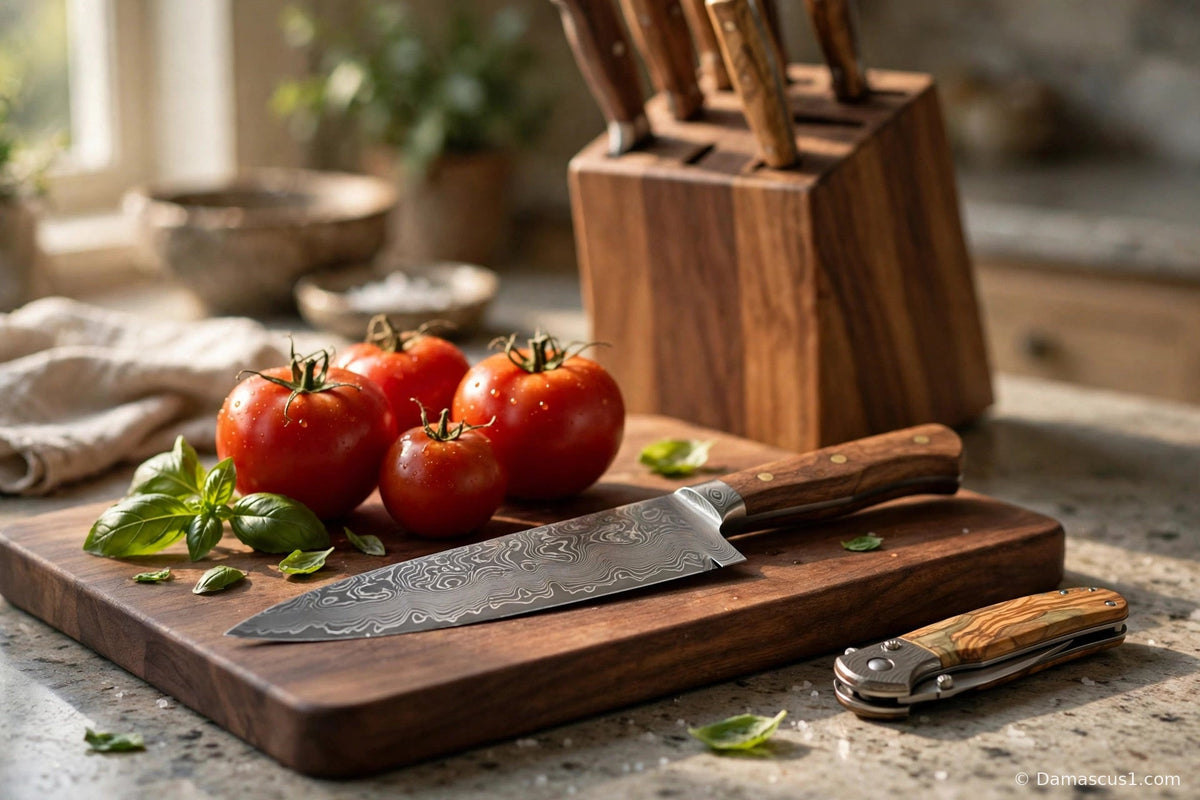
A Damascus knife is a knife whose blade is made by pattern welding: two or more different steels are stacked, forge-welded into one billet, then folded, twisted or cut and re-stacked so the finished blade carries visible layers. Acid etching reveals those layers as waves, raindrops or ladders, because the steels etch at different rates. The pattern is the structure, seen.
That last sentence is the part worth keeping. On a genuine Damascus blade the pattern is not printed, painted or lasered onto the surface — it is the cross-section of the steel itself, which is why it continues over the spine of the blade and reappears, in altered form, wherever the blade is ground. Modern pattern-welded Damascus is a revival of a much older family of techniques; the detailed history, including what the original wootz steel was and was not, is covered in what is the Damascus knife.
Two honest qualifications belong in any definition. First, "Damascus" describes how a blade is built, not how well it cuts. A patterned blade with a mediocre core steel and a careless heat treatment will cut worse than a plain blade made properly. Second, the word is also used loosely in the market for single-steel blades with a surface pattern, which are decorative objects wearing a technical name. Telling those apart is a learnable skill, and it is covered in its own section below — it is the single most useful thing a first-time buyer can learn.
What are the best Damascus knives at a glance?
The best Damascus knives, sorted by the job they are actually for, are these: an olive wood folding knife at $39.99 for everyday carry, a stag horn folder at $49.99 for a traditional pocket piece, a premium block set at $169.99 for a whole kitchen in one purchase, and a VG10-core Japanese set at $399.99 where a named core steel matters. The table below is the whole argument in miniature.
| Pick | Best for | Type | Live price |
|---|---|---|---|
| Olive Wood Damascus Pocket Knife Set | Everyday carry and first Damascus gifts | Folding pocket knife | $39.99 (was $89.99) |
| Buffalo Horn Damascus Pocket Knife Set | Buyers who choose by handle character | Folding pocket knife | $39.99 (was $99.99) |
| Stag Horn Damascus Folding Pocket Knife | A traditional, outdoors-leaning pocket piece | Folding pocket knife | $49.99 (was $139.99) |
| Premium Kitchen Knife Block Set | One purchase that covers a kitchen | Knife block set | $169.99 |
| Professional VG10 Core 6 PCS Japanese Kitchen Knife Set | Cooks who want the core steel named on the listing | Kitchen knife set | $399.99 |
| Knife Block Sets 7 Pieces with Wooden Block | A complete set presented as a gift | Knife block set | $449.99 (was $599.99) |
Read the table the way it was built: the "best for" column is the decision, and the price column is a fact to verify, not a promise. Prices on this store move with promotions, which is exactly why each one here carries its check date in the checklist above. The full reasoning for each pick — including the trade-off that comes with it, because every one of them has one — is in the picks section further down. Buyers who already know they want a folder can go straight to the Damascus folding knives collection; buyers furnishing a kitchen will find the same sets inside chef's best kitchen blades.
How were these picks chosen — and what does this guide not claim?
These picks were chosen by job fit, by what each product listing verifiably states — materials named in its title, its live price, its availability — and by how honestly the choice can be explained. No knife here was lab-tested for this guide, no edge-retention figures were measured, and no pick is ranked by performance data that does not exist. That disclaimer is not fine print. It is the method.
Most "best Damascus knives" pages work the other way around: a list is assembled from other people's listings, testing language is borrowed to give it weight, and prices are copied from wherever they were last seen. The result reads confidently and verifies poorly. This guide accepts a narrower, stronger position. It sells these knives, so its picks are this store's knives — stated openly rather than disguised as a market-wide survey. In exchange for that narrowness, everything it says about them can be checked on the linked product page in under a minute: the name, the handle material in the title, the price on the day, whether the item is in stock.
The criteria, in order, were: does the knife have a clear job (carry, kitchen workhorse, full set, gift)? Does its listing state its materials plainly enough to repeat without embroidery? Is its price live and competitive for its category on the day of writing? And can a genuine downside be named alongside the recommendation — a care obligation, a weight, a category limit? A pick with no nameable downside is marketing, not advice. The best Damascus pocket knife and best kitchen knives hubs apply the same method inside their own categories, in more depth than a cross-category guide can.
How can you tell if a Damascus knife is real?

Real Damascus steel shows its pattern through the metal, not just on it. Check five things: the pattern continues over the spine, it reappears on the edge bevel at a different scale, it is slightly irregular rather than perfectly repeating, the same character shows on both faces without being a mirror copy, and the seller describes layered construction instead of only showing a photograph. A printed pattern fails the first test immediately.
The spine test is the strongest because it is the hardest to fake cheaply. A pattern-welded blade is layers all the way through, so the lines that wander across the flat of the blade must wrap over the spine and continue down the other face, lining up at the edges. A surface-printed or laser-etched imitation is decorated on the faces only; its spine is plain steel, and the decoration stops at the edge of the flat as if cut off with scissors. The second test follows from the same structure: grinding the edge bevel cuts through the layers at an angle, so the pattern there stretches and compresses instead of repeating at the same size.
Irregularity is the third sign, and it runs against most buyers' instincts. Layered steel that has been genuinely folded and worked has a handwriting to it — waves that bunch and open, raindrops that are cousins rather than clones. Perfectly identical, stamp-regular repetition across a whole blade is what a printing process produces, and it should lower confidence, not raise it. Price is the fourth, quieter signal: a very cheap "Damascus" knife is not automatically fake, but layered construction takes more work than a plain blade, and a price far below every comparable layered knife is a reason to apply the other four tests harder. The fifth test is the listing itself — a seller of real layered steel can say how the blade is built; a seller of printed steel talks about how it looks.
The full walkthrough, with the acid-etch discussion and the questions to ask a seller before paying, lives in how to spot a fake Damascus knife. It is worth reading before any purchase over a hundred dollars, from any seller, this one included.
Which Damascus knife suits which job?

Match the knife to the job by shape first and steel second. A chef's knife earns its place through rocking cuts and board clearance for knuckles; a folding pocket knife earns its place by being present — in a pocket, on a belt, in a tackle box — when small cutting jobs appear; a block set earns its place by covering a whole kitchen's shapes in one purchase. No category substitutes for another.
Kitchen work is about geometry. A chef's knife with a curved belly handles the rocking motion most home cooking is built on, and the sets in this catalogue organise themselves around that centre: supporting pieces fill the gaps (bread, utility, paring work) that a single all-purpose blade does awkwardly. The best Damascus chef knife set guide works through piece-by-piece choices for cooks who want depth there. Carry work is about size and handle. A 6.5-inch-class folder — the size class of the three pocket picks in this guide, as their listings describe them — disappears into a pocket, opens boxes, cord, feed bags and fishing line, and asks almost nothing in return beyond being kept dry and occasionally oiled at the pivot.
The mistake to avoid is the crossover purchase: a beautiful kitchen knife bought for camp, or a pocket folder expected to do a chef's knife's board work. Each disappoints in the other's arena for reasons of shape, not quality. Buyers choosing between the two worlds will usually find the honest answer is one of each, bought in the order their weeks actually demand — and at the prices in the table above, the folder first is rarely a mistake.
Which Damascus knives does Damascus1 sell, and who is each one for?

Damascus1's range sorts into three honest groups: folding pocket knives in natural handles from $39.99, a mid-price block set at $169.99 that covers a kitchen in one purchase, and two premium sets at $399.99 and $449.99 that differ in what they emphasise — a named VG10 core steel on one listing, a complete wooden-block presentation on the other. Each card below states its trade-off as plainly as its selling point.
For everyday carry — Olive Wood Damascus Pocket Knife Set, $39.99 (was $89.99). The entry point of the whole catalogue and the easiest recommendation in this guide: a folding Damascus pocket knife in olive wood, a handle material with visible grain that makes two examples of the same knife genuinely different objects. It is the pick for a first Damascus purchase and for gifts, because the price leaves room to be wrong about someone's taste. The trade-off: a natural wood handle wants to be kept dry and out of a trouser pocket full of keys, and a folder of any kind is a light-duty tool, not a pry bar.
For handle character — Buffalo Horn Damascus Pocket Knife Set, $39.99 (was $99.99). The same category and price as the olive wood knife, with the decision moved entirely to the handle: buffalo horn is darker, denser-feeling and more variable from piece to piece, which is either its charm or its risk depending on the buyer. Choose it when the knife is as much an object as a tool. The trade-off: natural horn, like wood, dislikes long soaks and temperature extremes, so it rewards an owner who wipes a blade down without being reminded.
For a traditional pocket piece — Stag Horn Damascus Folding Pocket Knife, $49.99 (was $139.99). Ten dollars above the other two folders buys the most traditional handle of the three — stag horn, the material hunting pockets carried long before synthetic scales existed. It reads as an outdoorsman's knife even when its actual work is parcels and garden twine, and there is nothing wrong with that: half of what a pocket knife is for is how it feels to carry. The trade-off is the same natural-material care, plus the most textured grip of the three, which some hands love and some find busy.
For a whole kitchen in one purchase — Premium Kitchen Knife Block Set, $169.99. The value centre of the kitchen range: a block set that replaces a drawer of mismatched knives in a single order, at a price below many single premium chef's knives elsewhere. It suits a first serious kitchen, a house move, or a wedding gift that will actually be used. The trade-off is the one every set carries — a set is a bundle decision, so a cook who already owns a beloved chef's knife should price the single-knife route in the best kitchen knives hub before choosing a set for the remaining pieces alone.
For a named core steel — Professional Damascus Steel VG10 Core Steel 6 PCS Japanese Kitchen Knife Set, $399.99. This listing does the thing this guide keeps asking sellers to do: it names its construction in its title — a VG10 core steel under the Damascus layers, in a six-piece Japanese-style set. Buyers who have read the steel debate (the Damascus vs VG10 comparison lays it out) and landed on wanting the core stated, not implied, are this set's audience. The trade-off is price discipline: at $399.99 it asks to be compared carefully against the $169.99 set, and the honest difference is specification and finish, not a doubling of cutting ability.
For the complete gift presentation — Knife Block Sets 7 Pieces with Wooden Block, $449.99 (was $599.99). The top of the range in this guide: a seven-piece set in a wooden block, the purchase that arrives looking like an occasion. Its listing names the supporting shapes — santoku, bread, utility and fruit knives alongside the chef's knife — which makes it the easiest set here to give, because the recipient can see what each piece is for. The trade-off is counter space and commitment: a block set is furniture as well as cutlery, and a small kitchen should measure before it falls in love.
What do the patterns mean — raindrop, ladder, twist?
A Damascus pattern names the manipulation that produced it. Raindrop comes from drilling or pressing dimples into the billet before flattening, so the layers pool into concentric rings. Ladder comes from cutting grooves across the billet and grinding them out, leaving rungs. Twist comes from twisting the hot billet like rope. The pattern records a process; it does not grade the steel, and no pattern cuts better than another.
That last point deserves emphasis because pattern talk is where Damascus marketing drifts furthest from fact. Patterns differ in labour and in looks. A twist billet takes a different kind of work than a raindrop billet, and a complex mosaic takes more still, which legitimately affects price. But the edge of the finished knife is made of the core steel and its heat treatment, and two knives with different patterns and the same core will cut alike, while two knives with the same pattern and different cores will not. Choose a pattern the way a pattern deserves to be chosen: by looking at it, because the looking is a large part of what is being bought.
The practical consequence is liberating. A buyer freed from pattern rankings can spend attention where it pays: on whether the pattern is real (the spine test), on the handle material, on the shape's fit for the job, and on the price. The complete pattern library — feather, mosaic and the rest, with how each reads on a finished blade — is laid out in the basics of Damascus knife patterns, which is the natural next read after this one.
How much should a Damascus knife cost?
A genuine layered Damascus knife costs more than a plain knife of the same shape because the steel itself takes more work: stacking, welding, folding and etching happen before ordinary knife-making even starts. In this catalogue the honest ladder runs from $39.99 folders through a $169.99 block set to sets at $399.99–$449.99. What extra money buys, rung by rung, is specification, finish and completeness — not a different category of sharpness.
The bottom rung is the surprise for most buyers. Folding pocket knives are small, their handles are where the handwork concentrates, and a $39.99 layered folder is a plausible object rather than an automatic red flag — provided it passes the spine and listing tests above. The middle rung, the block-set territory around $169.99, is where cost-per-knife falls fastest: several blades share one block, one box and one delivery. The top rungs buy stated specification (a named core steel), more pieces, and presentation. None of those is a foolish purchase; each is foolish only when bought for a job the rung below already does.
Two pricing habits protect a buyer better than any single purchase decision. The first is to distrust the gap between a strikethrough "was" price and the selling price as a measure of value — this guide prints those figures because the listings state them, but the number that matters is the one charged, compared against other real knives. The second is to price the whole ownership, not the object: a whetstone, a dry storage answer and, for a folder, a sheath are part of what a Damascus knife costs, and they are cheap insurance next to any price in the table.
How should a Damascus knife be stored?

Store a Damascus knife dry, separated and with its edge protected: a block slot, a magnetic strip, a drawer insert with dividers, or a sheath for a folder. The enemies are moisture left standing on the blade, edges knocking against other steel in a loose drawer, and long storage in a damp sheath. Storage is not housekeeping decoration — for a layered blade it is half of all care, because most pattern dulling and spotting happens at rest, not at work.
A block earns its keep by doing three things at once: it keeps edges apart, it keeps blades dry by holding them out of sink-side puddles, and it makes the right knife the easy knife to reach for. Its one demand is that knives go in dry — a block that receives wet blades becomes a row of small damp cupboards. A magnetic strip follows the same logic with better airflow and a different demand: knives must be placed and lifted flat, not dragged sideways across the strip, which scuffs both strip and pattern over time.
Folders live differently. A pocket knife carried daily in its sheath or a pocket slip is stored by being carried; the care points are the pivot and the blade's return — grit out, a wipe down, the occasional drop of oil. A folder kept in a drawer for months wants the same wipe and a dry home, and natural handles (olive wood, horn, stag) prefer ordinary room conditions to a garage's swings of heat and damp. None of this is fussy. It is the same attention a good plain knife deserves, with the pattern as a visible reminder to give it.
How do you care for a Damascus knife?

Care for a Damascus knife in four habits: wash it by hand and dry it immediately, sharpen it on a whetstone rather than a pull-through sharpener, keep it out of the dishwasher without exception, and store it dry as the previous section describes. Layered steel is not fragile, and it does not need rituals — it needs the water and the neglect taken out of its routine, which is mostly a matter of minutes at the sink.
Hand-washing is the habit everything else hangs on. Dishwasher detergent is abrasive and alkaline, the cycle is long and wet, and blades rattle against racks and other steel; a patterned blade shows every one of those insults early. A sink wash takes under a minute: warm water, a soft sponge, dry with a towel straight away rather than leaving the blade to air-dry with droplets standing on the pattern. Whether a particular blade can rust depends on its steels — some Damascus is built on stainless layers, some on carbon steels that will spot if left wet — and because a listing does not always say which, the dry-immediately habit is the safe universal rule. The fuller discussion, including what a rust spot does and does not mean, is in can Damascus steel rust.
Sharpening is the second habit, and it is gentler than its reputation. A whetstone restores an edge by removing a whisper of steel at a controlled angle; a pull-through sharpener tears at the edge with preset carbide and can scar the flat of a patterned blade in a single pass. Most home Damascus knives need a stone a few times a year, with the frequency set by use and board material rather than by the calendar. The step-by-step method, grit by grit and angle by angle, is in how to sharpen a Damascus knife — and no, done properly, sharpening does not remove the pattern, because the pattern is the steel, all the way through.
The Olive Wood Damascus Pocket Knife Set — $39.99
Real Damascus steel, an olive wood handle and a genuine leather sheath included — the knife our readers ask about most.
Shop the Olive Wood Damascus Pocket Knife Set — $39.99 · Free US shipping on orders over $50.
Frequently asked questions
Are Damascus knives worth it?
They are worth it when the buyer is paying for real things: layered construction that passes the spine test, a shape that fits the work, a handle material chosen deliberately, and an object that will be looked at with pleasure for years. They are not worth it when the price is buying a printed pattern, an invented layer count, or a story. Worth, in this category, is mostly a verification result.
How do I know if a Damascus knife is real?
Look for the pattern continuing over the spine and reappearing, stretched, on the edge bevel; look for slight irregularity rather than stamp-perfect repetition; and read whether the listing describes layered construction or only shows a photograph. A surface pattern stops at the flat of the blade. A real one is the blade, all the way through, and it survives every one of those checks at once.
Can Damascus steel rust?
Yes, some of it can. Damascus describes layered construction, not a single alloy: blades built on carbon steels will spot and rust if left wet, while blades built on stainless layers resist far better. Because listings do not always state which family a blade belongs to, the safe habit for every Damascus knife is the same — wash by hand, dry immediately, store dry, and never leave a blade soaking in a sink.
Can a Damascus knife go in the dishwasher?
No. The combination is bad from every direction at once: abrasive alkaline detergent dulls the etched pattern's contrast, the long wet cycle invites spotting on any carbon content, heat and rattling endanger natural handles of wood and horn, and edges knock against racks and other steel. A Damascus knife of any price deserves the sixty seconds a sink wash takes. This is the one care rule with no exceptions in this guide.
How often should a Damascus knife be sharpened?
When it stops doing its work cleanly — when a tomato skin resists instead of parting, or paper-thin slicing turns to tearing. For a home cook using a knife daily, that usually means a whetstone session a few times a year, with light touch-ups between. Frequency is set by use, board material and the steel, not by the pattern; a blade sharpened on a schedule it does not need just wears away faster.
Are more layers always better in Damascus steel?
No. Layer count describes how many times the billet was stacked and folded; beyond a modest number the visible pattern changes more than any cutting property does, and a very high count can be produced by simple arithmetic on paper without appearing in the steel at all. Treat layer counts as pattern description, never as a quality grade — and be most suspicious of them when a seller quotes a huge number and nothing else verifiable.
Can Damascus knives cut bone or frozen food?
They should not be asked to. A Damascus edge is ground for slicing, and frozen food and bone are impact work that can chip any fine edge, patterned or plain. The honest rule is tool separation: a cleaver or a cheap utility knife takes the frozen and the bony jobs, and the Damascus knife keeps the work its geometry was built for. Chipping an edge on a frozen chicken is not a steel failure; it is a job assignment error.
Are Damascus knives hard for beginners to maintain?
No — the maintenance is four habits, none of them skilled: hand-wash, dry at once, store dry and separated, and sharpen on a stone occasionally. Beginners sometimes fear the pattern itself is delicate; it is not, because it is the structure of the steel rather than a coating. The genuinely beginner-friendly truth about this category is that its care routine is the same one any good knife, patterned or plain, was always supposed to get.
The bottom line on Damascus knives
The art of Damascus knives turns out to be two arts. The first is the maker's: steels chosen, stacked, welded and worked until the blade carries its own weather system of waves and rings. The second is the buyer's, and it is quieter — learning to see whether the pattern is the steel or merely on it, matching shape to job, reading a listing for what it states rather than what it implies, and paying a price that was checked on the day rather than remembered from a sale banner.
Bought that way, a Damascus knife stops being a gamble and becomes what the good ones have always been: a working tool that happens to be beautiful, at a price the buyer can defend. Start with the job. A pocket that needs a companion starts with the Olive Wood Damascus Pocket Knife Set at $39.99; a kitchen that needs furnishing starts with the Premium Kitchen Knife Block Set at $169.99; a buyer who wants the ranked argument in full starts with the top 10 Damascus knives. Whichever door in, run the spine test when the knife arrives. A real one passes it every time — and that small moment of verification is the whole guide, in one gesture.
Leave a comment: