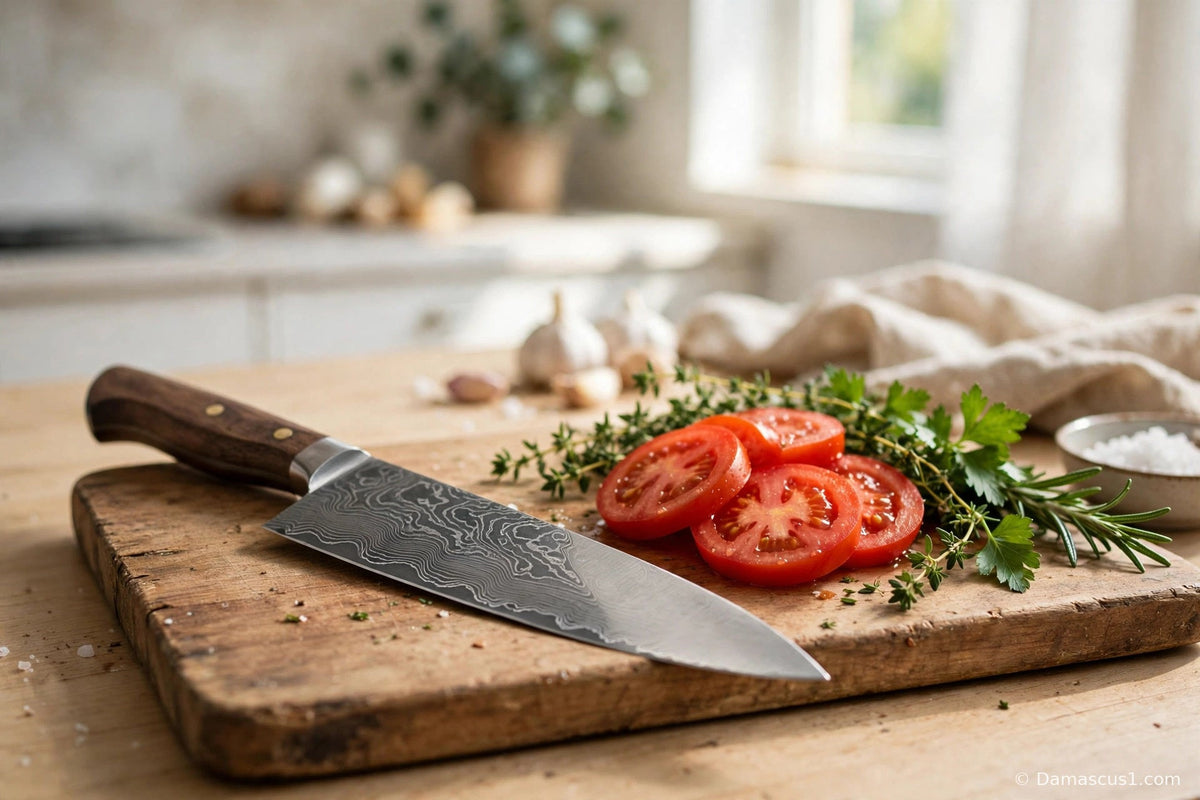
The real benefits of a Damascus knife are a pattern no other knife shares, a well-made edge whose behaviour comes from the steels inside the blade, natural materials and handmade finish, and an object people actually keep — as a daily tool, a kitchen workhorse, or a gift. The benefits are real. They are just not magic, and this page grades them honestly.
That grading is the point. Earlier versions of this page listed only the upside: beautiful, durable, timeless, made for a purpose. All four words can be true, and a list that stops there still misleads, because it leaves out the trade that comes with the knife — it can rust, it asks for care, the market is full of fake patterns, and the wavy figure in the steel does not, by itself, cut anything. What follows is the complete version: each benefit examined, each downside stated, real prices on real knives, and a clear answer on who should buy one and who should not. If you want the definition first, start with what is a Damascus knife? — this page takes the next question, which is what owning one actually does for you. The starting point of the range itself is the Olive Wood Damascus Pocket Knife Set at $39.99, a 6.5-inch folder with a genuine leather sheath included, in the everyday EDC pocket knives collection.
What are the benefits of a Damascus knife?
The genuine benefits are five: a one-of-a-kind pattern that also proves the blade is layered steel; cutting performance that, in a well-made knife, matches the good steels it is built from; a handmade object in natural materials that feels personal to use; strong gift and keeping value; and, in clad kitchen construction, a hard core protected by softer layers. Everything beyond those five is marketing.
Hold those five against the claims you will see elsewhere and the picture sharpens. "Sharper because it is Damascus" is not a benefit — sharpness comes from the edge geometry and the steel at the edge, not from the figure above it. "Never rusts" is not a benefit either, because for the common high-carbon construction it is not true. "Thousands of layers" is not a benefit in itself; layer count changes how fine the pattern looks, not how the knife works. Stripping the list down to what survives scrutiny does not make Damascus less worth buying. It makes the reasons honest ones, and honest reasons are the kind a buyer can still be glad about a year later. The graded version of the whole list is in the table a little further down, and the general money question — across kitchen, pocket, and field knives — is worked through separately in are Damascus knives worth it?.
Does the Damascus pattern make a knife cut better?

No. The pattern is the visible record of how the blade was built — layers of different steels forge-welded together and then etched so the layers show. Cutting is decided by the steels themselves, the heat treatment, the grind, and the edge angle. A plain knife built from the same steels, treated and ground the same way, cuts the same.
Understanding that one point protects you from most of the bad buys in this category. A seller who prices the photograph — who talks about the waves as if they were a cutting feature, or charges more for a finer pattern as if it were a performance grade — is telling you the money goes on looks while implying it goes on work. Looks are a legitimate thing to pay for; this entire category exists partly because the pattern is beautiful. The dishonesty is only in the implication. It also explains why two knives with equally dramatic patterns can behave completely differently in the hand: one is well-made steel wearing its construction openly, the other is mediocre steel wearing the same costume. How the layered billet is actually built, fold by fold, is explained in how pattern-welded pocket knives are made, and the common pattern families — what each one is and is not evidence of — are compared in the basics of Damascus knife patterns.
There is one honest sense in which construction, not pattern, does help in the kitchen. Many Japanese Damascus kitchen knives are built as a hard cutting core clad in softer layered steel. There, the layers are a jacket: the core does the cutting, and the softer sides add a measure of protection and, on some grinds, help food release from the blade face. That is a real construction benefit — but it belongs to the clad design, not to the wavy figure the etching reveals, and a pattern-welded pocket or hunting knife, layered all the way through, should not be sold with clad-knife language. Earlier versions of this page did exactly that, describing every Damascus knife as hard steel placed between softer layers. It has been corrected here because the distinction changes what a buyer should expect.
Do Damascus knives hold an edge longer?
A well-made Damascus knife holds an edge about as well as a good knife made from the same steels — which can be very well indeed, because the steels commonly used in quality Damascus work take and keep a keen edge. What it does not do is hold an edge longer because it is Damascus. Edge life is steel, hardness, and geometry, not pattern.
That answer frustrates people who want a simple yes, but it is the useful one. It tells you what to ask before you buy: what steels is the blade made from, and what does the seller actually state about it? A listing that names its construction plainly is a better sign than a listing that quotes a layer count and nothing else. It also tells you how to judge the knife once you own it. A Damascus blade that dulls quickly is not evidence that Damascus disappoints; it is evidence that that particular knife was softly treated or coarsely ground, and a plain knife with the same faults would dull just as fast. Conversely, a Damascus knife that stays keen through weeks of ordinary prep is doing so for ordinary, checkable reasons — good steel, properly hardened, sensibly ground — and those reasons, not the waves, are what you paid for. The steel-versus-steel comparison for one common kitchen core is in Damascus vs VG10, and the sharpening method that keeps any of these edges honest — a whetstone, a shallow, patient angle — is in how to sharpen a Damascus knife.
One practical note follows from this. Because heavy sharpening removes metal, and the etched pattern is shallowest near the edge, aggressive or constant sharpening gradually softens the figure where the blade meets the food. Sharpen when the knife needs it, hone and strop in between, and the pattern lasts as long as the knife does. Treated that way, edge care and pattern care turn out to be the same habit: as little intervention as the work requires, done properly when it is required.
Are Damascus knives more durable than regular knives?
Not automatically. A well-made Damascus knife is a durable tool — forge-welded layers, properly heat-treated, in a sensible grind will take years of ordinary kitchen, camp, and carry work. But durability is earned by the making, not conferred by the material's name, and a poorly welded or badly treated Damascus blade can fail sooner than a humble plain knife made well.
This is where the old version of this page went furthest wrong, calling the knives incredibly strong and, for hunting and survival, saying there is nothing better. There is a more careful truth underneath the boast. Layered construction can be forgiving: steels with different characters welded into one blade can handle the small shocks of real use without the brittleness a single very hard steel sometimes shows. But "can be forgiving, when well made" is a different claim from "nothing is better", and the difference is the whole of honest buying. For genuinely heavy field work — batoning, prying, levering — the honest variable is not Damascus versus plain at all; it is fixed blade versus folder, full tang versus pivot, thick stock versus thin. A fixed blade has no joint to foul or loosen, which is why the field pick in the priced list below is a fixed tracker rather than a folder. The shortlist built on exactly that reasoning is the best hunting knife guide.
Durability also has a quiet second half: the handle and the finish. Natural handle materials — olive wood, horn, bone, stag — are tough in ordinary use and pleasant in the hand, but they are not synthetic, and they punish the same neglect that punishes the blade: soaking water, dishwasher heat, and hot dashboards dry, crack, and warp them over time. A knife kept dry, in its sheath, away from the sink's worst habits, keeps both its edge and its handle. That is not fragility; it is the ordinary care any good tool expects, and it is priced into the downsides section below rather than hidden from it.
Why does every Damascus knife look different?

Because the pattern is made, not printed. Layers are stacked, welded, drawn out, and worked until they flow, and the exact flow depends on the steels, the patterning method, and the maker's hands — so the finished figure on one blade exists on no other. Etching reveals what the forging put there; it does not stamp a repeat design onto the surface.
That uniqueness is the benefit buyers feel most directly, and it carries three practical consequences worth naming. First, it is evidence: a pattern that runs through the steel, continuing over the spine and fading honestly at the edge, is hard to fake cheaply, which is why the authenticity checks further down work at all. Second, it is identity: the knife you carry is recognisably yours, in a way no two identical factory knives can be — a small thing that turns out to matter daily, because people take better care of objects that feel like theirs. Third, it is why Damascus dominates the gift end of the knife market. A gift that could be anyone's is forgettable; a blade whose figure exists once cannot be interchangeable, and adding a name or a date by engraving completes the thought. The wider beginner's framing, for readers starting from zero, is in a brief guide to Damascus knives.
Here is the grading table this page promised — every commonly claimed benefit, marked as plainly as the evidence allows. This is the asset to bookmark and to send to anyone being sold a Damascus knife on miracles.
| Claimed benefit | Grade | The honest version |
|---|---|---|
| Unique, beautiful pattern | Real | Made, not printed; no two blades share the same figure |
| A sharp, keen edge | Real — with conditions | Set by the steels, heat treatment, and grind, as in any good knife |
| Long edge retention | Partly | As good as the steels it is made from — not better because it is Damascus |
| Extra toughness from layering | Partly | Well-made layered steel can be forgiving; badly made layered steel is a liability |
| Rust resistance from the layers | Myth | High-carbon pattern-welded steel rusts readily if put away wet |
| The pattern improves cutting | Myth | The figure is construction made visible; it is not a cutting feature |
| More layers means a better knife | Myth | Layer count changes the pattern's fineness, not the knife's quality |
| A gift that will be kept | Real | Unique pattern, natural handle, and engraving make it one person's knife |
| Food releases better (clad kitchen knives) | Partly | True of some clad grinds; it is the geometry and jacket, not the waves |
Are Damascus knives good for the kitchen, hunting, and everyday carry?

Yes — in each role, for the jobs that role actually involves. In the kitchen, a well-made Damascus chef or set brings a keen edge and a blade you enjoy reaching for. As a pocket knife, it is a handsome light-duty daily tool. In the field, a fixed-blade Damascus knife is a durable cutting tool. The limits are job limits, not material failures.
| Job | Damascus verdict | Best for |
|---|---|---|
| Daily kitchen prep | Yes | Cooks who sharpen on a stone and hand-wash; see the best kitchen knives hub |
| A full kitchen set | Yes | One purchase that covers chef, slicing, and utility work with a matched look |
| Everyday pocket carry | Yes | Packages, cord, fruit, small repairs — light duty, done with an object you like handling |
| Hunting and camp cutting | Yes, fixed blade | Field dressing and camp work with no pivot to foul; a folder is the wrong form here |
| Gifting | Yes — the strongest case | Birthdays, groomsmen, retirements: unique pattern plus engraving |
| Collecting for pleasure | Yes, with open eyes | Collect patterns and makers you like; pleasure is the return |
| Zero-maintenance use | No — stainless wins this row | A knife that will be left wet, dishwashed, or lent freely should be plain stainless |
| Heavy prying and batoning with a folder | No | Wrong tool entirely; that work belongs to a thick fixed blade, Damascus or not |
The kitchen case deserves one extra sentence, because it is where the clad construction genuinely earns its keep. A hard core takes a fine edge and holds it through long prep sessions, while the softer layered sides give the thin blade a little protection against the small lateral stresses of board work. That is a real, feel-it-in-use benefit — and it is still not the pattern doing it. If the kitchen is your main interest, the set-level shortlist is in the best Damascus chef knife set guide, and the ranked folder shortlist for carry is the best Damascus pocket knife guide, with the wider field in the best pocket knife hub.
What are the disadvantages of a Damascus knife?
Four, and none of them is a reason to walk away — they are the price of the benefits, stated up front. It can rust, because the common construction is high-carbon. It asks for hand care instead of a dishwasher. Real work costs real money, so the market is flooded with cheap fake patterns. And in hard clad kitchen steels, a fine edge can chip on bone, frozen food, or a twisted cut.
Take them in order. Rust is the one that surprises buyers most, usually because a listing implied the opposite; the full honest position is the next section. Care is a few minutes, not a hobby: wash by hand, dry, oil now and then, store dry. Price cuts both ways — handmade work is never the cheapest knife in the drawer, which is exactly why the fake end of the market exists, selling a printed or lightly etched figure on ordinary steel at a Damascus-looking price. Chipping is the kitchen-specific one: the harder the edge, the finer it can be ground, and the less it forgives being levered sideways in a chicken joint or dropped on tile. None of these is hidden by good sellers. A page that lists benefits without them — as this page used to — is asking you to discover the trade after you have paid for it.
There is also a softer disadvantage worth admitting: disappointment risk. Damascus is sold with so much mythology that a perfectly good knife can feel like a let-down against the legend. Bought for the five real benefits, the same knife satisfies for years. That gap between legend and object is a marketing problem, and the cure is pages like this one.
Can Damascus steel rust?
Yes. Pattern-welded Damascus in the common high-carbon construction rusts readily if it is put away wet, left in a damp sheath, or forgotten in a sink — the layers do not protect it, and in some conditions the figure itself shows the first spotting. Stainless-clad Japanese kitchen Damascus resists far better. Either way, drying after use is the whole secret.
The detailed version — why it happens, what early spotting looks like, how a light patina differs from damaging rust, and how to recover a neglected blade — is in can Damascus steel rust?. The short working rules fit in one breath: wash by hand and dry straight away, never leave the knife soaking, wipe a trace of oil over the blade before longer storage, and store it dry — in its sheath on the bench, not loose in a wet drawer. A folder wants the same courtesy at its pivot, where trapped moisture does its quiet work unnoticed. Owners who follow those rules report the rust question simply never arising; owners who treat a high-carbon blade like a stainless one meet it within weeks. The steel is not fragile. It is just honest about wanting to be dried, the way cast iron and carbon-steel pans are honest about the same thing, and for the same reason.
How much do Damascus knives cost?

Expect a wide market. Big-brand and premium factory Damascus knives commonly run from about $100 to $500 and beyond, while honest handmade knives sold maker-direct start far lower — the Damascus1 folders below begin at $39.99 with a leather sheath included. At any price, the question is the same: does the seller state what the blade actually is?
The spread confuses buyers because it mostly is not about steel. It is about labour, distribution, and brand. Forge-welding a billet, working the pattern, grinding, heat-treating, etching, and fitting a natural handle is skilled time, and time is the ingredient that cannot be discounted away. A maker-direct store sells that time without layers of wholesale and retail markup on top of it, which is how a handmade folder can sit at $39.99 while a branded factory knife with a similar figure sits at three times the price. Neither price proves quality by itself — a cheap knife can be fake-patterned and a dear one can be ordinary — but the bands explain why "Damascus is expensive" and "this Damascus knife costs $39.99" can both be true on the same day. Below are the knives most relevant to this guide, with prices checked on the live store on November 17, 2026. Prices and compare-at figures can change; the product page on the day you order is the final word.
Priced picks, verified November 17, 2026:
- Olive Wood Damascus Pocket Knife Set — $39.99 (compare at $89.99). Best for: the first Damascus knife and the safest gift. 6.5-inch folder, olive wood handle, genuine leather sheath included.
- Buffalo Horn Damascus Pocket Knife Set — $39.99 (compare at $99.99). Best for: a darker, polished look at the same entry price.
- Camel Bone Damascus Folding Pocket Knife — $39.99 (compare at $99.99). Best for: the pale, traditional handle.
- Rose Wood Folding Pocket Knife Set — $39.99 (compare at $99.99). Best for: formal and gift carry.
- Ram Horn Damascus Folding Pocket Knife — $44.99 (compare at $99.99). Best for: textured grip at a small step up.
- Stag Horn Damascus Folding Pocket Knife — $49.99 (compare at $139.99). Best for: grip in wet, cold, or gloved hands.
- Olive Wood Damascus Tracker — $79.99 (compare at $119.99). Best for: the field benefit — a 9.5-inch fixed blade with no pivot to foul.
- Premium Kitchen Knife Block Set, 7 pieces — $169.99. Best for: the kitchen benefit in one purchase — a matched set with block storage.
Shipping, stated plainly: the store offers free US shipping on orders over $50, so a single $39.99 folder does not clear the threshold on its own. It clears with a second folder, an accessory, or the stag horn knife plus a small add-on — and two folders as a pair of gifts is how many readers do it. The pocket-knife-specific version of the value question, with its own market bands and ownership costs, is in is a Damascus pocket knife worth it?.
How do you keep the benefits — what care does a Damascus knife need?

Minutes, not hours: hand-wash and dry after use, wipe the blade with a trace of oil now and then, sharpen on a whetstone when it dulls rather than on a pull-through, and store it dry in its sheath or block. That routine protects the edge, the pattern, and the natural handle at the same time — care is what turns the benefits into years of them.
The routine repays a closer look because each step guards a different benefit. Drying guards against the rust in the section above. Oiling guards the pattern, which is an etched surface and appreciates not being left to the kitchen's humidity. Whetstone sharpening guards the edge geometry in a way aggressive gadgets do not, and, done only when needed, it also guards the figure near the edge. Dry storage guards the handle: wood, horn, bone, and stag all dislike soaking and heat, and a sheath kept dry is protection, while a sheath kept damp is a rust trap — the one storage mistake that undoes the rest. The full kitchen version of the routine is in the kitchen knife care, cleaning, and storage guide. None of it is specialised, and none of it is optional in the way sellers sometimes imply; it is simply the standing deal — a few minutes of care in exchange for a knife that stays keen, figured, and tight for a very long time.
How do you tell a real Damascus knife from a fake pattern?
Look for a pattern that runs through the steel: it should continue over the spine, show on both faces with the natural variation of a made thing, and fade honestly where the edge is ground. A figure that sits identically on the surface, stops at the spine, or looks printed under close light is decoration on plain steel — and a fake gets none of the benefits on this page.
The checks, in the order a buyer can actually do them, are these. First, the spine test: real layered steel shows its layers on the spine and tang, because the billet is layered all the way through; a surface-etched fake is plain there. Second, the variation test: a made pattern flows and shifts like wood grain, while a printed one repeats with a regularity no forge produces. Third, the seller test, which is the strongest of the three: a genuine maker states the construction plainly and prices the work, not the photograph, while a fake's listing leans on layer counts and superlatives and goes quiet when asked what the blade is. Fourth, the price test: a figure that would be cheap for a plain knife does not become real Damascus by being labelled one. The complete, illustrated version of every check is in how to spot a fake Damascus knife. This matters to a benefits page for a simple reason: every real benefit above — the made pattern, the steels' edge, the keeping value — belongs only to the real thing.
Who should — and should not — buy a Damascus knife?
Buy one if you will enjoy using a handmade, one-of-a-kind tool, if you cook or carry daily and will give it minutes of care, or if you need a gift that will genuinely be kept. Do not buy one if the knife will live wet, be lent freely, go through a dishwasher, or be expected to appreciate in value — buy plain stainless, and enjoy it without a second thought.
That is the whole argument of this page in one paragraph, and it is a more favourable argument for Damascus than the mythology ever made. The mythology promised a wonder material and delivered, at best, a good knife that could not live up to its own advertising. The honest version promises a beautiful, well-made, individual tool — sharp for checkable reasons, durable when the making is good, and personal in a way factory goods are not — and delivers exactly that, for as long as its owner dries it after use. If that is the knife you want, the range is in the everyday EDC pocket knives collection and the kitchen sets, starting with the Olive Wood Damascus Pocket Knife Set at $39.99. Buy it for the real benefits, keep it with the simple care above, and it will repay you every time you pick it up.
Shop handmade Damascus pocket knives
Prices checked November 21, 2026. The product page on the day you order is the final word.
- Olive Wood Damascus Pocket Knife Set, 6.5 in.: $39.99
- Green Wood Damascus Pocket Knife Set, 6.5 in.: $39.99
- Buffalo Horn Damascus Pocket Knife Set, 6.5 in.: $39.99
- Stag Horn Damascus Folding Pocket Knife, 6.5 in.: $49.99
- Camel Bone Scrimshaw Damascus Folding Pocket Knife, 7.6 in.: $49.99
- Ram Horn Scrimshaw Damascus Pocket Knife, 7.6 in.: $59.99
Damascus pocket knives under $50 · All handmade Damascus pocket knives
Frequently asked questions
What is Damascus steel?
Damascus steel is steel made by forge-welding layers of two or more steels together, then etching the blade so the layers show as a wavy pattern. The pattern runs through the blade, so it stays after sharpening. Kitchen knives often use it as cladding around a hard core; handmade pocket and hunting knives are commonly layered through the whole blade.
Is Damascus steel good for knives?
Yes — when it is well made. Good Damascus combines steels that take and hold a keen edge with a distinctive, one-of-a-kind pattern. Its quality depends entirely on the steels used, the forge welds, and the heat treatment, which is why a seller who states the construction plainly is a better sign than one who quotes only a layer count.
What are the main disadvantages of Damascus knives?
Four: high-carbon Damascus can rust if it is put away wet; it needs hand care rather than a dishwasher; genuine handmade work costs more than a plain factory knife, which invites cheap fake patterns; and a hard, fine kitchen edge can chip on bone, frozen food, or a twisted cut. None is hidden by honest sellers.
Do Damascus knives stay sharp?
A well-made Damascus knife stays sharp about as well as a good knife made from the same steels — the edge is set by the steel, its hardness, and the grind, not by the pattern. Sharpen it on a whetstone when it dulls, and avoid heavy, frequent sharpening, which gradually softens the etched figure near the edge.
Why are Damascus knives expensive?
Because of time. Forge-welding a billet, working the pattern, grinding, heat-treating, etching, and fitting a natural handle is skilled hand labour, and labour is most of the ticket. Prices still vary widely — branded factory knives commonly run $100 to $500 or more, while maker-direct handmade folders start at $39.99 — because brand and distribution sit on top of the same hours.
How long does a Damascus knife last?
A well-made Damascus knife, cared for, can serve for many years — there is no expiry in the steel itself. What shortens a knife's life is almost always neglect: rust left to deepen, dishwasher heat, soaking water warping a natural handle, or a sheath stored damp. Dry it, oil it occasionally, and store it dry, and longevity takes care of itself.
Are Damascus knives suitable for beginners?
Yes, with the care deal understood. A first Damascus knife at a maker-direct price is a cheap way to learn whether you enjoy owning one: the cutting is ordinary good-knife cutting, and the only new habits are drying the blade and sharpening on a stone. A beginner who knows they will never dry a knife should start with stainless instead — that honesty saves both the knife and the money.
Benefits explain what a Damascus knife does for you. The other half of the story - the pattern, the uniqueness, the craft - is in why Damascus knives are so popular, where the reasons people love them are graded just as honestly.
Leave a comment: