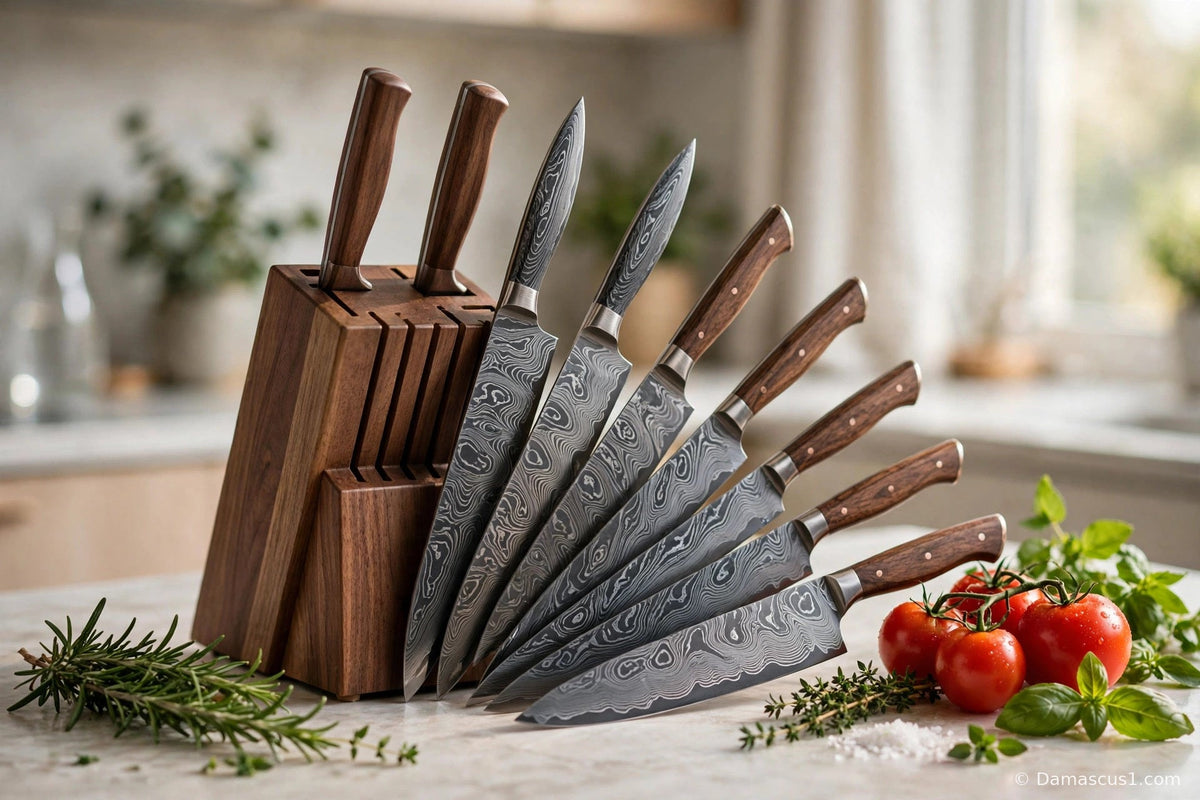
Direct answer: The best kitchen knives for most home cooks in 2026 are a complete, honestly priced set built around a proper 8-inch chef's knife — and at Damascus1 right now, that's the Premium 7-Piece Knife Block Set at $169.99. It covers every core job in a home kitchen in one purchase, ships free at that price, and costs less than many single big-brand chef's knives. Buy the set first. Add specialists later, only when a recipe proves you need one. The full range sits in the Kitchen Knife Sets & Chef Knives collection.
That's the short version. The honest version takes longer, because "best kitchen knives" is one of the most gamed phrases in all of shopping. Listicles crown winners they've never cooked with. Brands pay for placement. Sets get padded with knives nobody uses so the piece count looks impressive next to a competitor's. So this guide does something plainer and, we'd argue, more useful: it explains what a kitchen knife actually has to do, which five or six blades cover nearly all of it, how to read steel and handle claims without a metallurgy degree, and exactly where the Damascus1 range fits — including the places where our own product pages need a more careful read. If you finish this page and buy nothing from us but understand knives better, it still did its job.
What are the best kitchen knives for most home cooks?
The best kitchen knives for most home cooks are a matched core set — chef's knife, bread knife, slicing knife, santoku or second prep blade, boning or utility knife, and paring knife — in steel that holds an edge but can be sharpened at home, with handles that stay comfortable through a full hour of prep. One good set beats a drawer of mismatched singles bought at random.
Why a set first, when so much advice says buy knives one at a time? Because the one-at-a-time advice assumes you already know your own cooking. Most home cooks don't — not in knife terms. You know you cook. You don't yet know whether you're a rock-chop person or a push-cut person, whether you break down chickens twice a month or twice a year, whether bread is a daily job or a Christmas job. A sensibly priced set answers those questions by living in your kitchen. Six months in, the knives with wear tell you who you are as a cook. The one that never leaves the block tells you what not to upgrade.
There's a second, duller reason: money. A set prices its blades as a bundle, and the per-knife cost drops hard. Our core pick below works out to roughly twenty-four dollars a blade before you count the block and sharpener the page describes — a number no reputable single-knife purchase can touch. The trade-off is real, and we'll name it: a set gives you the manufacturer's chosen mix, not yours. That's exactly why the sections below grade each blade in the set individually, so you can see which pieces are doing the heavy lifting and which are along for the ride.
And a third reason, the one nobody puts in listicles: consistency. Knives from one set share a handle shape, a weight language, an edge style. Your hands learn them as a family. Switching between them mid-recipe feels like changing gears in the same car, not borrowing a stranger's. For a home cook building speed and confidence, that familiarity is worth more than a spec-sheet victory in any single category.
Which kitchen knife do you actually use for what?

You'll use the 8-inch chef's knife for roughly eight out of ten cutting jobs — vegetables, proteins, herbs, fruit. The santoku is its flatter-bellied partner for precise, up-and-down chopping. The bread knife handles crusts and soft tomatoes without tearing. The slicing knife makes long, clean cuts on roasts. The boning knife works around joints, the utility knife covers mid-size jobs, and the paring knife does in-hand detail work.
Let's slow down and earn each of those claims, because "which knife for what" is where home kitchens quietly go wrong. People force one knife — usually the chef's — through every job, then blame the knife when the job feels awful. Slicing a crusty loaf with a chef's knife crushes the crumb no matter how good the blade is. Trimming a chicken with a paring knife takes forever. The tools aren't failing. The matching is.
The chef's knife (8 inch) is the anchor. Its curved belly lets the blade rock: tip stays near the board, heel lifts and falls, and a pile of onions becomes mince in a steady rhythm. Eight inches is the home-kitchen sweet spot — long enough for a cabbage or a melon, short enough to control in a sink-side board space. Longer blades exist and some cooks love them, but reach without control is just a longer way to be imprecise.
The santoku (7 inch in our set) trades the chef knife's rock for a flatter profile and a sheepsfoot tip. Push-cutting — straight down, slight forward glide — is its home territory, and for dense vegetables, neat dice, and thin, even slices it often feels calmer and more predictable than a chef's knife, especially for cooks with smaller hands or a less practised rocking motion. Owning both isn't duplication. It's two dialects of the same language, and most cooks end up fluent in one and functional in the other.
The bread knife (8 inch) earns its slot with serrations, and serrations are misunderstood. They aren't a lesser edge; they're a different mechanism — a row of small points that start the cut through a hard crust without the downward force that squashes soft interiors. The same mechanism glides through tomato skin that a dull straight edge would skate across. Which is also the honest warning: if your chef's knife can't handle a tomato, the fix is sharpening, not reaching for serrations forever.
The slicing knife (8 inch) is the quiet specialist: long, narrow, built for single-pull strokes through roasts, hams, salmon sides, and large fruit. Short sawing strokes tear fibres and leave ragged faces; one long draw keeps them clean. You won't use it daily. On the days you need it — a holiday roast, a whole fish — nothing else in the block substitutes.
The boning knife (6 inch) is narrow and nimble for a reason: it has to travel around joints, along bones, and under silverskin in spaces a wider blade can't enter. Home cooks who buy whole chickens — and anyone trying to save money on meat eventually does — will feel the difference in the first bird.
The utility knife (5 inch) is the in-between blade: too big for in-hand work, too small for board marathons, perfect for the sandwich, the apple, the cheese, the avocado, the dozen small jobs that don't justify washing the chef's knife. The paring knife (3.5 inch) finishes the set: hulling, segmenting, peeling, deveining — work done in the hand, over a bowl, where control matters more than power.
Is a knife set or individual knives the smarter buy?
For most households, a set is the smarter first buy: it covers every core job at a much lower cost per blade, keeps handles and sharpening consistent, and shows you — through real use — which single knife deserves an upgrade later. Individual knives make sense as targeted replacements or specialist additions once you know exactly which job your current blades handle badly.
The math deserves thirty seconds. Bought one by one, seven respectable kitchen knives plus storage plus a sharpener add up fast, and the total usually lands well past the price of a bundled set of comparable everyday quality. The set discount isn't a trick; manufacturers genuinely save on packaging, shipping, and selling seven things at once instead of seven separate times, and some of that saving reaches you. What you give up is choice: the set's mix, steel story, and handle are take-it-or-leave-it. What you gain is a complete, working kitchen on day one.
The upgrade path matters more than the starting point, honestly. Cook with the set for a season. Notice which knife your hand reaches for without thinking — that's your primary, and if any single blade later earns an upgrade budget, it's that one. Notice which knife annoys you: too heavy by minute twenty, slippery when wet, always the one that's dull. Annoyance is data. The cooks who end up with a truly personal, excellent knife collection almost never bought it that way. They grew it, one informed replacement at a time, out of a set that taught them their own habits.
One more consideration that rarely gets said out loud: sets make better gifts than singles, by a wide margin. A single chef's knife is a connoisseur's gift — wonderful if you know the recipient's taste, risky if you don't. A handsome block set on a counter is a complete, generous, immediately usable present for a wedding, a housewarming, or a first apartment, and it doesn't require the giver to know anything about the recipient's grip. If you're buying for someone else, that completeness is the point.
What steel makes the best kitchen knife?

The best kitchen-knife steel balances three things: how keen an edge it can take, how long that edge survives real cooking, and how forgiving it is when you sharpen it at home. Hard, fine-grained core steels like VG10 are prized because they take a very sharp edge and hold it well; softer or simpler steels sharpen easier but need it more often. No steel wins all three at once.
Steel talk gets mystical fast, so here's the grounded version. When a blade is described as Damascus, that word is about construction, not a single steel: layers of steel are forge-welded, folded, and patterned, then usually built around — or combined with — a harder core that forms the actual cutting edge. The wavy surface you see is the visible record of those layers. It's genuinely beautiful, and it can tell you something real about how the knife was made. What it can't tell you, by itself, is how the edge will behave. The core steel and its heat treatment decide that. If you want the full honest explainer, our guide to Damascus vs VG10 walks through the distinction without the marketing fog.
Now the uncomfortable part, said plainly because this guide promised honesty: product pages in this category — including ours — don't always tell one clean steel story. Our core pick below, the Premium 7-Piece set, is described on its own product page with both AUS10 Damascus and German high-carbon language in different places. Those are different steel families. We are not going to smooth that over and present you a single tidy spec as if it were certain, because it isn't, from the page as written. What we can say is exactly what's in the product cards: check the current product page before you order, and if the steel designation matters to you — it reasonably might — ask the seller to confirm which description applies to the set you'd receive. A trustworthy kitchen purchase starts with a question you're allowed to ask.
By contrast, the Professional 6-piece set below is listed on its product page as a VG10-core Damascus construction with 67 layers and G10 handles — a clearer, more specific claim, and the reason it sits as this guide's upgrade pick. Clearer claims are easier to hold a seller to, ours included. Hold us to them.
Hardness numbers get thrown around in this category like scores in a game. Resist the scoreboard instinct. A harder edge can stay keen longer and can also be less forgiving of twisting, prying, and bone contact; a slightly softer edge gives some of that toughness back and sharpens with less fuss. Home cooking punishes both extremes rarely — you're not butchering all day or performing surgery. You want the broad, competent middle, maintained regularly. Which brings us to the subject most knife content avoids because it doesn't photograph well: the best steel in the world, dull, loses to ordinary steel, sharp. Every time. The sharpening section below matters more than this one.
How much should you spend on kitchen knives?
Spend enough to cover the core jobs with blades you'll happily maintain — for most households, that's a complete set somewhere in the $150 to $400 range rather than a $40 novelty set or a four-figure trophy purchase. Below that band, steel, fit, and finish usually suffer; above it, you're mostly paying for refinement and rarity, not for dinners that cook noticeably better.
Let's be specific with the real prices in this guide, because vague ranges help no one at checkout. At $169.99, the Premium 7-Piece set is this guide's value anchor: seven working blades plus block storage, free shipping at that price point, and a per-blade cost that leaves room in the budget for the two things that actually protect the purchase — a decent cutting board and the willingness to sharpen. At $349.99, the 9-piece Blue G10 set buys you more pieces and a bolder handle material, aimed at bigger households and gift buyers who want presence on the counter. At $399.99, the Professional 6-piece Japanese VG10 set is the enthusiast step: fewer pieces, a more specifically described core steel, and G10 handles listed on its page. Notice the pattern — as price rises, you're choosing between more pieces and more specification. Neither is automatically wiser. It depends on whether your kitchen needs coverage or refinement, and by the time you're spending at the top of this guide's range, you should know which one you are.
What about the truly cheap sets, the ones with double-digit piece counts at startling prices? Approach them the way you'd approach any too-good arithmetic. More pieces at a far lower total price means the money came out of somewhere — steel, heat treatment, handle, finish, or quality control. For a first apartment that needs anything at all in the drawer, a cheap set is a rational stopgap. Just buy it knowing it's a stopgap, and don't let its dullest habits convince you that you dislike cooking.
And the four-figure end? Beautiful objects live there, and some are worth every cent to the people who collect them. But nothing about a weeknight stir-fry improves past the point where the edge is keen, the handle is comfortable, and the blade suits the job. Spend the difference on ingredients. Seriously. The knife will not mind.
Which Damascus1 kitchen knives made the shortlist?

Every price below was verified live on October 16, 2026. Prices can change; the product page on the day you order is the final word. Where a detail comes from the product page rather than independent verification, we say so.
| Pick | Best for | What's included | Price (verified Oct 16, 2026) |
|---|---|---|---|
| Premium 7-Piece Knife Block Set | Best for most home cooks — the complete core set | 8" chef's, 8" bread, 8" slicing, 7" santoku, 6" boning, 5" utility, 3.5" paring + block/sharpener as described on its page | $169.99 |
| Professional 6-pc Japanese VG10 Damascus Set | Best for enthusiasts who want a specifically listed VG10 core | Listed on its page: 8" chef, 7" santoku, 8" bread, 6" boning, utility, 7" cleaver; 67 layers, G10 handle | $399.99 |
| 9-pc Blue G10 Knife Block Set | Best for larger households and statement gifts | 9-piece set with blue G10 handles (see product page for the current piece list) | $349.99 |
| VG10 Nakiri | Best for vegetable-heavy cooks adding one specialist | Single nakiri vegetable knife | $44.99 |
Product cards — priced, linked, and framed by the job
Best for most home cooks — Premium 7-Piece Knife Block Set — $169.99. The complete core kit in a single purchase: 8-inch chef's, 8-inch bread, 8-inch slicing, 7-inch santoku, 6-inch boning, 5-inch utility, and 3.5-inch paring, with the block and sharpener as described on its product page. One honest caveat, repeated from the steel section because it belongs wherever this set is sold: that page mixes AUS10 Damascus and German high-carbon descriptions, so treat the steel story as "check the page and ask us" rather than a single settled spec. The coverage, the price, and the free shipping over $50 are not in doubt. View the Premium 7-Piece Knife Block Set.
Best upgrade — Professional 6-pc Japanese VG10 Damascus Set — $399.99. For the cook who already knows their habits and wants the more specifically described blade: its product page lists a VG10 core, 67 layers, and G10 handles, across an 8-inch chef, 7-inch santoku, 8-inch bread, 6-inch boning, a utility knife, and a 7-inch cleaver. Fewer pieces than the 9-pc set, more specification per piece. View the Professional VG10 set.
Best for bigger households and gifts — 9-pc Blue G10 Set — $349.99. Nine pieces and blue G10 handles that make the block a deliberate piece of counter theatre as well as a tool store. Check the product page for the current piece list before ordering, as set compositions can be updated. View the 9-pc Blue G10 set.
Best single add-on — VG10 Nakiri — $44.99. If your cooking is vegetable-led — stir-fries, salads, curries, meal-prep Sundays — a nakiri's flat profile and tall blade turn a sack of produce into neat, even cuts with a rhythm people genuinely describe as relaxing. At $44.99 it's the cheapest meaningful upgrade in this guide, and it pairs with any set above. Note that at this price it sits under the $50 free-shipping threshold on its own, so it makes most sense added to another order. View the VG10 Nakiri.
If sets are your focus, our dedicated guide to the best Damascus chef knife set goes deeper on block-set buying specifically, and deal-hunters should keep an eye on the Black Friday Damascus knife deals for 2026 roundup as the season approaches.
Japanese or German kitchen knives: which style suits you?
Choose the Japanese style if you favour lighter blades, harder steel, and precise push-cutting; choose the German style if you favour heavier, tougher blades, a pronounced rocking motion, and forgiveness around bones and frozen foods. Plenty of good home kitchens run a hybrid — a Japanese-feeling chef's knife for vegetables, a sturdier blade for heavy work — and there's no rule that says you must pledge one flag.
The difference is philosophy expressed in geometry. Japanese kitchen tradition prizes thin edges, acute angles, and steels that can hold them; the payoff is glide — a blade that falls through an onion with almost no wedging — and the cost is a little delicacy. You don't twist a fine edge in a squash and expect gratitude. German tradition prizes durability: thicker spines, broader angles, softer-toughening steels that shrug off the chaos of a busy family kitchen, sharpen quickly on almost anything, and ask less technique of the cook. Neither philosophy is wrong. They're answers to different kitchens.
Where does a Damascus range like ours sit? Honestly, across the line. The blade shapes in our sets — a santoku and nakiri alongside a Western-profile chef's knife — borrow openly from Japanese forms, while a block set sold for American home kitchens is a German-style idea: complete, sturdy, general-purpose. We think that's a defensible place to stand. Most home cooks in Dallas or Des Moines or Denver aren't running a single-tradition kitchen; they're making tacos on Tuesday and stir-fry on Thursday. Hybrid tools for hybrid cooking.
Judge any individual knife by the meal in front of it, not by its passport. For a pile of delicate herbs or a tray of sashimi-adjacent slicing, reach for the thinnest, keenest edge you own. For a winter squash trying to end the evening early, reach for the sturdier blade and keep your fingers honest. The best kitchen knives, in practice, are the ones whose strengths match the next thirty minutes.
What handle material is best for kitchen knives?

The best handle is the one that stays secure in your wet hand for the length of a real prep session: dense synthetics like G10 are prized for grip, stability, and indifference to water, while quality wood and pakkawood-style handles offer warmth and classic looks but want drier, gentler treatment. Shape and balance matter as much as material — a handle that fits your hand beats a fashionable one that doesn't.
Hands are the reviewers that never lie. A handle can photograph beautifully and still fail the only test that counts, which happens around minute fifteen of prep, when your hands are wet, the board is crowded, and the blade needs to change direction without ceremony. That's why G10 shows up on both of our upper-range picks in this guide — the Professional VG10 set and the 9-piece Blue G10 set list G10 handles on their pages — and why it's worth explaining what it is: a fibreglass-and-resin laminate, compressed into a dense, stable material that doesn't swell, shrink, or sulk in a wet kitchen. It isn't romantic. It's reliable, and around sharp edges, reliable is a love language.
Wood sits at the other pole: warm, personal, sometimes genuinely gorgeous — and a material that asks for the same wash-dry-put-away respect as the blade itself. If your household's honest habit is "rinse it later," choose the handle that forgives your household. Kitchen tools should fit the cook you are, not the cook a catalogue imagines.
Balance deserves its own sentence. A knife balanced near the bolster — where blade meets handle — feels nimble for most cooks; blade-heavy knives can feel powerful to rock-choppers and tiring to everyone else. You can't fully judge balance from a product page, which is one more reason returns policy matters when you buy knives online: at the time of writing, free shipping and returns above $50 are shown site-wide on Damascus1, and a set you can send back is a set you can judge fairly, in your own kitchen, with your own hands.
How do you keep kitchen knives sharp?

Keep kitchen knives sharp with three habits: hone or strop lightly and often to keep the edge aligned, sharpen on a whetstone when honing stops restoring the bite, and store blades in a block, on a magnetic strip, or in guards — never loose in a drawer. Most "dull knife" problems are really storage and maintenance problems wearing a disguise, and they're fixable in one weekend.
Let's separate the two operations people constantly confuse. Honing doesn't remove meaningful metal; it straightens an edge that has folded microscopically in use. It's maintenance — quick, frequent, gentle. Sharpening removes metal to form a fresh edge; it's repair — occasional, deliberate, and the skill that quietly separates cooks who love their knives from cooks who replace them. Our step-by-step guide on how to sharpen a Damascus knife covers angles, grits, and the pattern-safe technique in detail; the short version here is that a whetstone, patience, and a consistent angle beat every gadget that promises sharpness without learning.
Damascus adds one care note that stainless owners can skip: layered blades built with carbon-leaning steels can react to moisture and acids if they're put away wet or left sitting in tomato juice and good intentions. It isn't fragility — generations of cooks have kept carbon blades for decades — it's a routine: wash, dry fully, store dry, and oil lightly if the knife will sit for a while. Our guide to whether Damascus steel can rust explains exactly what causes the marks people fear and how little effort prevents them. Five honest seconds with a towel after washing prevents most of it.
And storage, the silent edge-killer: a drawer where blades knock against each other and against the utensil crock will dull a fine edge faster than cooking does. The block in a block set isn't packaging — it's part of the system, which is another quiet argument for buying the set whole rather than assembling blades that then live in chaos.
How many kitchen knives do you really need?
You really need three to cook almost everything well — a chef's knife, a paring knife, and a serrated bread knife — and you'll cook more comfortably with six or seven, adding a santoku or second prep blade, a slicing knife, a boning knife, and a utility knife as your recipes demand them. Past seven, you're collecting specialists, which is fun and sometimes genuinely useful, but never required.
This is the section that argues with the product cards above, and we're keeping it anyway, because a guide that only sells is an advert with better grammar. If your budget is tight, the three-knife core is not a compromise diet version of cooking — it's what plenty of excellent home cooks actually use, daily, for years. The case for the seven-piece set isn't need. It's comfort, speed, and the pleasure of the right tool being already clean and already there: the slicing knife on roast day, the boning knife on whole-chicken day, the utility knife for the small jobs that keep the big blade on the block.
So read the set the way you'd read a menu. The first three knives are dinner. The next four are the difference between a kitchen that copes and a kitchen that flows. And the specialists beyond the set — the nakiri for the vegetable cook, a cleaver for the cook who loves big, rhythmic chopping — are dessert: buy them when you've felt their absence at least three times while cooking. That little rule, felt absence three times, will save you more money over a decade of kitchen buying than any coupon code ever printed.
Frequently asked questions
What is the single best kitchen knife to buy first? An 8-inch chef's knife. It covers the widest range of daily work — vegetables, proteins, herbs, fruit — and it's the blade every other purchase gets judged against. If you're buying a set instead, judge the whole set by its chef's knife: if that one's right, the set probably is too.
Are Damascus kitchen knives worth it? They can be, when the pattern reflects real layered construction over a competent core steel and the price stays honest — our core set is $169.99 for seven pieces. What you're paying for is the combination of a working edge and an object with genuine presence on the counter. If a Damascus knife costs dramatically more without a clearer steel story, ask harder questions before paying.
How often should kitchen knives be sharpened? Hone lightly every few uses; sharpen on a stone when honing no longer brings the bite back — for a typical home cook, that might be every few months, but it depends entirely on use, board material, and storage. The tomato test tells the truth: when a ripe tomato resists and skates instead of yielding, it's time.
Can Damascus knives go in the dishwasher? No — and neither should any kitchen knife you care about. Dishwasher heat, detergent, and jostling punish edges and handles alike, and layered blades especially want to be washed and dried by hand. The routine takes under a minute per knife and is the cheapest knife insurance that exists.
What size chef's knife is best for home use? Eight inches, for most people and most counters. It handles a cabbage without feeling like a sword and a shallot without feeling like a toy. Cooks with very small hands or very small boards sometimes prefer shorter; cooks doing high-volume prep sometimes prefer longer. Eight is where the evidence of millions of kitchens points.
Do knife sets include a sharpener and storage? Ours describes a block and sharpener on the Premium 7-Piece set's product page — check the current page for exactly what's in the box before ordering, since set contents can be updated. Whatever you buy, confirm storage is part of the plan; a great set stored loose in a drawer won't stay great for long.
Which kitchen knives should you buy? Our verdict
For most home cooks: the Premium 7-Piece Knife Block Set at $169.99 — complete coverage, one honest price, free shipping at that level — with the steel-description caveat noted above, which we'd rather print twice than hide once. For the cook who wants the clearest spec on the page: the Professional 6-pc Japanese VG10 set at $399.99, listed with a VG10 core, 67 layers, and G10 handles. For bigger households and gift-givers: the 9-pc Blue G10 set at $349.99. And for the vegetable cook building on any of them: the VG10 Nakiri at $44.99, added to an order so it rides along over the free-shipping line.
Whichever you choose, choose it like a cook, not a collector: match the blades to your actual week, keep them dry, keep them sharp, and let the set earn its place one dinner at a time. Browse the picks above, check the current product pages, and order the set that fits your kitchen today — your next onion is already waiting, and it can tell the difference.
Leave a comment: