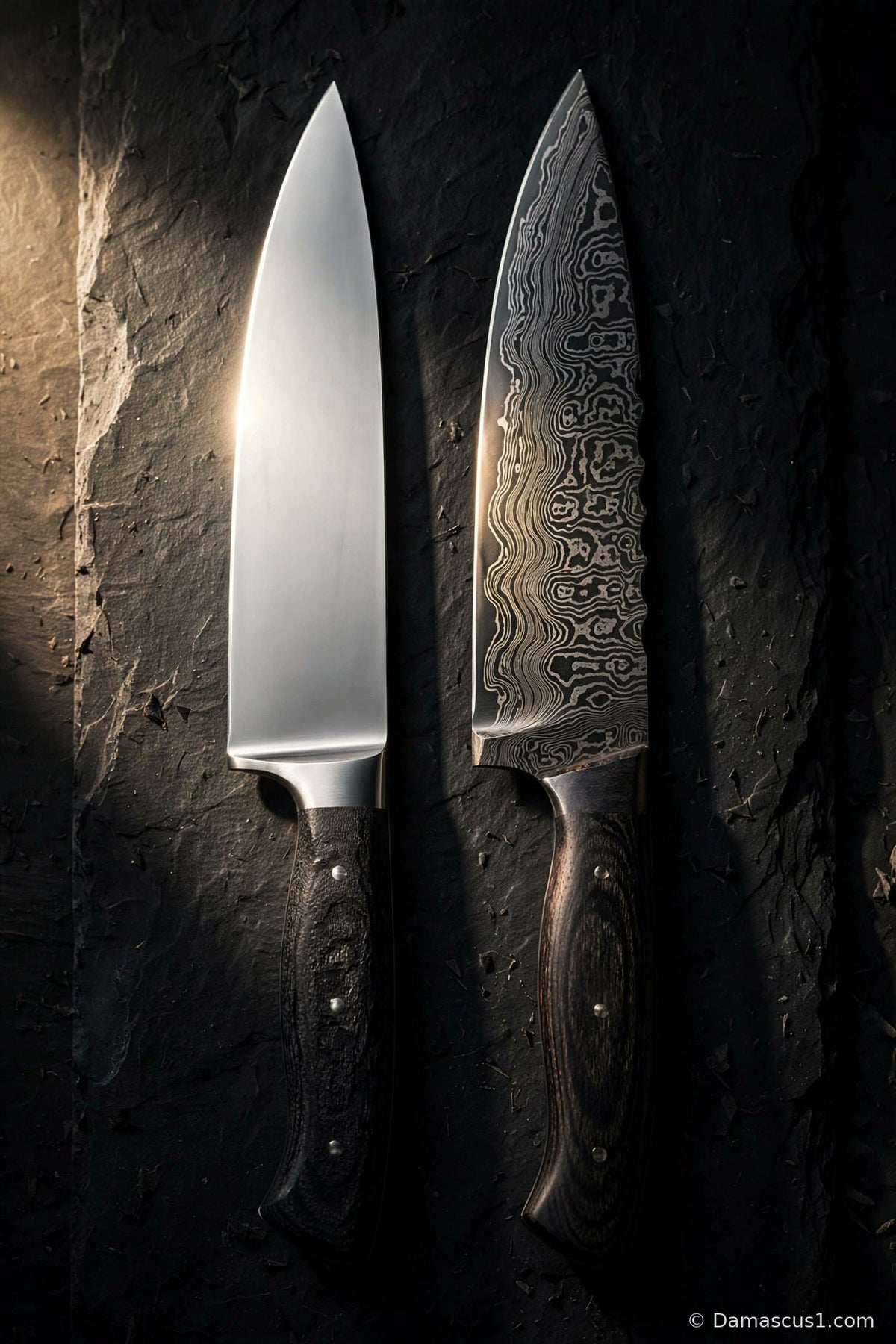
Direct answer: "Damascus vs VG10" is a trick comparison, because the two words describe different things. VG10 is a specific Japanese stainless steel — an alloy with a recipe. Damascus is a construction — many thin layers of steel forge-welded into one blade. A knife can be VG10, can be Damascus, can be neither — or, very commonly, can be both at once: a VG10 core wrapped in Damascus layers. So the real question is not which one wins. It is whether the knife in front of you names its core, and what that core is.
That one-paragraph answer resolves most of the confusion in this corner of knife shopping, and it is oddly hard to find stated plainly. Search this comparison and you land on a forum thread old enough to have a driving licence, plus product pages that use both words in the same breath without ever explaining how they fit together. Sellers are not exactly lying — a "VG10 Damascus knife" is a perfectly coherent description — but if nobody tells you that one word names the steel and the other names the structure, you cannot compare two listings intelligently. This guide fixes that. It explains what VG10 actually is, what Damascus actually is, how they combine, and how the combination behaves in the kitchen: sharpness, edge life, sharpening, rust, and price. If you are shopping while you read, the VG10-core Damascus sets at Damascus1 are the live examples this guide keeps coming back to.
What is VG10 steel?
VG10 is a Japanese stainless cutlery steel, originally developed for premium kitchen knives, typically containing around 1% carbon and about 15% chromium, with smaller additions of cobalt, vanadium, molybdenum, and manganese. It is usually hardened to roughly 60–62 HRC. In plain terms: it is a hard, fine-grained, rust-resistant steel that takes a keen edge and holds it well, which is why it became the default core steel of the modern Japanese-style kitchen knife.
Break that recipe down into kitchen language. The carbon is what lets the steel harden — no carbon, no hard edge. The chromium, at around 15%, is what makes it stainless in practice: enough chromium forms a passive surface layer that resists rust and staining far better than plain carbon steels. The cobalt contributes toughness and helps the steel keep its hardness; the vanadium forms hard carbides that support wear resistance and a fine edge; the molybdenum adds strength and corrosion resistance. You do not need to memorise any of this. You need the conclusion: VG10 was designed, deliberately, to be sharp, hard, and low-drama about water — the three things a kitchen knife most needs to be.
VG10 is also a single, consistent material all the way through a blade made from it. A plain VG10 knife — and plenty of excellent ones are plain — has the same steel at the edge as at the spine. That consistency is part of why it sharpens predictably: the stone meets one steel, behaving one way, from bevel to bevel.
What is Damascus steel, in a modern knife?

Modern Damascus steel is a layered construction: many thin sheets of two or more different steels are stacked, heated, and forge-welded into a single billet, then drawn out, sometimes folded or patterned, ground into a blade, and etched so the layers show as flowing lines. The steels etch at different rates, which is what reveals the pattern. In modern kitchen knives, those layers usually form the cladding around a separate core steel — and that core is very often VG10.
Two clarifications keep this honest. First, modern Damascus is not the legendary ancient material of historical fame; it is a contemporary layered construction that borrows the name and the look, made with modern, well-understood steels. Second, the layers are not decoration pasted on afterwards — they are real steel, welded into the blade's structure, which is exactly how you tell a genuine layered blade from a printed imitation. A printed pattern sits on the surface, looks identical from every angle, and vanishes at the edge and spine; real layers run through the blade and shift in the light. Our spot-a-fake guide gives the five checks, two of which need no tools at all.
So when a listing says "67-layer Damascus," it is describing the cladding's construction. When it says "VG10 core," it is telling you what the edge is made of. A complete listing says both. An incomplete one says only the first — and hopes you will not ask about the second.
So can a knife be both Damascus and VG10?
Yes — and most premium Damascus kitchen knives are exactly that: a VG10 core for the cutting edge, wrapped in layered Damascus cladding for structure and appearance. Damascus1's Professional VG10 Core 6 PCS Japanese Kitchen Knife Set is a textbook example, listing 67 layers of Damascus steel, a hardness of 58–62 HRC, an 11-degree edge, and G10 handles on its product page. When you see "Damascus VG10" on any listing, read it as "Damascus construction, VG10 heart."
Picture the blade as a sandwich in cross-section. In the middle, a relatively thin slab of VG10 runs the full length of the blade and forms the very edge — the only part that ever touches your onion. On either side, the layered cladding protects that core, gives the blade its thickness and pattern, and meets the food along the blade's faces. The edge's behaviour — sharpness, retention, sharpening feel — is overwhelmingly the core's behaviour. The faces' behaviour — how food releases, how the surface resists staining, how light moves across the pattern — belongs to the cladding.
This is why the old forum answer to "VG10 or Damascus?" was, in effect, "the Damascus one has a VG10 edge too, so they cut the same." That answer was pointing at something true: two knives sharing a VG10 core and similar geometry will cut far more alike than their appearances suggest. Where they differ is everything around the edge — feel, looks, maintenance of the finish, and price.
Damascus vs VG10: the head-to-head comparison
Since a plain VG10 knife and a VG10-core Damascus knife share an edge steel, the honest comparison is between the two formats: monosteel VG10 (one steel throughout) and VG10-core Damascus (core plus layered cladding). Here is how they line up on the things buyers actually ask about.
| Factor | Plain VG10 knife | VG10-core Damascus knife | Best for |
|---|---|---|---|
| Cutting edge | VG10 throughout | VG10 core at the edge | Tie — same edge steel |
| Sharpness potential | Very keen, fine edge | Very keen, fine edge (11° on Damascus1's set) | Tie, geometry decides |
| Edge retention | Strong; typical 60–62 HRC class | Strong; 58–62 HRC on Damascus1's VG10 set | Tie in practice |
| Rust resistance | High — stainless throughout | High at the core; cladding steels vary, so dry after washing | Plain VG10, by a nose |
| Sharpening | Predictable, one steel on the stone | Core sharpens like VG10; keep stones off the patterned flats | Plain VG10, slightly simpler |
| Food release | Smooth flat faces | Layered, etched faces can help food release | Damascus |
| Appearance | Clean, plain, professional | Flowing pattern, unique to each blade | Damascus, by a mile |
| Price | Usually lower for the same core quality | Usually higher — more material, more process | Plain VG10 on budget |
| Gift appeal | Understated | Immediate visual impact | Damascus |
Read the table the way a buyer should: the performance rows are ties, because the edge is the same steel. The differences live in care, looks, and cost. Anyone who tells you a Damascus blade inherently out-cuts an identical-geometry VG10 blade is selling you the pattern as performance. Anyone who tells you the pattern is "just cosmetic" is underselling the cladding's real, if modest, contributions — protection for the core, food release from an etched surface, and the simple daily pleasure of using a beautiful tool, which is a legitimate reason people maintain their knives better.
Which is sharper: Damascus or VG10?

Neither, inherently — sharpness comes from the core steel's hardness and the edge geometry ground into it, not from whether the blade wears layers. A VG10 core hardened into the low-60s HRC and ground to a fine angle, like the 11-degree edge listed on Damascus1's VG10-core set, will be extremely sharp in either format. A dull Damascus knife is just a pretty dull knife; a keen plain VG10 knife will out-cut it every time.
Geometry deserves its moment here, because it quietly outweighs steel choice in daily cutting. Edge angle decides how the blade wedges through food: finer angles slice with less effort and suit vegetables, fish, and precision work; wider angles are sturdier for heavy, hard ingredients. Blade thickness behind the edge matters just as much — a thin blade glides through an onion where a thick one splits it apart, whatever either is made of. When two listings both say VG10, compare the angle and the grind before you compare the adjectives.
Hardness plays its part within a range. Harder edges (toward 62 HRC) generally hold their keenness longer between sharpenings and take a finer polish; they also chip more readily if twisted in a joint or slammed into a bone, and they ask more patience on the stone. The 58–62 HRC band stated for Damascus1's VG10 set spans that working range honestly rather than promising a single heroic number — a small detail, and the kind this guide keeps telling you to look for.
Is Damascus or VG10 easier to sharpen?
Plain VG10 is marginally easier to sharpen, because the stone meets one consistent steel. A VG10-core Damascus knife sharpens almost identically at the edge — it is the same VG10 doing the cutting — with one added courtesy: work the bevel, not the patterned flats, so the stone does not polish the etch dull. In both cases a whetstone at the knife's original angle is the right tool; neither steel needs anything exotic.
What sharpening actually feels like differs less between these two than between hardness levels. A blade at the harder end of the range takes longer to raise a burr and rewards a finer finishing stone; a slightly softer blade sharpens quickly and forgives sloppy angles. Most home cooks sharpening a VG10-core knife a few times a year will notice no practical difference from a plain VG10 knife at all — which is, once again, the theme of this entire comparison: the edge is the edge.
The pattern-preservation point is worth one extra sentence, because it is the only genuinely Damascus-specific care note. The etched contrast lives in the surface of the cladding. Abrasive pads, aggressive polishing pastes, and stones wandering onto the flat will fade it over time. Keep your sharpening on the bevel, wash with a soft sponge rather than a scourer, and the pattern outlasts the cook. The full routine, grit by grit, is in our how to sharpen a Damascus knife guide.
Does Damascus rust more easily than VG10?

A VG10-core Damascus knife resists rust well but asks for one habit plain VG10 forgives more often: dry it after washing. VG10 itself is properly stainless thanks to its chromium content. Damascus cladding, however, is made of two alternating steels, and depending on the pairing, those layers can be less uniformly stainless than the core — so a layered blade left wet in a block can spot sooner than a monosteel one. Hand-wash, towel-dry, store dry: three habits, no rust drama.
This is the section where honesty beats reassurance, because "stainless" has done real damage as a marketing word. Stainless means stains less. Every kitchen steel in this guide — VG10, AUS-10, and the cladding steels around them — will stay bright indefinitely with basic drying, and every one of them can spot if abandoned wet, especially around salt and acids. The difference between the formats is one of degree and forgiveness, not of kind. If your household genuinely cannot commit to drying a knife, a plain VG10 monosteel blade is the more forgiving purchase, and there is no shame in choosing the tool that matches the household.
Storage finishes the job. A dry blade in a block, on a strip, or in a sheath stays dry; a blade in a damp drawer with three wet neighbours does not. If you live somewhere humid, a light wipe of food-safe mineral oil before longer storage is cheap insurance for any layered blade — a habit borrowed from carbon-steel care that does no harm here.
What about AUS-10 — where does it fit?

AUS-10 is another Japanese stainless cutlery steel in the same class as VG10, with a similar carbon level and a reputation for a slightly tougher, slightly less ultimate edge. In Damascus sets it appears as an alternative core: Damascus1's 9-piece AUS-10 Damascus set with blue G10 handles is $349.99, a touch below its VG10 sets. For most cooks the practical difference between AUS-10 and VG10 cores is smaller than the difference between a sharp knife and a dull one.
Think of AUS-10 as the VG10 conversation's quiet sibling rather than a rival camp. Both are Japanese stainless steels designed for kitchen edges; both harden into the same working band; both sit happily inside Damascus cladding. If you are choosing between two sets and one is AUS-10 while the other is VG10, let the rest of the package decide — blade list, handle, block, price — because the cores are close enough that those factors will matter more in your kitchen than the steel badge will. Our best Damascus chef knife set guide compares the actual Damascus1 sets side by side, AUS-10 included.
Where the badge does matter is resale of your own attention: some buyers simply want the VG10 name because it is the one they researched. That is a fine reason. Just buy it knowingly — for the excellent steel it is — rather than because a listing implied the alternative was inferior. It is not.
Product cards — VG10 and Damascus, priced and linked
The textbook combination — Professional Damascus Steel VG10 Core 6 PCS Japanese Kitchen Knife Set — $399.99. VG10 core, 67 Damascus layers, 58–62 HRC, 11° edge, G10 handles. See it on its product page.
VG10 with scissors and block — Professional VG10 Japanese Knife Set 7 PCS — $399.99. The alternative VG10 set shape for buyers who want the accessories in the box. View the set.
The AUS-10 alternative — Kitchen Knife Set 9 Pcs, Japanese AUS-10 Damascus, Blue G10 — $349.99. A fuller block on the sibling core. View the set.
The single-knife way in — Nakiri Knife, Japanese VG10 — $44.99. A VG10 vegetable specialist with a rosewood handle per its listing, for cooks who want to feel the steel before buying a set. View the nakiri.
How can you tell if a "VG10 Damascus" listing is honest?
An honest VG10 Damascus listing names the core, states a hardness range, gives a layer count for the cladding, lists every blade with sizes, and shows the pattern continuing over the spine and edge. A listing that says only "Damascus style," "Damascus pattern," or "premium steel" — with no core named — is telling you, in code, that the pattern may be printed and the core may be anything. The words "style" and "pattern" doing the work of the word "steel" is the oldest tell in this market.
Run the five checks before money moves. One: find the core steel named in words — VG10, AUS-10, or another specific alloy. Two: find a hardness stated as HRC, ideally as a range. Three: find the blade list with lengths, so you know what the set actually contains. Four: look at product photos of the spine and choil; real layers wrap over both. Five: read what the seller will not say — no returns terms, no specification section, no answers in the questions — and price that silence accordingly.
Damascus1's own listings are not exempt from your checklist, and this guide does not ask you to exempt them. The VG10 set above states its layers, hardness, edge angle, and handle on its page, which is why it is the example used throughout. Where a Damascus1 page is thinner — and some are — the honest move is the same as anywhere else: ask, or choose the product whose page answers you fully.
Damascus vs VG10 for gifts: which makes more sense?

For gifts, VG10-core Damascus makes more sense than plain VG10, because the recipient sees the difference before they ever feel it. A plain VG10 knife is a superb tool that looks, to a non-enthusiast, like a knife. A layered blade announces itself across a room, and the VG10 core means the performance matches the presentation. That combination — beauty outside, a respected Japanese steel at the edge — is why VG10 Damascus dominates the gift end of this market.
The nakiri at $44.99 is the thoughtful small version of this gift: one distinctive, genuinely useful knife for the vegetable-heavy cook, at a price that does not require a special occasion. The full VG10 set at $399.99 is the wedding-and-milestone version. Both carry the same story the recipient can repeat — layered steel outside, VG10 at the edge — which, as any gift-giver knows, is half the pleasure of giving something well made.
Frequently asked questions
Is VG10 a type of Damascus steel?
No. VG10 is a single Japanese stainless steel alloy; Damascus is a layered construction that can wrap many different cores. VG10 is frequently the core inside Damascus kitchen knives, which is why the two names appear together so often. A knife described as "VG10 Damascus" has a VG10 edge and layered cladding — it is both, in different parts of the same blade.
Which lasts longer, a Damascus knife or a VG10 knife?
With the same VG10 edge, both last equally long in normal kitchen use — decades, with basic care. The cladding on a Damascus blade protects its core and resists staining on the faces; a monosteel VG10 blade has no finish to fade. Longevity is decided by habits — hand-washing, drying, sensible boards, proper sharpening — far more than by which of these two formats you choose.
Is VG10 better than AUS-10?
VG10 is generally regarded as taking a slightly finer edge; AUS-10 is generally regarded as a touch tougher. Both are Japanese stainless cutlery steels hardening into a similar range, and in a home kitchen the difference is subtle enough that blade list, handle, and price should usually decide between two sets. Damascus1 sells both: VG10 sets at $399.99 and a 9-piece AUS-10 set at $349.99, prices verified October 14, 2026.
Why do Damascus knives cost more than plain VG10 knives?
Because the cladding costs more to make: more steel, a forge-welding process, pattern development, and an etching step, all before grinding and finishing even start. You are paying for material, process, and appearance — not for a sharper edge, since the edge is the same VG10. Whether that premium is worth it depends on how much you value the pattern and the modest food-release and protection benefits of the layers.
Does the number of Damascus layers matter?
Less than marketing suggests. Layer count describes the cladding's construction — 67 layers on Damascus1's VG10 set — and influences how fine the visible pattern is. It does not measure sharpness or edge life, which come from the core steel, hardness, and geometry. Read a listing core-first, hardness second, geometry third, and layers last, and you will rarely be misled.
Can a Damascus VG10 knife be used every day?
Yes. VG10-core Damascus knives are built as daily working tools, not display pieces. The daily contract is simple: hand-wash, dry, store in a block or on a strip, keep off glass boards, and sharpen on a whetstone at the original angle when the edge fades. Follow that and a VG10 Damascus knife handles everything from breakfast eggs to a Sunday roast without complaint.
The bottom line on Damascus vs VG10
Stop choosing between them, because the choice is illusory: VG10 is a steel, Damascus is a structure, and the best kitchen knives in this niche combine the two — a VG10 edge doing the cutting, layered cladding doing the protecting and the showing off. If you want that combination with its specification stated on the page, start with the Professional Damascus Steel VG10 Core 6 PCS set at $399.99. If you want to feel VG10 at the edge for the price of a takeaway dinner, start with the VG10 nakiri at $44.99.
Browse the full Damascus1 kitchen collection, and buy the knife whose listing answers your questions in specifications — not adjectives.
Prices verified against live damascus1.com product pages on 2026-10-14 and subject to change. DRAFT — not yet published.
Leave a comment: