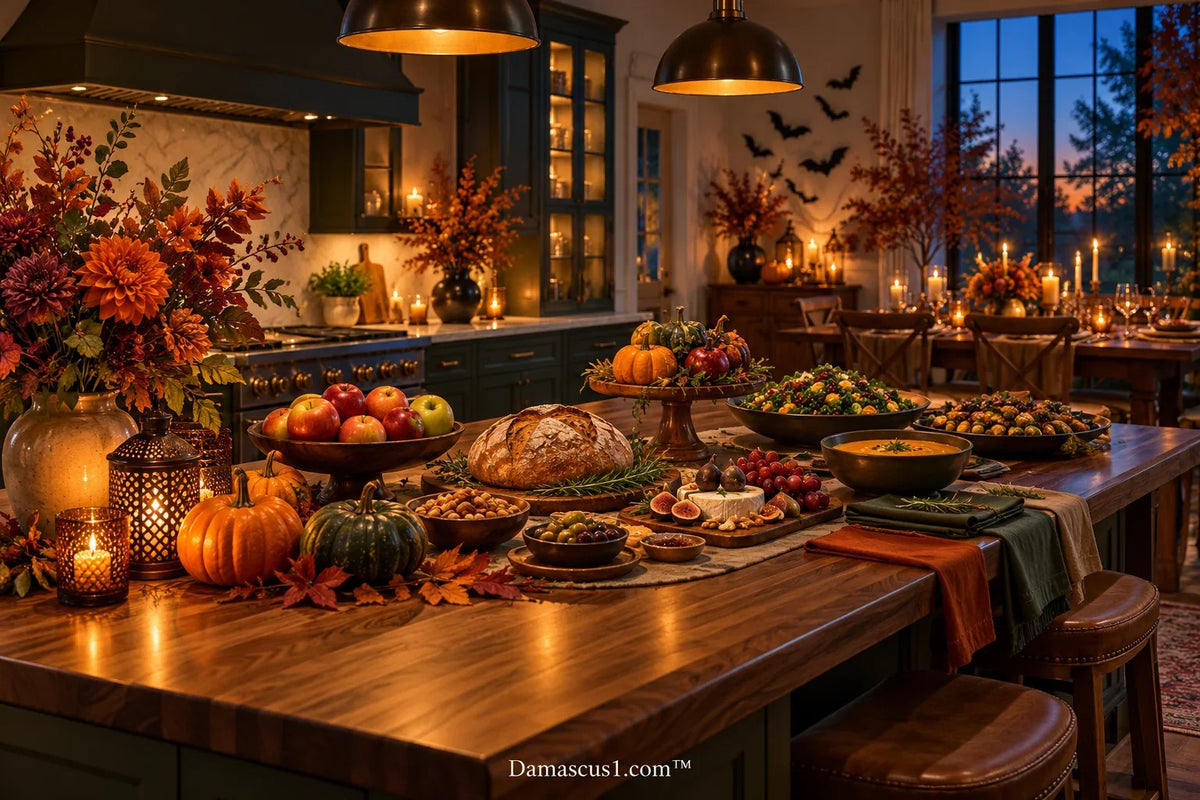
The quick answer: Plan a Halloween kitchen around the food you will actually prepare, a clear work surface, suitable kitchen tools, a separate decoration area and a realistic serving schedule. An ordinary kitchen knife is not automatically a pumpkin-carving tool. Buy only the equipment your menu needs, and confirm the exact contents and dimensions of any knife set before ordering.
Halloween has a way of filling every available surface. A bag of apples arrives beside the candy bowl. Someone brings a pumpkin. The serving platters appear before you have decided where the chopping board will go. Then the first guests knock while you are still looking for the container lids. The solution is usually a better plan rather than a bigger collection of kitchen equipment.
This guide helps you build that plan for a small gathering, a family evening or a larger open-house party. Halloween falls on Saturday, October 31, 2026, but the worksheet works for any autumn event. It covers menu decisions, a practical kitchen-tool checklist, shopping questions, preparation zones, serving rounds and the cleanup that makes the following morning easier.
Editorial scope: This is an original AI-assisted planning guide, not a record of hands-on product testing. Its cover and five interior illustrations are AI-generated editorial concepts, not photographs of products for sale or demonstrations of cutting technique. Product pages supply the current model photographs, price, availability and confirmed details. Food-safety references were checked on October 20, 2026.
Start with a party brief that fits your home
Write down the date, the likely number of people, the arrival window and the main purpose of the food. Is this dinner before trick-or-treating, a snack table that people visit throughout the evening, or a sit-down meal? Those are different jobs. A dinner menu needs a coordinated serving time. An open-house snack table needs a replenishment plan. A short family activity may need only one prepared snack and a drink.
Count helpers as carefully as guests. A second adult who can answer the door or clear plates may be more useful than an additional dish. Give each helper a specific responsibility and a place to work. “Please refill the glasses from this tray” is easier to act on than “help wherever you can.” If nobody can manage replenishment, simplify the menu until one host can serve it without constantly leaving the guests.
Walk through your kitchen before making the shopping list. Open the refrigerator and check which shelves can hold the planned containers. Find a route from the sink to the food-preparation surface that does not pass through the drinks queue. Identify a place for coats, bags and costume accessories outside the cooking area. These small decisions protect the working space you already have.
Three party formats, three different priorities
For a pre-trick-or-treat meal, prioritize food that can be served at one defined time and cleared away before everyone leaves. For an adult evening, prioritize a calm preparation schedule and a separate drinks station. For a mixed-age open house, prioritize a clear separation between guests, food preparation and activities. You do not need to choose the most elaborate format; choose the one your room and available help can support.
Write one sentence describing success: “Everyone can eat before leaving,” or “I can spend the evening with guests rather than finishing recipes.” Keep that sentence beside the menu. When a new idea adds a shopping trip, a special tool and another last-minute task, compare it with the original purpose. A dish that looks impressive online may be the wrong choice for this particular evening.

Build the Halloween menu around the work it creates
Start with a short list of dishes you already know how to prepare. Assign each dish a job: something substantial, something fresh, something easy to serve and an optional themed treat. These are planning categories rather than a nutritional prescription. A party does not need an equal number from every category, and you should adjust the menu to the people attending.
Next, write the preparation task beside each dish. A vegetable platter needs washing, suitable cutting equipment, a serving bowl and refrigerator space. Bread may need slicing and a separate serving tool. A soup needs a tested recipe, cooking equipment, a serving vessel and a suitable way to manage its temperature. A decorated dessert may need more counter space than its ingredients suggest. The task list reveals conflicts that a list of dish names hides.
Give particular attention to the final hour. If several dishes all need their last step just before guests arrive, the menu is asking too much of one person. Replace or simplify a dish, delegate an independent task, or change the serving sequence. Do not solve the scheduling problem by assuming a new knife or food processor will make every preparation step immediate.
A practical menu worksheet
| Menu item | Preparation question | Space or equipment question |
|---|---|---|
| A substantial dish | Which tested recipe and final preparation time will you use? | Does its pot, tray or serving vessel fit your kitchen? |
| A fresh accompaniment | What needs washing, trimming or portioning? | Which clean board, suitable knife and storage container will it need? |
| Bread or another simple accompaniment | Can it be served without a complicated finishing step? | Do you have the appropriate serving utensil? |
| A themed treat | Is decoration a separate job from food preparation? | Where will it wait without occupying the main working surface? |
| Drinks | Who will refill them during the event? | Can guests reach the drinks without entering the preparation area? |
For a potluck, ask contributors what they are bringing and how they expect it to be served. A dish arriving in a hot pan, a bowl needing refrigeration and a dessert needing assembly all create different demands. Agree the serving equipment in advance. Request original packaging or ingredient information where appropriate, and do not promise an allergy-free environment simply because a dish has a handwritten label.
Make a kitchen-tool checklist before buying anything
Take out the equipment you already own and compare it with the preparation tasks. Useful categories include a stable cutting board, knives appropriate to the foods and their instructions, mixing bowls, measuring equipment, serving utensils, food containers, cleaning supplies and any temperature-control equipment your menu requires. The right checklist is the one that matches the menu rather than the longest list of kitchen accessories.
Inspect the complete tool, including its handle and storage arrangement. A knife that is loose, damaged or behaving unexpectedly should not become the central tool for a busy event. Ask the maker or seller for appropriate guidance. If you need instruction for an unfamiliar cutting task, obtain a suitable demonstration instead of trying to infer hand placement from a photograph or a general buying article.
Separate preparation equipment from serving equipment. A knife used by the cook does not need to stay on the buffet after the food is portioned. Serving tongs, spoons or other utensils can help guests serve themselves without entering the preparation area. Put the preparation tools away appropriately once their task is finished, and give each serving dish the utensil it needs.
Choose the missing function, not the largest piece count
If your existing collection covers the menu, you may not need a new knife set. If one task is unsupported, investigate a suitable individual tool. If you are equipping a kitchen more broadly, compare the exact packing lists of sets. Blocks, scissors, honing tools and repeated steak knives can affect the advertised piece count; the number on a title does not tell you how many different preparation tasks a set covers.
Measure the place where equipment will live. Note the available counter footprint and clearance beneath a shelf before selecting a block. Consider how you will reach the tools without moving decorations or drinks. For an individual knife, confirm compatible edge protection or storage rather than assuming a general-purpose sheath or an existing block slot will fit it.

Give preparation, serving and decorations separate zones
Think of the kitchen as a set of small jobs rather than one large shared counter. Reserve one area for the cook's current task. Reserve another for finished serving dishes. Place the drinks station where guests can reach it without passing the preparation tools. Keep pumpkin crafts, paint, costume makeup and decorative materials away from food-contact surfaces and ingredients.
Decide where used dishes will go before the first plate is filled. A tray or clearly defined collection point can stop guests placing glasses on the chopping board or beside ingredients waiting to be prepared. Empty the dishwasher or make another practical washing arrangement beforehand. A pile of used dishes can consume the working room that the rest of the plan depends on.
Lighting belongs in this plan too. A dark room may suit the party atmosphere while being a poor place to prepare food. Keep the preparation area properly lit and use decorative lighting elsewhere. Put trailing decorations, loose fabric and costume accessories away from working equipment. The kitchen can stay practical even when the dining room is theatrical.
Use a short reset between different jobs
Before moving from one preparation task to the next, clear away the packaging and equipment that no longer belong there. Check the next recipe, bring out its tools and make enough room to work without balancing bowls on the edge of the surface. Build this reset into the schedule instead of treating it as an interruption. It is especially useful when several people share a small kitchen.
The FDA's holiday guidance emphasizes clean hands and surfaces, separation of raw foods from foods ready to eat, appropriate cooking temperatures checked with a food thermometer, and prompt refrigeration. Use separate suitable boards and utensils where needed, and clean food-contact equipment between tasks. See the FDA's full holiday food-safety guidance for the details relevant to your menu.
Treat pumpkin decoration as its own activity
A pumpkin on the menu and a pumpkin on the craft table are separate planning decisions. Decide whether you are buying food for a tested recipe or a decoration for an activity. Keep paints, glues, surface treatments and craft materials away from ingredients and kitchen equipment. Do not treat a decorated display pumpkin as automatically suitable for food preparation afterwards.
You can create a Halloween display without cutting a pumpkin. Painted shapes, paper decorations and other suitable craft approaches avoid the need to turn a food-preparation knife into a decoration tool. Choose materials appropriate to the activity and the people taking part. Set up that work on a separate table so a guest does not have to reach across food preparation to collect a brush or stencil.
If you choose carving, use tools intended for that task and follow their manufacturer's directions. This guide does not recommend a Damascus folder, hunting knife or kitchen chef's knife as a universal pumpkin-carving tool. The word “Damascus” describes a blade-related feature or construction; it does not establish suitability for a particular craft, user or cutting technique.
Keep real cutting tools out of costume accessories and guest play areas. A knife bought as an adult gift or kitchen tool should be stored and used for its appropriate purpose, not handed around as a party prop. If a planned activity cannot be supervised and equipped appropriately, change the activity. A simpler decoration can still provide the seasonal look without adding an unfamiliar tool task to a busy evening.

Plan serving rounds rather than one crowded buffet
Make a list of the bowls, platters and utensils each dish needs. Lay out the empty serving pieces before the event and use temporary notes to assign them. This simple rehearsal shows whether you own enough suitable containers and whether the dishes fit on the intended table. It also makes it easier for a helper to place the right food in the right location.
Consider putting out a manageable serving portion while keeping the reserve appropriately stored. Assign someone to monitor replenishment and food timing. A smaller bowl can be easier to manage than a large platter that blocks the rest of the table. The serving size and replenishment interval depend on the dish, the guests and the arrangements you have made; there is no universal batch size that makes food safe.
The FDA's Halloween guidance recommends pasteurized juice or cider, avoiding tastes of raw dough or batter containing uncooked eggs or unbaked flour, and keeping perishables chilled until serving. It says not to leave perishable food out for more than two hours, or one hour when the temperature is above 90°F. Read the full Halloween guidance and plan for the actual conditions at your event.
Make the reserve supply easy for a helper to find
Keep each reserved dish in an appropriate container with a clear identification and preparation record. Write down which serving bowl it belongs in and which utensil goes with it. Give your helper a short handover rather than expecting them to identify every dish from appearance. If an item needs a particular serving or storage arrangement, keep those instructions with the plan.
Have enough clean serving utensils available to replace one that becomes unsuitable during the evening. Keep the refill route clear of guests carrying drinks. Replenishment is much easier when the reserve containers have a known location and do not require unpacking an entire refrigerator shelf. This is a layout decision you can make before the party begins.

Compare kitchen knives and sets using confirmed information
A seasonal event can reveal a real gap in your kitchen, but urgency is a poor substitute for product information. Start with the kitchen knife set comparison and the piece-count buying guide. Then inspect the actual product page. The comparison should help you ask better questions, not imply that every listing has already answered them.
Two current listings you can investigate are the Premium Kitchen Knife Block Set and the German-labelled kitchen block-set listing. Both are linked as shopping options, not recommendations based on a hands-on test. Their current descriptions require confirmation of the exact packing list and material specifications. Do not infer a count, steel grade or manufacturing location from a legacy URL, photograph or label alone.
Send one concise enquiry with the product link and the questions that affect your choice. Ask for the measured blade and handle dimensions, current included items, storage footprint, care instructions and any specific task limitations. If a photograph shows an accessory, confirm whether it is included. If a product name and detailed description disagree, obtain a written clarification before buying.
| Buying question | Why it matters for event preparation |
|---|---|
| What exactly is supplied? | It prevents planning a task around an accessory that is not part of the selected set. |
| What are the measured dimensions? | They help assess working and storage fit rather than judging scale from a photograph. |
| Which materials and care instructions are confirmed? | They help you choose appropriate cleaning, drying and storage arrangements. |
| What does the delivery estimate apply to? | It lets you distinguish a general estimate from a confirmed option for your destination. |
| What are the return conditions? | They help you decide whether to order without assuming the purchase is an unrestricted trial. |
Check the shipping policy and refund policy before relying on a purchase for October 31. Availability, destination and the chosen shipping option affect delivery. No Halloween arrival guarantee is made here. If the equipment you already have can support a simpler menu, keep that option available while an enquiry or delivery remains uncertain.
Use a timeline that protects the final hour
Several days before: decide, measure and assign
Confirm the event format, expected guests and helpers. Choose recipes and read them fully. Check boards, knives, serving utensils, containers and available storage. Resolve any equipment questions before the shopping trip. Agree what guests are bringing and who will handle each independent job. The aim is to remove decisions from the last hour, not to prepare every ingredient several days early.
Write a shopping list divided into ingredients, serving supplies and activity materials. Keep the craft list separate so decorations do not displace the food essentials in your budget. Look through cupboards before buying duplicates. If you are purchasing a new kitchen tool for use beyond this event, make that longer-term purpose explicit. A seasonal deadline should not be the only reason the item seems useful.
The day before: prepare the room and the plan
Clear the surfaces you intend to use, match containers with their lids and make room for the menu's storage needs. Lay out serving equipment and write the dish assignments. Check what each recipe permits you to prepare in advance, following suitable storage guidance. Do not assume every salad, filling or garnish can be made on the same schedule simply because it appears on the same party menu.
Put the event plan somewhere helpers can read it. Include the arrival window, the serving order, where reserve food is stored and who is responsible for each job. Keep the contact or message thread for potluck contributors available if a question arises. Leave some space in the plan for changes: a smaller guest count, a late arrival or a missing ingredient should not force you to rebuild the whole evening.
On the day: work from a short finish list
Bring out only the equipment needed for the current task. Follow the recipes and the relevant food-safety guidance. Finish one preparation area before opening another where practical. Keep decorations out of the working zone, and put knives into suitable storage after their preparation role is complete. Give guests a clear place to put drinks and used dishes so those items do not return to the cook's board.
In the final hour, use a finish list with three headings: prepare, place and hand over. “Prepare” contains the remaining recipe tasks. “Place” covers serving dishes, utensils and drinks. “Hand over” reminds you to explain replenishment and timing to your helper. If the list is too long, remove a nonessential item rather than rushing a tool task or letting the working space become crowded.
Mark your Halloween party-prep planner
Use the checkboxes below as a working reminder, or print the page and add your own quantities and timings. The boxes are a simple on-page checklist; their state is not stored with an account. Keep recipe-specific preparation, cooking and storage instructions beside this general plan. If one of those instructions changes the timetable, update the timetable rather than forcing the food to fit an earlier idea.
My event preparation checklist
Make cleanup part of the event, not an afterthought
Before serving begins, identify the containers that will be available afterwards and clear a practical route to the washing area. Keep lids with their containers. Decide which serving pieces can be cleared first and which will remain in use. When equipment has an assigned destination, cleanup becomes a sequence of small jobs instead of a single pile at the end of the night.
Follow the care instructions for your specific knives, boards and other equipment. Do not assume every handle, finish or blade construction tolerates the same treatment. Keep cutting edges appropriately protected and avoid leaving a knife hidden under dishes or in cloudy washing water. If you need a fuller care routine, read the kitchen knife cleaning and storage guide and confirm the instructions for the actual model.
The next day, record what the event taught you. Which dish was easy to serve? Which piece of equipment stayed in the cupboard? Where did people queue? Save those notes with the menu rather than starting from scratch for Thanksgiving, a winter gathering or the next Halloween. The most useful improvement may be a clearer setup rather than another purchase.

Halloween kitchen-prep questions, answered
What kitchen tools do I need for a Halloween party?
Start with the menu: suitable food-preparation tools, a stable board, mixing equipment, serving dishes, utensils, containers and cleaning supplies. Add any temperature-control equipment your dishes require. You do not automatically need a new knife set, and a larger advertised piece count does not establish a better fit for your menu.
Can I use a Damascus kitchen knife to carve a pumpkin?
Do not assume that it is suitable. Check the exact tool's intended use and instructions. For a carving activity, choose equipment intended for that task; painting and paper decoration are alternatives. This guide does not recommend an ordinary kitchen knife, folder or hunting knife as a universal pumpkin-carving tool.
Should I buy one kitchen knife or a block set before the event?
Identify the missing task first. One suitable tool may address an isolated gap, while a set may be worth comparing when equipping a kitchen more broadly. Confirm dimensions, contents, materials, care and storage fit on the selected listing. Keep a simpler menu available if delivery timing remains uncertain.
How early should I prepare Halloween party food?
Make the room layout, equipment check and menu plan early. Prepare ingredients only on the schedule supported by the recipe and appropriate storage guidance. There is no single advance-preparation interval that suits every dish. Work backwards from serving time and avoid putting every finishing step in the final hour.
How do I keep a small kitchen from becoming crowded?
Move drinks and guest activities away from the preparation surface. Assign a place for used dishes and reserve a clear route to the sink and refrigerator. Give helpers specific jobs. If several dishes require the same surface at once, change their sequence or simplify the menu rather than adding more equipment to that surface.
Does this guide guarantee delivery before Halloween?
No. Check current availability, destination restrictions, shipping options and the store's policies. Ask about the exact item and your event date before ordering. Neither a product link nor a general shipping estimate in an article is a guaranteed arrival commitment.
Can I join the Damascus1 community without buying anything?
Yes. The free email signup offers product news, useful guides and available offers, with consent and an unsubscribe option. Use the community signup on the homepage. Interest in a possible monthly membership does not itself start a paid subscription or establish a recurring discount.
What should I read after Halloween?
Use your event notes to decide. The kitchen-set comparison helps with an equipment shortlist; the care guide helps organize cleaning and storage questions. For an adult gift, the pocket knife gift finder and pocket-set comparison provide a separate buying path. Check suitability, product facts and recipient preferences rather than treating a knife as a costume accessory.
Turn the checklist into your next useful decision
Compare the current kitchen collection, check the set comparison, or send a model-specific question. If you would rather keep learning before shopping, join the free Damascus1 email community for guides, product news and offers when available.
Sources and editorial notes
The food-safety points above were checked against the FDA's Halloween Food Safety Tips for Parents and Food Safety Tips for Healthy Holidays on October 20, 2026. Follow the full current guidance and the instructions for your menu and equipment. The rest of the worksheet is editorial planning guidance, not a tested recipe, professional catering plan or product performance test.
Leave a comment: