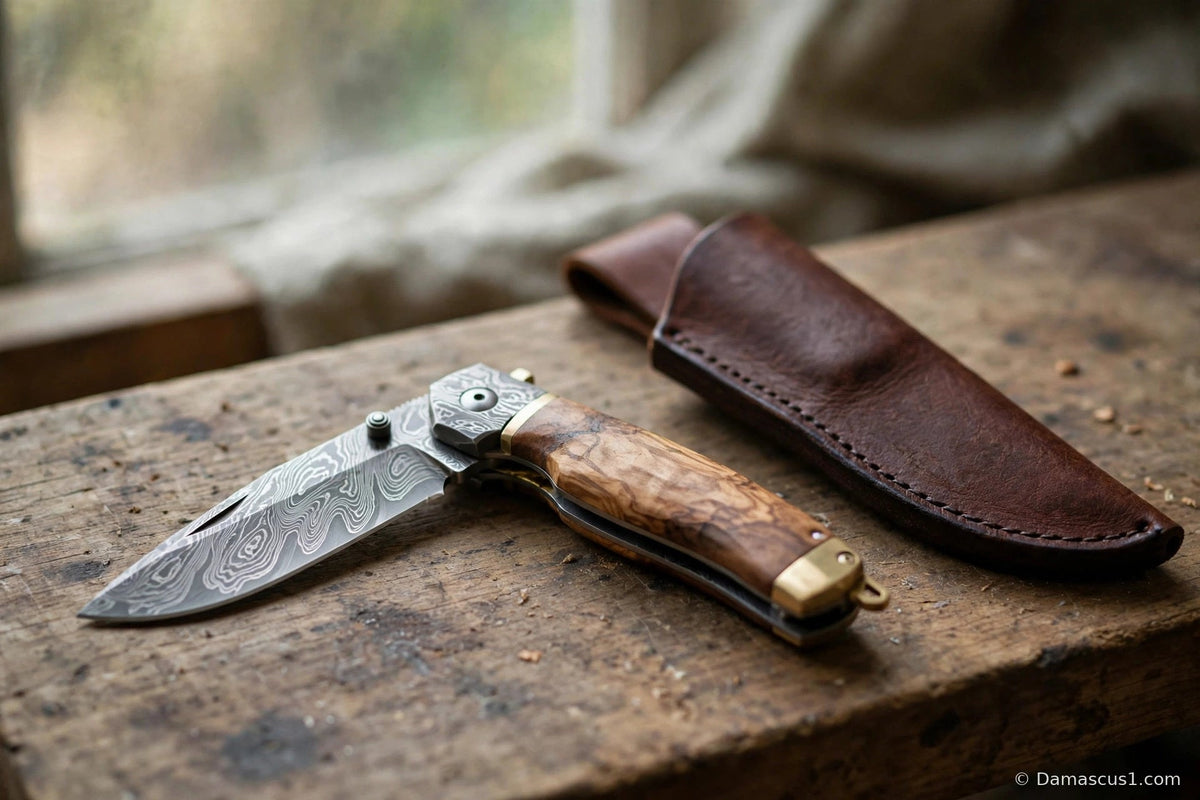
What is a Damascus folding knife, in plain terms?
A Damascus folding knife is a pocket knife whose blade is pattern-welded steel: two or more steels forge-welded, folded and drawn out so the finished blade shows flowing layers, paired with a pivot that folds the blade into the handle for pocket carry. The pattern is structural, not printed on, and it runs through the steel.
That last clause carries the whole purchase. A genuine pattern-welded blade shows the same layered figure on both faces, across the spine and into the edge bevel, because the figure comes from the billet itself. A surface treatment can imitate the look on one flat photograph while leaving the spine plain — the single most useful distinction a remote buyer can learn, and the reason most of this guide is about checks rather than adjectives.
The folding format adds a second set of questions that a fixed blade never raises. The pivot, the lock and the closed length decide whether a knife carries comfortably and opens predictably, and none of those qualities appears in a hero photograph. Blade steel gets the attention; the mechanism decides daily satisfaction. A sound buying order therefore runs steel first, mechanism second, handle third, price last — the order the sections below follow.
Context helps on terminology as well. Sellers use Damascus, pattern-welded and folded steel for the same construction, and the explainer on what the Damascus knife is separates the modern material from the historic metal of the same name. The pattern families themselves — raindrop, ladder, twist, random — are compared in the guide to the basics of Damascus knife patterns, which is worth reading before paying a premium for a named pattern.
How much does a Damascus folding knife actually cost?
Price bands only help when they describe a real shelf. On the Damascus1 catalogue checked today, folding pocket knives run from $39.99 to $99.99 at current prices, with compare-at prices from $89.99 to $179.99. Any guide quoting $250 as an entry point and $500 as mid-range is describing a different market, not this store.
The older version of this article quoted exactly those invented bands, presented as first-hand findings. Correcting the record matters more than politeness here: a reader who budgets $250 for a first Damascus folder and lands on a store where the range tops out at $99.99 has been misled twice — once about the market, once about the store. The honest figures are the live ones, and the six priced cards further down hold to them.
What moves price inside a truthful range is mundane, and none of it photographs well. Handle material carries part of it: plain and dyed woods sit at the lower end, while horn and hand-worked scrimshaw bone sit higher, because carving time is real time. Finish carries another part — polishing, fitting bolsters and tuning a pivot are hand operations. Gift presentation carries a third part on some listings. What does not justify a higher price is a layer count or a hardness figure quoted without a named steel, a point the pattern-realness section returns to.
A first purchase also deserves a total-cost line, not just a ticket price. A leather sheath, a basic whetstone and oil are the usual companions, and the first Damascus pocket knife checklist prices that starter kit honestly. Readers comparing across the whole pocket-knife shelf, rather than one product page, can start from the best Damascus pocket knife hub and the wider everyday carry pocket knives collection, where the same live prices apply. One example sets the floor plainly: the Olive Wood Damascus Pocket Knife Set at $39.99 (was $89.99) is the entry point of the current folding range.
How can a buyer tell whether the pattern is real Damascus?

Real pattern-welding survives three remote checks. The figure should continue over the spine and soften or distort at the edge bevel instead of stopping at a printed boundary; both blade faces should show related but not mirror-identical pattern; and the listing should describe layered steel construction in words, not only show a wavy photograph.
The spine check is the strongest of the three because it is the hardest to fake cheaply. A laser-etched or acid-printed imitation lives on the flats of the blade; turn the knife over and the spine reads as plain, uniform steel. On a pattern-welded blade the layers wrap the whole billet, so the spine shows banding that matches the faces. Any listing with a clear spine photograph has already passed the first screen, and any listing that hides the spine behind angled beauty shots has answered a question as well.
The mirror check catches a second family of imitation. Two faces of one billet are cousins, not twins: the figure rhymes across the blade without matching line for line, because folding displaces the layers unevenly. Perfectly mirrored pattern on both faces points to a printed or etched surface. Perfect uniformity across a whole product range points the same way — hand-forged billets vary, and a catalogue where every blade carries an identical swirl is showing artwork, not steel.
Language is the third check. Honest listings name the construction — pattern-welded, folded, layered — and describe handle materials and dimensions in plain terms. Listings that lean on atmosphere instead of specification, or that pair the word Damascus with a named modern stainless grade without explaining the construction, deserve a slower read. The dedicated guide to how to spot a fake Damascus knife works through these tells with the etched-versus-welded distinction in full, and the rust guide adds a fourth, slower test: behaviour over time, since Damascus steel can rust when the billet is carbon-based, whatever the marketing implies.
None of these checks requires handling the knife, which is the point. Online buying removes the hand-feel test, so the photograph set and the wording have to do that work instead — and a buyer is entitled to treat missing evidence as evidence.
Which closed length and lock type suit daily carry?

Closed length decides carry comfort more than blade length does. Listings in the Damascus1 folding range state overall sizes such as 6.5″ in the product title; that figure is the open, end-to-end length on those listings, so a buyer should confirm the closed length and blade length on the product page and match them against a pocket, a sheath and local rules before ordering.
The distinction between the three lengths sounds pedantic and saves real returns. Open length is the headline number. Closed length is the number a pocket feels. Blade length is the number many local rules are written around. A knife can be legal by blade, comfortable by closed length, and still disappoint if the buyer only ever read the headline. The pocket knife size and measurement guide defines each measurement, shows where each is taken, and addresses the "smaller than expected" disappointment that ambiguous listings cause.
Lock type is the second half of the same decision. A back lock gives a firm, traditional action and a blade that stays put under pressure; a liner lock gives one-handed convenience and a slimmer build. Neither is a quality grade — both fail when poorly fitted and both serve for decades when well fitted — so the buying question is fit and smoothness, not the label. The comparison of back lock vs liner lock lays out the trade-offs, and the carry guide on how to carry a pocket knife covers pocket, sheath and belt carry once the size is chosen. Where a listing title states a lock, that statement is part of the specification; where it does not, the lock belongs on the list of questions to settle on the product page rather than a detail to assume.
A practical sizing rule closes the section: choose for the hand and the pocket that will actually carry the knife, on an ordinary day, rather than for the largest task imagined once a year. Oversized folders get left in drawers, and a drawer knife helps nobody.
Which handle material suits which hands, pockets and climate?

Handle material is a working decision disguised as a style choice. Woods such as olive and the dyed colour woods are light, warm in the hand and forgiving in a pocket. Horn is dense and smooth, with natural variation in every piece. Carved camel bone — the scrimshaw work — is the statement option, priced for the hand-carving time it takes.
Each material also carries a care signature, and honesty about that signature beats romance. Wood handles dislike long soaking and very dry heat; a wipedown and occasional conditioning keep them stable. Horn is hard-wearing and largely untroubled by damp hands, though it can show fine surface lines over years of pocket carry. Bone takes engraving and carving better than any other handle material on the shelf, which is why scrimshaw lives there, and it rewards the same dry storage as the blade it holds. The full comparison of pocket knife handle materials scores olive wood, horn, bone and the synthetics against grip, weight and upkeep.
Grip in wet conditions deserves a direct sentence, because folding knives get used at sinks, lakesides and camp kitchens. Smooth polished handles of any material are at their worst with wet or greasy hands; shaped handles with some contour hold better than straight slabs, and a sheath carried on a belt beats a slick pocket draw for genuinely wet work. Buyers choosing a gift can sidestep the guesswork differently: handle material is the most personal part of the knife, and the scrimshaw pocket knives collection gathers the carved options, while personalized pocket knife engraving turns a sound material choice into a named present.
Price follows the handwork, as the cost section noted. At today's prices the wood-handled folders open the range at $39.99, the horn and scrimshaw pieces sit at $39.99–$49.99, and the range's top card is a blue wood piece at $99.99 — a spread explained by finish and presentation rather than by any claim that one blade steel outranks another.
What should a product listing show before money moves?
A listing earns trust by showing work, not by sounding confident. Before money moves, the page should show the blade from both faces and the spine, state dimensions in numbers, name the handle material, state the price and any compare-at price plainly, and say what arrives in the box. Missing photographs and vague dimensions are the two most common red flags.
That checklist replaces a vaguer warning culture — dramatic talk of scams and counterfeits — with something a buyer can actually run in two minutes. Both-faces photography connects directly to the mirror check. A spine photograph connects to the wrap check. Stated dimensions connect to the size section. Box contents matter more than they sound: several listings on this catalogue carry the word "Set" in the title, and the honest reading of that word is a question — set of what, exactly — which the product page, not a blog post, should answer before an order is placed.
Three further red flags deserve naming, because each appears across the wider internet market for Damascus folders. First, a price dramatically below every comparable listing, paired with stock photographs reused across many storefronts. Second, specification theatre: layer counts in the thousands and hardness numbers quoted for an unnamed steel, numbers no buyer can verify and no honest seller needs. Third, pressure mechanics — countdown timers and vanishing-stock banners on a handmade product — which sit oddly beside any claim of small-batch craft.
The seller side of the page matters as well. A store that publishes care guidance, a fake-spotting guide and a rust explainer is putting checkable expertise on the record; the Damascus folding knives collection is the shelf those guides support. A store with none of that may still sell a fine knife, but the buyer carries more of the verification burden — and should price that burden into the decision.
Which Damascus folding knives does Damascus1 sell, and which suits what?
Six current listings span the folding range, all verified live today. Two wood-handled folders open the range at $39.99; horn and scrimshaw bone pieces sit at $39.99–$49.99; one blue wood folder tops the range at $99.99. The table below matches each to the job it fits best, at today's prices — no ranking beyond that fit is claimed.
| Knife | Handle | Price today | Best for |
|---|---|---|---|
| Olive Wood Damascus Pocket Knife Set | Olive wood | $39.99 (was $89.99) | A first Damascus folder at the lowest entry price |
| Green Wood Damascus Pocket Knife Set | Green wood | $39.99 (was $99.99) | Daily carry with a colour-handled, giftable look |
| Buffalo Horn Damascus Pocket Knife Set | Buffalo horn | $39.99 (was $99.99) | A dense, smooth handle with natural variation |
| Camel Bone Scrimshaw Damascus Folding Pocket Knife | Carved camel bone | $49.99 (was $99.99) | A hand-carved statement piece and a distinctive gift |
| Stag Horn Damascus Folding Pocket Knife | Stag horn | $49.99 (was $139.99) | Traditional looks with the deepest compare-at saving |
| Blue Wood Damascus Pocket Knife 6.5″ | Blue wood | $99.99 (was $179.99) | The top of the range, for a buyer who wants the flagship folder |
The Olive Wood Damascus Pocket Knife Set at $39.99 (was $89.99) is the sensible default first purchase: the lowest price in the range, a light and warm handle material, and a pattern-welded blade that teaches the care routine without a large sum at risk. The Green Wood Damascus Pocket Knife Set at $39.99 (was $99.99) sits at the same price with a dyed green handle for buyers who want colour in a pocket or a gift box. The Buffalo Horn Damascus Pocket Knife Set at $39.99 (was $99.99) trades wood grain for horn: denser in the hand, smooth, and different in figure on every piece, because horn is a natural material and no two handles match exactly.
The Camel Bone Scrimshaw Damascus Folding Pocket Knife at $49.99 (was $99.99) is the range's hand-worked piece — scrimshaw carving on camel bone is slow, skilled labour, and the price reflects the carving rather than a different blade claim. The Stag Horn Damascus Folding Pocket Knife at $49.99 (was $139.99) pairs the most traditional handle material in the range with its steepest compare-at reduction. The Blue Wood Damascus Pocket Knife 6.5″ at $99.99 (was $179.99) closes the range: the highest current price among the folders, in a blue-dyed wood handle, for a buyer who has run the checks in this guide and wants the flagship end of the shelf.
Two honest limits apply to every card. First, "Set" in a listing title is the store's own wording, and the contents belong on the product page — confirm them there before ordering. Second, no card claims a lock type, a hardness figure or a layer count, because the listings do not state them in a form a guide can responsibly repeat; the product page and the arrival inspection below are where those details get settled.
What should a buyer check in the first ten minutes after delivery?

The arrival inspection converts every remote check into a physical one. In order: confirm the handle material and figure match the listing; open and close the knife slowly and feel for grit, scraping or side-play at the pivot; hold the blade to a window and confirm the pattern wraps the spine; and compare the closed length against the stated size.
Each step maps to a promise made earlier in the buying process. The handle check settles the material question while photographs can still be compared side by side. The pivot check settles fit: a sound folder opens with even resistance, locks without play, and closes centred between the liners rather than kissing one side. A blade that arrives off-centre or gritty is a conversation to have with the seller immediately, not a flaw to break in hopefully. The spine check repeats the strongest remote test with the actual object in hand — the pattern either wraps or it does not, and no lighting trick survives holding the knife personally.
The size check closes the loop with the measurement section: a ruler against the closed knife, compared with the product page figure. The step-by-step knife order inspection checklist extends this ten-minute version into a full arrival routine, including edge and finish checks, and the best pocket knife hub shows how the same checks rank the wider shelf. Photographing the knife on arrival, before carry marks accumulate, also gives any later seller conversation a clean starting point.
Only after those checks should the knife go into a pocket. A folder that passes all four has earned carry; a folder that fails one has given the buyer a specific, factual point to raise while the order is fresh.
How is a Damascus folding knife cleaned, oiled and stored?

Care for a pattern-welded folder is short, regular and mostly about water. Wipe the blade dry after use, wash by hand only when genuinely dirty and dry it immediately, work a drop of oil into the pivot and a thin film over the blade before storage, and store the knife dry — in a sheath or a drawer, never damp in a pocket or a car.
The folder format adds two duties a fixed blade escapes. The first is the pivot: pocket lint, dust and dried pocket debris migrate into the mechanism, and a periodic blast of air plus a drop of oil keeps the action even. The second is the interior of the handle, where moisture hides against the blade's folded face; storing a folder closed and damp is the fastest route to spotting on steel that was dried carefully on its visible surfaces. The dedicated Damascus folding knife care guide covers pivot cleaning and lock care in full.
Sharpening follows the same little-and-often rule as every pattern-welded blade. A whetstone refresh at a consistent angle beats a rescue session on a coarse stone, and the whetstone sharpening guide sets out angles and grits step by step. Storage choices — sheath, roll, drawer or display — are compared in the pocket knife storage, cases and sheaths guide, and a fitted leather sheath remains the kindest home for a folder that travels. Carbon-based billets reward the oil film most; stainless-clad builds forgive more, and neither forgives a wet sheath.
Frequently asked questions
Is a Damascus folding knife good for everyday carry?
Yes, provided the size suits the carrier and local rules allow it. Pattern-welded blades handle the ordinary EDC workload — packaging, cord, food prep away from a kitchen, light outdoor tasks — and the folding format carries more discreetly than a fixed blade. Closed length and lock fit matter more to daily satisfaction than any steel claim, which is why both get full sections above.
How can a buyer be sure a Damascus pattern is not fake?
Run the three remote checks: pattern continuing over the spine, related-but-not-mirrored figure on the two faces, and listing language that describes layered construction in plain terms. Then repeat the spine check physically on arrival. A seller who photographs both faces and the spine has made those checks easy on purpose; a seller who hides them has made the decision easy instead.
Why do Damascus folding knives at Damascus1 cost less than the $250–$500 some guides quote?
Because those quoted bands describe a different segment — small-batch custom and high-end production folders — and the older version of this article repeated them as though they described this store. The live Damascus1 folding range runs $39.99–$99.99 at today's prices. Lower price here reflects the range's positioning and handle materials, and the correct response is the same set of authenticity and fit checks, run at any price.
What does "Set" mean in several of the product titles?
"Set" is part of the store's own listing titles — for example, the Olive Wood Damascus Pocket Knife Set. A blog guide should not invent the contents behind that word. The product page is the authoritative list of what arrives in the box, and confirming it there before ordering takes under a minute.
Can a Damascus folding knife be given as a gift?
Yes — folders are the most giftable format on the shelf: pocket-sized, presentable, and available with carved or engraved personalisation. Handle material is the choice to get right, since it is the part a recipient sees and holds daily; scrimshaw bone and the colour woods present most distinctively. The groomsmen and gift guides on this blog cover occasions and presentation in detail.
Will a Damascus folding knife rust?
It can, depending on the billet. Pattern-welded carbon steel spots and rusts when stored damp, exactly like plain carbon steel; stainless-based constructions resist far more. The pattern itself grants no immunity either way. Drying after use, a thin oil film and dry storage keep either construction clean, and the rust guide linked earlier explains the chemistry without the folklore.
The bottom line on buying a Damascus folder online
A Damascus folding knife is one of the easiest knife purchases to get right online, precisely because the important checks survive photography: pattern over the spine, honest dimensions, a named handle material, a plain price and a box whose contents are stated. Run those checks, match the closed length to the pocket and the lock to the hand, inspect the knife for ten minutes on arrival — and the purchase rests on evidence instead of adjectives. Start with the range itself: the Damascus folding knives collection holds every current folder at live prices, from the $39.99 olive wood entry to the $99.99 blue wood flagship, and the guides linked throughout this article stay available for every check along the way.
Leave a comment: