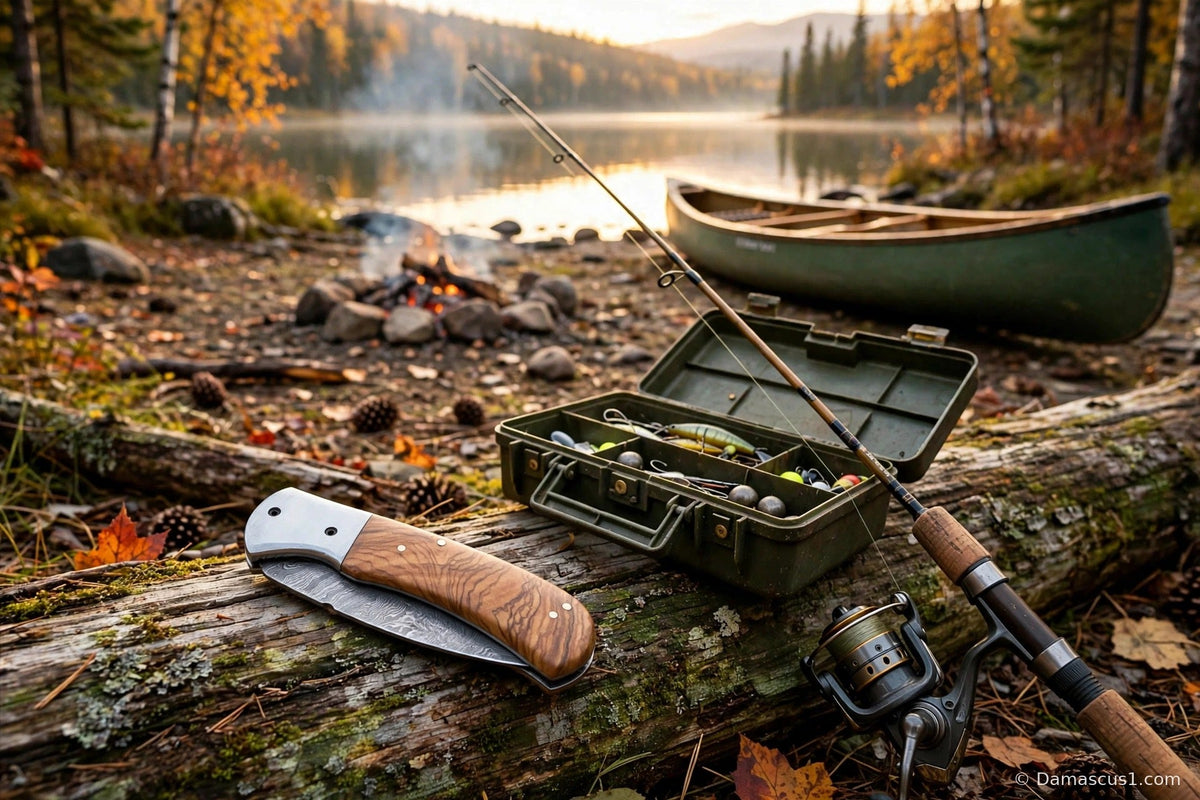
The short answer: Yes, you can carry a pocket knife in Canada — as a tool, for a lawful purpose you can name. An ordinary manual folder carried to open parcels, cut line at the lake, or do a job at work is a tool. The same knife carried to use on a person, or "just in case," becomes a weapon in law. Purpose, place, and manner decide — not blade length, for which there is no federal limit.
This post is general information, not legal advice. If you are facing a charge, or your situation is unusual, talk to a criminal lawyer in your province.
This is the carry companion to our Canada guide to whether pocket knives are legal in Canada. That guide owns the ownership question: which mechanisms the Criminal Code prohibits by design, and what the Canada Border Services Agency's flick test means when a knife crosses the border. This guide owns the different question people actually ask on the street, at camp, and in the truck: once I own a legal folder, when can I have it on me — and when does carrying it become the offence?
The best page-one answer to that question is Recording Law's Canada knife-laws guide, fact-checked against primary sources and updated in October 2026. Its opening line is the whole federal picture in one sentence: there is no federal blade-length limit in Canada; what makes a knife illegal is its design or the purpose and manner in which it is carried. LegalClarity's carry guide makes the same point from the other side: carrying even a perfectly legal knife becomes a criminal offence the moment your purpose shifts from a practical task to personal protection. StaySafe Vancouver's shorter post puts the tool-versus-weapon distinction in its first lines, and warns in plain language that carrying for self-defence is the illegal purpose. Those three holders agree on the core. Where page one gets weaker is the detail: one widely ranked seller guide states a 3-inch carry limit and a 30-centimetre rule as if they were general carry law, which the primary-source guides show they are not — the 30 cm figure in federal regulations measures a disguised device, not a knife blade, and there is no federal 3-inch rule at all. This guide follows the primary-source holders, names the sections, and then does the thing none of them does in one place: it walks the rule through the five places Canadians actually carry a knife — pocket, workplace, vehicle, camp, and downtown — with the sentence you should be able to say, truthfully, in each one.
One honesty note before we start, carried through this whole series: the photographs in this post are editorial scenes made for this guide — camps, trucks, workshops, cabin porches — not photographs of the specific knife sold further down the page. The knife itself is described exactly as the store describes it, and its prices are the store's own listed prices in US dollars. Nothing here is converted into Canadian dollars, because a conversion the store did not make would be an invention.
What is the one rule that decides whether carrying is legal?
Carry it as a tool for a lawful purpose, and be able to show that purpose from the circumstances. That is the rule, and everything else in this guide is an application of it.
Canadian law does not start with a list of places where knives are allowed. It starts with a definition. Under section 2 of the Criminal Code, a "weapon" is anything used, designed to be used, or intended for use in causing death or injury to a person, or for threatening or intimidating a person. Read that carefully, because it is an intent definition, not an object list. A folding knife in a fisherman's tackle box is a tool, because nothing about its use, design, or the owner's intent points at a person. The same knife, in the same pocket, carried into a bar "just in case" is a weapon, because the intent has changed even though the object has not. LegalClarity uses almost exactly that pair of examples — tackle box versus nightclub — and Recording Law makes the same point in reverse: police and courts infer intent from the circumstances, such as where and how the knife was carried, what the person said, and what was happening at the time.
That is why the honest answer to "can you carry a pocket knife in Canada?" is never just yes or no. It is yes, with a purpose — and the purpose has to be real, current, and visible in the situation. "I use it at work" is a purpose when you are at work, with work to do. "I use it fishing" is a purpose at the lake, with a rod and a tackle box beside you. "I might need it for something" is not a purpose at all, and downtown at midnight it reads to an officer exactly as thin as it sounds. The guides on page one all circle this point. This guide states it as the test you run before the knife goes in your pocket: Can I name the job this knife will do, here, today? If you can, you are carrying a tool. If you cannot, leave it at home.
There is a second, separate gate, and it comes first in practice: the knife itself must not be prohibited by design. No lawful purpose rescues a prohibited knife. Section 84 prohibits a knife whose blade opens automatically by gravity or centrifugal force, or by hand pressure on a button, spring, or other device in or attached to the handle — switchblades and gravity knives are the textbook cases, and the border agency reads flick-open folders into the same paragraph. Federal regulations add push daggers, bladed finger rings, the belt-buckle knife, and disguised blades in devices under 30 cm. Owning one of those is an offence under section 91 whatever your reason. Our ownership guide covers that list in full; this guide assumes you have passed it — an ordinary manual folder, opened by hand — and asks only about carrying it.
What do sections 88 and 90 actually punish?
Two offences do almost all the work in ordinary carry cases, and every serious holder on page one names the same two. Learn them, because they are the difference between a tool in your pocket and a charge.
Section 88 — possession for a purpose dangerous to the public peace. Section 88(1) makes it an offence to carry or possess a weapon for a purpose dangerous to the public peace or for the purpose of committing an offence. Recording Law's wording is the clearest: this is what turns a legal pocketknife into a criminal charge — not the object itself, but the purpose behind carrying it, assessed from the surrounding circumstances. On indictment the maximum is ten years, which tells you how seriously the courts treat the intent element. In plain terms: if the Crown can show you carried the knife to use it on someone, or in a way that endangered public safety, the knife's legality as an object does not save you.
Section 90 — carrying a concealed weapon. Section 90(1) makes it an offence to carry a weapon concealed, unless you are authorized under the Firearms Act to carry it concealed. The key word, again, is "weapon." An ordinary pocketknife carried out of sight for work is not a concealed weapon, as Recording Law puts it, but the same knife carried hidden because you intend to use it on someone can be. LegalClarity adds the practical warning: Canada has no separate open-carry and concealed-carry frameworks for knives, but hiding a knife from view is a fast path to liability, because concealment is powerful evidence of bad intent. A chef's roll of knives visible in the back seat is a commute. A large blade tucked into a waistband under a jacket is a problem — the manner is what separates them.
Put the two together and the everyday rule writes itself. Carry a legal knife, openly or in the ordinary way a tool is carried — pocket, tackle box, tool belt, sheath — for a job you can name, and neither section has anything to attach to. Carry it hidden, with no job in sight, in a place where a knife has no business, and you have handed an officer the circumstances from which intent gets inferred. Neither offence requires you to have used the knife, threatened anyone, or even taken it out. The carry itself, with the wrong purpose, is the offence.
A note on penalties, stated the way the primary-source guides state them, because a carry guide that hides the stakes is not helping you: sections 88, 90, and 91 are hybrid offences. The Crown can proceed by indictment or by summary conviction. Recording Law records the indictment maximums as ten years for section 88, five years for section 90, and five years for simple possession of a prohibited weapon under section 91 — with the honest rider that actual sentences for a first offence involving an otherwise legal knife, with no injury and no record, are typically far below those maximums. The lasting damage is usually the conviction itself: a criminal record, with its effects on employment checks and travel. That is the real price of carrying carelessly, and it is why the boring habits in this guide — a named purpose, an ordinary manner, the right mechanism — are worth the thirty seconds they take.
Why is "for self-defence" the one answer you must never give?
Because in Canada, self-defence is not a lawful carry purpose, and saying it changes what the knife is in law. This is the single most repeated warning on page one, and it deserves its own section.
StaySafe Vancouver states it in its second line: in Canada it is not illegal to carry a knife per se, but it is illegal to carry a knife for the purposes of self-defence — and if you tell an officer the knife is for self-defence, you could face legal repercussions. Recording Law explains the mechanism: neither section 88 nor section 90 contains a self-defence exception, and carrying a knife because you intend to use it on a person if attacked brings it within the section 2 definition of a weapon; carried hidden, that engages section 90. LegalClarity is blunter still: saying "I carry it for protection" is functionally an admission that you intend to use it against another person, which satisfies the legal definition of a weapon, and the charge that follows is possession for a dangerous purpose under section 88.
The confusion is understandable, because it is imported. In much of the United States, "for self-defence" is a common and often accepted reason to carry. Canadian law does not work that way, and Recording Law flags the contrast explicitly. There is also a genuine legal distinction hiding underneath, and a good guide should make it rather than blur it: defending yourself when an attack is actually happening is a separate question, governed by section 34 of the Criminal Code, from deciding in advance to carry a weapon "just in case." The first is a defence assessed after the fact, on the facts of the moment. The second is a carry purpose, and as a carry purpose it fails. This guide is not a self-defence guide and does not advise on section 34 — it is a carry guide, and its advice is narrow and firm: never carry a knife for protection, and never describe a tool as protection. If the knife is in your pocket, it is there to open, cut, trim, or fix something. If it is not there to do a job, it should not be there.
The same logic covers the products people reach for instead. Pepper spray made for use on people is a prohibited weapon in Canada. Bear spray and dog spray are legal to buy and carry for their labelled purpose — deterring an animal — and become a "weapon" problem the moment the intent switches to people. A knife is no different in structure: lawful object, lawful purpose, lawful carry; change the purpose and the law changes with it.
Is there a blade-length limit for carrying in Canada?


No federal blade-length limit exists, and the belief that there is one is the most durable myth in Canadian knife law. Recording Law busts it in its first section: a persistent rumour holds that Canada bans any knife over some fixed length — usually quoted as 3 inches or 4 inches — and it is repeated constantly online and even by some retailers, but the Criminal Code contains no measurement-based rule for knife blades at all. A large kitchen knife, a hunting knife, or a long folding pocketknife is not illegal on its own. A small automatic knife can be illegal however short its blade is. Design and purpose govern; size, federally, does not.
Where does the myth come from? Partly from other countries' rules, partly from two real numbers that get misread as carry limits. The first is the 30 cm figure in the federal regulations — but as Recording Law explains, that figure measures the whole disguised device (a knife hidden in something that looks like an ordinary object), not a knife blade, and it defines a prohibited disguised weapon, not a maximum carry length. The second is local law. Provinces and municipalities can and do layer their own rules on top of the federal floor. Saskatchewan's Safe Public Spaces (Street Weapons) Act, in force since August 1, 2025 in municipalities and First Nations that opt in — Saskatoon among them — makes it a provincial offence to possess a "street weapon," including a knife of 30 cm or larger, in a public urban space, with an exemption for a legitimate legal purpose and penalties up to a $5,000 fine, a year in jail, or both; an opted-in municipality can set a different length. That is a real length rule — local, recent, and specific — and it is exactly why this guide's advice is to check your province's and your city's rules as well as the federal ones, rather than to memorize a single number that does not exist federally.
There is one more length rule Canadians meet in practice, and it belongs to air travel, not street carry: the Canadian Air Transport Security Authority allows knives with blades of 6 cm or shorter in carry-on baggage on flights within Canada, while prohibited knives are never permitted, and longer legal knives belong in checked baggage. Our Canada guide to pocket knives in checked luggage covers the travel picture in full. On the ground, for ordinary carry, the federal answer stands: no length limit — mechanism and purpose are the law.
Can you carry a pocket knife in your car or truck?
Yes — a vehicle is one of the most ordinary places in Canada for a tool to live, and the same purpose test applies to it, with the manner of transport doing most of the talking. Recording Law illustrates its concealed-carry section with a photograph of a closed folding knife on a car seat for a reason: the vehicle is where the tool-versus-weapon question gets asked at traffic stops, campsite arrivals, and border crossings alike.
Think about what makes vehicle carry read as a tool. The knife is closed. It is in a sheath, a console, a glove box, a tackle box, or a tool roll — the places tools live — not loose in a door pocket beside the driver's hand with nothing else in the vehicle to explain it. And the trip itself supplies the purpose: you are driving to the lake, to the job site, to the cottage, to the campsite, and the rest of the load — rod, tools, firewood, work gear — tells the same story. The vehicle image in this post is that picture: the sheathed folder on the console beside the keys and the map, the snowy road ahead. Nothing about it is hidden, rushed, or out of place.
What makes vehicle carry read badly is the mirror image: a knife concealed where it can be reached and used in a confrontation, no lawful job anywhere in evidence, and — worst of all — an explanation that names protection. Section 90 does not have a vehicle exception, and section 88 does not care that you were sitting down. The practical habits are simple and they are the whole section: keep the folder closed and sheathed or boxed for transport, keep it with the gear it serves, and if you are asked, answer with the job — truthfully, because the gear around it backs you up. Transport to a place where the knife will be used as a tool is itself a lawful purpose; that is how chefs get their rolls to work and how hunters get their knives to camp, every day, without incident.
One border note belongs here, because so many Canadian vehicle trips end at one. Import is a separate gate from carry, run by the CBSA, and its flick test is a mechanism test: a folder that can be flicked fully open and locked with one brisk wrist motion can be seized as a prohibited centrifugal knife at import, whatever its carry status at home. The defence is design — a stiff manual two-hand opener is hard to flick open by construction. Our ownership guide covers the border in full; this guide's point is only that a knife can be perfectly lawful to carry in Ontario and still be the wrong knife to take across the line, so check the mechanism before the trip, not at the booth.
What does lawful carry look like at camp — and downtown?
The same rule, two very different pictures. This is the section page one never writes, and it is the one most readers came for, so here it is as a decision table — the citable asset of this post. Copy it, print it, keep it with the knife.
| Where you are | What lawful carry looks like | The job you can name | What turns it risky |
|---|---|---|---|
| At camp / the lake | Folder in pocket, tackle box, or sheath; used openly for line, food, fire prep | "Cutting line, prepping food, camp chores" | Brandishing it in an argument; carrying it into the nearby town bar at night with no job attached |
| On a hiking trail | Sheathed or closed in the pack or pocket, with the rest of the trail gear | "Trail chores, food, cord, first-aid kit work" | Concealing it on your body away from any gear, in a place with no trail purpose in evidence |
| At work (trades, warehouse, farm) | On a tool belt, in a work pocket, used through the shift | "Opening stock, cutting strap and twine, the job itself" | Carrying it out of the workplace context into a dispute; lending the purpose of a job you are not doing |
| In a vehicle | Closed, sheathed or boxed, stored with the gear for the trip | "Taking it to camp / work / the cottage to use as a tool" | Loose and reachable with no trip purpose; describing it as protection |
| Downtown / shopping / transit | Closed in a pocket or bag, on your way to or from a real task — the parcel run, the market, the job | "Opening parcels at the shop; on my way to work" | No nameable task; a venue with its own rules (check local bylaws and venue policy); any hint of a protective purpose |
| At home / the cottage | On the bench, in the drawer, on the crate by the firewood | "Everything a household tool does" | Almost nothing — home is where ownership is clearest; store it dry and sheathed like any good tool |
Read the table by its last column and the pattern is impossible to miss: risk almost never comes from the place. It comes from the mismatch — a knife with no job in a place with no use for it, carried in a way that hides it, explained with a purpose the law does not accept. Camp is easy because the job is obvious; the tackle box, the rod, and the fire are all witnesses. Downtown is where discipline matters, because the job is not obvious and has to be real: the folder in the shopkeeper's pocket that opens the morning's deliveries has a purpose you can point to — the downtown image in this post, the knife resting on the parcel it is about to open, is that purpose in one frame. The folder in a pocket at midnight with no delivery, no job, and no destination has nothing to point to. Same knife. Different carry.
Local rules sit on top of this picture, and a responsible guide repeats the warning rather than smoothing it over: provinces and municipalities add their own restrictions — Saskatchewan's street-weapons law is the current example, and transit systems, parks, and licensed venues can have their own bylaws and policies. The federal rule in this guide is the floor, not the whole building. Check your city before you assume.
Which pocket knife is built for low-risk carry in Canada?
The knife this Canada series is built around earns its place in a carry guide for one reason: its mechanism. The Olive Wood Damascus Pocket Knife Set is $39.99 USD (compare-at $89.99) — forge-welded 1095 and 15N20 Damascus at roughly 276 layers and 58–60 HRC, an olive wood handle, 6.5 inches overall, single-edged — and it opens with a manual two-hand nail-nick and locks with a back-lock. Two hands and a thumbnail. No button, no spring, no flipper, no flick. That design is the carry argument: it sits on the low-risk side of the section 84 line by construction, and it is the hardest kind of folder to fail a flick test with, because there is nothing to flick. No guide can guarantee a border or a street outcome, and this one does not — but if you get to choose the mechanism, choose the one whose opening you have to do slowly, with both hands, on purpose. The workshop image in this post shows exactly that motion.
The rest of the store's route, for the reader whose carry is mostly at camp or the cottage: the Orange Wood 6.5" Hunting Pocket Knife at $39.99 USD (compare-at $99.99) is the warmer-handled second folder of the same family. Two folders at $39.99 each come to $79.98 USD, which crosses the store's "Free Shipping & Returns above $50!" banner as the store lists it — one for the truck, one for the cottage, each living where its job is. At home, the kitchen route is a different carry question entirely — knives that never leave the counter: the Premium Kitchen Knife Block Set at $169.99 USD and the VG10-Labelled Nakiri Knife at $44.99 USD. The hero is not stainless — keep it clean, dry, and lightly oiled — and it carries buyer reviews of 4.9/5 on its product page, cited as the page's own figure. Engraving is available on request, quote-based, up to 25 characters, with proof, price, and timing confirmed before custom work starts. The standard cross-border picture applies to a US order into Canada: prices in USD exactly as listed, possible GST/HST and a carrier handling or brokerage fee on arrival, and no delivery date promised anywhere in this post.
For the reading around this guide: our Canada hub on the Damascus pocket knife in Canada covers the folder itself, our guide to the best pocket knife under $50 in Canada puts its price class in context, and our Canada guide to real versus fake Damascus steel covers how to know the pattern is real. Two sibling Canada guides are planned as follow-ons to this post — a 60-second guide to telling whether Damascus is real, and a provenance guide to where Damascus knives are made — and will be linked here when they publish; until then they are drafts, not live pages, and this guide does not link to them as if they were.
What is actually on page one — and what it leaves out
Page one gets the core right and the application wrong, or missing. The primary-source guides — Recording Law and LegalClarity — nail the federal frame: no length limit, design bans under section 84, purpose offences under sections 88 and 90, self-defence excluded. StaySafe Vancouver adds the plain-English tool-versus-weapon framing a general reader needs. But none of them walks the rule through a vehicle, a campsite, and a downtown street in one place; none of them gives you the sentence to be able to say in each setting; and the seller-led results actively mislead on length, stating a 3-inch carry limit and a 30-centimetre rule that the primary sources show do not exist as general federal carry law. The gap this post fills is application: the same law, carried into the five places Canadians actually carry a knife, with a decision table you can keep. The full teardown is in the research brief beside this draft.
Shop handmade Damascus pocket knives
Prices checked November 21, 2026. Prices are in US dollars. The product page on the day you order is the final word.
- Olive Wood Damascus Pocket Knife Set, 6.5 in.: $39.99
- Green Wood Damascus Pocket Knife Set, 6.5 in.: $39.99
- Buffalo Horn Damascus Pocket Knife Set, 6.5 in.: $39.99
- Stag Horn Damascus Folding Pocket Knife, 6.5 in.: $49.99
- Camel Bone Scrimshaw Damascus Folding Pocket Knife, 7.6 in.: $49.99
- Ram Horn Scrimshaw Damascus Pocket Knife, 7.6 in.: $59.99
Damascus pocket knives under $50 · All handmade Damascus pocket knives
Frequently asked questions
Can I legally carry a pocketknife in Canada?
Yes — an ordinary folding pocketknife is legal to own and carry for a legitimate purpose, such as work or outdoor use, including in your pocket, as Recording Law's FAQ puts it. It becomes a "weapon" under Criminal Code section 2 only if it is used, or intended for use, to injure, threaten, or intimidate someone — and carried with that intent it can support a charge under section 88, or, if hidden, section 90. Police and courts judge intent from the circumstances. This is general information, not legal advice.
Is it legal to carry a knife for self-defence in Canada?
It is legally risky, and this guide's answer is no — do not do it. Neither section 88 nor section 90 has a self-defence exception, and intending to use a knife on a person makes it a weapon under section 2, so carrying it hidden can be charged under section 90. StaySafe Vancouver states it plainly: it is illegal to carry a knife for the purposes of self-defence. Defending yourself during an actual attack is a separate question under section 34 — it is not a carry purpose.
Is there a legal blade length for carrying a knife in Canada?
Not under federal law. The Criminal Code sets no measurement-based limit on blade length; legality turns on design and on the purpose and manner of carry. Some local rules do use length — Saskatchewan municipalities that have opted into the Safe Public Spaces (Street Weapons) Act, such as Saskatoon, treat a knife of 30 cm or larger in a public urban space as a provincial offence, with an exemption for a legitimate purpose — so check provincial and municipal rules as well.
Can I carry a pocket knife in my car in Canada?
Yes, as a tool being transported to a job, a campsite, a cottage, or a workplace. Keep it closed and sheathed or boxed, stored with the gear it serves, and let the trip supply the purpose. Sections 88 and 90 apply in a vehicle just as they do on foot, so a knife concealed for quick use with no lawful job in evidence is the risky picture — and never describe a vehicle knife as protection.
What knives are actually illegal to possess in Canada?
Knives prohibited by design under Criminal Code section 84: blades that open automatically by gravity or centrifugal force, or by hand pressure on a button, spring, or similar device in the handle — switchblades, gravity knives, and, as the CBSA reads it, butterfly knives and flick-open folders. Federal regulations add push daggers, bladed finger rings, the belt-buckle knife, and disguised blades in devices under 30 cm. Possessing one without a licence is an offence under section 91 regardless of intent, subject to narrow exceptions.
Is it illegal to carry a concealed pocket knife in Canada?
Carrying a weapon concealed is an offence under section 90 — and the word that matters is "weapon." An ordinary pocketknife carried out of sight in a pocket for work is a tool being carried the ordinary way, not a concealed weapon. The same knife hidden because you intend to use it on someone is a concealed weapon. Concealment with no visible lawful purpose is also strong evidence of bad intent, which is why manner matters as much as placement.
Can I take a pocket knife camping or hiking in Canada?
Yes — camp and trail are the clearest lawful-purpose settings there are. The folder in the tackle box, the pack, or the pocket at the lake, used for line, food, cord, and fire prep, is a tool with its purpose in plain sight. Keep it sheathed or closed in transport, check any park or municipal rules for the specific place you are going, and let the carry end when the trip does — the camp purpose does not follow the knife into town afterwards.
The last word: carry the tool, name the job
Canadian carry law is not a trap for people who use pocket knives. It is a trap for people who carry them for the wrong reason, in the wrong way, and then say so. The whole of it fits in one habit: before the folder goes in your pocket, name the job it will do today, in this place. If the job is real — the parcels, the line, the shift, the campsite — carry it the ordinary way a tool is carried, and the law has no quarrel with you. If you cannot name the job, the knife stays home. That is not caution for its own sake; it is exactly how the Criminal Code draws the line, and it is how generations of Canadians have carried a pocket knife every day without ever thinking about sections 88 and 90 at all.
If you are choosing the knife itself, choose the mechanism that makes the lawful picture easy: a manual two-hand nail-nick folder with a back-lock, like the Olive Wood Damascus Pocket Knife Set at $39.99 USD. Carry it as a tool. Name the job. That is the guide.
General information, not legal advice. Federal rules are summarized here; provincial, municipal, park, transit, and venue rules can add restrictions — check yours.
Leave a comment: