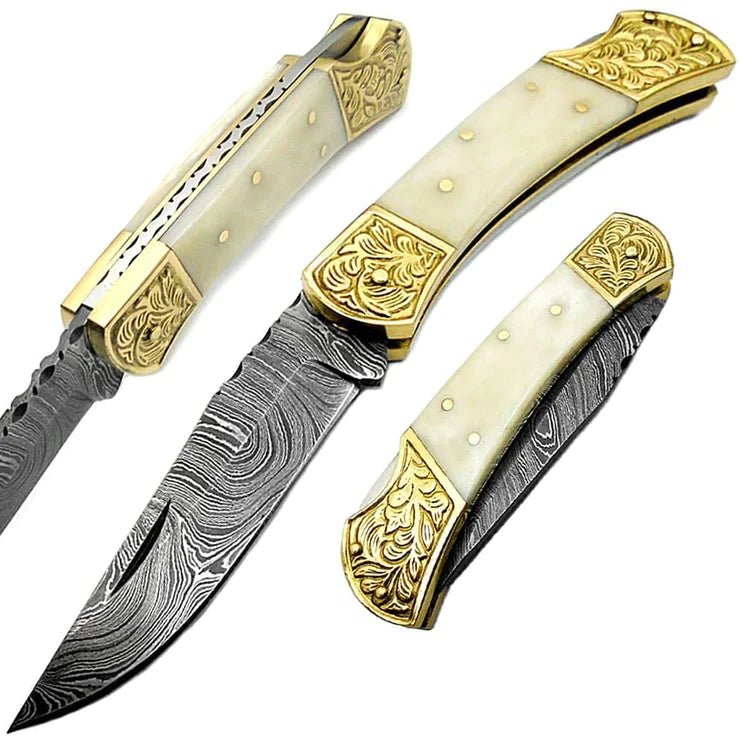
Want prices, real vs fake checks and care in one place? Read the Damascus pocket knife buyer's guide (2026).
Damascus knives range from under $40 to thousands, and some cheap ones aren't Damascus at all. Here's what counts as real Damascus, how fakes are made, and the checks you can do without damaging the knife.
Quick answer
There are three kinds of blade sold as Damascus. Wootz, the historical crucible steel, and pattern-welded Damascus, layers of two steels forge-welded together, are both real. A fake is a plain steel blade with a pattern etched, lasered or printed on the surface. Real patterns run through the steel, so they show on the spine and continue into the edge bevel. A fake pattern sits on the surface and looks too regular or stops at the edge.
Real Damascus: two kinds
- Wootz: a single high carbon crucible steel whose pattern comes from carbides inside the steel. Rare today. See what the original Damascus steel was.
- Pattern-welded: two steels, often a high carbon steel and a nickel steel such as 15N20, stacked, forge-welded, folded or manipulated, then etched. Layer counts vary widely by maker.
How fakes are made
- Laser or acid etching a pattern onto one plain steel.
- Printing or stamping a pattern onto the surface.
Etching itself isn't a sign of a fake: real Damascus is etched too, to darken one steel and reveal the layers. A fake is etched without any layers underneath.
Checks you can do without damaging the knife
- Look at the spine: real pattern-welded blades usually show layer lines on the back.
- Follow the pattern into the edge: it should continue through the ground bevel, not stop where the edge was sharpened.
- Check for repeats: a perfectly repeating or very sharp, printed-looking pattern is a warning sign.
- Ask which steels: a real maker can name them.
- Be wary of extreme prices: a large Damascus knife for a few dollars is a red flag.
Some makers polish the spine or bolsters, so a missing pattern there isn't proof of a fake. Look at several clues together.
Our handmade Damascus
Our pocket knives are pattern-welded from 1095 and 15N20. The Olive Wood Damascus Pocket Knife Set ($39.99) has about 276 layers, and the Buffalo Horn Damascus Pocket Knife Set ($39.99) and Stag Horn Damascus Folding Pocket Knife ($49.99) show the pattern across the blade.
Shop handmade Damascus pocket knives
Prices checked November 21, 2026. The product page on the day you order is the final word.
- Olive Wood Damascus Pocket Knife Set, 6.5 in.: $39.99
- Green Wood Damascus Pocket Knife Set, 6.5 in.: $39.99
- Buffalo Horn Damascus Pocket Knife Set, 6.5 in.: $39.99
- Stag Horn Damascus Folding Pocket Knife, 6.5 in.: $49.99
- Camel Bone Scrimshaw Damascus Folding Pocket Knife, 7.6 in.: $49.99
- Ram Horn Scrimshaw Damascus Pocket Knife, 7.6 in.: $59.99
Damascus pocket knives under $50 · All handmade Damascus pocket knives · Damascus pocket knife buyer's guide
Frequently asked questions
How can I tell if my Damascus knife is real?
Look for the pattern on the spine and check that it continues into the sharpened edge bevel. Real patterns run through the steel; a fake pattern sits on the surface, looks printed or stops at the edge.
Is acid-etched Damascus fake?
No. Real Damascus is etched to reveal its layers. It is only fake when a single plain steel is etched or lasered to imitate a pattern with no layers underneath.
Is pattern-welded Damascus real Damascus?
Yes. Pattern-welded Damascus, layers of two steels forge-welded together, is the most common real Damascus made today.
Leave a comment: