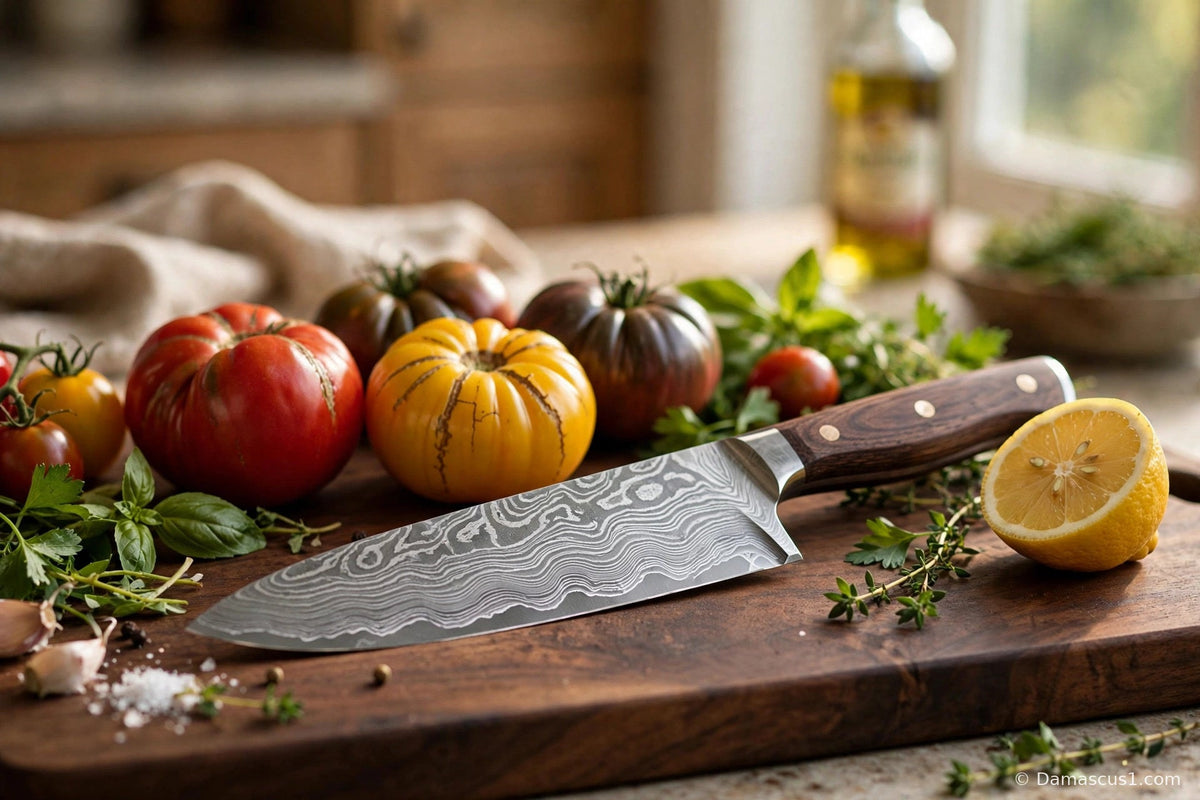
Direct answer: The best chef knife under $100 for most home cooks is the G10 Handle Chef Knife at $34.99 (was $59.99) — a proper chef profile, a hard-wearing G10 handle, and $65 of the budget still in your pocket. If your cooking is vegetable-heavy, the $44.99 VG10 nakiri beside it may honestly suit you better.
That answer will surprise people who assume a budget guide should spend the whole budget. It should not. Under $100 is the most honest price band in kitchen knives: high enough to buy a real, lasting blade, low enough that overspending on one knife while owning no way to sharpen it is the classic mistake. This guide is built around that idea. One lead pick at $34.99. Two more chef profiles at $59.99 each, for cooks who want to spend more of the cap on the knife itself. Two nakiris for the vegetable-first kitchen. And a plain statement of what sits above the cap, so nobody is tricked by a headline.
If you want the unrestricted version of this category first, our best chef knife hub compares German, Japanese and Damascus traditions without a price ceiling. This page is its budget sibling: same honesty, hard cap.
What is the best chef knife under $100 for most home cooks?
The best chef knife under $100 for most home cooks is the G10 Handle Chef Knife at $34.99. It gives you the all-purpose chef profile most dinners actually need, a moisture-resistant G10 handle that tolerates daily washing and drying, and enough budget left over for the sharpening gear that keeps any knife good.
Start with the profile, because profile is what a chef knife really is. A chef knife is the curved-belly all-rounder: rock it through herbs, push it through onions, walk it across a pile of carrots. Most home cooking, most nights, is that one motion repeated. A first serious knife should be the knife that does the most work, and in almost every kitchen that is the chef profile — not a specialty blade, not a cleaver, not a set. Buy the workhorse first. Specialize later, if your cooking ever asks you to.
Then the handle, which budget guides underrate and cooks feel every single day. G10 is a dense, hard-wearing laminate that does not swell, shrink, or go slippery the way tired wood can, and it shrugs off the wash-dry cycle a daily knife lives through. On a $34.99 knife that matters more, not less: a budget blade you grip confidently gets used carefully, and a knife used carefully stays sharp and safe longer.
Finally, the arithmetic, because it is the strongest argument on this page. At $34.99, this knife leaves roughly $65 of a $100 budget unspent. That remainder is not savings in the abstract — it is a whetstone, a better board, or a second specialized knife, any of which will improve your cooking more than spending the same $65 upgrading this one blade. A sharp $35 knife out-cuts a dull $95 knife every night of the week. Budget guides that spend the whole cap on the knife and nothing on keeping it sharp have the priorities exactly backwards.
Why shouldn't you spend the whole $100 on one knife?

You should not spend the whole $100 on one knife because the knife is only half the system. The other half is maintenance: a whetstone to restore the edge, a decent board that does not destroy it, and dry storage. A $35 knife plus sharpening gear will out-cook a neglected $95 knife within a few months.
This is the least glamorous advice in knife buying, and the most valuable. Edges dull. All of them. Expensive steel dulls more slowly, cheap steel dulls faster, but the difference is measured in weeks of home cooking, not years. What separates kitchens after six months is not what the knife cost. It is whether anyone in the house can sharpen, and whether the knife lives on a kind board instead of being dragged across glass, granite, or the bottom of a crowded drawer.
So read every under-$100 guide — including this one — with a total-system question in mind: knife plus care, under the cap. The G10 chef knife at $34.99 plus a nakiri at $44.99 is a two-knife system for $79.98 that covers meat, veg, and everything between, with $20 left toward a stone. The G10 alone plus a stone is a complete one-knife system for well under the cap. Both beat a single $99 knife with no maintenance plan, and it is not close after the first season of cooking.
There is one honest exception. If you already own sharpening gear and a good board — if the system around the knife is already handled — then spending more of the cap on the knife itself makes sense. That is exactly who the $59.99 picks in this guide are for. The comparison table below lays the whole field out so you can see which situation is yours.
Which Damascus1 chef knives under $100 should you compare first?

Compare four under-cap routes first. The G10 Handle Chef Knife at $34.99 is the value lead. The Japanese AUS-10 Chefs Knife at $59.99 is the step-up chef profile. The Serbian Chefs Knife at $59.99 is the heavy-duty cleaver-chef hybrid. And the two VG10 nakiris, $44.99 and $49.99, are the vegetable specialists.
Every price in the table below was verified on October 20, 2026, against the live Damascus1 catalog. Prices can change, and the product page on the day you order is always the final word. One framing note belongs up front: the Serbian knife is a cleaver-style chef knife — a tall, heavy profile built for serious chopping — not a classic curved-belly chef knife. It is in this guide because many cooks searching this term actually want that power, and it would be dishonest to list it without saying plainly how it differs.
| Pick | Best for | Profile | Price (verified Oct 20, 2026) |
|---|---|---|---|
| G10 Handle Chef Knife | Best for most home cooks and first serious knife buyers | Classic chef profile, G10 handle | $34.99 (was $59.99) |
| Japanese AUS-10 Chefs Knife | Best for cooks who want to spend more of the cap on one chef profile | Chef profile, Japanese AUS-10 line | $59.99 |
| Serbian Chefs Knife | Best for heavy chopping, large vegetables and confident cleaver-style work | Tall cleaver-chef hybrid, full tang per its listing | $59.99 |
| Nakiri Knife Japanese VG10 | Best for vegetable-heavy cooking on a budget | Flat nakiri profile, VG10 line | $44.99 |
| Nakiri Knife 8" Japanese VG10 | Best for cooks who want the larger nakiri format | Larger flat nakiri profile | $49.99 |
| 8.5" VG10 Damascus chef knife / Premium 7-Piece Block Set | Best for stepping above the cap deliberately | Upgrade tier — over $100, stated plainly | $399.99 (was $499.00) / $169.99 |
Priced product cards — what each dollar actually buys
Lead pick — G10 Handle Chef Knife — $34.99 (was $59.99). The recommendation for most readers, full stop. A real chef profile at a price that leaves the rest of the system affordable. G10 handle, daily-driver manners, and the lowest cost of entry into serious home cooking on this page. If you buy one thing from this guide, buy this, and put the change toward a whetstone. View the G10 Handle Chef Knife.
Step-up chef profile — Japanese AUS-10 Chefs Knife — $59.99. For the cook who already owns a stone and a board and wants more of the budget in the blade. AUS-10 is a Japanese steel family cooks choose for a fine, keen edge character; read the product page for this knife's own stated construction and dimensions before ordering, and hold it to exactly what the page says. View the Japanese AUS-10 Chefs Knife.
The power option — Serbian Chefs Knife — $59.99. A tall, full-tang cleaver-chef hybrid for cooks whose prep is heavy: winter squash, big root vegetables, large volumes, bones-adjacent confidence work within what its product page describes. It is not a rocking, herb-mincing chef knife and this guide will not sell it as one. Matched to the right cooking, it is the most fun $59.99 on the page. View the Serbian Chefs Knife.
Vegetable specialist, standard — Nakiri Knife Japanese VG10 — $44.99. The flat profile that changed how many home cooks feel about vegetable prep: the whole edge meets the board, so slices separate cleanly instead of accordion-folding. If half your board time is onions, cabbage, carrots and cucumbers, this plus the G10 is the $79.98 two-knife system this guide keeps coming back to. View the Nakiri Knife Japanese VG10.
Vegetable specialist, larger — Nakiri Knife 8" Japanese VG10 — $49.99. The bigger-format nakiri for bigger boards, bigger vegetables, and cooks with larger hands. Five dollars over its sibling buys you format, not a different idea — choose by the size of your cabbage, honestly. View the Nakiri Knife 8" Japanese VG10.
Over the cap, on purpose — $399.99 and $169.99. The 8.5-inch VG10 Damascus chef knife at $399.99 (was $499.00) is the flagship single this store sells, and the Premium 7-Piece Block Set at $169.99 is the set route. Both are named only so the step up is visible. Neither is an under-$100 pick, and neither will be described as one anywhere in this guide. If a set is actually your answer, our best kitchen knife set under $200 guide works that budget honestly.
What separates a good $35 chef knife from a bad one?
A good $35 chef knife separates itself on basics done right: a true chef profile with a usable belly, a handle that stays secure in a wet hand, honest listing details you can check, and an edge you can restore on a basic whetstone. A bad one spends its budget on looks and hides its compromises.
Profile first. Cheap knives often look like chef knives in a thumbnail and cut like toys on a board: no belly to rock with, a tip too blunt to do detail work, a blade too short to span an onion. The test is in the silhouette. If the edge curve is continuous and the tip sits at a useful height, the knife will cook. If the shape is decorative, it will decorate.
Handle second. At this price, handle quality is where value hides. A dense synthetic like G10, fitted cleanly with no gaps or sharp seams, will outlast and out-grip a pretty handle made carelessly. Squeeze it in your mind as a wet, soapy, mid-dinner handle — because that is the handle you actually own, twice a week, for years.
Honesty third, and it applies to sellers as much as knives. A good budget listing tells you what the knife is, what it costs, and what it is not. It does not invent layer counts, hardness numbers, or test results. This guide holds itself to the same rule: where a construction detail matters, you are pointed to the product page's own current wording rather than given a number nobody verified. Judge every budget knife — and every budget guide — by that standard.
Should you buy a chef knife or a nakiri first?


Buy a chef knife first unless your cooking is mostly vegetables. The chef profile handles the widest range of work — meat, herbs, hard and soft produce — in one blade. A nakiri is the better second knife, or the better first knife only for the genuinely vegetable-first kitchen, where its flat profile shines daily.
Run the honest audit. Think about your last ten dinners. How many involved trimming or portioning meat, mincing herbs, or breaking down something irregular? How many were a board full of vegetables and nothing else? Most mixed kitchens find the chef knife touches nine dinners out of ten and the nakiri would star in perhaps half. That is a first-and-second order, not a contest — and at $34.99 plus $44.99, this is one of the rare categories where you do not have to choose forever. You have to choose first.
The vegetable-first exception is real, though, and it is not rare. Households cooking plant-heavy food several nights a week often find the nakiri becomes the daily driver and the chef knife becomes the specialist. If that is your kitchen, invert the order without guilt: nakiri at $44.99 first, chef profile when a recipe finally demands one. The cap accommodates either sequence. What the cap does not accommodate is buying a specialty knife for a kitchen you wish you had instead of the one you cook in.
Our wider best kitchen knives hub walks through every major profile — chef, nakiri, santoku-style, bread, utility — if you want the full map before you commit to a first and second.
One last sizing note for the nakiri-curious: the two nakiris in this guide differ by format, not philosophy. The standard VG10 nakiri at $44.99 suits most boards and most hands; the 8-inch version at $49.99 suits the cook whose vegetables arrive whole and large — cabbages, squash, melons — and whose board has the room to match. Neither is the "better" knife. Buy the one whose size matches your produce, and let the five dollars go toward the whetstone either way.
How does a $59.99 chef knife compare with the $34.99 lead pick?
The $59.99 chef profiles — the AUS-10 chef knife and the Serbian cleaver-chef — put more of your money into the blade and its format, while the $34.99 G10 pick puts more of your money back in your pocket for care gear. Neither is automatically better; the right choice depends on what you already own.
Think of it as two complete budgets. Budget A: G10 chef knife $34.99, plus roughly $65 of headroom. That headroom buys the maintenance system, or a nakiri, or a serious board — the things that surround a knife and decide how well it cooks in month six. Budget B: AUS-10 chef knife $59.99, plus roughly $40 of headroom. Still workable, still honest — provided the surrounding system already partly exists in your kitchen. Budget B with no stone and no board is the trap: a finer knife on a worse system.
The Serbian at $59.99 is a different comparison entirely, because it is a different tool. You do not choose it instead of a chef knife on specs; you choose it because your cooking is heavy and tall-bladed work genuinely dominates your board. Cooks who know, know. Cooks who are guessing should buy the chef profile first and let real dinners teach them whether they need the cleaver at all.
One more comparison matters, and it is with doing nothing fancy at all: a single $99 factory knife from a big brand. Those knives are often perfectly decent. What they rarely offer at this cap is handmade character, a patterned blade with a story on your counter, or money left over. This guide's whole argument is that under $100, system beats label. If you finish this page and still prefer the factory route, buy it with clear eyes — just buy the whetstone too.
What should you skip when shopping under $100?

Skip three things: giant knife sets priced under $100 that spread the money across a dozen thin blades, any knife whose listing invents unverifiable steel claims instead of describing the product plainly, and spending the last dollar of the cap on the knife while owning nothing to sharpen it with. All three are false economy.
The under-$100 mega-set deserves its own warning because it targets exactly this budget. Fifteen pieces for $89 sounds like the end of shopping. Count the working knives — chef, utility, paring — and you will usually find three ordinary blades wrapped in steak knives, shears, and a block. The same $89 spent as this guide suggests — a $34.99 chef knife, a $44.99 nakiri, and change — buys two knives you will use daily instead of three you will tolerate. Sets have an honest price band, and it starts above this cap; that is why the set in this guide's table sits at $169.99, labelled over, not squeezed in.
Unverifiable claims are the second skip. Layer counts, hardness figures, and performance promises that appear in marketing copy but nowhere checkable are decoration, not information. A seller confident in a budget knife describes it plainly. Be suspicious in proportion to the poetry.
And the third skip is the quiet one: the maxed-out single purchase. A $98 knife, no stone, no board upgrade, drawer storage. In six months that kitchen is worse off than the $35-knife kitchen that maintained its edge. Under $100, restraint is a feature. Spend like a cook, not like a collector, and this price band will reward you out of all proportion to its size.
How do you keep a budget chef knife sharp and safe?
Keep a budget chef knife sharp and safe with four habits: hone or strop lightly and often, restore the edge on a whetstone when it truly dulls, hand-wash and dry immediately after use, and store it separated from other steel — never loose in a drawer. Cheap to do, decisive in effect.
Sharpening is a skill, not a purchase, and budget knives are actually the kindest teachers: the stakes feel lower, so people practice, and practice is the entire secret. Learn the angle on the $34.99 knife and you own the skill for every knife you will ever buy afterward. That, quietly, is another argument for starting under the cap instead of at the top of the market: your first sharpening mistakes — and everyone makes them — happen on a knife that forgives them.
Washing and storage are simpler and stricter. Dishwashers punish every knife at every price: heat, detergent, and rattling contact with other steel. Hand-wash, dry at once, put it away separated — in a block, on a strip, or in a sheath. Damascus-patterned blades in particular reward prompt drying, because the layered steel that makes the pattern wants the same dry respect any fine edge wants. None of this takes five minutes a week. All of it together is the difference between a budget knife that disappoints by spring and one still cooking well years later.
If care is the part of knife ownership you have never been taught, start with the store's wider kitchen coverage in the Chef's Best Kitchen Blades collection and the under-$200 set guide linked above — the care sections there go deeper than this budget page can.
Frequently asked questions
What is the best chef knife under $100?
The best chef knife under $100 for most home cooks is the G10 Handle Chef Knife at $34.99 (was $59.99): a true all-purpose chef profile with a hard-wearing G10 handle, at a price that leaves most of the budget for sharpening gear. Cooks who already own care equipment can step up to the $59.99 Japanese AUS-10 Chefs Knife instead.
Is a $35 chef knife actually good enough for daily cooking?
Yes — provided the basics are right. A $35 knife with a true chef profile, a secure handle, and an owner who sharpens it will handle daily home cooking indefinitely. What makes budget knives disappointing is rarely the price itself; it is dullness nobody maintains and profiles that look right but cut wrong. Buy the basics done right, then maintain them.
What is the difference between a chef knife and a nakiri?
A chef knife has a curved belly made for rocking through herbs and general prep across meat and produce. A nakiri has a flat edge made for straight up-and-down vegetable work, so slices separate cleanly. Most kitchens should own the chef knife first; vegetable-heavy kitchens get unusual value from adding — or even starting with — a nakiri.
Should I buy a knife set instead of a single chef knife under $100?
Not under $100. At this cap, a set spreads the money too thin across its core knives. An honest set starts higher — the Premium 7-Piece Block Set is $169.99 — which is why this guide recommends singles under the cap and points set buyers to the under-$200 guide rather than pretending a padded budget set is a bargain.
Does Damascus1 offer engraving on a chef knife gift?
Engraving is offered as a quote-based service — up to 25 characters, confirmed by quote — and is never promised free, fast, or included in the knife's price. If this knife is a gift and personalization matters, ask for the engraving quote through the product page before you rely on it, and allow the order the time the quote specifies.
How was this guide's pricing verified?
Every Damascus1 price in this guide was checked against the live store catalog on October 20, 2026, and the product page on your order day is the final word, because prices can change. No testing, review, or ownership claims are made for these knives; construction details are stated only as the product pages themselves state them.
The bottom line: spend under the cap like a cook
Here is the whole guide in one breath. Buy the G10 Handle Chef Knife — $34.99 (was $59.99) if you are most cooks. Add the Nakiri Knife Japanese VG10 — $44.99 if your board is full of vegetables, for a two-knife system at $79.98. Step up to the Japanese AUS-10 Chefs Knife — $59.99 or the Serbian Chefs Knife — $59.99 only when your cooking — not your curiosity — asks for them. Whatever you choose, keep real money back for sharpening and storage. That restraint, not any single blade, is what makes an under-$100 knife great.
Ready when you are: start with the lead pick, check its product page for today's price and full details, and build the system around it under the cap. One good knife, kept sharp, changes daily cooking more than any other $100 in the kitchen.
Leave a comment: