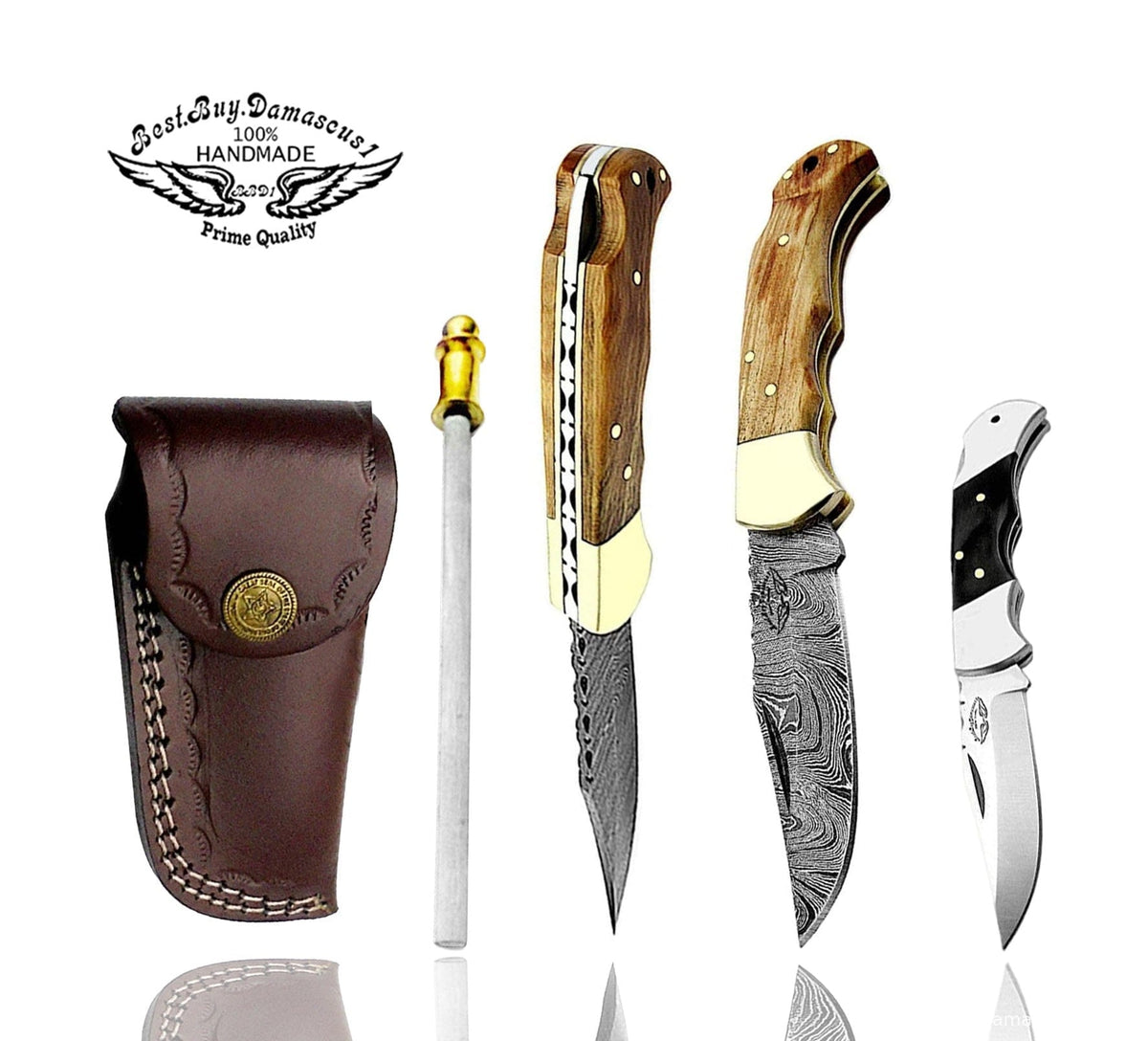
Short answer: The best EDC knife is one whose confirmed closed dimensions, opening method, lock, carry features and permitted uses suit your actual routine. This is a catalogue-based comparison, not a hands-on ranking. The Olive Wood Damascus Pocket Knife Set, listed at $39.99 on October 19, 2026, is a starting point for comparing traditional-looking folders, not a proven best choice for most people.
We checked current catalogue information and store policies on October 19. No cutting, weight, wet-grip, lock-strength or carry-comfort tests are claimed. Product names, photos and listing statements are not independent material verification. Prices can change, and natural-material appearance can vary. Existing store catalogue images are preserved; pictured accessories are not a substitute for a current packing list.
Browse the EDC collection and ask about the exact model's carry features. If a pocket clip, one-hand operation or specific closed length is essential, confirm it before ordering instead of inferring it from a traditional style.
What everyday carry means for your purchase
EDC means everyday carry. In this guide it describes a knife someone might choose for ordinary permitted cutting tasks, not a special steel grade or a guarantee of suitability. Opening a small parcel at home, cutting suitable cord outdoors and working all day with packaging are different demands. A knife can appeal visually while still being the wrong tool for the frequency or conditions of your work.
Start by writing down what you cut, how often you cut it and where the knife would be stored between uses. Include restrictions and cleaning needs. If the main task is repeated packaging work, consider whether a task-specific cutter with appropriate safety features is a better solution. Buying a decorative folder is not a requirement for having a useful everyday kit.
Also record features that would disqualify a knife. Perhaps you need confirmed clip orientation, an opening method compatible with your needs, or dimensions that fit a particular storage pouch. Do not let a low selling price override those constraints. A knife left at home because it does not fit your routine provides little value, even if the handle and blade pattern are attractive.
The current shortlist, with uncertainties visible
These are specific catalogue listings rather than interchangeable names for one platform. The table compares the checked selling price and the named handle or style. Size figures in names are model labels, not newly measured blade, closed or overall dimensions. A shared label does not prove identical thickness, weight, lock or carry footprint.
| Listing | Price, Oct 19 | Listed distinction | Check before purchase |
|---|---|---|---|
| Olive Wood Damascus Pocket Knife Set | $39.99 | Olive wood; folding Damascus model, 6.5 designation | Closed size, mechanism, clip and contents |
| Green Wood model linked in this guide | $39.99 | Green-wood Damascus folder listing | Exact SKU, dimensions and set contents |
| Camel Bone Scrimshaw folder | $49.99 | Camel bone and scrimshaw styling | Current artwork, measurements and mechanism |
| Buffalo Horn Scrimshaw folder | $49.99 | Buffalo horn and scrimshaw styling | Current artwork, measurements and mechanism |
| Stag Horn Scrimshaw folder | $59.00 | Stag-horn listing with brass-bolster styling | Actual handle, lock and measurements |
| Rose Wood Scrimshaw folder | $59.00 | Rose wood and brass-bolster styling | Conflicting 7.5/7.6 labels and actual dimensions |
Do not silently substitute a similarly named product. The store has more than one green-wood or scrimshaw listing, and a short model name may not uniquely identify the item. Keep the exact product link when asking questions and when comparing the cart. A review or specification from a different listing should not be transferred merely because the photographs or handle names look familiar.
The $39.99 options cost less than the listed scrimshaw options. That establishes a budget difference, not equal cutting performance at every price. There is no verified test here showing that the more expensive models cut better or that the cheaper models perform identically. Pay for appearance if that is what you value, but do not mistake decorative detail for a measured performance upgrade.

Closed size matters more than a name suggests
Ask separately for blade length, open overall length and closed length. Add maximum closed width, thickness and weight if carry comfort is important. These measurements are not interchangeable. Overall length says little about the pressure a folded handle might create in a particular pocket, and blade length alone does not tell you whether a pouch will close safely around the folded tool.
Measure your intended storage space and compare it with something you already carry comfortably. Include any pouch or protective cover in the measurement. A pocket full of keys and other objects changes the available space and can put pressure on a tool. Avoid assuming that loose carry is automatically secure, discreet, comfortable or legal simply because a knife folds.
The 6.5, 7.5 and 7.6 figures appearing in model names do not establish a universal beginner size. The Rose Wood listing itself uses different size labels across its name and descriptive material. Ask for a measured answer rather than selecting whichever number supports your preference. If the seller cannot resolve a fit-critical measurement, treat that uncertainty as a reason to pause the order.
Do not calculate blade length by subtracting an assumed handle length from a title. Folding mechanisms and measurement conventions can complicate that arithmetic. For a fitted accessory, provide the actual model and measurements, not just the advertised size family. A careful fit check before payment is more useful than discovering after delivery that a nominally matching sheath does not retain the knife.
Lock type is model-specific, not a style guarantee
A back lock and a liner lock describe mechanisms that secure an opened folding blade. They do not, by themselves, establish opening method, closed-blade retention, clip availability or a safe load rating. Do not assume every traditional-looking folder uses the same back lock, or that every liner lock can be operated comfortably by every user with one hand.
Spyderco's official mechanism reference, checked October 19, explains how different lock designs engage a blade. That is a useful vocabulary reference, not a specification sheet for Damascus1 knives. A retailer should confirm the actual mechanism on the exact current item rather than extending another manufacturer's description to an entire collection.
Ask how the selected knife opens, how its lock releases, what its instructions require and whether there are hand-orientation considerations. Keep fingers out of the blade's closing path and follow the exact product's instructions. A guide cannot certify safe operation from a side photograph. If a mechanism is loose, damaged or does not engage as intended, stop using the tool and seek appropriate service advice.
No folding lock turns a knife into a pry bar, screwdriver or impact tool. The absence of a measured failure in a review is not a load test. Do not test lock strength by striking the spine, twisting a blade in material or deliberately forcing the mechanism. Choose suitable equipment for the task rather than trying to establish a folder's limits yourself.

Confirm clips and opening features before buying
This guide does not certify either the presence or absence of clips across all six models. Nor does it certify universal two-hand-only opening. Current listing evidence is insufficient to make those blanket statements. If you need a pocket clip, ask for a clear photograph of both handle sides and confirmation of attachment, orientation and compatibility with the intended carry arrangement.
If one-hand operation is an access requirement rather than a preference, make it a condition of the shortlist. Ask for the exact operating method and instructions, and select a tool appropriate to your needs. An EDC label or a familiar-looking handle should not replace that answer. Do not modify or improvise an opening method to make an unsuitable product fit your routine.
For pouch or sheath carry, confirm whether the accessory is included and intended for that item. A set image may contain several objects, and the product name alone may not define which ones ship. Ask for the current packing list. Retention, belt compatibility and fit should be established for the accessory itself, not inferred from a photo of a similar set.
Handle materials: choose character without unsupported rankings
Olive wood, green wood, rose wood, camel bone, buffalo horn and stag horn provide different named visual choices in the shortlist. Photos can help compare grain, colour and decorative detail. They cannot establish that olive wood stays warmest, that stag horn is safest with damp hands, or that one material is more comfortable throughout a working day.
Shape, finish, transitions and the particular piece all affect how a handle feels. Request current photographs if appearance is central to a gift or collection purchase. Natural variation means the pictured sample may not exactly match another item. A material name should not become a promise of a specific shade, texture or pattern unless the merchant confirms the actual item.
Choose your preferred appearance only after confirming practical fit. Ask about cleaning and finish care as well. A blade treatment may not suit a handle or bolster, and generic advice to oil every natural handle is not a substitute for product-specific guidance. Keep any claimed durability or moisture resistance tied to documented information rather than an attractive material story.

What Damascus does and does not tell you
The shortlisted products are described in the catalogue as Damascus models. That is a listing statement, not an independent examination of each delivered blade. A visible pattern alone does not establish constituent steels, layer count, heat treatment, hardness, manufacture location or edge retention. This guide assigns none of those properties without model-specific confirmation.
Damascus also does not mean that every patterned blade is non-stainless or that all patterned blades share the same corrosion behaviour. Ask which steels are used and what care is required on the selected product. Stainless-labelled folders elsewhere in the collection are separate products, not interchangeable versions of these listings. Similar pricing is not evidence that the materials or finish are the same.
If material identity is decisive, include that question in a pre-order enquiry. Request confirmation of the current stock rather than relying on a collection-level description. Do not use another model's steel claim, a layer count from an image or an unrelated owner's review as the answer. A precise material statement is more useful than terms such as premium, handmade or razor sharp.
Scrimshaw and gift choices without imagined performance
The scrimshaw listings offer decorative styling in different named handle materials. That can be a legitimate reason to choose one as a gift or collection item. We have not verified the precise technique used on each current piece, so this guide does not certify hand engraving, ink application, where the decoration is applied or how it will wear over years of use.
Ask for a photograph of the actual pattern and whether artwork varies. Clarify whether any displayed sheath, sharpening accessory, smaller knife or packaging is included. A gift decision often depends on presentation, but a product photograph cannot define a packing list by itself. If a particular box or accessory matters, get that answer before placing the order.
A suitable gift also depends on the recipient's preferences, ability to handle the tool responsibly and the rules where it will be owned and carried. A decorative folder is not a universally appropriate gift. If uncertain, discuss the category with the recipient or choose something that does not require a knife-carry decision on their behalf.
Personalization is an enquiry, not an included feature of the checked prices. The store's established quote route accepts a short message of up to 25 characters; suitability, placement, design approval, charge and production timing must be confirmed for the exact knife. Do not assume engraving is free, immediately available or possible on every material. Keep a non-personalized alternative if a deadline is important.

Use reviews as evidence about the right item
Read reviews attached to the exact product and look for enough detail to identify the model and experience. Useful details include the item received, current accessories, operating concerns and the context of use. A broad store rating or a review of another handle style cannot certify this model's lock, steel or comfort.
This guide does not claim an owner consensus, a complete model-specific review count or a tested winner. Reviews can help identify questions, but one person's description is not a controlled comparison. If a review conflicts with the current listing, ask the merchant to resolve the discrepancy instead of choosing whichever version sounds more appealing.
Likewise, do not treat the absence of complaints as evidence of a specific durability level. There may be limited feedback, changes over time or differences between variants. Preserve the distinction between what a reviewer reports, what the catalogue states and what an independent test would establish.
Carry rules and storage are separate checks
Check current official rules for the place of ownership, route, destination and intended venue. Workplace and venue policies are separate questions from general possession rules. This guide provides no legal clearance and does not claim that traditional folders, small models or manually opened knives are permitted everywhere.
Do not use concealment, bag carry or vehicle storage as a presumed workaround. If you cannot establish that taking a knife somewhere is permitted, resolve the question before carrying it there. A product's size designation or an EDC label is not a legal category on which to base a decision.
When transporting or storing a permitted tool, protect the edge and secure it against unintended movement or access. Keep it away from children and from people who should not handle it. Choose an arrangement consistent with the exact model's instructions, and do not leave an exposed knife among shared equipment.

Care that respects an uncertain specification
Keep the whole tool clean and dry following its instructions, including the pivot and lock where applicable. Do not put a wet folder away and assume a patterned or stainless-labelled blade needs no attention. Avoid prolonged soaking, harsh treatment or unapproved chemicals. If lubrication is required, confirm which product is appropriate for the mechanism, blade and handle.
Food contact adds a separate cleaning question. A lubricant for moving parts is not automatically appropriate on a food-contact surface. If using a knife with food is intended and suitable, follow the necessary cleaning and residue-removal instructions. Do not move directly from dirty packaging or equipment to food with only a dry wipe.
Sharpen according to the actual blade's instructions rather than a universal angle copied from a roundup. If you lack the equipment or skill, seek appropriate help. Avoid making a damaged lock, chipped blade or loose handle into a home repair experiment. Read the folding-knife care guide as a companion, while keeping the product's specific instructions in control.
Shipping, returns and a useful final enquiry
The shipping policy bases delivery estimates on availability and selected options, with restrictions that can affect destinations. Confirm charges and estimates at checkout rather than assuming free shipping or a fixed delivery window. For a dated gift, ask before ordering and do not equate a dispatch estimate with guaranteed arrival.
The refund policy describes a 30-day period from purchase, subject to unused condition, original condition and packaging, intact tags and proof of purchase. Shipping fees are non-refundable. This is not an unconditional trial in which a used knife can automatically be returned.
A useful enquiry contains the exact product URL, the feature you need confirmed and your relevant constraint. Ask for measured closed dimensions, the current packing list or the actual opening method. Before payment, check the selected item, variant, quantity, shipping choice and final total. Good buying clarity comes from resolving the answer, not from adding more products to an uncertain cart.
EDC knife FAQs
Which is the proven best knife here?
No hands-on winner is established. Compare the listed options against confirmed fit, features and permitted tasks. The olive-wood folder is a price and style starting point, not a universal recommendation.
Do all six have back locks and no pocket clips?
That blanket claim is not verified. Ask about the exact model's mechanism, opening method and clip features. Do not infer them from styling or another listing.
Does a 6.5-inch name give the closed length?
No. Request blade, open and closed measurements separately, with thickness and weight when fit matters. A model label is not a complete measurement sheet.
Are the scrimshaw models better cutters?
No comparative cutting test supports that claim here. Decorative detail can justify a preference without being presented as a performance upgrade.
Where can I compare the next details?
Use the current EDC collection, carry and retention checks, and model-specific enquiry route. Keep the exact product link with every question.
Leave a comment: