Want prices, real vs fake checks and care in one place? Read the Damascus pocket knife buyer's guide (2026).
Knife collecting is one of the most rewarding hobbies for anyone who likes craft, history and good tools. It can also get expensive and messy if you start without a plan. Here are the honest pros and cons, and a simple way to start.
Quick answer
Start a knife collection with a clear theme (a steel, a maker, a handle material or a knife type), a monthly budget, and a rule to buy only knives you can verify. The rewards are the craft, the history and knives you can pass on. The downsides are spending creep, safety around children and counterfeit knives. Don't collect expecting profit: a few knives hold or gain value, most don't.
The pros of knife collecting
- You learn a lot: steels, forging, locks and handle materials. Each knife teaches you something, and you make better buying decisions as you go.
- It's a satisfying hobby: handling, sharpening and caring for good knives is relaxing, and you can enjoy it in small doses.
- You build something to pass on: a well-kept collection, with notes on where each knife came from, makes a real family keepsake.
- Some knives hold their value: rare, well-documented knives in good condition can keep or grow their value. Treat that as a bonus, not a plan.
The cons of knife collecting
- Spending creep: it's easy to buy more than you planned. Set a budget and stick to it.
- Safety: knives are not toys. Store them locked or out of reach if there are children in the house.
- Fakes: counterfeit antique and "Damascus" knives are common. Research the seller and the knife before you buy. Our buyer's guide shows how to spot fake Damascus.
- Local rules: some knife types, such as automatics and OTF knives, are restricted in some places. Check your local laws before buying or carrying.
How to start a knife collection in 5 steps
- Pick a theme: for example, Damascus folders with natural handles, hunting knives, or one maker's work. A theme keeps the collection focused.
- Set a budget: a monthly amount, so the hobby stays fun.
- Buy what you can verify: named steels, clear photos and a seller who answers questions. Use our knife quality checklist.
- Keep records: a photo, the receipt, the steel, the size and where you bought it.
- Store it well: see the next section.
How to store a knife collection
For a collection, a lined display case or a drawer insert is gentler on edges than a kitchen knife block, because each knife sits still and doesn't slide against wood. Keep the case somewhere dry, oil carbon steel and Damascus blades lightly, and check them every month or two for spots. Our guide on how to store a Damascus knife covers this in detail. Knife blocks are still a good choice for kitchen knives you use every day.
A Damascus starter collection under $300
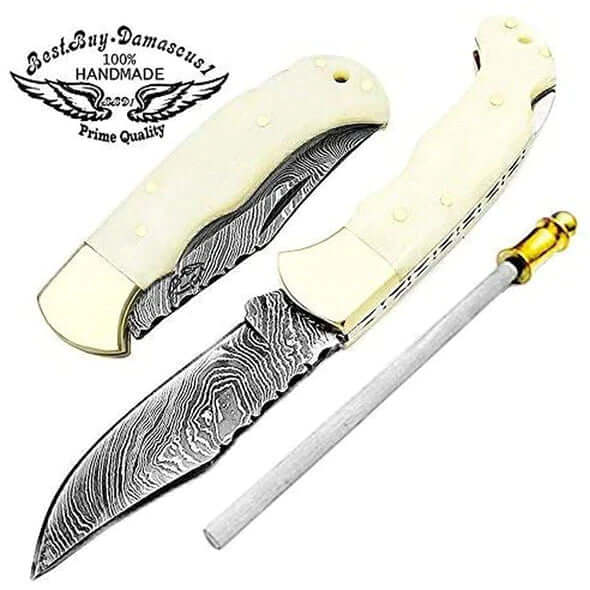
A theme that works well for beginners is handmade Damascus folders with different natural handles, because every piece looks different. A first shelf might be the Olive Wood and Green Wood pocket knife sets ($39.99 each), the Buffalo Horn set ($39.99), the Stag Horn folder ($49.99), and the two scrimshaw folders in camel bone ($49.99) and ram horn ($59.99). That's six knives for $279.94 at today's prices.
Shop handmade Damascus pocket knives
Prices checked November 21, 2026. The product page on the day you order is the final word.
- Olive Wood Damascus Pocket Knife Set, 6.5 in.: $39.99
- Green Wood Damascus Pocket Knife Set, 6.5 in.: $39.99
- Buffalo Horn Damascus Pocket Knife Set, 6.5 in.: $39.99
- Stag Horn Damascus Folding Pocket Knife, 6.5 in.: $49.99
- Camel Bone Scrimshaw Damascus Folding Pocket Knife, 7.6 in.: $49.99
- Ram Horn Scrimshaw Damascus Pocket Knife, 7.6 in.: $59.99
Damascus pocket knives under $50 · All handmade Damascus pocket knives · Damascus pocket knife buyer's guide
Frequently asked questions
Is knife collecting a good investment?
Usually not as an investment. A few rare, well-documented knives in excellent condition hold or gain value, but most knives sell for less than they cost. Collect for enjoyment and treat any gain as a bonus.
How do I start a knife collection?
Choose a theme, set a monthly budget, buy only knives whose steel and maker you can verify, keep a record of each knife, and store them in a dry, lined case.
How should I store a knife collection?
Use a lined display case or drawer insert in a dry room, keep blades lightly oiled, and keep the collection out of reach of children. Check each knife every month or two for rust spots.
Leave a comment: