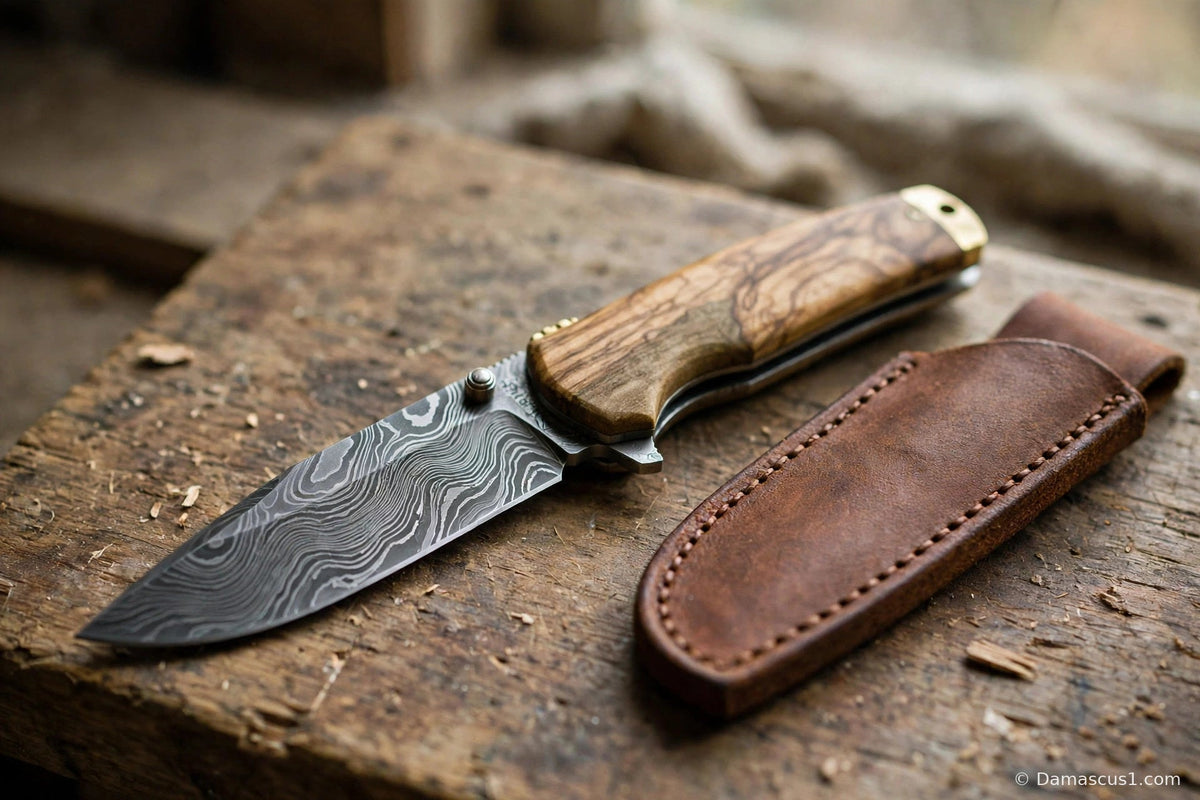
A Damascus folding knife is the pocket form of a very old idea: a blade built from layers of steel, folded into a handle you can carry every day. It is also a category full of loose language. Listings call a patterned handle "Damascus" when the blade is plain steel, quote layer counts as if they were performance grades, and describe one model's specification as if it defined every folder ever made. The old version of this page did some of that itself, and it has been rewritten properly: what a Damascus folder actually is, how its lock, size and handle change the knife you end up carrying, what the real ones cost, and how to look after the pivot and blade once it is yours. The starting point of the range itself is the Olive Wood Damascus Pocket Knife Set at $39.99, a 6.5-inch handmade folder with a genuine leather sheath included, in the everyday EDC pocket knives collection. If you want ranked picks rather than the explanation, that is a different page: the best Damascus pocket knife guide. This page is the one that teaches you how to judge any folder, including ours.
What is a Damascus folding knife?
A Damascus folding knife is a pocket knife whose blade is made from layered steel — two or more steels forge-welded into one billet, worked until the layers flow, then etched so they show as a wavy pattern — mounted on a pivot so it folds closed into its handle. Most traditional handmade folders use a lockback and open with a nail nick.
Two constructions hide inside that definition, and telling them apart is the first buying skill in this category. The first is pattern-welded through: the blade is layered steel all the way through, spine to edge, which is how traditional handmade folders — including the Damascus1 range — are built. The second is clad construction, common on factory folders: a single hard core steel does the cutting, and layered Damascus steel is applied as a jacket on the faces. Spyderco's Damascus Endura is the famous example, a VG-10 core inside Damascus cladding. Neither construction is a cheat; they are different answers to the same question. What is a cheat is the third thing you will meet in listings: a plain blade — sometimes not even the blade, just the handle — given a Damascus look and sold under the name. A folder whose product page talks about a "Damascus finish" or "Damascus handle" while saying nothing about the blade's construction is telling you, if you read it carefully, that the steel is not layered at all. The general definition, before the folding part, is in what is a Damascus knife?, and the wider folder picture — including the stainless models in this store's own collection — is in the best pocket knife hub.
How is a Damascus folding blade made?

A pattern-welded blade starts as a stack of alternating steel strips, heated and hammer-welded into a single billet, then drawn out, cut, restacked and worked until the layers multiply and flow. After grinding and heat treatment, a mild acid etch makes the two steels react at different rates, which is what reveals the pattern. The figure is the construction, made visible.
One pairing you will see named often is 1095 high-carbon steel with 15N20, a nickel-bearing steel: the nickel steel stays bright in the etch while the carbon steel darkens, which is why the waves read so clearly. It is a common pairing, not the definition — other makers pair other steels, and stainless Damascus exists for clad kitchen and factory blades. Earlier versions of this page presented that one recipe as what Damascus simply is, and described the etch as something that "sanitizes the nickel". Neither is true, and both have been removed: etching sanitises nothing; it is a surface reaction that creates contrast, the way developing fluid reveals a photograph. The fold-by-fold version of the process is in how pattern-welded pocket knives are made, and the pattern families the working produces — ladder, raindrop, twist and the rest — are compared in the basics of Damascus knife patterns.
A folder then adds the machinery a fixed blade never needs. The finished blade is drilled for a pivot pin, ground with a tang shaped for its lock, and fitted between liners and handle scales with a spring or lock bar. That joint is the folder's whole character: it is what makes the knife pocketable, and it is also its weakest point, its dirt trap, and the part that decides how the knife feels after a year of use. When you judge a folding knife, you are really judging two things — the blade, and the joint. The sections below take the joint first, because it is the part most buyers never think about until it disappoints them.
Which lock is best on a Damascus folding knife?

For a traditional handmade folder, the lockback is the best default: a rocker bar along the spine drops into a notch in the blade's tang, holds the blade firmly open, works for either hand, and keeps your fingers out of the blade's path when you close it. Its honest costs are two-handed closing and a notch that resents grit.
The four lock families you will actually meet on Damascus folders, compared on the things that matter in use:
| Lock | How it holds | How you release it | Fingers in blade path? | What wears or fouls first | Best for |
|---|---|---|---|---|---|
| Lockback (back lock) | Rocker bar on the spine hooks a notch in the tang | Press the bar at the back of the handle | No | Grit and lint packed into the notch | Traditional handmade folders, hunting and camp carry |
| Liner lock | A sprung steel liner inside the handle snaps behind the tang | Push the liner sideways with your thumb | Yes — mind the thumb as the blade starts to close | The liner's contact face; engagement creeps with wear | Slim modern folders, one-hand closing |
| Frame lock | Part of the handle frame itself springs behind the tang | Push the frame sideways | Yes | The frame's contact face | Heavier modern metal-handled folders |
| Slip joint (no lock) | A backspring presses on the tang and holds by tension | Push the blade closed against spring pressure | No lock to release | Spring tension softens over years | Light traditional pocket knives, strict carry rules |
Two judgements follow from the table. First, "strongest lock" is the wrong question for a pocket knife: every lock here is strong enough for cutting, which is the only work a folder should do — no lock makes prying or batoning safe, because the pivot, not the lock, takes that abuse. Second, the lock decides your daily habits. A lockback's two-handed close feels slow for a week and then disappears into routine, and it buys you the safest closing geometry of the four. A liner lock's one-handed close is genuinely convenient and genuinely puts a thumb where the edge is travelling; owners learn the roll-off technique or they learn it the other way. Traditional handmade Damascus folders are overwhelmingly lockbacks with a nail-nick opening — no thumb studs, no flippers, no pocket clip on most — and that is a deliberate, older idea of a pocket knife: slower to open, calm to close, and carried in its sheath or loose in a pocket. If your day needs one-hand opening fifty times a day, a modern factory folder serves it better, and this page would rather tell you that than sell you the wrong knife. The care routine that keeps a lockback's notch clean and its pivot smooth is summarised further down and written in full in the Damascus folding knife care guide.
What size Damascus folding knife should you carry?

Judge a folder by its closed length first, because that is the knife you actually carry: around 3.5 to 4 inches closed suits most pockets and hands, opening to roughly 6.5 inches overall with a blade near 3 inches — enough edge for daily work without the bulk or the legal attention a longer blade draws.
Listings quote overall length because it is the biggest number, but the three measurements do different jobs. Closed length decides pocket comfort and how the knife sits in a sheath. Blade length decides what the knife can cut and, in many places, what the law allows. Overall length decides leverage and how much handle your hand gets. The Damascus1 folder range is built around two sizes, and the honest way to present them is side by side:
| Damascus1 folder size | Overall (open) | Best for |
|---|---|---|
| 6.5-inch folders | 6.5 inches | Everyday carry, gifts, a first Damascus knife — the size most buyers should start with |
| 7.6-inch scrimshaw folders | 7.6 inches | Larger hands, milestone gifts, display-leaning carry where the engraved-style handle is the point |
A blade between 2.5 and 3.5 inches suits most everyday tasks — packages, cord, fruit, light workshop work — and is legal to carry in more places than a longer blade; that answer was on the old version of this page and it survives, because it is true. What the old page never said is the buyer's half of the sizing story: more "smaller than expected" disappointment comes from closed length than from blade length, because a knife that looks generous in a product photo arrives as a 3.5-inch object in the hand. Measure the pocket knife you already like, closed, before you order anything. The full measuring method — blade from tip to bolster, closed length, how to read a listing's numbers — is in the pocket knife size measurement guide, and the complete first-buyer walk-through is the first Damascus pocket knife checklist.
Which handle material is best for a folding knife?

There is no single best — there is a best for your hands and your weather. Olive wood is the balanced default: warm, grippy enough, and forgiving. Horn and stag give the firmest grip, bone the most traditional look, and coloured woods the most personal gift. All of them are natural materials, and all of them dislike soaking water and dishwasher heat.
| Handle material | Best for | The honest trade-off |
|---|---|---|
| Olive wood | The first folder and the safest gift — warm in the hand, classic with the pattern | Shows scratches honestly; wants the same dry storage as the blade |
| Buffalo horn | A darker, polished look with a firm grip | Natural variation is wide — no two handles match, which is either the charm or the problem |
| Camel bone | The pale, traditional pocket-knife look | Smoothest of the group; the least grippy with wet hands |
| Rose wood and coloured woods (blue, red, green, multi) | Gifts where the colour carries the meaning | Dyed finishes vary batch to batch; check the product photos, not just the name |
| Ram horn | Texture you can feel — grip without checkering | The most rustic finish; not the choice for a formal gift |
| Stag horn | Wet, cold or gloved hands; the strongest grip of the range | The boldest texture and the highest price in the 6.5-inch line |
The deeper comparison — how each material ages, what humidity does to it, and how the weight differs in the pocket — is in the pocket knife handle materials comparison. One point that comparison makes and this page repeats, because it decides returns: natural handles are finished by hand and vary by nature. The figure in the wood, the marbling in the horn, the pores in the bone — the knife that arrives will be a sibling of the photographed knife, not its twin. Buyers who want identical should buy synthetic handles from a factory line; buyers who want theirs are exactly who handmade folders are for.
Is a folding knife or a fixed blade better?
A folding knife is better for everyday carry: it closes safely into its own handle, rides in a pocket or sheath, and handles the hundred small cuts of a normal day. A fixed blade is better for hunting, camp chores and heavy work, because it has no pivot to loosen or foul and no lock to mind. Neither is better at cutting — the work decides.
| Factor | Folding Damascus knife | Fixed-blade Damascus knife |
|---|---|---|
| Carry | Pocket or belt sheath, blade enclosed | Sheath required, always at full length |
| Strength | Limited by the pivot and lock — cutting only, never pry | Full tang has no joint; the stronger tool |
| Cleaning | Pivot and lock notch trap grit and moisture — needs the folder routine below | Wipe the blade and dry; nothing hidden |
| Best work | Packages, cord, food on the go, light repairs, gifts and daily carry | Field dressing, camp kitchen, kindling-adjacent work, heavy cutting |
| Legal picture | A blade near 3 inches is accepted in more places | Open carry rules vary more; check locally either way |
That is the same answer the old page's FAQ gave, kept and expanded, because it was the most honest paragraph on the old page. The camp-specific version — which form survives a wet weekend better, and why — is worked through in the folding vs fixed camping knife guide, and the camping shortlist itself is the honestly rewritten best pocket knives for camping guide. If your folder will live outdoors, its home matters as much as its lock: a sheath that fits the closed knife, kept dry, beats a drawer full of loose tools, and the options are compared in the custom leather pocket knife sheath guide and the pocket knife storage, cases and display guide.
How much do Damascus folding knives cost?
Expect two different markets. Factory Damascus folders from the big brands commonly run from about $100 to well past $300, and handmade folders from specialist sellers cluster around $60 to $150. Maker-direct handmade folders start lower — the Damascus1 lockbacks below begin at $39.99 with a leather sheath included. At every price, ask what the blade actually is before you ask what it costs.
The spread is labour and distribution, not magic. A factory folder carries machining, brand and retail markup on top of its steel; a handmade folder carries a maker's hours; a maker-direct store removes the wholesale layers between the two. What price cannot tell you is whether the pattern is real — cheap fakes and honest cheap knives sit in the same band, which is why the checks in the next sections matter more than the number. Below are the folders most relevant to this guide, with prices checked on the live store on November 18, 2026. Prices and compare-at figures can change; the product page on the day you order is the final word.
Priced picks, verified November 18, 2026:
- Olive Wood Damascus Pocket Knife Set — $39.99 (compare at $89.99). Best for: the first Damascus folder and the safest gift. 6.5-inch lockback, olive wood handle, genuine leather sheath included.
- Buffalo Horn Damascus Pocket Knife Set — $39.99 (compare at $99.99). Best for: the darker, polished look at the same entry price.
- Camel Bone Damascus Folding Pocket Knife — $39.99 (compare at $99.99). Best for: the pale, traditional handle.
- Rose Wood Folding Pocket Knife Set — $39.99 (compare at $99.99). Best for: formal and gift carry.
- Blue Wood Damascus Pocket Knife Set — $39.99 (compare at $99.99). Best for: the modern colour at the entry price.
- Ram Horn Damascus Folding Pocket Knife — $44.99 (compare at $99.99). Best for: textured grip at a small step up.
- Stag Horn Damascus Folding Pocket Knife — $49.99 (compare at $139.99). Best for: grip in wet, cold or gloved hands.
- Buffalo Horn Scrimshaw Damascus Pocket Knife, 7.6 inch — $49.99 (compare at $99.99). Best for: the larger, milestone-gift size.
Shipping, stated plainly: the store offers free US shipping on orders over $50, so a single $39.99 folder does not clear the threshold on its own. It clears with a second folder, the stag horn knife plus a small add-on, or any of the 7.6-inch scrimshaw folders paired with an accessory — and two folders as a pair of gifts is how many readers do it. For a folder that has to be one person's and nobody else's, engraving is the finishing step: the options and the honest limits are in the personalized pocket knife engraving guide, the gift framing is in the groomsmen knife gift guide, and the money question in full — what the years of ownership actually cost — is in is a Damascus pocket knife worth it? and the graded benefits of Damascus knives.
How do you care for a Damascus folding knife?

A folder needs everything a fixed blade needs — wash by hand, dry straight away, oil the blade lightly, sharpen on a whetstone — plus two folder-only habits: keep the pivot and the lock notch clean and dry, and never store the knife long-term in a damp sheath. The joint, not the blade, is where folders quietly fail.
The routine, in the order it happens. After dirty work, wipe the blade before you close it, so grit is not dragged into the handle where it grinds at the pivot and packs into the lockback's notch. Wash in warm water with a drop of soap, rinse, and dry the whole knife — then open and close it once on a dry cloth, because water hides in the joint after the faces look dry. A trace of food-safe oil on the blade protects the high-carbon steel, and a smaller trace at the pivot keeps the action smooth; too much oil in the joint collects lint instead of preventing it. Once a month, or after a wet day out, blow or brush the lint out of the notch and check that the lock bar still seats with a clean click — a lockback that feels gritty is asking for a rinse, not for more force. Sharpen on a whetstone at a shallow, steady angle when the edge dulls, and strop in between; the etched pattern sits shallow near the edge, so aggressive gadgets cost you figure as well as metal. The full illustrated routine — pivot cleaning, notch care, sheath storage, rust recovery — is the Damascus folding knife care guide, and the rust science behind it is in can Damascus steel rust?.
How can you tell a real Damascus folder from a fake pattern?
Look for a pattern that runs through the steel: on a genuine layered blade the figure continues over the spine, varies naturally like wood grain, and fades honestly where the edge is ground. A figure that sits only on the flat faces, repeats with printed regularity, or stops dead at the spine is decoration on plain steel — whatever the listing calls it.
Three checks, in the order a buyer can do them. First, the spine test: a pattern-welded blade is layered through its whole thickness, so the spine shows the layers too; a surface-etched fake is plain there. Second, the variation test: a made pattern flows, pools and shifts; a printed or laser-etched one repeats, and repetition is the tell no forge produces. Third, the seller test, which is the strongest of the three: a genuine maker describes the construction plainly, prices the work rather than the photograph, and does not need a layer count to do the talking — while a fake's listing leans on layer numbers and superlatives and goes quiet when asked what the blade is. Apply the same test to this store: the Damascus1 listings describe handmade layered-steel folders with natural handles and a sheath included, at maker-direct prices, and the complete version of every check — including what to do when a knife arrives — is in how to spot a fake Damascus knife. The everything-in-one-place companion to this page is Damascus steel pocket knives: everything you need to know.
Is it legal to carry a Damascus folding knife?
In many places, yes — a manually opening folding knife with a blade near 3 inches is the most widely accepted form of pocket knife. But the rules that decide legality are local, and they turn on blade length, lock type and where you carry, not on the steel. Check your state, city and workplace rules before you carry, every time you travel.
That is the old page's answer, kept nearly word for word, because careful is correct here and nothing about it has changed. What can be added usefully is where the traps sit. Some jurisdictions measure blade length differently, some restrict locking folders in specific places such as schools, government buildings and licensed premises, and some countries treat any locking blade as a restricted item regardless of length. Air travel is its own rule everywhere: a folder goes in checked baggage, never the cabin. A Damascus folder adds no legal category of its own — the law sees a folding knife of a given length and lock, and the pattern is irrelevant to it — but a knife you would be sorry to surrender at a door check is a knife to leave at home that day. This section is general information, not legal advice; your local rules are the ones that apply to you.
Who should buy a Damascus folding knife — and who should not?
Buy one if your cutting is daily and light, if you will enjoy carrying a handmade object that exists exactly once, or if you need a gift that will be kept rather than drawer-bound. Do not buy one if you need one-hand opening all day, if the knife will live wet and unwashed, or if it will be asked to pry, lever or baton — buy a modern factory folder or a fixed blade instead, and enjoy it without a second thought.
That is the whole argument of this page in one paragraph. A Damascus folder is not a wonder tool and it is not a fragile ornament; it is a well-made, individual pocket knife whose blade shows how it was built, whose lockback asks for two calm hands, and whose joint asks for a dry cloth now and then. Bought for those real qualities — at $39.99 with its sheath, from the everyday EDC pocket knives collection — it repays its owner every time it comes out of a pocket. If you want one made to a specification rather than picked from the range, the custom route is explained in custom Damascus folding knives. Start with the Olive Wood Damascus Pocket Knife Set at $39.99, dry it after use, keep its notch clean, and it will still be clicking open, clean and sure, years from now.
Frequently asked questions
What is a good blade length for an everyday carry knife?
A blade between 2.5 and 3.5 inches suits most everyday tasks and is legal to carry in more places. Check your local rules before carrying. Judge the knife by its closed length too — around 3.5 to 4 inches closed is the pocket-comfort range most people settle on.
Is it legal to carry a pocket knife?
In many places, yes, but rules vary by state and country, mostly on blade length, lock type and where you carry. Check your local laws before carrying a knife in public, and put any folder in checked baggage when you fly.
Should I choose a folding or fixed-blade knife?
Choose a folder for everyday carry and light cutting, because it closes safely into its handle. Choose a fixed blade for hunting, camp chores and heavier work, because it has no moving joint and is stronger and easier to clean. Fixed blades need a sheath to carry.
Are Damascus folding knives good for everyday carry?
Yes, for the work everyday carry actually is: packages, cord, fruit, small repairs. A traditional handmade folder opens with two hands and a nail nick, so it suits a calm pace of use. If your day needs constant one-hand opening, a modern factory folder with a thumb stud or flipper is the better tool.
Do Damascus folding knives rust?
The blade can, yes — pattern-welded Damascus in the common high-carbon construction rusts if it is put away wet, and a folder adds two traps a fixed blade does not have: moisture in the pivot and grit in the lock notch. Dry the joint after washing, oil the blade lightly, and store the knife dry, and the question rarely arises.
What is the strongest lock on a folding knife?
For cutting, every common lock — lockback, liner, frame — is strong enough; folders fail at the pivot when they are pried or twisted, which no lock prevents. The lockback's real advantage is not strength but geometry: it releases from the back of the handle, so your fingers stay out of the closing blade's path.
How long does a Damascus folding knife last?
A well-made folder, kept dry and sharpened on a stone, serves for many years. What shortens its life is neglect with an address: rust left to deepen in the pivot, a lock notch packed with grit, a natural handle soaked or dishwashed, or a sheath stored damp. The care routine on this page is the whole of the maintenance bargain.
Leave a comment: