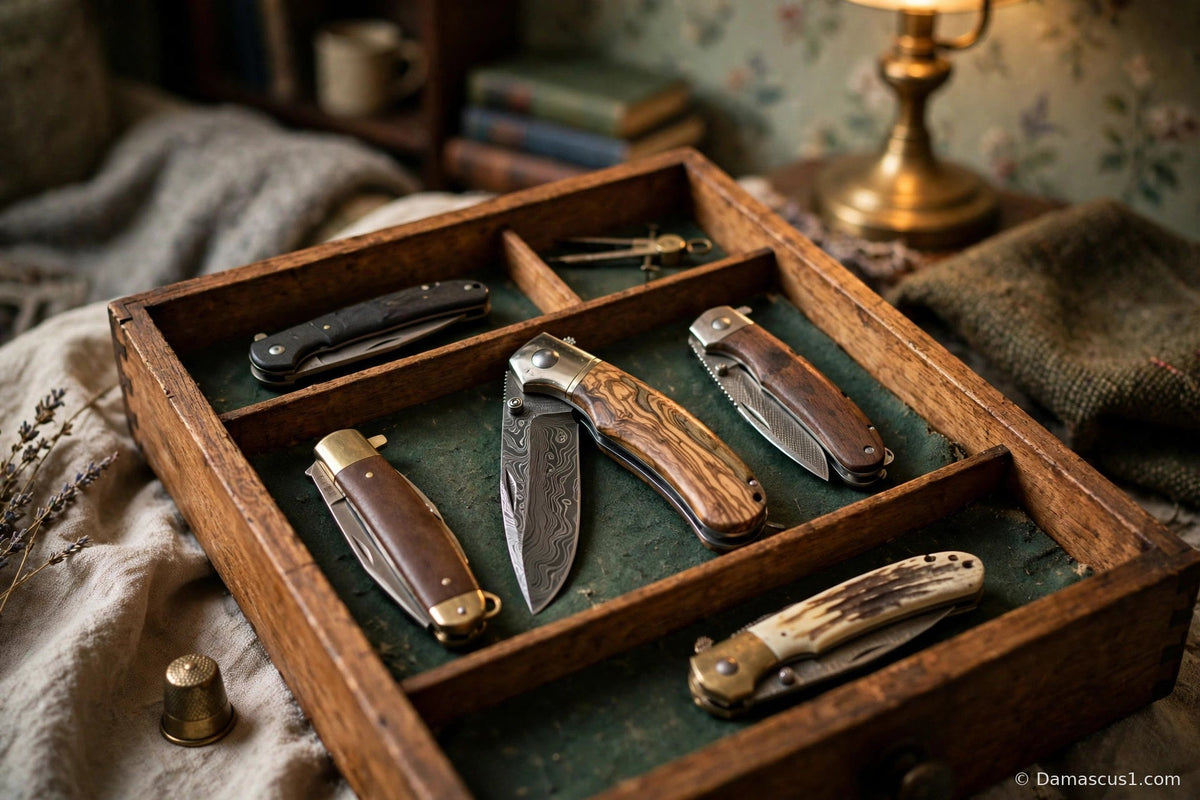
The short answer: Yes — locking knives are legal in the UK for adults to buy, own, collect and use at home. They are not banned. What the law restricts is carrying one in a public place: there, a locking knife needs a specific, current good reason, because a lock knife is not a "folding pocketknife" under section 139 — at any blade length.
If you have heard the opposite — that lock knives were banned, that owning one is an offence, that the one in your drawer is contraband — you have heard one of the most durable myths in British knife talk, and this page exists to retire it properly. The myth survives because it contains a splinter of truth, badly placed. The splinter is real: a locking knife does not qualify for the one privilege the law gives a small slipjoint, the right to be carried in public without any reason at all. Somewhere between the courtroom and the pub, "does not qualify for the carry exception" hardened into "illegal", and "illegal to carry without a reason" hardened further into "banned". Both hardenings are false, and both do damage — the first frightens honest owners into thinking a lawful tool is illicit, and the second, stranger still, leads some buyers to assume that because the ban story is nonsense, the carry rule must be nonsense too. It is not. Own: yes, plainly. Carry: with a reason. This guide walks both halves slowly, names the cases and the section that decide them, separates a real good reason from the excuses the sources agree are not reasons at all, and then — only then — talks about what a locking knife is actually for, and which one to buy for the home, the bench, the collection and the campsite.
As everywhere in this series: general information about how the rules are generally understood, not legal advice. Circumstances decide real cases; check current official guidance for your own situation.
Where did the "lock knives are banned" myth come from?
From a genuine legal distinction, retold badly for thirty years. Start with what is actually prohibited in the UK, because there is a prohibited list and it matters not to smudge it: certain knives are banned to own outright — flick knives and gravity knives are the classic examples — and nobody in this guide's world sells, buys or defends them. A locking folder is not on that list. It never has been. What happened to locking folders happened somewhere else entirely: not in the law of ownership, but in the law of carrying, and in one specific exception to it.
Section 139 of the Criminal Justice Act 1988 makes it an offence to have a bladed article in a public place without good reason or lawful authority — and then exempts the humble folding pocketknife, non-locking, cutting edge 3 inches or less, from needing a reason. When lock knives reached the courts, in Harris v DPP and R v Deegan, the question was whether a knife that locks open is a "folding pocketknife" within that exemption. The answer was no: a folding pocketknife, for this purpose, must be foldable at all times, and a locked blade is not foldable until you release the lock. While locked, it is in substance a fixed blade. So the lock knife fell outside the exemption — not outside the law, outside the exemption. It joined the large, ordinary category of bladed articles that are perfectly lawful to own and need a reason to be carried in public, a category that includes every kitchen knife, every fixed-blade sheath knife, every billhook and every trade blade in Britain.
That is a subtle outcome, and subtle outcomes do not survive retelling. "Lock knives fall outside the section 139 exemption" became "lock knives aren't covered by the legal-carry rule", which became "lock knives aren't legal carry", which became — in the mouth of someone selling you a slipjoint, or frightening you at a car boot sale — "lock knives are illegal". Each step dropped a qualifier. This page puts the qualifiers back, because on the correct version of the story, a great deal of ordinary British life makes sense: the angler's locking folder in the tackle box, the gardener's in the shed, the collector's in the drawer, the enormous lawful trade in locking knives by respectable retailers to verified adults. A banned object does not have that biography. An owned-with-conditions object does.
What does section 139 actually require of you?

Three things, in practice, and it is worth stating them as duties rather than abstractions. First, a reason, if you are carrying outside the exception: a specific, current good reason or lawful authority for having the knife in a public place at that moment. Not a reason in general — not "I use it for work sometimes" — but a reason attached to this journey, this day, this activity. Second, the ability to prove it: the burden of proving a good reason sits on the carrier. That is the provision's quiet engine. It means the question is never merely "did a reason exist somewhere in the universe?" but "can you show it, here, with what is around you?" The fisherman whose knife is among the rods and the net, on the way to the river, is surrounded by his proof. The same knife, alone in a coat in a shopping centre, has a story where its proof should be. Third, proportion in the penalties if you cannot: carrying without a good reason is an offence that can attract, in general hedged terms, up to four years' imprisonment and an unlimited fine. Most real outcomes are far below the maximum and turn entirely on circumstances — which is precisely why circumstances, and being able to show yours, are the whole game.
Scotland, again, for completeness: the materially similar Scottish provision is section 49 of the Criminal Law (Consolidation) (Scotland) Act 1995, and a Scottish reader should work from that wording. The practical shape — own freely, carry with a provable reason, exception only for the small non-locking folder — is the same shape on both sides of the border, and this guide's advice is written to hold under either.
What counts as a good reason — and what never does?

The sources behind this guide — law explainers, retailer guides, camping specialists — agree on the core list with unusual consistency, because the list is really just ordinary life described carefully.
Reasons that generally work, when they are true, current and visible: work that needs the knife, carried to, at and from that work; an outdoor activity actually in progress — camping, fishing, bushcraft, field work — with the knife carried as part of that activity's kit; transporting a knife to or from a place of use, a purchase, a repair or a sharpening, sensibly packaged rather than pocketed for use; and established religious or national-dress reasons, which the law recognises in their own right. Notice the grammar these reasons share: each one is a sentence with a destination and a clock on it. I am taking this to the campsite. I use this at work and I am on my way there. I have just bought this and I am taking it home. A good reason is an errand, not an attitude.
Reasons that do not work, however sincerely offered: self-defence — never a good reason, in any of the sources, without exception; "just in case" — a reason whose entire content is the absence of one; and "I forgot it was in my pocket" — which the camping and law explainers behind this guide call out by name as not a good reason, and which is, if you think about it, a confession that no reason was operating at all. There is a grey fringe, of course — there always is — around journeys that mix purposes and activities that end an hour before the journey home begins. The honest advice for the fringe is the advice that runs through this whole series: make the knife's presence explicable in one sentence, keep it packaged when it is being transported rather than used, and when the activity ends, let the knife go home with the kit rather than migrating into your everyday coat. The law rewards a legible story. Give it one.
| Scenario | Good reason? | Why |
|---|---|---|
| Locking folder in the tackle box, driving to the river | Generally yes | The activity is current, the knife is part of its kit, the story proves itself |
| Locking folder on the workbench at work, carried in a tool roll | Generally yes | Work use, transported as a tool among tools |
| Locking folder packaged in a bag, home from the shop that sold it | Generally yes | Transport from purchase is the errand itself |
| Locking folder in a coat pocket in town, "just in case" | No | No activity, no errand — the absence of a reason offered as one |
| Locking folder in a coat pocket, forgotten since the weekend | No | Forgetting is specifically not a good reason |
| Any knife carried for self-defence | No | Never a good reason, per every source behind this guide |
| Locking folder at home, in the garden, in a collection | Not applicable | No public-place question arises; owning and home use are lawful |
That table is this page's original asset — screenshot it before you travel with any knife — and its last row is the one the myth obscures: a very large share of locking-knife life never touches the public-place question at all.
Why do people choose a locking knife at all?
Because a lock is, in the hand, a safety device — and it is one of the small ironies of this subject that the mechanism the law treats as making a folder more serious is the same mechanism that makes it safer to use. A slipjoint is held open by spring tension. Put real load through a cut badly — twist, pry, bear down at the wrong angle — and a non-locking blade can close, and what it closes on is your fingers. A locked blade cannot. It stays open until you deliberately release it, which is why the locking folder became the ordinary working knife of people who cut things for a living or a serious hobby: cord and rope, leather and webbing, wood, line, packaging, food at a camp table. The back-lock vs liner-lock comparison on this site walks the main lock families; the back-lock, the traditional arrangement on the folder at the centre of this page, is the oldest and simplest of them — a spine-mounted bar that drops into a notch in the blade tang, released by pressing the bar at the back of the handle, with both hands in charge of the operation from start to finish.
So the choice between a slipjoint and a locking folder is not a choice between a legal knife and a dodgy one, or between a safe knife and a dangerous one. It is a trade, and it should be made with both sides visible. The slipjoint offers a public life without reasons, and asks for technique and care in the hand for ever. The locking folder offers a blade that cannot fold on you, and asks that its public life be organised around reasons. People whose knife lives in a pocket all day should usually pay the slipjoint's price. People whose knife lives at home, at work and in the kit bag should usually pay the lock's. The trouble documented at the top of this page — the myth, the blurring, the borrowed "UK legal" labels — exists almost entirely to stop you seeing that this is a trade at all.
Which locking knife should you buy for home, work and camp?

Buy for the world the knife will live in, and hold the specification to the standard you would apply to any working tool. The decision table below is the buying half of this page; the scenario table above is its legal half, and the two are designed to be read together.
| Your use | What to look for | Our honest option | Price (as listed, 2026-11-05) |
|---|---|---|---|
| Home, garden and workshop workhorse | A back-lock or similar positive lock, a handle that fills the hand, steel you can maintain on a stone | Olive Wood Damascus Pocket Knife — pattern-welded 1095 + 15N20, ~276 layers, 58–60 HRC, olive wood, two-hand nail-nick opener, back-lock | $39.99 USD (compare-at $89.99) |
| The same job, warmer-toned handle | Same mechanism and steel expectations, different wood | Orange Wood 6.5" Hunting Pocket Knife | $39.99 USD |
| A collection's centrepiece gift | Individual pattern — no two pattern-welded blades alike — plus personalisation | Olive Wood folder with engraving available on request (quote-based, up to 25 characters) | $39.99 USD + engraving on request |
| Camp and kitchen crossover at home | Leave folders; a fixed kitchen set does the chopping-board half of camp cooking better | Premium Kitchen Knife Block Set | $169.99 USD |
| Everyday pocket carry without any reason | Not a locking knife at all — a non-locking slipjoint, edge ≤3in | Buy the slipjoint class honestly; our Damascus pocket knife UK buyer's guide names the current shelf | See that guide |
A note on the Damascus part of the specification, since it is why this particular locking folder exists. Real pattern-welded Damascus — two steels forge-welded into one billet, folded and worked until the layers run through the whole blade — shows its figure on every surface, spine and edge included, never repeats its pattern exactly from knife to knife, and comes from a seller who will name the steels in plain words: here, 1095, which etches dark, and 15N20, whose nickel content keeps it bright, so the contrast you see is the two steels side by side. That individuality is the collector case for the knife, and the working case is simpler: a properly made blade at 58–60 HRC, maintained on a whetstone, does the garden-and-bench work described above without fuss. Our best Damascus pocket knife guide holds the wider category to the same tests.
Price honesty, as always on this site: the store prices in US dollars. $39.99 USD sits, at typical exchange rates, in the under-£40 gift band — hedged, because rates move and checkout is in dollars — and our UK gift roundup, best pocket knife gift under £40, shows its working. The store banner offers free shipping and returns above $50; one folder is under that line, two at $79.98 cross it. And a locking folder bought as a gift carries the gift rule of this whole category: the recipient must be an adult, and delivery will be age-verified into an adult's hands, so buy it to yourself and hand it over in person — the framework in Damascus knife gift for men in the UK is built around exactly that handover.
How do you buy a locking knife, and how do you look after one?
Buying is the straightforward half, and it is worth saying clearly after all this law: an adult in the UK can walk into a shop and buy a locking knife, or order one online, entirely lawfully. Online, under the Offensive Weapons Act 2019 pattern for remote sales of bladed articles, expect a real age-verification system at the point of sale — typing your date of birth into a box is not, by itself, enough — and delivery only into the hands of a person of 18 or over, in a marked parcel, with no parcel lockers, no click-and-collect for bladed products, and no leaving it on the doorstep. The step-by-step of that process, and what is proposed to change, is the subject of the companion guide in this series [PLANNED: can-you-buy-knives-online-in-the-uk — link at publish].
Looking after a locking Damascus folder is a minute's ritual, and the lock adds one item to it. Wash the blade by hand and dry it properly; work the cloth into the pivot and the lock channel, because a folder's mechanism is where moisture hides; keep a whisper of food-safe mineral oil on the blade and a trace in the pivot; check occasionally that the lock engages cleanly and the blade has no side-play that was not there before; sharpen on a whetstone, not a pull-through. Store it dry — in the drawer, the roll or the pouch, not loose in a damp shed. The full routine, written for exactly this construction, is our Damascus folding knife care guide, and the sharpening half is covered step by step in how to sharpen a Damascus knife. Treat the knife that way and the legal position and the physical position rhyme: an object that is kept deliberately, maintained deliberately and carried deliberately is an object nobody ever has to make excuses for.
Do all locks count the same — back-lock, liner-lock, frame-lock?

In law, yes; in the hand, they differ, and a buyer should know both halves. The legal test from Harris and Deegan is about the effect, not the engineering: if the blade is held open by a mechanism that must be released before the knife can fold, the knife is not foldable at all times, and it sits outside the exception — whether the mechanism is a back-lock's spine bar, a liner-lock's sprung liner walking behind the tang, a frame-lock using part of the handle itself, or a modern crossbar. There is no clever lock that threads the needle, and any product copy that hints a particular lock design is "UK friendly" while locking is borrowing against your safety again. Treat every lock as a lock. The law does.
In the hand, the families have real characters worth choosing between. The back-lock is the traditionalist: strong, ambidextrous, two-handed to close, and the natural partner of a two-hand nail-nick opener — the whole operation stays slow, deliberate and visibly intentional, which suits a knife whose public life is built around being explicable. The liner-lock and frame-lock are one-hand closers, quicker and slicker, usually paired with one-hand opening — a combination that changes nothing in law about the lock, but which a thoughtful buyer will recognise as a different kind of object from the traditional folder: faster, more modern, further from the penknife tradition this guide keeps returning to. The folder at the centre of this page was chosen on the traditional side of that line on purpose: manual two-hand opening, nail nick, back-lock, single edge. Nothing about it is quick, flickable or assisted, and that deliberateness is part of its legal biography as well as its charm.
One more mechanism question arrives in almost every inbox on this subject, so it belongs here: what about a knife that locks but is also small, traditional-looking and sold by a heritage brand in a heritage box? The answer is the answer Harris gives every version of this question. Looks do not fold a blade; mechanisms do. If it locks, it is own-and-good-reason — and the good news, stated for the last time on this page, is that own-and-good-reason is where most of these knives were always going to live anyway.
How should you transport a locking knife so the reason stays obvious?

Transport is where good reasons are won and lost in practice, because transport is the moment a stranger — a police officer, a security guard, a fellow passenger — meets your knife without meeting your intentions. The goal is to make the intentions visible in the arrangement itself. Pack the knife with the activity: in the tackle box among the tackle, in the tool roll among the tools, in the kit bag among the tent pegs and cord — not alone in a jacket pocket, where it reads as carried rather than transported. Keep it closed, and where the journey is long or mixed — train, service station, a stop in town on the way — keep it in a pouch, roll or sheath inside the bag, so that at no point is a locked-open or ready-to-hand blade part of the picture. Keep the story to one sentence and make it true: where you are going, what the knife is for there, and why it is travelling now. And let journeys end properly. The commonest real-world failure in this whole area is not defiance; it is drift — the knife that came home from the campsite in a coat pocket and simply stayed there, week after week, until the coat went somewhere the campsite story no longer reached. Unpack the knife when you unpack the tent. That single habit does more for your legal position than any sentence in this guide.
Frequently asked questions
Are locking knives banned in the UK?
No. Lock knives are legal for adults to buy, own, collect and use at home. The ban story is a myth produced by a real but narrower rule: a locking knife does not qualify for the carry-without-reason exception, so carrying one in public needs a good reason. Prohibited knives — flick and gravity knives among them — are a separate list, and a locking folder is not on it.
Can I carry a locking knife for work?
Generally yes, where the knife is genuinely needed for the work and is carried to, at and from it — ideally as a tool among tools, in a tool roll or kit bag. The burden of proving the good reason is on you, so the work, the journey and the knife should tell the same story. This is general information, not legal advice.
I forgot my locking knife was in my coat. Is that a good reason?
No. The explainers behind this guide name forgetting specifically as not a good reason. A reason has to be operating at the time — an activity, an errand, a job — not discovered afterwards. This is the single easiest offence in this area to avoid: when the activity ends, the knife goes home with the kit.
Does blade length save a locking knife?
No. In Harris v DPP and R v Deegan, a lock knife was held not to be a folding pocketknife under section 139 at any length, because it is not foldable at all times while locked. Length only matters — 3 inches of cutting edge or under — for knives that do not lock.
Can I take a locking knife camping or fishing?
Carrying a knife as part of the kit for an outdoor activity actually in progress — camping, fishing, field work — is the standard example of a good reason, and the journey to and from the activity travels with it. Keep it with the kit, packaged in transport, and do not let it migrate into everyday town carry afterwards.
What is the penalty for carrying without a good reason?
Carrying a bladed article in public without good reason or lawful authority is an offence under section 139 of the Criminal Justice Act 1988 (section 49 in Scotland), with maximum penalties stated in general terms as up to four years' imprisonment and an unlimited fine. Real outcomes depend heavily on circumstances.
Can I buy a locking knife online in the UK?
Yes, if you are 18 or over. Expect real age verification at sale and delivery of a marked parcel into an adult's hands only — no lockers, no click-and-collect, no doorstep drops. Sales to under-18s are banned.
Is a locking knife safer than a slipjoint?
In the hand, a lock prevents the blade closing under a badly loaded cut, which is why working knives lock. In public law, the slipjoint has the easier life. Neither fact cancels the other; choose by where the knife will live, and read the trade in full in our UK legal pocket knife guide [PLANNED: uk-legal-pocket-knife, sibling post in this series, link at publish].
The bottom line
Are locking knives legal in the UK? Yes — to buy, to own, to collect, to work with at home and in the garden and at the bench, and to carry when a real reason carries them. No — only to the one thing the myth-makers, in both directions, keep claiming: they are not banned, and they are not carry-anywhere knives either. Between those two false stories sits the true one, and it is not a frightening one. It is the story of most tools worth owning: keep it deliberately, use it where it belongs, and when it travels, let it travel with its reason visible. If that is the life your knife will lead, a handmade locking folder in real pattern-welded steel — the Olive Wood Damascus Pocket Knife at $39.99 USD — is a lawful, sensible and rather beautiful way to live it.
Planned sibling links at publish (not yet live — do not link until verified 200): uk-legal-pocket-knife; can-you-buy-knives-online-in-the-uk.
laissez un commentaire: