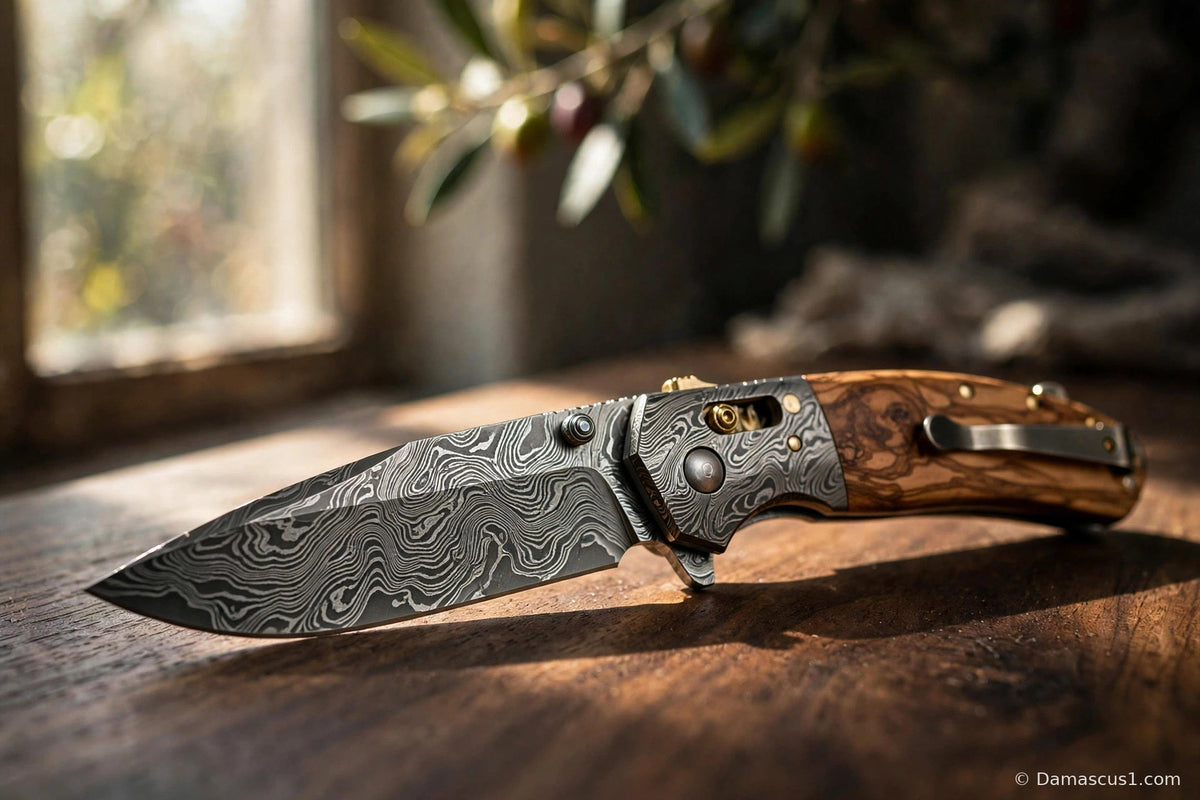
Direct answer: The best Damascus pocket knife under $100 for most people is the Olive Wood Damascus Pocket Knife Set at $39.99. It is a 6.5-inch folding knife with a Damascus steel blade and a warm, neutral handle that suits daily carry and gifting alike. If you want more presence in the hand, step up to a 7.6-inch scrimshaw model at $59.
That short answer is honest, but it is not the whole story. Under $100 is a confusing band: some knives are exactly what the label says, some are stainless wearing a Damascus-looking pattern, and some pair a genuine blade with a handle that will not suit how you carry. This guide sorts the eight verified options by size, handle, and job. Browse alongside it in the everyday EDC pocket knives collection.
What is the best Damascus pocket knife under $100 right now?

For most buyers, the Olive Wood model at $39.99 is the best Damascus pocket knife under $100 because it balances price, size, and versatility. The five 6.5-inch wood and horn models share that same $39.99 price, so your real choice is handle character. The two 7.6-inch scrimshaw knives at $59 suit buyers who want a larger, more collectible piece.
Here is the full comparison, prices verified live on 2026-10-13.
| Pick | Best for | Size | Handle | Price |
|---|---|---|---|---|
| Olive Wood Damascus Pocket Knife Set | Best overall — everyday carry and safe gifting | 6.5" | Olive wood | $39.99 (was $89.99) |
| Buffalo Horn Damascus Pocket Knife Set | Best for a bold, dark look | 6.5" | Buffalo horn | $39.99 (was $99.99) |
| Blue Wood Damascus Pocket Knife Set | Best for standing out without shouting | 6.5" | Blue wood | $39.99 (was $99.99) |
| Green Wood Damascus Pocket Knife Set | Best for the buyer who wants something different | 6.5" | Green wood | $39.99 (was $99.99) |
| Multi Wood Damascus Pocket Knife Set | Best for the knife owner who has seen everything | 6.5" | Multi wood | $39.99 (was $99.99) |
| Deer Antler Horn Folding Pocket Knife | Best for outdoors and traditional tastes | 6.5" | Deer antler horn | $49.99 (was $139.99) |
| Deer Antler Scrimshaw Pocket Knife | Best for collectors who love detail | 7.6" | Deer antler, scrimshaw | $59.00 (was $119.99) |
| Blue Wood Scrimshaw Pocket Knife | Best large gift with visual impact | 7.6" | Blue wood, scrimshaw | $59.00 (was $99.99) |
A note on that table: prices move, and sales end. Every figure above was read off the live collection the day this was written. When you buy, the number on the product page is the number that counts — not the number in any article, including this one.
The eight picks as priced product cards
1. Olive Wood Damascus Pocket Knife Set — $39.99 (was $89.99). The default recommendation: it offends nobody and suits almost everybody. Warm, visible grain that reads classic rather than trendy, in the 6.5-inch size most people find comfortable for daily pocket carry. View the Olive Wood pocket knife →
2. Buffalo Horn Damascus Pocket Knife Set — $39.99 (was $99.99). Dark, dense, and dramatic. Horn varies from knife to knife because it is natural, so the one that arrives is genuinely yours alone. Choose it if your everyday carry runs dark. View the Buffalo Horn pocket knife →
3. Blue Wood Damascus Pocket Knife Set — $39.99 (was $99.99). Colour, but grown-up colour: blue tones that feel modern while the blade keeps it traditional. A strong pick for younger carriers, or anyone bored of brown handles. Find it in the EDC pocket knives collection.
4. Green Wood Damascus Pocket Knife Set — $39.99 (was $99.99). The one people ask about. Green wood is uncommon enough to start conversations, yet still looks like a serious tool. For the person who enjoys the unusual version of a familiar object, this is theirs. View the Green Wood pocket knife →
5. Multi Wood Damascus Pocket Knife Set — $39.99 (was $99.99). Several wood tones in one handle, so the knife shows a different face in different light. Collectors land here because it duplicates nothing already in the drawer. Find it in the EDC pocket knives collection.
6. Deer Antler Horn Folding Pocket Knife 6.5" — $49.99 (was $139.99). Ten dollars above the wood models buys antler: textured, traditional, ridged and secure in the grip in a way smooth wood is not. The 6.5-inch pick for hunters, campers, and heritage tastes. Find it in the EDC pocket knives collection.
7. Deer Antler Scrimshaw Pocket Knife 7.6" — $59.00 (was $119.99). The largest and most detailed knife here. Scrimshaw — etched artwork worked into the handle, a tradition borrowed from maritime craft — turns it into an object people pick up and turn over slowly. A statement piece first, a daily carrier second. Find it in the EDC pocket knives collection.
8. Blue Wood Scrimshaw Pocket Knife 7.6" — $59.00 (was $99.99). The same 7.6-inch format with blue wood and scrimshaw instead of antler — the same size and detail work in a cleaner, more contemporary palette, if antler feels too rustic. Find it in the EDC pocket knives collection.
One practical note: the site header currently offers free shipping and returns above $50. A single $39.99 knife sits just under that line; either $59 scrimshaw model clears it alone. Worth knowing before checkout, not after.
How were these picks chosen — and how do you avoid buying stainless by mistake?
These picks were chosen three ways: every price was verified on the live collection page the day of writing, every pick is listed as a Damascus model rather than assumed to be one, and the list covers the real decision buyers face — size and handle — instead of padding the count with near-duplicates that differ only in name.
That second point is the most useful thing in this guide. The EDC collection, like most pocket knife collections, is not exclusively Damascus: it also contains 420C stainless models — a Rose Wood 6.5-inch listing, for example, is labelled 420C Stainless Steel at $39.99. That is no scam and nothing hidden; it is right in the listing. But a handsome stainless knife is not a Damascus knife, however similar the photos look.
So here is the rule, on any site: read the individual product description, every time. Check the blade material line for the specific knife in your cart. Do not infer it from the collection name, a wavy blade in a photo, or a Damascus neighbour on the page. If it says Damascus steel, you are buying Damascus; if it says 420C stainless, you are buying stainless — possibly a decent knife, but a different purchase, made knowingly.
Why so often? Because "Damascus" has become a style word as much as a material word. Real Damascus gets its pattern from layered steels forge-welded together, so the pattern runs through the metal; a surface treatment sits on top of it. Both photograph beautifully — only one is Damascus. Our guide on how to spot a fake Damascus knife walks through the checks in depth.
One more filter: honesty about what is not known. This article quotes no layer counts, hardness figures, or steel pairings for these eight knives, because those numbers were not verified per product. Printing unconfirmed specifications would be exactly what this guide exists to protect you from. Where a detail matters, confirm it on that knife's product page before ordering.
What does under $100 really buy in a Damascus pocket knife?
Under $100 buys you a genuine Damascus folding knife with a natural-material handle — wood, horn, or antler — in a carry-friendly size. What it does not buy is bespoke, made-to-order work or a famous maker's name. At $39.99 to $59, you are paying for real layered steel and hand-finished character, not for rarity or a certificate.
Be clear-eyed about the tiers. At the bottom sit the look-alikes — stainless blades with a Damascus-style finish. In the middle, where everything here sits, you get actual Damascus blades in ready-to-ship designs: you choose among finished options rather than commissioning your own. Well above $100, individual makers forge to order, and prices reflect weeks of bench time. No tier is dishonest in itself — dishonesty creeps in only when one tier is described as another, which is why this guide sticks to what the listings say.
Also expect variation: natural handles and Damascus patterns are never perfectly uniform, because the pattern records how the blade was folded. Two buyers ordering the same model receive the same design and subtly different objects — the charm, for most people. And expect slightly more care than a stainless beater asks: minutes per month, covered below.
Should you choose a 6.5-inch or a 7.6-inch Damascus pocket knife?


Choose 6.5 inches for everyday carry and 7.6 inches for presence. The six smaller models on this list — five at $39.99 and the deer antler folder at $49.99 — sit in the size most people find natural in a pocket and in a hand doing ordinary jobs. The two 7.6-inch scrimshaw knives trade some carry discretion for detail and impact.
Think about where the knife will live. A 6.5-inch folder disappears into a routine — front pocket, glove box, desk drawer, tackle bag — and gets reached for to open deliveries, trim cord, or break down cardboard without ceremony. That ordinariness is the point of everyday carry: the best EDC knife is the one that is there, and smaller knives are there more often.
The 7.6-inch models live differently: the extra length is noticeable in a pocket, and the scrimshaw work is meant to be seen — natural milestone gifts, collection pieces, and bag or truck carry. Torn for daily urban carry? The tie goes to 6.5 inches. Hand size matters less than expected, too: handle material changes grip feel more than an inch of length, so shop handles first if grip is your concern.
Which handle is best — olive wood, coloured wood, buffalo horn, or deer antler?
The best handle depends on taste and use, not quality ranking. Olive wood is the classic all-rounder. Blue, green, and multi wood offer colour and individuality at the same $39.99 price. Buffalo horn is dark and dramatic. Deer antler is textured and traditional, and the scrimshaw versions add hand-detailed etching at the $59 tier for collectors and gift buyers.
Olive wood is where to start if you are buying blind. Its grain is warm and visibly natural without being loud, and it suits a wide age range. There is a reason it anchors the comparison table.
Coloured woods — blue, green, and multi — are the personality options, and personality costs nothing extra: all three sit at the same $39.99 as olive wood. Blue reads modern, green outdoorsy and uncommon, multi wood artisanal. Owners with traditional handles already in the drawer drift here — it fills a gap instead of duplicating one.
Buffalo horn is the dark option, polished to a depth that can look almost like stone, its light-and-dark movement unrepeatable. Choose it for someone whose gear runs black, brown, and leather.
Deer antler, plain and scrimshaw, is the heritage choice: ridged, organic, grippy where polished wood is not. The plain folder at $49.99 is this list's outdoors-leaning worker. The scrimshaw versions add folk-art etching — the detail that moves a $59 knife from "nice" to "keep this." Buying to keep? Start with the scrimshaw pair.
One care note across all of these: natural handles prefer to stay dry and out of prolonged soaking. Not fragility — just the normal deal with wood, horn, and antler.
Is a Damascus pocket knife good for everyday carry, gifts, or collecting?

Yes — for all three, with different models suiting each job. For everyday carry, the 6.5-inch wood and horn models at $39.99 are the practical core of this list. For gifts, any model gains impact from its natural handle variation, and the scrimshaw pair leads. For collecting, handle rarity and detail — antler, scrimshaw, multi wood — matter most.
Everyday carry is a habit before it is a category. A carry knife earns its place by being present for the small jobs that make up most knife use: packaging, cord, tape, food on the go. The 6.5-inch models fit that life — and there is quiet pleasure in carrying a pattern no one else shares.
Gifts are where these knives punch furthest above their price. A $39.99 or $59 knife with a swirling blade and one-of-a-kind handle presents like a far costlier object, because the visual richness is real. Birthdays, Father's Day, groomsmen, graduations — anywhere a carried tool beats a shelf object. For a wider shortlist, our gift coverage lives on the Damascus1 blog. On personalisation: custom orders are handled case by case — expect a quote and a proof confirmed before a custom order proceeds.
Collecting runs on variation: a new material, a technique like scrimshaw, a size that completes a run. A small focused collection here — one wood, one horn, one antler scrimshaw — costs less than a single famous-name knife, and every piece stays usable.
What should you check before you carry a pocket knife where you live?
Check your local rules before you carry, every time your location or routine changes. Knife carry law varies widely between countries, states, cities, and even venues, and it can turn on blade length, opening mechanism, and where you are carrying. This guide offers no legal advice and no jurisdiction table — your local rules, checked directly, are the only reliable source.
That caution is not boilerplate; it is the difference between a good purchase and a confiscated one. Rules people assume are universal — pocket carry, knives in vehicles, workplaces, schools, government buildings, airports, events — are not universal at all, and "I bought it openly online" is a defence nowhere.
So build the check into the purchase: look up current rules where you live and routinely go, from an official source, and check destinations before travelling. Air travel is its own regime — verify it with your airline and security authority. When in doubt, leave the knife at home. Giving across jurisdictions? A quiet word about checking local rules is a thoughtful part of the gift.
How do you care for a Damascus pocket knife so it lasts?

Keep it clean, dry, lightly oiled, and sharpened little and often. Wipe the blade after use, especially after food or moisture, dry the natural handle rather than soaking it, and store the knife dry. Sharpen on a whetstone before the edge goes fully dull — maintaining a Damascus edge is easier than rescuing one.
The daily habit is thirty seconds: wipe the blade when the job is done. Layered steel dislikes being left wet, acidic, or gunked with adhesive — fruit juice left sitting is particularly unkind. Rinse, dry, done. Never dishwasher a natural handle or leave the knife soaking; heat, detergents, and prolonged water are hard on handles and blades alike.
The weekly habit is a whisper of oil: a thin film of suitable blade or mineral oil, wiped almost dry, protects pattern and edge, especially in humid climates. Give the pivot the same attention, and brush out grit before it grinds.
Sharpen early, while the edge is merely less keen — not after it tears instead of slices. Our guide on how to sharpen a Damascus knife covers whetstone choice, angle, and stropping; read it before your first session. Ground rules: whetstone over pull-through sharpener, consistent angle over perfect number, both sides evenly, light finishing strokes.
Storage, lastly: dry, indoors, not rattling against loose metal. A sheath or its own drawer spot keeps edges from knocking.
What are the red flags that a Damascus pocket knife is not what it claims to be?
The biggest red flags are a listing that never names a blade material, a pattern that looks printed or perfectly uniform, prices paired with specifications that sound copied from a far more expensive knife, and a seller who cannot answer simple questions. A genuine listing states plainly what the blade is — and, as noted earlier, honest stainless listings state that plainly too.
Work through the pattern first. Real Damascus patterning is organic — flowing, varied, never in identical repeats, and part of the metal rather than sitting on it like a decal. A flawlessly regular pattern, identical from blade to blade, deserves hard questions. Our breakdown of how to spot a fake Damascus knife is the right read before buying from an unfamiliar seller.
Then the words. Vague listings lean on atmosphere — heritage, warrior, legendary — while dodging what the blade is made of and how big the knife is. This guide modelled the opposite: it named the Damascus models, flagged the 420C stainless listings in the same collection, and refused unverified specifications. Expect that standard everywhere. A seller who will not say what a blade is has told you what the blade is.
Price flags both ways, finally: absurdly cheap "Damascus" is usually printed pattern, while countdown-timer drama around a modest knife warns too. Judge every listing by its live page.
Who should not buy a Damascus pocket knife?
Do not buy a Damascus pocket knife if you want a zero-maintenance tool you can dishwasher, neglect wet, and forget for a year. Do not buy one if you need a knife for a workplace or jurisdiction where carry is restricted, or if you expect machine-made identical perfection — natural handles and layered patterns vary by design, and that variation is the product.
No shame in that. Plenty of excellent knives are built for abuse and indifference — if yours will live in a fishing bucket or a site toolbox, a basic stainless folder is honestly the better tool. Damascus repays a wipe, a dry, and an occasional sharpening with character no coated blade can match, but the exchange only works if you hold up your end.
Pause, too, if the purchase hinges on a specification this guide could not verify: confirm the detail on the product page or with the seller rather than assuming it from the word "Damascus." And if you are buying for someone whose carry rules you do not know, solve that first.
Frequently asked questions
What is the best Damascus pocket knife under $100?
The Olive Wood set at $39.99: a 6.5-inch Damascus folder with a classic, neutral handle for daily carry and gifting. For more detail, the 7.6-inch scrimshaw models are $59. Prices verified live on 2026-10-13.
Is a $39.99 Damascus pocket knife real Damascus?
It can be — the five 6.5-inch wood and horn models here are listed as Damascus at $39.99. But price proves nothing. Read the individual product description: some knives in the same collection are 420C stainless, and only that knife's blade material line settles it.
What size Damascus pocket knife should I buy, 6.5 inch or 7.6 inch?
Buy 6.5 inches for everyday carry — comfortable and discreet for daily jobs. Buy 7.6 inches for a larger, decorative gift, collection, or bag-carry piece. Here, 6.5-inch models run $39.99–$49.99; the 7.6-inch scrimshaw pair is $59.
Which handle material is best for a Damascus pocket knife?
There is no single best, only a best match: olive wood the safe all-rounder, coloured woods for individuality, buffalo horn dark and dramatic, deer antler textured and traditional, scrimshaw for collectors. All are natural materials — expect pleasant variation.
How do I know if a Damascus knife is fake?
Look for organic, varied pattern flow rather than a uniform, printed look, and a plain blade-material statement in the listing. Distrust atmospheric language that never names the blade. If the description says stainless, it is stainless — whatever the photo suggests.
How do I care for a Damascus pocket knife?
Wipe the blade clean and dry after use, keep natural handles out of dishwashers and soaking water, apply a very light film of suitable oil for storage, and sharpen on a whetstone before the edge goes fully dull. Store it dry and separate from loose metal. Small, regular care keeps both the pattern and the edge in good shape.
Is shipping free on these Damascus pocket knives?
The site header currently offers free shipping and returns above $50: the $59 scrimshaw models clear it alone; a single $39.99 knife sits just below. Confirm the offer when ordering — promotions can change.
Can I get a Damascus pocket knife engraved or customised?
Custom orders are handled individually: expect a quote and a proof to be confirmed before a custom order proceeds. If a date matters, start early — do not order at the last minute.
The bottom line
Under $100, the best Damascus pocket knife is the one whose description you have read, in the size that matches how you live, with a handle you will enjoy daily. For most people: Olive Wood, $39.99. Bold tastes: buffalo horn. Colour: blue, green, or multi wood. Outdoors: deer antler, $49.99. To keep and show: the 7.6-inch scrimshaw pair at $59 — which also clear the $50 free shipping threshold alone.
Shop the everyday EDC pocket knives collection →
Pick your handle, check the blade line one last time, and order with confidence. Once it arrives, keep it sharp with our Damascus sharpening guide and the guides on the Damascus1 blog.
laissez un commentaire: