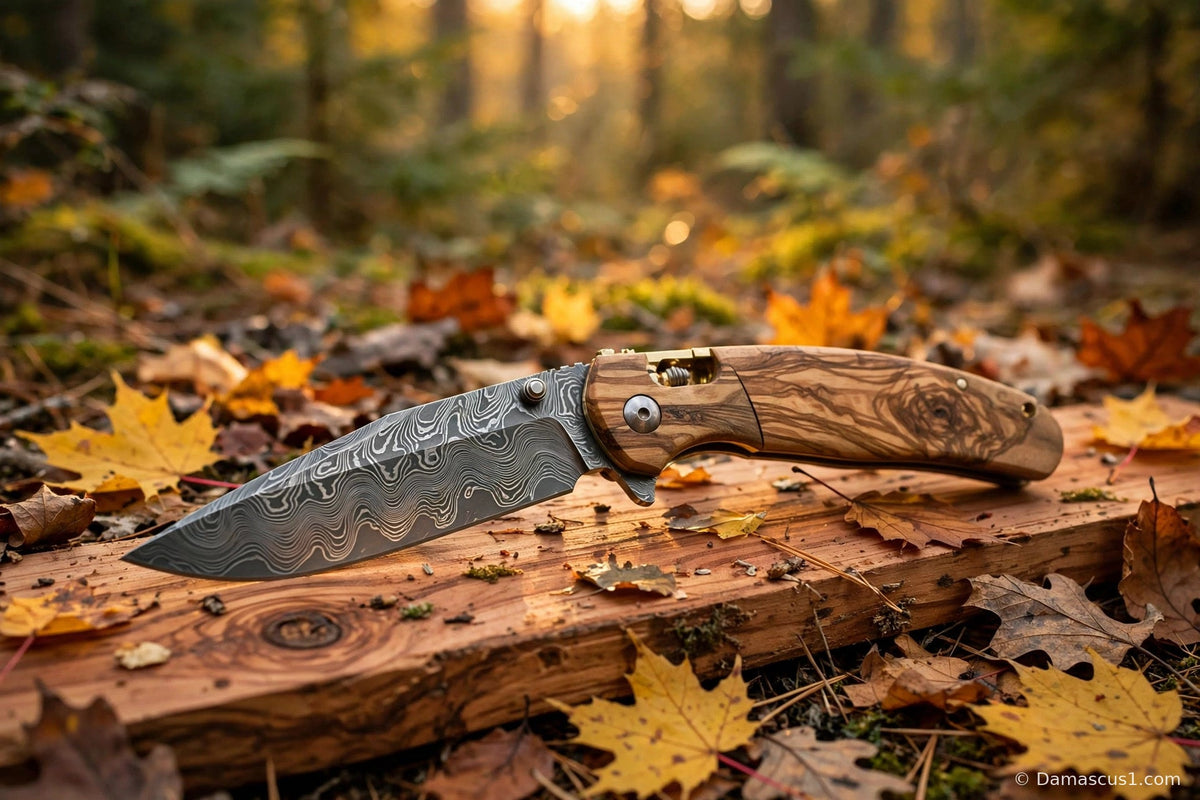
Direct answer: The best pocket knife under $100 at Damascus1 right now is the Olive Wood Damascus Pocket Knife Set at $39.99 (was $89.99). It is the lowest-priced pick in this guide, it gives you a real Damascus folder with a natural wood handle, and it leaves room in a $100 budget for a sheath, care basics, or a second knife as a gift.
That answer comes with a condition. Under $100 is not one market. It is three decisions stacked together. At $39.99 you choose among three handle materials. At $49.99 the handles get more distinctive. At $59.00 to $69.00 you pay mainly for scrimshaw work and a larger, more collectible-feeling folder. Skip the tiers and you can pay $29 more for decoration you do not need — or miss the detail that would have made the knife right for your pocket.
Every Damascus1 folder in the main ranking costs between $39.99 and $69.00 at the time of writing, so the whole handmade range fits under the cap. Browse alongside the guide in the everyday EDC pocket knives collection, and read our main best pocket knife guide for the broader picture. This page is narrower on purpose. The budget is the point.
What is the best pocket knife under $100 right now?
The Olive Wood Damascus Pocket Knife Set at $39.99 is the best starting point for most buyers because it delivers the core Damascus folder experience at the lowest verified price in this guide. Choose Blue Wood or Buffalo Horn at the same $39.99 price if you prefer their look or feel, per each product page.
At $39.99, handle preference is a legitimate deciding factor. Some people want the warm, grain-led look of olive wood. Others want colour. Others want horn, which reads more traditional. Pretending one is objectively better for everyone would be dishonest. Move up only for a reason you can name — a preferred handle, a larger format, scrimshaw you will enjoy. “More expensive must be better” is not a reason.
Why does the $100 cap change what you should buy?
A $100 cap should make you stricter, not looser. It rules out impulse upgrades, forces you to compare handle material, size, and decoration honestly, and leaves room for ownership costs like care and storage. Under this cap, every extra $10 needs a visible job: better fit, a handle you prefer, or detailed scrimshaw work you will actually enjoy.
Many “under $100” guides cluster everything at $89 to $99, as if spending almost the whole budget is automatically smarter. It is not. A knife carried daily at $39.99 beats a knife admired in a drawer at $69.00, unless collecting is genuinely part of why you are buying. EDC buyers should weight size and comfort. Gift buyers can weight character, because the knife will be looked at as much as used. With Damascus, treat product photos as your guide to appearance, and construction specifics as per its product page.
How are these pocket knives ranked by price tier?
These knives rank in three clear tiers: $39.99 for Olive Wood, Blue Wood, and Buffalo Horn; $49.99 for Camel Bone Scrimshaw and Stag Horn; and $59.00 to $69.00 for the larger scrimshaw folders. Start at the lowest tier that meets your needs, then move up only for a handle or artwork upgrade you truly want.
| Best for | Product | Price | Was | Handle / character |
|---|---|---|---|---|
| Best overall under $100 | Olive Wood Damascus Pocket Knife Set | $39.99 | $89.99 | Olive wood, warm and natural |
| Best colour at $39.99 | Blue Wood Damascus Pocket Knife Set | $39.99 | $99.99 | Blue wood, bold and modern |
| Best traditional feel at $39.99 | Buffalo Horn Damascus Pocket Knife Set | $39.99 | $99.99 | Buffalo horn, dark and classic |
| Best detailed work at $49.99 | Camel Bone Scrimshaw Damascus Folding Pocket Knife | $49.99 | $99.99 | Camel bone with scrimshaw |
| Best dramatic discount at $49.99 | Stag Horn Damascus Folding Pocket Knife | $49.99 | $139.99 | Stag horn, rugged texture |
| Best larger scrimshaw folder | Blue Wood Scrimshaw 7.6" Damascus folder | $59.00 | $99.99 | Blue wood with scrimshaw |
| Best top-tier pick under $70 | Camel Bone 7.5" Scrimshaw Damascus folder | $69.00 | $119.99 | Camel bone with scrimshaw |
Read the table as a map, not a verdict. “Best for” does real work in each row. If a gift should look unmistakably hand-worked, the scrimshaw rows matter more than the headline price suggests. If you want a daily folder you will not baby, start at the top and stop early.
Priced product cards
Lead pick — Olive Wood Damascus Pocket Knife Set — $39.99 (was $89.99) The default recommendation. Natural olive wood and the joint-lowest price in the range. Shop the Olive Wood folder
Blue Wood Damascus Pocket Knife Set — $39.99 (was $99.99) Same entry price, different personality. The blue handle is the one people notice across a table. Shop the Blue Wood folder
Buffalo Horn Damascus Pocket Knife Set — $39.99 (was $99.99) Dark, traditional, understated. For buyers who find bright wood too cheerful for a working knife. Shop the Buffalo Horn folder
Camel Bone Scrimshaw Damascus Folding Pocket Knife — $49.99 (was $99.99) The first step into scrimshaw, on a light camel bone handle that shows the work clearly. Shop the Camel Bone Scrimshaw folder
Stag Horn Damascus Folding Pocket Knife — $49.99 (was $139.99) Texture you can feel before you open the blade. The largest listed reduction in this guide. Shop the Stag Horn folder
Blue Wood Scrimshaw 7.6" Damascus folder — $59.00 (was $99.99) Colour plus scrimshaw in a larger 7.6-inch format, per its product page. Shop the Blue Wood Scrimshaw folder
Camel Bone 7.5" Scrimshaw Damascus folder — $69.00 (was $119.99) The top of this guide, still $31 under the cap. Buy it for bone and scrimshaw, not for price alone. Shop the Camel Bone 7.5" Scrimshaw folder
Browse the full ranges: Damascus folding knives and scrimshaw pocket knives.
Which pocket knife is best at $39.99?

At $39.99, the Olive Wood folder is the safest all-round buy, the Blue Wood folder is best if you want colour, and the Buffalo Horn folder is best if you want a darker, traditional handle. All three share the lowest verified price in this guide, so choose by handle feel and appearance, not by chasing a supposed performance gap.
Olive wood ages gracefully next to leather and canvas, and it does not shout. Blue wood is a deliberate splash of colour. Buffalo horn sits at the serious end, closer to classic folders many people grew up seeing. None is a “cheap version” of the others. They are three answers at one price — pick the one that matches how and where the knife will be carried.
Is the Blue Wood folder different from the Olive Wood folder at the same price?
Yes, mainly in character. Both folders cost $39.99, but Blue Wood gives you a vivid, modern handle that stands out as a gift or a personal marker, while Olive Wood gives you a warmer, more natural grain-led look. Check each product page for its full listed details before deciding between them.
You will see the handle far more often than you study the blade. If the blue makes you smile, that is practical — you are more likely to carry a knife you enjoy picking up. If it feels like too much in your pocket, take the olive wood. For gifts: blue for personality, olive for earth tones and worn leather.
When does Buffalo Horn make more sense than wood?

Buffalo Horn makes more sense when you want a darker, more traditional folder, a handle that pairs with formal or heritage-style gear, or a gift for someone who dislikes bright colours. At $39.99, the same price as both wood folders, it is a taste and use-case choice rather than an upgrade in price.
Wood reads warm and approachable. Horn reads serious — often the better mood for a father, a mentor, or anyone who carries older, well-kept tools. One unglamorous detail: a dark handle is easier to lose visually in a dark bag, while it looks superb in the hand and in a presentation box.
Which pocket knife is best at $49.99?
At $49.99, choose the Camel Bone Scrimshaw folder if detailed hand-style artwork is your priority, and choose the Stag Horn folder if grip texture and a rugged, natural handle matter more. Both cost $10 more than the entry tier, so that extra $10 should buy a feature you can name in one sentence.
“I want the scrimshaw.” Good reason. “I want real texture.” Good reason. “It was next on the page.” Not a reason. This tier is where the guide stops being only about value and starts being about character — a legitimate thing to buy in a handmade folder, as long as you know which character you are paying for.
Is Stag Horn worth choosing over Camel Bone?

Stag Horn is worth choosing over Camel Bone when you prefer a darker, heavily textured, outdoors-leaning handle and a knife that feels rugged even before it opens. Choose Camel Bone instead when you want a lighter-looking handle and scrimshaw detail that stands out clearly. Both folders are $49.99 in this guide.
Stag horn looks at home with outdoor gear and field kit. Camel bone with scrimshaw looks at home in a gift box or a collection drawer, where someone will pick it up and turn it over slowly. Different rooms, neither better. Buying for someone else? Picture which of their possessions the knife will live beside. That settles it fast.
Which pocket knife is best in the $59 to $69 tier?

In the $59.00 to $69.00 tier, the Blue Wood Scrimshaw 7.6-inch folder is best for colour plus artwork, while the Camel Bone 7.5-inch Scrimshaw folder at $69.00 is best for a classic light handle with detailed work. Both are larger, more presentation-led folders, so buy them for character and size, not necessity.
The extra money buys presence, not a secret class of cutting ability: a bigger folder, more visible hand work, a knife that makes an impression out of a box. For a milestone gift or a first serious collection piece, that is exactly the point. For plain weekday carry alongside keys and coins, $39.99 is usually smarter.
What does scrimshaw actually add to a pocket knife?

Scrimshaw adds detailed decorative work to the handle, turning a useful folder into a personal, giftable, collectible object. It does not make the knife cut differently. On the Camel Bone and Blue Wood scrimshaw folders in this guide, priced from $49.99 to $69.00, you are paying for visible craftsmanship and individual character.
Its value is visual and personal. A scrimshaw handle invites a second look and gives a gift a story a plain handle cannot. It also gives a collection variety — two bone folders stop looking alike once the work differs. But artwork on the wrong knife is still the wrong knife. Choose the folder first, then enjoy the scrimshaw. See the scrimshaw pocket knives collection.
How big is too big for an everyday pocket knife?
A pocket knife is too big for everyday carry when you start leaving it at home, when it dominates a pocket, or when it feels awkward for the small jobs you actually do most days. Check the listed size on each product page, picture it beside your phone and keys, and favour the smaller folder if you are genuinely torn.
The 7.6-inch Blue Wood Scrimshaw and 7.5-inch Camel Bone folders, per their product pages, suit a jacket pocket, bag, desk drawer, or presentation use. A more compact folder tends to suit deep daily pocket carry better. Mixing those roles up is the most common sizing mistake under $100. For more on daily carry, read our best EDC knife guide. And check local rules before carrying — laws vary, and they are your responsibility.
What should you check before you carry a folding knife every day?
Before daily carry, check the size and details listed on the product page, your local rules for folding knives, where the knife will ride, and how you will keep it clean and dry. Then build a simple habit: same pocket or pouch, opened and closed carefully, put away dry, every time.
Routine beats gear. The knife lives in one place. It gets wiped after messy jobs. It does not get tossed wet into a bag or lent to someone who will pry with it. Pry with something else. Treating a folder as a cutting tool — packaging, cord, fruit, light cardboard — keeps it pleasant to own. On a tighter budget? Compare our best pocket knife under $50 rankings first.
How does a Damascus blade behave in daily use?
In daily use, a Damascus folder behaves like what it is: a working folding knife whose visible layered pattern makes ordinary jobs feel a little less ordinary. Expect to treat it with basic respect — cut suitable materials, avoid prying and twisting, clean it after use, and rely on its own product page for listed construction details.
Damascus is chosen partly for how it looks, and that is fine — tools are allowed to be beautiful. Use it for real tasks, then give it thirty seconds: wipe the blade, check the fold for lint and grit, store it dry. Knives that live that life stay handsome. Knives babied in a drawer or abused in a toolbox both lose something, in different ways.
How do you care for a Damascus pocket knife without overdoing it?
Keep care simple: wipe the blade clean and dry after use, clear lint from the folding area, store the knife dry and protected, and sharpen thoughtfully rather than constantly. Avoid soaking the knife, tossing it loose into a damp bag, or using harsh scrubbing on the blade or handle. Consistent small habits beat occasional deep rescue jobs.
Moisture is the enemy owners underestimate. A folder used on food or outdoor jobs can carry dampness into the joint where you cannot see it. A quick dry now prevents a slow problem later. A separate pouch or drawer section also means the knife is in the same place every morning — which is how daily carry survives. No ritual needed. Just a routine you will still do in February.
How do you care for wood, horn, and bone handles?
Wood, horn, and bone handles all ask for the same basics: keep them dry, wipe them clean with a soft cloth, avoid long soaks and harsh chemicals, and store the knife away from damp and extreme heat. Natural materials reward gentle handling, and small dings or shade changes over time are part of owning a natural handle.
Each shows its life differently. Wood can deepen where your hand works most. Horn is naturally varied, so no two handles read alike. Bone shows scrimshaw beautifully, and deserves a gentler drawer life than a knife thrown in with loose tools. That is not fragility. It is character arriving slowly — exactly why people choose natural materials.
What makes a pocket knife a good gift under $100?
A good gift pocket knife under $100 looks considered, fits the recipient’s taste, arrives in a size they will actually use or display, and leaves budget room for presentation. In this guide, Olive Wood at $39.99 is the safe warm choice, Blue Wood suits bolder tastes, and scrimshaw folders from $49.99 feel most deliberately chosen.
Under $100 is generous without being awkward, and the object feels substantial — real materials, visible pattern, work you can see. Match material to person: Stag Horn or Buffalo Horn for outdoors tastes, Blue Wood for design tastes, Camel Bone scrimshaw for traditional and sentimental. Then write the card like you mean it. Two honest sentences outlast wrapping paper.
Can you add engraving to a Damascus1 pocket knife?
Engraving is available on a quote-based basis, for text of up to 25 characters — ask Damascus1 for a quote for your specific knife and wording before ordering. Engraving is never promised here as free or fast, and timelines or costs should only be taken from the quote you receive directly for your piece.
Personalisation can change price, timing, and whether a piece can be exchanged, so those details belong in a written quote, not a guess in a blog post. For a dated gift, ask early, keep wording short, and check spelling character by character. Names, initials, and short dates engrave best. Long sentiments belong in the card.
How does this guide compare to factory pocket knives under $100?
Factory folders under $100 compete on uniformity, widely stocked parts, and familiar big-brand designs, while the handmade Damascus folders in this guide compete on natural handles, visible pattern, scrimshaw work, and gift-ready character. Neither side wins automatically. Choose factory consistency if that is your priority, and handmade character if individual variation appeals to you.
October 2026 search results show that split: video roundups and gear-lab style factory picks — the Spyderco Tenacious class — still dominate much of this keyword’s coverage. This guide answers a different question: what if you want the most personal knife under $100, not the most standardised one? Stated plainly, most buyers know their side at once. Compare the full Damascus folding knives collection.
Which pocket knife under $100 should most people buy first?
Most people should buy the Olive Wood Damascus Pocket Knife Set first, at $39.99. It is the lowest-priced pick in this guide, its natural wood handle suits the widest range of tastes and uses, and buying it first teaches you what you actually want from a folder before you spend more on horn, bone, or scrimshaw.
After a month with it you will know what no guide can tell you: whether you reach for it daily, whether the size feels right, whether you want more texture, colour, or artwork next time. That makes a second purchase — yours or a gift — far better aimed. Start with the knife. Let it teach you.
What are the most common mistakes when buying a pocket knife under $100?
The most common mistakes are spending the whole budget without a reason, choosing size by photo instead of by carry habits, ignoring local carry rules, expecting decoration to improve cutting, and neglecting basic dry storage. Avoid them by starting at $39.99, naming what each extra $10 buys, and checking the product page carefully.
One more: buying a natural-handle knife and treating it like plastic. Wood, horn, and bone are not fragile, but they keep score — soak them or store them damp and they will show it. And beware the reverse error, a scrimshaw folder you are afraid to use at all. A knife kept perfect by never cutting anything has missed its point. Use it kindly.
What are the most frequently asked questions about pocket knives under $100?
Buyers most often ask whether a good pocket knife really exists under $100, which handle material suits them, whether scrimshaw is worth paying for, and how much care a Damascus folder needs. The short answers are yes, match the handle to your taste, pay for artwork only if you love it, and keep care simple and dry.
Is $39.99 enough for a good pocket knife?
Yes. In this guide, $39.99 already buys a Damascus folder with an olive wood, blue wood, or buffalo horn handle. Spend more only for a specific upgrade — a different handle character, a larger format, or scrimshaw work — not because the entry price implies a lesser knife.
Which handle is best for a first Damascus pocket knife?
Olive wood is the easiest first choice for most people. It looks natural with almost any other gear, suits both everyday use and gifting, and sits at the joint-lowest price in this guide at $39.99. If its warmth does not appeal, follow your taste — at this price, preference is a sound guide.
Is scrimshaw worth the extra money?
It is worth it if you will genuinely enjoy looking at it, gifting it, or collecting it. Scrimshaw folders here run from $49.99 to $69.00. It is not worth it if you are paying for artwork on a size or handle you do not like — fix the folder choice first, then decide on decoration.
How large are the biggest folders in this guide?
The largest named formats are the Blue Wood Scrimshaw folder listed at 7.6 inches for $59.00 and the Camel Bone Scrimshaw folder listed at 7.5 inches for $69.00, per their product pages. Always confirm the current listed details on the product page itself before ordering, especially if pocket size matters to you.
Can a pocket knife under $100 be a serious gift?
Absolutely. A handmade Damascus folder with a natural handle, priced between $39.99 and $69.00, reads as thoughtful rather than extravagant. Add a short handwritten note, and consider quote-based engraving of up to 25 characters if you want it personalised — just arrange the quote well ahead of the date.
How should I store a Damascus pocket knife at home?
Store it clean, dry, and separate — in a pouch, a slot, or a drawer section of its own. Keep it away from damp rooms and loose metal clutter. A consistent home for the knife protects the blade and handle, and it means you always know where your daily carry is waiting.
Ready to choose your pocket knife under $100?
Start with the Olive Wood Damascus Pocket Knife Set at $39.99 if you want the strongest value in this guide, or step up to a scrimshaw folder between $49.99 and $69.00 if artwork and presence are what you are really buying. Either way, you are well under the $100 cap — so choose deliberately and order yours today.
Do not overthink the last step. If the Olive Wood folder has sounded right since the first paragraph, that consistency is information — take it. If you keep scrolling back to the stag horn texture or the camel bone scrimshaw, that pull is information too. The right knife is the one you will reach for, carry, and clean without thinking twice.
Shop now: Olive Wood Damascus Pocket Knife Set — $39.99 (was $89.99), explore the everyday EDC pocket knives, or compare the full best pocket knife guide before you decide. Whichever tier you choose, choose it today and put a real Damascus folder in your pocket this week.
laissez un commentaire: