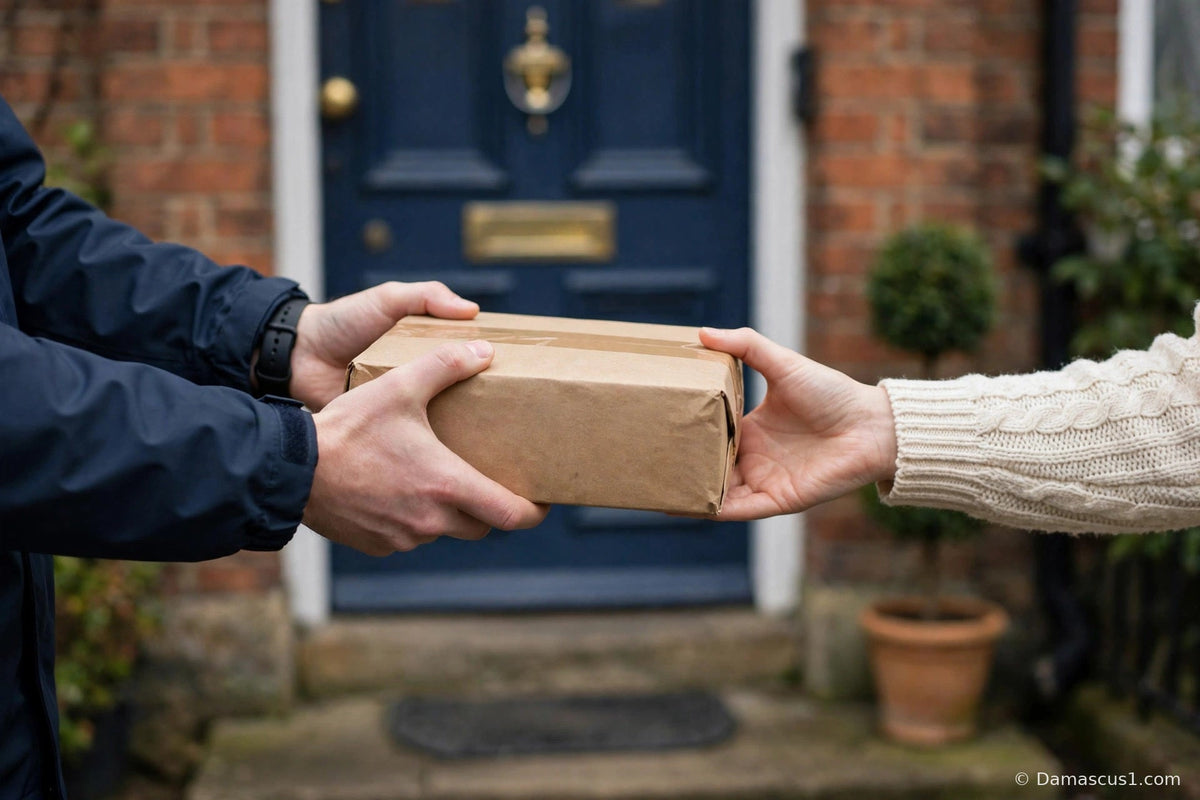
The short answer: Yes — if you are 18 or over, you can buy knives online in the UK, lawfully and routinely. Expect real age verification when you order, a marked parcel, and delivery only into the hands of an adult who may have to prove their age. The parcel cannot go to a locker, a collection point, or be left on your doorstep.
That is the answer. What almost nobody gives you is the experience: what actually happens, in what order, from the moment you press order to the moment the knife is in your drawer — which checks feel intrusive and why they exist, what happens if you are out, what changes if the knife is a gift, what a good seller's process looks like versus a bad one's, and what is currently proposed to change, clearly separated from what the law says today. The pages that rank for this question today are mostly written for sellers — compliance guides, age-verification vendors, Trading Standards leaflets — or are a single help-centre paragraph from a general retailer. The buyer's version barely exists. This is the buyer's version, built from the same sources the sellers read, in the order a buyer lives them.
Two standing notes. First, general information, not legal advice — check current official guidance for your own circumstances. Second, on scope: this page covers buying ordinary knives — kitchen knives, pocket knives, outdoor knives — from legitimate retailers for delivery to a UK home address. Prohibited knives are a different subject and no legitimate process exists for buying them; nothing here touches it.
What does the law actually require for an online knife sale?
The framework comes mainly from two places: the long-standing ban on selling knives to under-18s, and the remote-sale rules strengthened by the Offensive Weapons Act 2019, which were written precisely because a shop counter's age judgement does not travel down a wire. Stripped to what a buyer will actually meet, the requirements are these.
The seller must have a system for verifying that the buyer is 18 or over — a real system. The age-assurance guidance behind the current rules is explicit that a buyer simply declaring their date of birth is not, by itself, sufficient; expect verification that checks something, from account and payment signals up to document or database checks, depending on the seller. The parcel must be marked — its outside must show, in effect, that it contains a bladed article and that it is to be delivered only to a person of 18 or over. Delivery must be into the hands of an adult: the delivery arrangement has to be one where a person of 18 or over receives the parcel, and the person handing it over has to be able to check that — which is why the familiar modern liturgy of parcels left behind bins, in sheds and on doorsteps is, for this category, simply not available. And the parcel must not be delivered to a locker or a collection-style arrangement where no adult handover happens: the Trading Standards guidance behind this guide is blunt — deliver only into the hands of an adult of 18+, never to a locker — and some general retailers have gone further in their own policies, making certain knives store-collection-with-identification only, or refusing home delivery models that cannot guarantee the handover. Finally, the familiar retail disciplines stand behind all of it: the Think 21 and Think 25 culture of challenging anyone who looks under the threshold age, which the government's voluntary agreement with major retailers carries into online age-verified delivery as well.
Notice what that framework is designed to do. Every requirement exists to recreate, for a parcel, the one moment a shop takes for granted: a responsible adult looking at another adult and handing over a knife. Verification at sale recreates "the assistant judged you old enough". The marked parcel recreates "everyone in the chain knows what this is". The adult handover recreates the counter. Once you see the design, nothing in the process that follows should surprise you — and anything in a seller's process that removes one of those moments should make you suspicious of the seller, not grateful for the convenience.
What happens, step by step, when you order a knife online?

Here is the walkthrough the rest of the internet skips, in the order you will live it.
Step 1 — You choose, and the category declares itself. On any legitimate site, a knife product page sits inside an age-gated category: expect age notices, 18+ markings and delivery explanations before you ever reach a checkout. A seller who merchandises knives exactly like socks is telling you something about their compliance before you've spent a penny.
Step 2 — Age verification at checkout. At the point of sale, the seller's verification system runs. What you experience varies — an account check, a verification service, a document-based check on higher-friction stores — but the constant is that it is a check, not a box-tick. Have identification to hand the first time you buy from a given seller; repeat purchases from a verified account are usually smoother.
Step 3 — Payment and the currency moment. You pay as for any online order — with one wrinkle this guide must state plainly for its own store: our prices are in US dollars, and checkout is in USD. The Olive Wood Damascus Pocket Knife is $39.99 USD (compare-at $89.99), verified 5 November 2026 — a figure that sits, at typical exchange rates, in the under-£40 gift band, hedged because rates move; there is no GBP store price, and any guide inventing one for you is guessing with your money. What we will also not do is promise a delivery date or a customs outcome for a cross-border order. No honest seller can.
Step 4 — The marked parcel travels. Your knife is packed and labelled as a bladed-article parcel restricted to adult delivery. It will not be diverted to a locker or a pickup point, however convenient that option looks in a tracking app, and it will not be marked as safe to leave.
Step 5 — The doorstep handover. This is the moment the whole system exists for. An adult must be there. The driver may ask for proof of age — photo identification is the normal currency — and under current practice will apply the same look-older-than-you-think judgement retailers call Challenge 25: if the adult at the door looks under 25, expect to be asked. If no adult is available, the parcel is not left, full stop; it goes back into the system for a redelivery attempt or a depot-style collection with identification, depending on the carrier. That is not a failed delivery. That is the delivery working.
Step 6 — Unboxing and keeping the record. The knife is yours, lawfully bought by a lawful process. Keep the order confirmation and, for a while at least, the marked packaging: together they are the paper trail of a proper purchase, and if the knife is a gift you are about to hand over, they are part of the story of giving it properly. Then put the knife where it lives — for the folding knife at the centre of this page, the drawer, the bench and the kit bag described in our Damascus pocket knife UK buyer's guide.
How is buying a gift knife online different?
In one way only, and it decides everything: the adult who must receive the parcel is part of your gift plan now. You cannot lawfully arrange for a knife to be delivered as a surprise to someone who may not be home, may not be expecting an age check, or — if the recipient is under 18 — may not receive it at all, because sales to under-18s are banned and a gift does not launder that rule. The working method, used by every experienced gift-buyer in this category, is dull and perfect: order the knife to yourself, receive the age-verified parcel yourself, and hand the knife over in person. The handover is better gift-giving anyway — a knife like the Orange Wood 6.5" Hunting Pocket Knife at $39.99 USD deserves a moment, not a doorstep — and engraving, available on request on our hero folder (quote-based, up to 25 characters), turns the moment into the kind that gets remembered at the level of decades. Our Damascus knife gift for men in the UK guide is built entirely around this recipient-first method, and the best pocket knife gift under £40 roundup prices the options in the same spirit: USD figures stated as USD, the under-£40 framing hedged at typical rates rather than faked into a store price.
One more gift wrinkle, because it catches people every December: buying a knife for an adult is lawful; buying one on behalf of a teenager, to hand to them, steps around a ban that exists in plain terms. The ban is on sales to under-18s, and a respectable seller — and a respectable gift-buyer — treats the spirit of it as the rule. Wait a year. The knife, and the giving of it, will keep.
What might change? The proposed rules, labelled as proposed

Read this section with its label on: everything in it is proposed or upcoming direction, not current law as of this guide's date in November 2026, and a buyer today is governed by the rules in the sections above. The age-assurance and policy sources behind this guide describe the direction of travel associated with the Crime and Policing Bill as it has been discussed to date: tighter remote-sale requirements, including photo identification and proof of address at purchase, a requirement that the same person who ordered shows identification on delivery, and an explicit prohibition on doorstep drops. Whether each element survives into enacted law, in what form and from what date, is for Parliament and the eventual commencement rules to decide — and at publish time this guide must be re-checked against the Bill's actual status and this section re-labelled accordingly. What a buyer can sensibly take from it today is only this: the system is moving towards more identification, matched at both ends of the journey, not less. If you buy knives online regularly, the practical preparation is simply to expect identity checks at checkout and at the door to become more joined-up, and to keep your identification consistent between the two. Anyone who tells you the proposed changes are already the law — in either direction, to sell you friction or to sell you ease — is ahead of the facts.
Which seller should you trust? The process checklist
Because the process is the product's legal biography, you can judge a seller by their choreography before you judge their steel. This checklist is this page's original asset — run any online knife seller through it.
| Checkpoint | A compliant seller | A warning sign |
|---|---|---|
| Age verification at sale | A real system — checks something beyond a self-typed date of birth | "Confirm you are 18" tick-box only, or no check at all |
| Parcel marking | States the parcel is marked as bladed contents, adult delivery only | Promises discreet, unmarked, "no questions" shipping |
| Delivery method | Hands the parcel to an adult; ID may be requested; Challenge 25 culture | Offers lockers, click-and-collect for bladed items, or "leave in a safe place" |
| If you are out | Redelivery or identified collection — the parcel stays in the system | Doorstep drop presented as a feature |
| Prices and currency | States prices in the currency charged, exactly as listed | Converts silently, invents local prices, or hides the checkout currency |
| The knife itself | Names mechanism, materials and steels plainly — e.g. a locking folder called a locking folder | "UK legal" floating near a knife that locks |
Two rows deserve a sentence each. The locker row is absolute in the current guidance: whatever a general parcel network offers for other goods, a bladed article must not be delivered into a locker, because a locker cannot be 18. And the last row connects this page to its siblings: the seller who is honest about delivery is usually honest about the knife — our folder, for example, is a locking, two-hand nail-nick, back-lock folder, pattern-welded from 1095 and 15N20 at around 276 layers and 58–60 HRC, and every page in this series says so before it mentions the $39.99 USD price. The seller who blurs either process or product is saving their effort at your expense. There are plenty of straight sellers in this market; the checklist exists so you can find them in about ninety seconds.
Practical store notes, verified 5 November 2026: the store banner offers free shipping and returns above $50 — one hero folder at $39.99 sits below it, two at $79.98 cross it. If your order's real destination is the kitchen rather than the pocket, the same checkout carries the Premium Kitchen Knife Block Set at $169.99 USD and the VG10-labelled Nakiri Knife at $44.99 USD — and the same adult-handover logic will greet them at your door, because bladed is bladed, however domestic the blade. For the carrying rules that apply once any of them leaves the house, the companion explainer in this series covers section 139 in full [PLANNED: uk-legal-pocket-knife, sibling post, link at publish], and our best pocket knife under $50 guide keeps the wider category honest on price.
What goes wrong most often — and how to avoid it?

Almost nothing dramatic; this process fails in small, predictable, avoidable ways. Nobody adult is home. The commonest by far: the order is placed on a workday, the parcel attempts delivery to an empty house, and days of redelivery shuffle follow. Order against your calendar, not your enthusiasm — choose a day, or an address, where an adult will actually be in. The identification is not to hand. The adult is home but the ID is in a coat, a car, another life. Keep photo ID near the door on delivery day. The gift surprise. Covered above: surprises and age-verified parcels do not mix; receive it yourself. The locker reflex. Years of parcel habit make buyers reach for the locker option at the first missed delivery; for this category the option does not lawfully exist, and a carrier flow offering it for a marked bladed parcel should be declined and, frankly, reported to the seller. The too-easy seller. And the failure that is not a failure of logistics at all: a checkout with no verification, a parcel with no marking, a delivery with no questions. It feels like convenience for exactly one purchase, and it means the seller cut the corners that exist to keep this whole, ordinary, lawful market ordinary and lawful. Do not reward it. The friction in the proper process takes perhaps four minutes across an entire purchase. It is the cheapest legitimacy you will ever buy.
Which knives can you buy online — and which can you not?

The process above serves the ordinary knife market, and that market is wide. Kitchen knives — chefs' knives, sets, Japanese blades like a nakiri — are bought online by adults every day under exactly the adult-handover rules described here; bladed is bladed, and the chopping-board destination changes nothing about the parcel. Pocket knives, including locking folders of the kind our companion guides discuss, travel the same road: verification at sale, marked parcel, adult hands. Outdoor and field knives, craft knives, and the tools of a dozen trades do likewise. If a legitimate retailer lists it for adult sale and the delivery choreography is intact, the transaction is an ordinary one.
Two boundaries bound that market, and a buyer should be able to see both clearly. The first is the prohibited list: knives banned to own outright — flick and gravity knives are the standard examples — cannot be made buyable by any website's process, and a site offering them to a UK buyer with breezy shipping promises is not a loophole but a liability, for itself and potentially for you. The second boundary is the buyer: under 18, the market is closed, at every checkout, in every category, without a gift-shaped or parent-shaped door through it. Between those two boundaries — adult buyer, ordinary knife, compliant seller — lies the whole legitimate online market, and it is neither small nor furtive. It is how most knives in Britain are now bought, and the rules described in this guide are the reason it can stay that way: visible, verified and dull in the best sense.
A word on marketplaces and overseas sellers, because that is where the choreography most often frays. A large general marketplace may apply its own version of age-verified delivery — the government-backed voluntary agreement with major retailers points the big platforms towards verification on delivery, and the largest of them operate it — but third-party sellers within a marketplace vary, and the checklist in the previous section is your instrument: apply it to the actual seller, not the platform's logo. With an overseas seller, add the currency and expectations discipline from Step 3: prices in the currency charged, no invented conversions, no promised delivery dates or customs outcomes, and the same adult handover required at your door regardless of where the parcel began. A cross-border purchase that respects all of that is unremarkable. One that promises to skip all of it is telling you, in advance, exactly what it is.
What if something goes wrong with the order?
The ordinary consumer machinery applies, with the category's one twist carried through it. A knife that arrives damaged, mis-described or simply not as ordered is returnable under the seller's returns arrangements — our own store banner, verified on 5 November 2026, offers free shipping and returns above $50, and two hero folders at $79.98 cross that line — but a return is itself a bladed article in the post, so follow the seller's return instructions exactly: their packaging guidance, their carrier arrangements, their labelling. Do not improvise a return with a jiffy bag and optimism. A delivery that fails because no adult was home is not a lost parcel; it is a parcel waiting inside the carrier's process, and the seller's tracking and redelivery route — not a locker — is where it resolves. An age check that fails at the door resolves the same way a shop refusal does: the sale does not complete, the parcel goes back, and the refund machinery follows the seller's terms. None of these outcomes is a scandal. Each is the system preferring a delay to a mistake, which, for this category of goods, is the correct preference — and knowing it in advance turns all of them from grievances into logistics.
Frequently asked questions

Can you legally buy knives online in the UK?
Yes — adults of 18 or over buy knives online in the UK lawfully and routinely. The process around the purchase is regulated: age verification at sale, a marked parcel, and delivery into an adult's hands. Sales to under-18s are banned. This is general information, not legal advice.
What age verification should I expect when I order?
A real verification system at the point of sale, run by the seller. A self-declared date of birth alone is not sufficient under the current age-assurance expectations, so expect a check that verifies something — account, payment or document based, depending on the seller — and have identification available, particularly on a first purchase.
Can my knife be left on the doorstep or in a safe place?
No. A bladed article bought online must be delivered into the hands of a person of 18 or over. It cannot be left unattended on a doorstep, and it cannot be delivered to a parcel locker or a collection arrangement with no adult handover. If no adult is home, the parcel returns into the system for redelivery or identified collection.
Will I need ID when the parcel arrives?
You may. Delivery into an adult's hands includes the ability to check the adult's age, and photo identification is the normal proof; retailers operate a Challenge 25 culture, so an adult who looks under 25 should expect to be asked. Keep ID to hand on delivery day.
Can I buy a knife online as a gift for someone else?
Yes, for an adult recipient — the working method is to have the age-verified parcel delivered to yourself and hand the knife over in person. Do not arrange delivery to a recipient who is under 18 or who cannot receive an age-verified parcel; sales to under-18s are banned and a gift purchase does not bypass that.
Are the rules about to change?
A tightening has been proposed and discussed in connection with the Crime and Policing Bill — including photo ID and proof of address at purchase, the same person showing ID on delivery, and an explicit ban on doorstep drops. As of this guide's writing in November 2026 that is proposed direction, not current law; re-check its status at the time you buy.
Why can't I use click-and-collect or a locker for a knife?
Because the law's requirement is a handover to a verified adult, and neither a locker nor an unattended collection point can perform it. Some general retailers go further and make knives store-collection with identification only. Trading Standards guidance is explicit: deliver only into the hands of an adult of 18 or over, never to a locker.
The store prices in dollars. Is that normal, and what will I actually pay?
Our store prices in US dollars, and checkout is in USD: the Olive Wood Damascus Pocket Knife is $39.99 USD exactly as listed. At typical exchange rates that sits in the under-£40 band, but rates move and no GBP store price exists — judge the dollar total shown at checkout, and expect no promised delivery date or customs outcome from any honest cross-border seller.
What identification actually works at the door?
A short, practical coda, because "bring ID" is easy to say and surprisingly easy to fumble. The identification that does the work at a British doorstep is photo identification that shows your date of birth: a passport or a photocard driving licence are the two documents nobody argues with, and they are the pair to have ready. A bank card proves you can pay, not how old you are. A photograph of a document on your phone may be accepted by an individual driver and may not — the document itself, in your hand, at your own front door, is the version that never starts a negotiation. If the adult receiving the parcel is not the person who ordered — a partner, a housemate, an adult family member — current practice asks that the receiver be demonstrably 18 or over; it is their hands and their age that complete the delivery. The proposed future rules discussed above would tighten this to the same person at both ends, which is one more reason to order in the name of the person most likely to be home. None of this requires preparation beyond a thirty-second thought on the morning of delivery — but that thought, taken in advance, is the difference between a handover and a redelivery saga, and in this category the handover is the whole point.
The bottom line
Can you buy knives online in the UK? Yes — and once you have seen the process whole, it stops looking like an obstacle course and starts looking like what it is: a shop counter, rebuilt for a parcel. Be an adult, pass a real age check, receive a marked parcel into adult hands with identification ready, and keep the paperwork. Do that, and buying a knife online in Britain in 2026 is one of the most ordinary transactions in the world — which is exactly what the rules were designed to keep it. If the knife at the end of that process is to be a handmade locking Damascus folder, honestly described and plainly priced, the Olive Wood Damascus Pocket Knife at $39.99 USD will meet you at the door — provided, of course, that you are there, adult and identified, to meet it.
Planned sibling links at publish (not yet live — do not link until verified 200): uk-legal-pocket-knife; are-locking-knives-legal-in-the-uk.
laissez un commentaire: