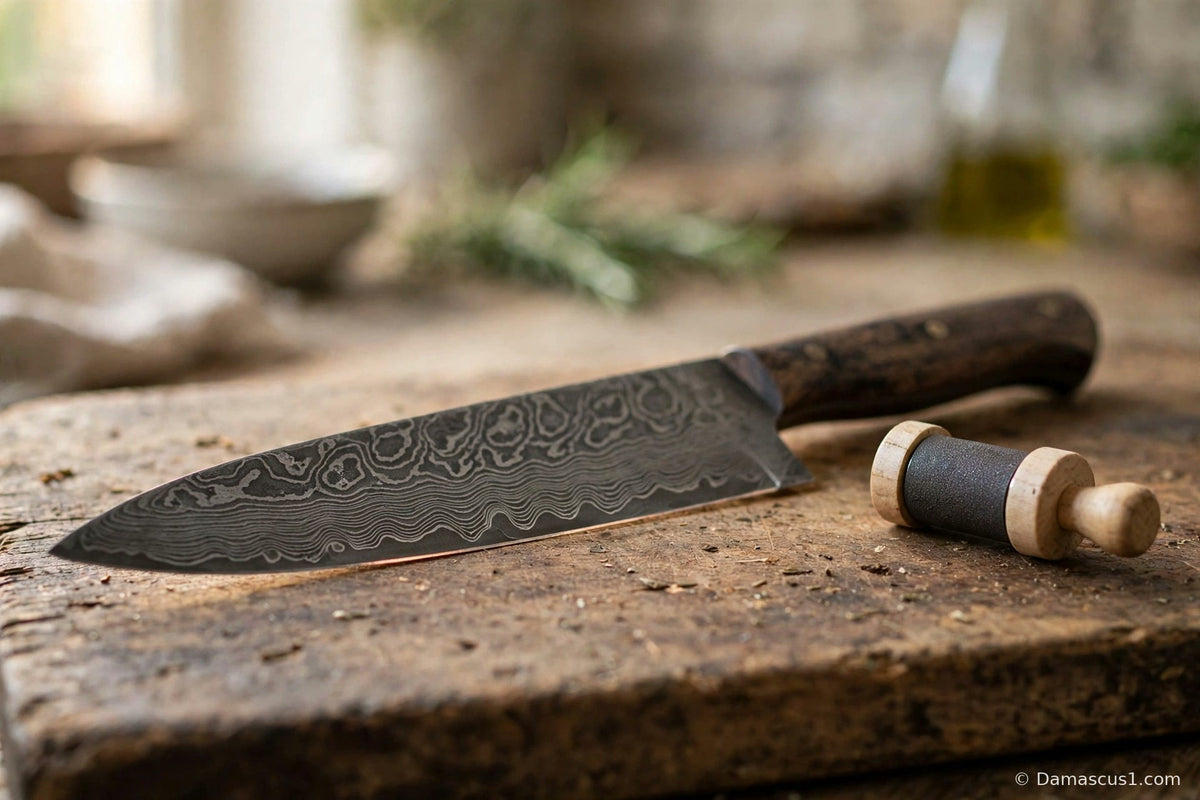
The fastest honest way to sharpen a kitchen knife at home is the method that holds the angle for you: a rolling sharpener, whose magnetic holder keeps the blade at a fixed 15 or 20 degrees while a diamond disc rolls along the edge. It takes minutes, it needs no soaking, no oil and no practised wrist, and for a dull-but-undamaged chef's knife it restores a working edge reliably. It is not the best method for every knife — a whetstone still gives the finest, most controlled edge, and some blades should never touch a roller at all — and this guide will draw those lines plainly, including the one that matters most to this store's readers: what a rolling sharpener does, and does not do, to a Damascus blade.
That framing is a change from the older version of this page, and the change deserves a sentence of its own. The old page was an endorsement of one brand — the Horl sharpener — written as a personal discovery story, with specifications nobody had checked and a technique section that described a different kind of sharpener altogether. This rewrite keeps the useful topic, sharpening at home, and drops the endorsement. How rolling sharpeners work, how they compare with stones, electrics and pull-throughs, which angle suits which knife, how to run the routine step by step, how to test the result, and where this store's own single sharpener honestly fits — those are things a guide can teach without inventing a test bench. Where a claim comes from a page-1 reviewer or a seller, it is attributed to them, in the open.
What is a rolling knife sharpener, and how does it work?
A rolling knife sharpener is a two-part guided system: a magnetic angle holder that grips the flat of your blade and holds it at a preset angle — most commonly 15 degrees on one face and 20 degrees on the other — and a handheld cylinder, capped with an abrasive disc, that you roll back and forth along the exposed edge. The holder does the skilled part. On a whetstone, the angle lives in your wrist and drifts with every stroke; on a roller, the angle is built into the furniture, so a beginner's tenth pass matches their first. The disc does the cutting: diamond abrasive for sharpening, then a finer ceramic or steel disc for honing the burr away.
The category is younger than most cooks realise. The page-1 reviewers trace it to Horl, a German family company founded in 1993, which introduced its rolling sharpener in 2016; the design has since been widely copied, most visibly by Tumbler and by Work Sharp's rolling entry. The systems differ in the details that matter — disc grits, whether the discs swap out, magnet strength, how long the angle support is — and the comparison section below works through those differences as published by the reviewers who have tested them side by side. But the mechanism never changes: blade held still at a known angle, abrasive rolled along the edge, both sides in turn, coarse disc first and honing disc last. Everything else in this guide follows from those two facts — a fixed angle, and a disc that only travels in a straight line along a straight edge.
One vocabulary point before going further, because the old page blurred it and the blur causes real mistakes. Sharpening removes metal to rebuild a bevel; honing removes almost none and simply realigns an edge that has folded over in use. The steel rod in a knife block hones — it does not sharpen, whatever the block's marketing says. A rolling system does both jobs in sequence, which is why it ships with two discs: the diamond disc sharpens, the ceramic or steel disc hones. A knife that only needs honing should not be ground on the diamond disc out of habit, and a knife that is genuinely dull will not be rescued by honing alone. Knowing which job your knife needs is the first step of the routine, and there is a test for it further down.
Does Damascus1 sell the Horl sharpener?
No. Damascus1 sells no Horl sharpener, no Tumbler and no Work Sharp — verified against the live catalogue on 5 November 2026. What this store sells, in the whole sharpening category, is one tool: a rolling knife sharpener of its own, with a diamond sharpening surface and a magnetic holder offering 15-degree and 20-degree angle rollers, priced at $39.99. It is listed in full, with its live price, in the product section near the end of this guide, described exactly as its own listing describes it and as nothing more. No whetstone, honing rod or strop is sold here either, and this guide will recommend whetstones repeatedly anyway, because for some knives — patterned Damascus above all — a stone is the right answer whether or not this store profits from saying so.
That disclosure sorts the Horl question honestly. Horl's own system is a legitimate, well-reviewed premium option: the reviewers on page 1 credit the Horl 2 with 420-grit diamond and 1000-grit ceramic discs that can be swapped for finer 3000- and 6000-grit discs sold separately, a long magnetic support, and the smoothest rolling action of the three systems tested head-to-head — at the highest price of the three. A reader who wants that system should buy it from Horl or its dealers, with those published facts in hand. A reader who wants the guided-rolling method itself, at a maker-direct price, is the reader this store can serve. What this page will never do again is borrow Horl's name to sell a different tool, or dress this store's sharpener in Horl's specifications. The method is the subject here; brands are mentioned only where a published fact needs its source.
Rolling sharpener vs whetstone, electric and pull-through — which is best for what?

The best sharpener is the one matched to the knife, the damage and the hands holding it — and each of the five routes wins somewhere and loses somewhere, which is why single-answer roundups mislead. A whetstone offers total control: any angle, any grit progression, the least metal removed when used well, and the finest edge of any home method. Its price is skill — weeks of practice before the angle stops wandering — plus soaking, flattening and time, roughly ten to twenty minutes a knife. An electric sharpener is the fastest guided route and the most aggressive: motorised wheels pull the blade through preset stages in a minute or two, and that aggression, on a thin or hard blade, is exactly the problem. A pull-through is the cheapest guided option and the crudest; its fixed carbide slots shave metal unevenly, and the Damascus-care guides in today's research name pull-throughs and electrics as the tools to keep away from patterned blades.
A rolling sharpener sits in the honest middle. Its angle discipline beats a beginner's whetstone work from the first session, its diamond disc removes metal more gently and evenly than a pull-through's carbide teeth, and a full routine takes minutes with nothing to soak or plug in. Its limits are just as real: the angles are the two presets and nothing else, the disc travels straight so curved and specialty profiles defeat it, there is no coarse repair grit for chips, and the edge it produces, while genuinely sharp, is a working edge — not the polished finish a 3000-to-6000-grit stone progression gives a premium blade. The professional route closes the table: a good sharpening service reprofiles, repairs chips and resets bevels for a per-knife fee, and this blog's guide to knife sharpening services, their costs and how to choose one works that decision in full.
| Method | Best for | The honest trade-off |
|---|---|---|
| Rolling sharpener | Beginners and busy home cooks with dull, undamaged, double-bevel kitchen knives | Fixed 15°/20° angles only; no chip repair; straight edges only |
| Whetstone | Premium and Damascus blades; anyone willing to practise; the finest, most controlled edge | Steepest learning curve; soaking, flattening and 10–20 minutes per knife |
| Electric sharpener | High-volume, everyday stainless knives where speed matters most | Aggressive metal removal; a poor match for thin, hard or patterned blades |
| Pull-through sharpener | A cheap stopgap for soft, inexpensive knives | Crudest edge of the guided tools; keep it away from any knife you value |
| Professional service | Chips, bent tips, reprofiling, single-bevel Japanese blades, an annual reset | Per-knife cost and days without the knife |
How do you sharpen a knife at home with a rolling sharpener?

Set the clean, dry knife on the magnetic holder at the angle its bevel needs, roll the diamond disc along the full edge with light, even pressure until a burr rises, repeat on the second side, then finish with the honing disc and test. In full: wash and dry the blade first — grit and food residue under a magnet scratch the flat and break the disc's contact — and inspect the edge against the light. Chips, a bent tip or a rolled-over section you can feel with a thumbnail are stop signs, not challenges; those belong to a stone or a professional, as the table above states. A knife that is merely dull — it slides on tomato skin instead of biting, it crushes herbs instead of cutting them — is the rolling sharpener's exact job.
Seat the blade flat against the holder's angled face so the magnet takes it fully; a narrow knife that barely reaches the magnet, or a very long blade that flexes past the support, will rock as you roll, and a rocking blade gets an uneven bevel — the page-1 Horl review names long and narrow blades as the format's known weakness, and it is better to know it before the first pass than to learn it from a wavy edge. Roll the diamond disc from heel to tip in smooth passes, letting the abrasive do the work. Pressure is the beginner's error in both directions: pressing hard does not sharpen faster, it gouges and overheats the contact line; the rolling guides are unanimous that light, even pressure is the whole technique. Work one side until you can feel a burr — a fine wire of displaced metal — along the whole edge on the opposite side, then turn the knife, seat it on the same angle, and give the second side the same treatment until the burr flips. Finish on the honing disc with a few light passes per side to strip the burr and align the edge, wipe the blade clean, and test before you cook with it, not during.
How many passes is that, in numbers? The honest answer is: as many as the burr requires, checked as you go — a lightly dulled knife may raise a burr in a handful of passes per side, a neglected one in several dozen, and counting strokes instead of feeling for the burr is how edges get over-ground on one side and left dull at the tip. Two habits protect the result. Keep the count roughly even between sides, so the bevel stays centred. And stop the moment the tests below pass; every extra pass on a diamond disc is metal off the blade that no method gives back. Sharpening is a subtraction. The goal is to subtract as little as possible, as evenly as possible, and then to maintain the edge so the subtraction stays rare.
Should you use the 15-degree or the 20-degree side?
Use 20 degrees for sturdy Western-style edges and everyday workhorses, and 15 degrees for finer Japanese-style and Damascus edges that were ground thin to begin with — and when you do not know a knife's factory angle, match the shallower, more conservative choice the blade already wears rather than regrinding it to a new one. The angle is not a quality dial. A 15-degree edge is keener and more delicate; a 20-degree edge gives up a little of that bite for a bevel that survives board work, dense vegetables and the occasional bone-adjacent mistake. Rolling systems from Horl to this store's own sharpener converge on the same two presets because those two numbers cover the overwhelming majority of kitchen cutlery ever sold.
The rule that outranks the table is consistency: a bevel sharpened at one true angle, evenly, on both sides, will out-cut a theoretically perfect angle applied unevenly. That is the rolling format's whole argument — it trades the whetstone's freedom for a guarantee that the angle you chose is the angle you got, heel to tip, side to side. What it cannot do is split the difference: a knife ground at 17 degrees will be slowly re-bevelled to whichever preset you choose, which is another reason to choose once, choose knowingly, and then maintain at that angle instead of alternating. Single-bevel Japanese knives — yanagiba, deba, usuba — appear in the table only to be excluded: neither preset fits them, and they are whetstone-or-professional knives, full stop.
| Knife | Angle per side | Why |
|---|---|---|
| Western chef's and utility knives | 20° | The durable, general-purpose bevel these knives are sold with |
| Japanese double-bevel knives (gyuto, santoku, nakiri) | 15° | Their thinner factory grind; a 20° regrind thickens the edge they were designed around |
| Damascus kitchen knives (double-bevel) | 15°, light pressure | Matches the fine edge; see the Damascus section below for the full conditions |
| Paring and small utility knives | 15° or 20°, matching the existing bevel | Control matters more than the number at this size |
| Pocket and outdoor folders | 20° | A working edge that survives cord, wood and camp use |
| Single-bevel, serrated and ceramic knives | Neither — do not use a rolling sharpener | See the exclusion list below |
Can you use a rolling sharpener on a Damascus knife?
Yes, with conditions — and the conditions matter more than the yes. A rolling sharpener is a reasonable maintenance tool for a Damascus kitchen knife when four things are true at once: the blade is double-bevelled, its existing bevel matches the 15-degree preset, the edge is dull but undamaged, and you work with light pressure on the diamond disc and stop at the burr. On those terms, the guided angle is a genuine protection: the commonest way home cooks hurt a patterned blade on a whetstone is a wandering angle that grinds one section coarse and leaves another untouched, and a magnetic holder removes that failure mode entirely. The rolling-sharpener sellers themselves make the stronger version of this claim — their published guidance holds that diamond rolling at 15 degrees suits Damascus and high-carbon blades — and it is quoted here as a seller's position, not adopted as this page's verdict.
The other side of the record deserves equal space, because the Damascus-care guides in today's research converge on it: a whetstone remains the preferred method for patterned steel. Their reasoning is control — a stone progression from around 1000 grit to 3000–6000 lets a careful hand remove the least metal, feel the burr form section by section, and polish the bevel without ever pressing a powered or coarse abrasive against the etched pattern; the same guides warn explicitly against electric and pull-through sharpeners on Damascus. A roller is neither of those tools — it is unpowered, guided and diamond-fine — but it is also not a stone: it offers two angles and one sharpening grit, and it cannot reprofile, repair a chip, or thin a blade that has grown thick behind the edge over years of sharpening. So the honest division of labour is this. Maintain a sound Damascus edge on the roller at 15 degrees between stone sessions, if the bevel matches. Take the knife to a whetstone — yours, once the skill is learned from this blog's whetstone guide for Damascus knives, or a professional's — for damage, for reprofiling, and for the periodic fine finish that keeps a patterned blade cutting like the day it arrived. And keep the rest of the Damascus contract either way: wash and dry by hand, never soak, and store the blade protected, as the kitchen knife care, cleaning and storage guide sets out — a sharp edge on a rusting blade is a job half done, and the rust question itself is answered in can Damascus steel rust?
Which knives should never go on a rolling sharpener?
Run this six-point check before any knife meets the disc — it is this guide's citable asset, and it takes under a minute. A knife passes to the roller only if every answer is yes.
- Is the edge straight and smooth? Serrated and bread knives fail here: their teeth need a tapered rod or a specialist, and rolling across serrations damages both the teeth and the disc.
- Is it steel — not ceramic? Ceramic blades are harder than the format is built for and chip rather than sharpen; they go back to their maker or a specialist.
- Is it double-bevelled? Single-bevel Japanese knives fail: a preset that grinds both sides evenly destroys the geometry that makes them work.
- Does its bevel match 15° or 20°? A knife ground notably finer or more obtuse will be re-bevelled by force of repetition; specialist angles belong on a stone.
- Is the edge undamaged? Chips, cracks, a bent tip or a snapped point fail: a maintenance disc cannot rebuild missing steel.
- Does the blade sit stable on the magnet? Very narrow blades that barely grip, and very long, flexible blades that overhang and rock, fail the stability test the reviewers flag — an unsteady blade sharpens unevenly and can shift mid-pass.
Scissors, cleavers with their thick, tall geometry, and any knife whose owner cannot answer point 4 are likewise excluded — not because the roller is dangerous, but because sharpening the wrong tool on the wrong system is how good blades get mediocre edges. When in doubt, the doubt itself is the answer: a whetstone session or a professional visit costs less than a reground knife.
How do you know the knife is sharp enough?

By testing it on food and paper, never on skin. The tomato test is the cook's standard: rest the blade on a ripe tomato's skin and draw it back with no downward pressure — a sharp edge bites and starts the cut under the knife's own weight, while a dull one skids across the skin and needs a sawing push. The paper test is the workshop's standard: hold a sheet of ordinary printer paper by its top edge and slice downward through it — a sharp knife cuts cleanly without tearing or folding the sheet, and a dull one crumples it. Between them they catch the two common failures: an edge that was never rebuilt (fails both) and an edge left with its burr still attached, which feels fierce for one cut and then folds (passes the first tomato slice, drags by the third).
Run the tests before the knife goes back to work, every time, and let them — not optimism — end the session. A blade that still skids gets another short, even round of passes and a re-test; a blade that passes gets wiped, dried and stored, because the work after sharpening decides how long the edge lasts. That is also the moment to notice the edge's other enemies, which no sharpener can outpace: glass and stone boards, the dishwasher's heat and jostling, and the drawer where blades rattle against each other edge-to-steel. The care guide linked above covers board choice and washing in full; the storage rule is simple enough to state here — a block, a magnetic strip, or a sheath, with the edge touching nothing hard. A freshly sharpened knife thrown into a cutlery drawer has begun dulling before its first meal.
How often should you sharpen, and how do you keep the edge between sharpenings?

Sharpen when the tests say so — for a home cook using one main knife daily, typically every few months on a guided system — and maintain the edge in the long intervals between: that rhythm, not a calendar date, is what keeps a knife keen for years without grinding it away. Maintenance is mostly about alignment and storage. Between sharpenings, an edge does not usually go blunt by losing metal; its fine apex folds microscopically to one side, and gentle honing — the rolling system's fine disc, used lightly — stands it back up. That is why the same tool carries two discs and why the fine one sees ten times the use of the coarse one: reach for the diamond disc only when honing stops bringing the bite back.
Storage finishes what honing starts. A block that holds knives by their handles, edge protected in its slot, is still the default for a reason, and the scene below follows the rule this blog applies to every storage photograph and every real counter: in a block, blades are hidden and only handles show — any storage that displays bare edges against other steel is dulling the set it claims to protect. Add the two Damascus habits — dry before it goes away, a whisper of food-safe oil on a carbon-patterned blade that will sit unused — and the interval between sharpenings stretches from weeks to seasons. When it no longer stretches, when the fine disc stops reviving the edge and the tomato test fails again within days, the knife is telling you its bevel needs a rebuild, not another touch-up — and that rebuild is the whetstone-or-professional job described in the Damascus section, after which the roller resumes its proper work of maintenance.
How do you clean and maintain a rolling sharpener?

Brush the discs clean after use, keep the magnet face wiped, and store the whole system dry — a rolling sharpener has almost no maintenance beyond that, which is part of its appeal, but the little it needs is not optional. Every pass sheds microscopic steel; left on the disc, that swarf loads the abrasive and turns a cutting surface into a skating one, so a soft brush across both discs and a wipe of the holder after each session keeps the tool honest. Never wash a diamond disc in the dishwasher or leave the wooden bodies of premium systems soaking by the sink: water is the enemy of bearings, magnets' coatings and timber alike, and a damp cloth is all the cleaning the surfaces ever need.
Judge the discs by their work, not their age. A diamond disc that still raises a burr in a reasonable number of passes is alive, however old it is — the GearJunkie reviewers note more than fifty knives sharpened on their Horl 2's original discs with the discs still performing — while a disc that has been crashed against serrations, ceramic or a dropped knife's chip can be ruined in an afternoon. The replaceable-disc systems (Horl's swap-out design is the published example) make that a spare-part question; fixed-disc systems make it a whole-tool question, which is a real, if unglamorous, point to weigh before buying either kind. Store the sharpener where it will not roll off a shelf or gather kitchen grease in a drawer beside the stove, keep the angle holder's magnet away from the knife block's own magnets if either is strong enough to shift the other, and the system will be ready, unchanged, the next time the tomato test fails.
What should you buy, and what does it cost?
Buy for the method first and the badge second: any rolling system whose discs, angles and replaceability are stated in writing is a candidate, and the priced option below is this store's own, verified against the live catalogue on 5 November 2026 and described as itself — a diamond rolling sharpener with a magnetic holder and 15-degree and 20-degree angle rollers. Its listing's variant and compare-at figures are inconsistent, so this guide quotes the single verified selling price and nothing else. It maintains an edge; it does not repair chips, reprofile bevels or sharpen serrated and ceramic blades, and it should not be run on a blade whose bevel matches neither of its angles.
- Rolling Knife Sharpener — $39.99. The store's only sharpening product: a guided roller with a diamond sharpening surface and magnetic angle holder, for the maintenance routine this guide teaches.
A sharpener is only worth owning alongside knives worth maintaining, and the same live check priced the blades this routine exists to protect. The Premium Kitchen Knife Block Set — $169.99, no compare-at figure listed — is the set whose edges the 20-degree and 15-degree routines above will be keeping. The AUS-10-labelled Kitchen Knife at $59.99 and the VG10-labelled Nakiri at $44.99 are the 15-degree cases in single-knife form. And because not every edge lives in a kitchen, the Olive Wood Damascus Pocket Knife at $39.99 (store compare-at $89.99) is the 20-degree folder of the range. The wider benches sit in the kitchen blades collection and the Damascus pocket knife collection, and the hub that compares the kitchen field in full is best kitchen knives — with the standing reminder that a blade's pattern is worth verifying before its edge is maintained, in how to spot a fake Damascus knife.
Shop handmade Damascus pocket knives
Prices checked November 21, 2026. The product page on the day you order is the final word.
- Olive Wood Damascus Pocket Knife Set, 6.5 in.: $39.99
- Green Wood Damascus Pocket Knife Set, 6.5 in.: $39.99
- Buffalo Horn Damascus Pocket Knife Set, 6.5 in.: $39.99
- Stag Horn Damascus Folding Pocket Knife, 6.5 in.: $49.99
- Camel Bone Scrimshaw Damascus Folding Pocket Knife, 7.6 in.: $49.99
- Ram Horn Scrimshaw Damascus Pocket Knife, 7.6 in.: $59.99
Damascus pocket knives under $50 · All handmade Damascus pocket knives
Frequently asked questions
Is a rolling sharpener good for beginners?
Yes — it is the guided format most forgiving of a beginner, because the magnetic holder sets the angle the learner cannot yet hold by hand. The first session produces an even bevel instead of the wavy one a first whetstone attempt usually yields. The beginner's remaining jobs are light pressure, even passes on both sides, and stopping at the burr — all three are habits, not skills, and this guide's step-by-step is built around them.
Can a rolling sharpener damage my knives?
Used on the right knives, no; used on the wrong ones, yes — and the difference is the checklist, not the tool. On a straight, double-bevel steel blade whose angle matches a preset, a roller removes metal evenly and gently. On serrated, ceramic, single-bevel or chipped blades it can chip edges, wreck serrations and ruin its own disc. Pressing hard, grinding past the burr and alternating angles between sessions are the user errors that do the quieter damage.
Is the Horl sharpener worth its premium price?
That is a value judgement this page will frame but not make for you, because this store does not sell Horl and has run no test bench of its own. The published record from page-1 reviewers: the Horl 2 pairs 420-grit diamond and 1000-grit ceramic swappable discs with the smoothest action and longest magnetic support of the systems tested head-to-head, at the highest price of them; finer discs cost extra. Whether swappable discs and that action are worth the premium depends on how many knives, and how premium, the buyer maintains.
How many passes does a rolling sharpener take?
As many as the burr requires — there is no honest fixed number. A lightly dulled knife may need only a few passes per side on the diamond disc; a neglected edge may need several dozen, checked by feeling for the burr rather than by counting. Even counts per side keep the bevel centred, the honing disc finishes with a few light passes, and every pass beyond the sharpness tests is metal removed for nothing.
Does a rolling sharpener work on serrated or ceramic knives?
No. Serrated edges need a tapered rod worked tooth by tooth or a specialist service, and rolling across them damages the teeth and the disc. Ceramic is harder than the format is built for and chips instead of sharpening; ceramic blades go to their maker or a specialist. Both exclusions are stated by the rolling-sharpener sellers themselves, and the six-point checklist in this guide exists to catch them before money or steel is wasted.
Whetstone or rolling sharpener for a Damascus knife?
Both, in their places. The whetstone is the reference method for patterned steel — full angle and grit control, the least metal removed, progressions from roughly 1000 to 3000–6000 grit — and it owns repairs, reprofiling and fine finishes. A rolling sharpener at 15 degrees, with light pressure, is sound maintenance for an undamaged double-bevel Damascus edge between stone sessions, provided the bevel matches the preset. What patterned steel should never meet is an aggressive electric or a carbide pull-through.
How long do rolling sharpener discs last?
Years of home use, judged by performance rather than age: a diamond disc is alive while it still raises a burr in a reasonable number of passes, and reviewers report dozens of knives on original discs with performance intact. Discs die early from abuse, not time — serrations, ceramic and crashes — and from swarf left unbrushed. Whether a worn disc is a spare part or a new tool depends on the system's design, which is worth checking before purchase.
Start with the test, not the tool: tonight, rest your main knife on a tomato and draw it back. If it bites, your edge needs nothing but the storage and honing habits above. If it skids, choose by the lines this guide has drawn — the roller for a sound, dull, double-bevel blade, at the angle it already wears; the stone for the premium, the patterned and the practised; the professional for the chipped and the bent. And if the guided route is yours, the Rolling Knife Sharpener at $39.99 is priced live today, next to the kitchen blades it exists to maintain — a fixed angle, a light hand, and an edge you tested yourself.
laissez un commentaire: