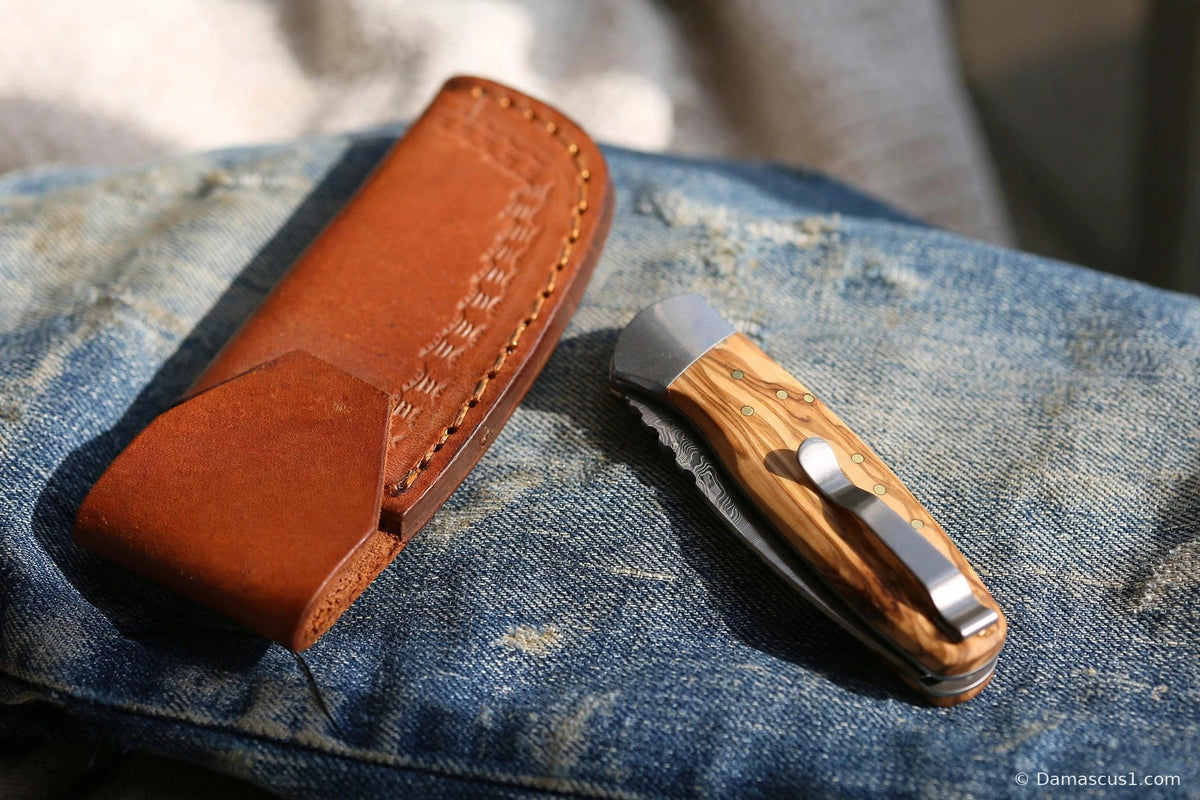
Most people carry a pocket knife the way someone once showed them, then never think about it again — until the knife turns sideways in a pocket, fills with lint, or vanishes into the bottom of a bag. Carry sounds too simple to deserve a guide. It isn't. How you carry decides how fast you can find the knife, how safe it stays closed, how much grit gets into the pivot, and whether it is even there on the day you need it.
Here is the honest starting point. The folders we sell at Damascus1 are traditional back-lock knives with no pocket clip. They open with two hands. They ship with a leather sheath. That design was carried loose in pockets and on belts for generations, long before clips became standard, and it still works beautifully — if you carry it on purpose instead of by accident. Browse the everyday EDC pocket knives collection and you will see the pattern throughout: compact 6.5-inch folders built for a pocket or a sheath, not for hanging off one.
What is the safest way to carry a pocket knife every day?
The safest everyday carry is a fully closed folder, carried the same way every day, in a place your hand finds without looking. For a clip-free back-lock knife, that means loose in a front pocket by itself, or in its leather sheath on your belt. Consistency matters more than cleverness — a knife that always lives in one spot is a knife you handle calmly, open deliberately with two hands, and close without fumbling.
Safety starts with a truth about this style of knife. A back lock does not flick open. You grip the handle, catch the blade with your other hand, and swing it open until the lock engages. Then you reverse that to close it, keeping your fingers clear of the blade's path. That two-hand routine is slower by a second or two. In exchange you get a deliberate open and close every time. Nobody opens one of these by accident in a pocket, and nobody closes one on autopilot while distracted. We frame that as tradition because it is, but it is also a genuine safety feature.
Three habits make any method safer. First, the knife goes away closed, always — never carry a folder half-open. Second, it gets its own space: loose change and keys chew up finishes and drive grit into the pivot. Third, a home-base habit: at night it lands in the same drawer, tray, or sheath. Most lost knives are not dropped in a field — they are set down somewhere odd, once, and forgotten.
Still choosing a knife rather than a method? Start with our hub guide to the best pocket knife, then come back here — size and weight decide your method long before steel does.
How do you carry a pocket knife loose in your pocket?

Carry a loose pocket knife in a front pocket, on its own, with the closed spine resting against the pocket's rear seam so it stays upright instead of tumbling. Front pockets beat back pockets — you sit on a back-pocket knife, bend it against the chair, and forget it. Check the blade is fully closed every time, and empty the pocket's lint regularly, because pocket carry feeds grit straight into the pivot.
Which front pocket? Most right-handed carriers use the right front, because that hand reaches for the knife first. Some prefer the left because the right is already claimed by a phone. Either works. What does not work is switching day to day. Pick one and let muscle memory build. After a few weeks your hand goes straight to it while your eyes stay on the job, and that calm, unhurried retrieval is exactly what you want with any blade.
Position inside the pocket matters more than people expect. Let the closed knife settle vertically, spine against the back seam, rather than lying flat across the bottom. A knife lying flat prints oddly, rotates when you sit, and comes out at a random angle. A knife resting upright stays put through most of a normal day. In looser trousers or shorts it will still wander — that is the honest trade-off of loose carry, and one reason the sheath exists. If your day involves ladders, roofs, or crawling under machinery, loose carry is the wrong tool. Use the belt sheath and stop worrying.
Now the part nobody warns beginners about: lint and grit. A pocket is a dusty little cave. Fibres, dust, and crumbs migrate into the pivot and the lock notch, and a back lock with grit in the notch may not seat as crisply. The fix is boring and effective. Turn pockets inside out when you wash the trousers. Once a week, blow out the pivot or sweep it with a soft brush or a wooden toothpick. Work the blade open and closed and feel for grittiness — smooth means clean, crunchy means clean it today. A drop of suitable oil in the pivot after cleaning keeps things moving, used sparingly. Drowning a folder in oil just gives lint something to stick to.
Give the knife a pocket of its own, without keys and coins — keys scar a wooden or bone handle over time. Some carriers drop the knife into its leather sheath first, then into the pocket: slower access, but better protection and far less lint. And note sitting comfort: a 6.5-inch folder disappears in jeans, but prints and digs in slim dress trousers. On formal days, move it to a jacket pocket or a bag.
How do you carry a pocket knife in a belt sheath?

Wear the leather sheath on your belt on your dominant-hand side, just behind the hip bone, threaded securely so it cannot slide. Draw by gripping the handle firmly, pulling the closed knife clear of the sheath, then opening it with two hands away from your body. Sheath carry beats pocket carry when your pockets are full, your work is physical, or you want the knife in exactly the same place all day.
The belt sheath fell out of fashion for a silly reason — it looks old-fashioned. Ignore that. Functionally it solves almost every weakness of loose carry at once. The knife cannot tumble. It cannot fill with pocket lint. It does not compete with your phone. It sits at the same height and angle whether you are standing, kneeling, or climbing into a truck cab. Tradespeople and farm workers carried this way for a century because the knife was a tool they reached for twenty times a day, and the sheath never made them pat three pockets looking for it.
Placement is simple. Thread the belt through the sheath's loop rather than clipping anything on — a threaded loop cannot pop off. Position it just behind the front of the hip, roughly above your back pocket's front edge. Too far forward and it digs when you sit or bend. Too far back and the draw gets awkward, and the sheath catches on chair backs and door frames. Wear it for a day, nudge it an inch either way, and you will find your spot. Left-handers mirror everything to the left side.
The draw deserves slow practice at home before it ever matters. Grip the handle with your whole hand, pull the closed knife clear, then open it with two hands, edge away from you. Closing is the reverse: two hands, fingers clear, blade fully home, back into the sheath until it seats. Practise five times and it becomes unremarkable — which is the goal.
When does the sheath clearly beat the pocket? On work sites, in the yard, in the woods, and on any day in gloves — a sheath draw with gloves is manageable, while fishing a loose knife out of a deep pocket with gloves is a comedy routine. It also wins in summer shorts with shallow pockets. Where it loses is in town settings where a visible sheath draws more attention than you want, and under tucked-in formal wear. That is not a flaw. That is a method with a home turf.
Look after the sheath and it will look after the knife. Let a wet sheath dry at room temperature, away from direct heat, before the knife goes back in — damp leather holds moisture against steel. Check the stitching and the fit now and then. A sheath that has stretched sloppy-loose is a knife waiting to slip out.
How do you carry a pocket knife in a pack, bag, or vehicle?

Carry a pocket knife in a pack, bag, or vehicle inside its closed leather sheath, in a fixed internal pocket or organiser slot — never loose in the main compartment. A dedicated spot means you can find it by touch, the edge stays protected, and nothing else in the bag gets cut or scratched. Treat pack carry as transport and back-up storage, not quick access, and check it is actually there before a trip starts.
Pack carry is the right answer more often than people admit. On a hike, the knife you need for lunch, cord, or a splinter does not need to ride in your pocket for six hours to be useful for six minutes. In the sheath, in a top pocket or zippered internal sleeve, it travels clean, dry, and out of the way. The same logic covers a work bag and the console or glove compartment of a vehicle, where a sheathed folder joins a small kit alongside a torch, tape, and gloves.
The one hard rule is containment. A loose folder rattling in the bottom of a rucksack works its way into the lining, collects every crumb in the bag, and presents itself handle-last or not at all when you dig for it in the rain. Worse, any folder deserves the basic respect of being sheathed before it goes into a shared space where hands rummage blindly. The sheath your knife shipped with is exactly the tool for this. Use it every time, not just on tidy days.
Give the knife a named home inside the bag and defend it. The knife returns there immediately after use — especially when you are tired. The classic loss story: someone sets the knife on a rock or a bumper "for a second" and drives away. A fixed home plus a five-second check before leaving any spot — knife, phone, keys, wallet — kills that story.
Vehicle carry has one wrinkle: a knife in a vehicle can fall under the same local rules as one on your person, so check yours (see the laws section below). Keep it sheathed, in one fixed place, as equipment for the vehicle. The same caution covers travel generally: places, venues, and forms of transport have their own rules, sometimes strict. Check before any trip — a knife left at home is a disappointment; a knife surrendered at a checkpoint is gone.
Which pocket knife is easiest to carry every day?
The easiest pocket knife to carry daily is a compact folder around 6.5 inches open — small enough to disappear in a pocket or sheath, big enough for real cutting. Handle material changes the feel more than the carry: smooth wood rides comfortably, horn and bone add grip and character. All four of our back-lock folders below cost $39.99, ship with a leather sheath, and carry exactly the ways this guide describes.
For a fuller comparison, our guide to the best Damascus pocket knife walks through the range. All four below share the same 6.5-inch back-lock format, so the real choice is the handle.
Olive Wood Damascus Pocket Knife — $39.99 — Our hero carry. Warm, visible grain that hides pocket wear gracefully. If you carry loose in a pocket daily, this handle still looks good after a year of it.
Buffalo Horn Pocket Knife — $39.99 — Dark, polished horn, naturally varied from piece to piece. It suits belt-sheath carry particularly well, and its polished surface slides in and out of a sheath cleanly.
Camel Bone Pocket Knife — $39.99 — Pale, smooth bone with a classic look. It carries cooler in the hand, wipes clean easily, and suits town carry where you want the knife to look like the traditional tool it is.
Rose Wood Pocket Knife — $39.99 — Deep reddish-brown wood with a rich finish, a favourite for gifts. Its darker tone shows everyday marks the least of the four.
Whichever handle you pick, the knife underneath is the same: a two-hand-opening back lock with no clip, a leather sheath in the box, and a size chosen for pockets rather than display cabinets. Pick the handle you will enjoy touching every day — a carried knife, unlike a drawer knife, earns its keep.
Which carry method is best for work, the woods, town, and travel?

The best carry method depends on the day in front of you, not on loyalty to one system. Belt sheath carry wins for physical work and the woods, loose pocket carry wins for ordinary town days, and pack carry wins for travel and as a back-up. Most long-term carriers quietly use all three across a week. The table below matches each situation to its method, and the notes after it explain the judgement calls.
| Situation | Recommended method | Why it works | Best for |
|---|---|---|---|
| Workshop, site, or yard work | Belt sheath | Same place all day, works with gloves, pockets stay free for fixings and tools | Best for frequent use during physical work |
| Woods, trail, or farm | Belt sheath, pack as back-up | Secure on the move, no loss risk in brush, back-up stays dry in the pack | Best for outdoor days and rough ground |
| Office and ordinary town days | Loose front pocket | Discreet, comfortable, no visible sheath, easy reach for packages and tape | Best for low-key everyday carry |
| Dress clothes or formal events | Jacket pocket or bag, in sheath | Slim trousers print and dig; the sheath protects linings and keeps it contained | Best for smart dress |
| Hiking or travel days | Pack, in sheath, fixed pocket | Transport rules and comfort favour stored carry; findable by touch | Best for journeys and back-up carry |
| Vehicle kit | Console or glove box, in sheath | Stays with the vehicle as equipment for roadside and picnic jobs | Best for drivers |
Read the table as a starting point, not a law. Your work might be a desk in a warehouse office, where pocket carry beats a sheath you would take off at lunch anyway. The real skill is the ten-second decision at the door each morning: what am I doing today, where will I need a blade, and how am I dressed? Carriers who ask that question rarely lose knives and rarely get caught carrying in a way that does not suit the place they are in.
Two situations deserve an extra word. First, workplaces: some employers and sites have their own rules about knives, separate from any law, and those rules decide the matter on their property — if your workplace restricts blades, leave the knife in a bag in a locker, or do not carry at work. Second, other people's businesses: a sheath is normal in a feed store and conspicuous in a jewellery shop. Reading the room is part of carrying well. Over a month you will likely settle into a pattern — sheath on workdays, pocket on weekends, pack on trips — and that pattern is the sign the system is working.
Are there laws about carrying a pocket knife you should know about?
Yes — knife carry rules exist almost everywhere, they vary a great deal from place to place, and they can depend on the type of knife, the blade, how it is carried, and where you are. This guide cannot state the rules for your area, and you should not rely on general articles for that. Check your local rules from an official source before carrying, especially when travelling somewhere new.
That answer frustrates people looking for a simple yes or no, but honesty matters more here than convenience. Rules differ between countries, between regions within a country, and sometimes between a city and the countryside around it. They may treat an ordinary folding pocket knife differently from other categories of knife. They may distinguish between carrying openly and carrying concealed. They may set different expectations in ordinary public places than in schools, government buildings, venues, or on particular forms of transport. A paragraph that claimed to summarise "the law" for everyone would be wrong for most readers — so we will not write one, and you should be suspicious of any guide that does.
What we can offer is a sensible way to stay on the right side of things. Look up the rules for where you live and anywhere you visit, using official government or law-enforcement sources rather than forums. Pay attention to how the rules describe folding knives and carry methods. Respect the separate rules of workplaces, venues, events, and transport providers even when general local rules are relaxed — a venue can refuse entry on its own terms. And when you are genuinely unsure, choose the more cautious option: carry in a pack rather than on your person, or leave the knife at home that day.
How do you keep a carried pocket knife clean and working?

Keep a carried knife working by wiping the blade dry after use, clearing lint and grit from the pivot weekly, using a drop of oil sparingly, and storing it dry rather than sealed in a damp sheath. Damascus steel needs that dryness — left wet, it can rust. Five small minutes a week is the whole routine; a carried knife fails from neglect between uses, almost never from the uses themselves.
Carry and care are the same subject seen from two sides. Everything a knife meets while carried — pocket lint, sheath leather, rain on a belt, crumbs in a pack — ends up on the steel or in the mechanism. So the routine starts at the moment of use. Cut something wet, sticky, or acidic, and the blade gets wiped before it closes. Not later. Later is how residue gets folded inside the handle where you cannot see it working on the steel. A cloth, a sleeve in a pinch, kitchen paper at home — the tool matters less than the timing.
The weekly five minutes go like this. Open the knife and look at the pivot and lock area in decent light. Blow out loose lint, sweep the gaps with a soft brush, and pick stubborn fibres out with a wooden toothpick — wood, not metal, so you are not scratching anything. Work the blade open and closed and listen. Smooth and quiet is healthy. Gritty means repeat the cleaning. Then one small drop of oil at the pivot, worked in by opening and closing a few times, with any excess wiped away. More oil is not better. Excess oil is a lint trap, and lint is what you just removed.
Damascus steel earns its own paragraph because its beauty comes from layered steels, and those layers deserve dry storage. Our full guide, can Damascus steel rust, explains the why in detail. The short version for carriers: never put the knife away wet, never store it long-term inside a leather sheath that has been soaked, and if you carry on a belt through rain, dry knife and sheath separately that evening. A light surface mark caught early is usually a cleaning job. The same mark ignored for a damp month becomes a repair conversation. Daily carriers have an advantage here — a knife you touch every day is a knife whose problems you notice while they are still small.
Handles need almost nothing. Keep wood, horn, and bone dry, wipe them down with the blade, and do not soak the knife or leave it baking on a sunny dashboard. Brush grit out of the sheath's inside occasionally, too — a gritty sheath scratches a blade a little on every draw. That is the whole system: wipe, brush, drop of oil, dry storage.
Frequently asked questions about carrying a pocket knife
Most carry questions come down to comfort, habit, and choosing the method that fits your day. The answers below are short on purpose — each one points back to a section above if you want the full reasoning. If your question is about which knife to buy rather than how to carry it, the product section above and our linked buying guides will cover you better than any single answer here can.
Is it better to carry a pocket knife with or without a clip?
Neither is automatically better. A clip holds a knife at the top of a pocket. A clip-free knife rides deeper and more discreetly, carries comfortably in a sheath, and has no clip to snag or dig into your hand. Our folders have no clip by design — carry them loose or in their sheath, as this guide describes.
Can you carry a pocket knife in your back pocket?
You can, but we advise against it as your main method. You sit on the knife all day — uncomfortable, hard on the knife, and awkward to draw — and back pockets let a knife work its way out in vehicles. A front pocket or belt sheath is safer.
Will carrying a knife loose in a pocket damage it?
It can, slowly, if the knife shares the pocket with keys, coins, and grit. The fix is easy: give the knife its own pocket, or drop it into its leather sheath before pocketing it. Carried that way, wood, horn, or bone ages gracefully rather than wearing out.
How do you carry a pocket knife with dress trousers?
Move the knife out of the trouser pocket — slim fabrics show its outline and let it dig when you sit. Carry it in its sheath in a jacket pocket or a bag instead, or on your belt under a jacket, where the occasion and your local rules allow.
Is a belt sheath a good way to carry a pocket knife?
Yes — for many carriers it is the best method of all. The knife stays upright, clean, and in exactly the same place, and it works with gloves and full pockets. Its trade-offs are visibility and formality: a sheath suits work and the outdoors more than a tucked-in shirt in town. Try it for a working week.
How do you stop a pocket knife getting lost?
Give it one home per method — one pocket, one sheath position, one pack sleeve — and a home-base spot at night. Then build the five-second check before leaving any place: touch the pocket or sheath and confirm it is there. Losses follow breaks in routine. Routine is the whole secret.
Do pocket knives open accidentally in a pocket?
A traditional back-lock folder like ours is one of the least likely knives to do this — the blade is held closed by spring pressure and needs a deliberate two-hand opening. Still, carry it on its own, not tangled with keys, and check it is fully closed before pocketing.
How often should you clean a pocket knife you carry daily?
Wipe it after any wet or sticky use, clean the pivot about once a week, and add a drop of oil whenever the action feels dry. Daily carry makes care easier — you notice grit or a mark the day it appears, while it is still a ten-second fix.
Carry is a small skill, and like most small skills it repays being learned properly once. Choose your pocket and mean it. Try the sheath for a working week. Give the pack knife a fixed home. Check your local rules one time, wipe the blade before it closes, and brush the lint out weekly. Do those unglamorous things and a simple folder becomes one of the most useful objects you own — present, safe, clean, and ready, every day.
Ready to carry one properly? Pick your handle — olive wood, buffalo horn, camel bone, or rose wood, each $39.99 with a leather sheath included — or browse the full everyday EDC pocket knives collection and start carrying the traditional way.
laissez un commentaire: