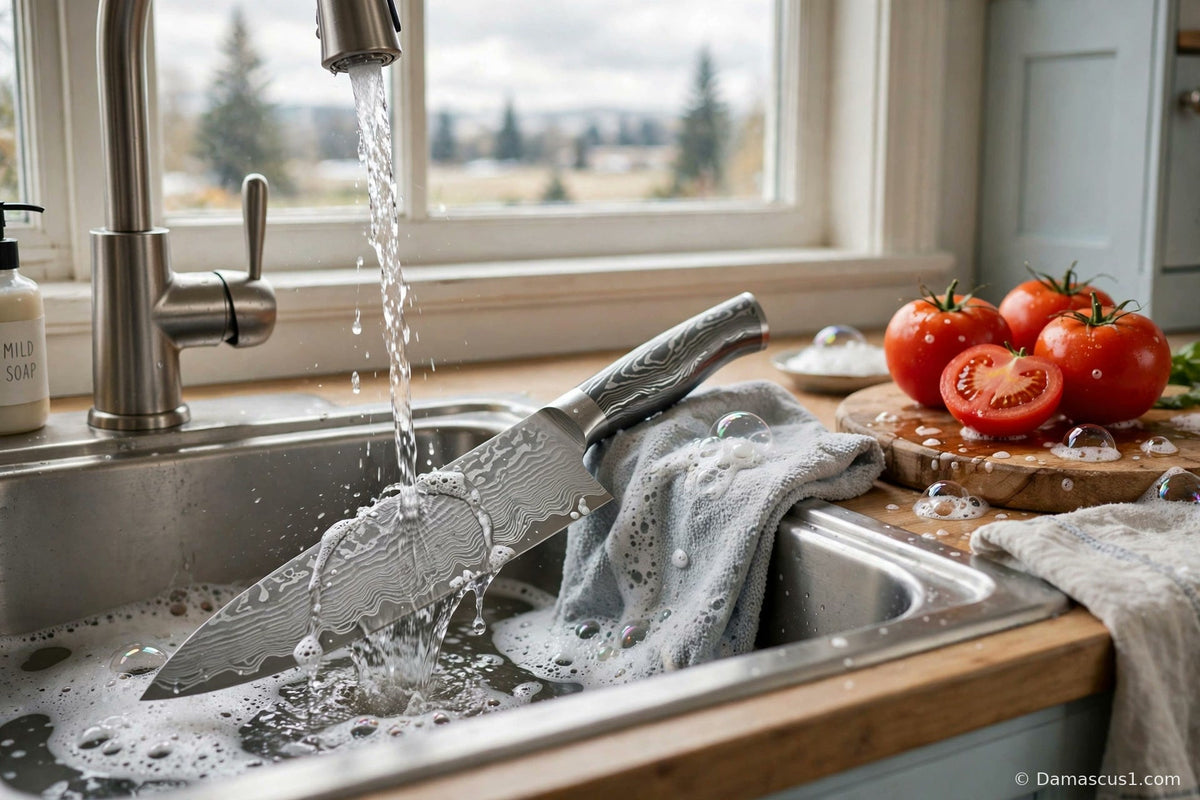
The short answer: Hand-wash a Damascus knife in warm water with a drop of mild dish soap on a soft cloth, rinse it, dry it completely the moment you finish — blade, spine, handle, and, on a folder, the pivot — then wipe on the thinnest film of food-safe oil and store it dry. Thirty to sixty seconds after every use. That routine, done every time, is what prevents the rust other guides teach you to remove.
This is the prevention guide in our Canada care series. Its companion is the rescue guide — the one about removing rust that is already there, with its triage of patina versus orange surface rust versus pitting. Rescue is the emergency department. This post is the daily habit that keeps you out of it. Every serious holder on page one agrees on the core routine, and this guide follows them: the Damascen Knives maintenance schedule, which opens with the instruction to clean and dry a Damascus knife after every single use; the Yakushi care guide, which insists you care for the actual steel and not the pattern alone; and the World of Blades step-by-step, which runs rinse, mild soap, immediate thorough drying, one to two drops of oil, and dry storage in that order. Where page one gets thin is exactly where Canadian owners live: nobody walks the routine through a folding knife's pivot, nobody adjusts it for a dry, furnace-heated Canadian winter or a humid coastal summer, and the holders openly disagree about how often to oil. This guide does all three, and it says which side of the argument applies to the knife this series is built around — and why.
One honesty note before the steps, carried through this whole series: the photographs in this post are editorial scenes made for this guide — kitchen sinks, workbenches, campsites, cabin shelves — not photographs of the specific knife sold further down the page. The knife itself is described exactly as the store describes it, and its prices are the store's own listed prices in US dollars. Nothing is converted into Canadian dollars, because a conversion the store did not make would be an invention.
Why does a Damascus knife need cleaning after every single use?
Because the steel in most Damascus blades — and in the folder at the centre of this Canada series — is reactive. Damascus is not one steel. It is a construction: layers of different steels forge-welded together, folded, and etched so the layers show as the flowing pattern everyone recognizes. In the Damascus1 hero, those layers are 1095 and 15N20, both high-carbon steels, at roughly 276 layers and 58–60 HRC — and the store states plainly that the knife is not stainless. High-carbon steel trades corrosion resistance for edge quality. Leave moisture, salt, tomato juice, or onion acid sitting on it and the surface starts oxidizing within hours. The Damascen schedule puts the timeline bluntly: a wet blade left on a towel for twenty minutes is usually fine; left overnight, it can develop rust in a single night.
That reactivity is why "clean it sometimes" fails. Stainless forgives a night in the sink. Carbon Damascus does not, and the pattern makes the stakes visible: the same etched contrast that makes the blade beautiful is a surface that abrasives, harsh chemicals, and neglect can flatten or stain. Yakushi's framing is the right one — you are caring for the actual steel, not the pattern alone — but the pattern is what tells on you. A plain carbon blade hides a careless month under an even patina. A Damascus blade shows every fingerprint left to sit, every wet hour in a sheath, every dishwasher cycle, in the contrast itself.
There is a second reason, and it is the folder reason. A kitchen knife has one surface to dry. A folding pocket knife has a pivot, liners, a lock, and a handle junction — four places water hides after a quick towel pass, which is why the CJRB folder-care holder gives the pivot its own step (compressed air or a soft brush for lint and debris, then complete drying of the pivot area and the inside of the handle liners). A folder cleaned like a kitchen knife is a folder rusting from the inside, at the one joint it cannot afford to lose. The routine below therefore comes in two versions that share one spine: kitchen first, folder second, then the Canadian adjustments both of them need.
What is the kitchen-knife cleaning routine, step by step?
Five steps, in order, every time. This is the citable asset of this post — the routine table. Print it and tape it inside the cupboard door nearest the sink.
| Step | Do this | Why it matters |
|---|---|---|
| 1. Wash now | Hand-wash right after use: warm water, a drop of mild dish soap on a soft cloth or non-abrasive sponge, wipe spine-to-edge with the blade visible — never leave the knife hidden in a sink of water | Residue and moisture start oxidizing reactive steel within hours; a concealed blade in a sink is also how hands get cut |
| 2. Mind the acid | If you cut citrus, tomato, or onion, wipe the blade between cuts, not just at the end | Acid reacts with carbon steel faster than plain water does |
| 3. Rinse | Rinse the soap off under warm water | Soap film left to dry dulls the etched contrast over time |
| 4. Dry completely | Dry at once with a clean towel — both faces, the spine, the bolster, and where blade meets handle; keep the edge facing away from your hand, never slide cloth lengthwise along the edge | The handle junction is where water hides longest and rust starts first; drying is the single step that prevents most damage |
| 5. Oil lightly, store dry | On reactive (non-stainless) Damascus, wipe on 2–3 drops of food-grade mineral or camellia oil with a lint-free cloth to a light satin sheen — not a visible film — then store dry: saya, block, magnetic strip, or guarded drawer slot | Oil is a storage barrier, not a cleaning shortcut; never apply it over moisture or residue |
Two timing notes complete the kitchen picture, both from the Damascen schedule and both about frequency rather than technique. Honing is not cleaning, but it lives on the same calendar: a few passes on a ceramic rod every few uses, at roughly a 12–15° angle, heel to tip, alternating sides, realigns an edge that has rolled; an actual whetstone sharpening is a months-level event, only when honing stops restoring the bite. And once a month, look at the blade properly — near the handle, along the spine, anywhere a sheath touches — because a rust spot caught at the orange-speck stage is a paste-and-cloth fix, while the same spot caught at the pitting stage is metal permanently gone. Our Canada rust-rescue guide owns that repair ladder; this guide's job is to make sure you rarely climb it.
What about the handle? On the kitchen route in this store — the Premium Kitchen Knife Block Set and the VG10-Labelled Nakiri further down — the same rule Yakushi gives for natural wood applies everywhere: keep handles out of standing water, dry around the bolster and joints, and never let a wet-dry cycle repeat daily until a scale swells or cracks. A handle dried as carefully as the blade outlasts the edge it carries. A handle soaked nightly fails first, and it fails holding a sharp blade, which is the worst order for things to fail in.
What changes when the Damascus knife folds?
The wash is the same. Everything after the wash is different, because a folder is a machine as well as a blade. Here is the folder routine for a knife like the series hero — a manual two-hand nail-nick folder with a back-lock and an olive wood handle.
Open it to clean it. Wash the blade open, warm water and mild soap on a soft cloth, exactly as above. Then, before drying, deal with the pivot. Pocket lint, camp grit, and food residue collect where the blade rotates, and soapy water follows them in. A soft brush — the CJRB holder's toothbrush-and-soapy-water approach for handle scales translates directly — works the pivot and the lock channel clean. Compressed air, if you have it, blows the joint dry-clear in seconds; if you do not, a folded corner of lint-free cloth drawn through the open joint does the same job more slowly.
Dry the inside, not just the outside. This is the step page one understates. Towel the blade, then hold the folder open and dry the pivot, the liners, and the inside faces of the handle. Shake out what you cannot reach, work the cloth corner through the joint again, and leave the knife open on the counter for a few minutes before it closes. A folder closed wet is a folder stored wet, whatever its outside looked like. The folder-pivot image in this post is that moment: brush, cloth, and the joint open to the light.
Oil in two places, in two amounts. On the blade, the same whisper-thin film as the kitchen routine — this hero is non-stainless 1095/15N20, so the blade film is not optional decoration; it is the moisture barrier between uses. On the pivot, one pinpoint drop of light knife oil, worked in by opening and closing the blade a few times, then the excess wiped away. Too much pivot oil collects the lint you just removed; too little leaves the joint dry and gritty. One drop is the measure, and the back-lock channel gets the wipe, not a flood.
Store it closed, dry, and out of the sheath for the long term. Every holder agrees on the leather warning, and it matters more in Canada than almost anywhere: leather absorbs and holds moisture against steel, so a sheath is a carry tool, not a storage home. The folder lives in a dry drawer, a roll, or a box — in a humid house or a coastal cottage, with a silica gel pack nearby, the same trick the Damascen storage section recommends. At camp, the routine compresses but does not disappear: wipe the blade clean and dry after food or fish, oil if the trip is wet, and let the folder ride in the pack, not in a damp sheath overnight. The camp image in this post is that thirty-second version — cloth, mug, stove, lake — and thirty seconds is genuinely all it takes.
How often should you oil a Damascus knife in Canada?


This is the question page one answers three different ways, so here is the disagreement stated honestly, and then resolved for the knife in front of us. The Damascen schedule says about once a week in regular use, and every two to three uses in humidity or after acidic food. Yakushi says oil only when the steel or the storage conditions call for it — a frequently used stainless Damascus knife in a dry kitchen may need no routine oil at all. SiliSlick's finish guide lands at once every one to two months for carbon Damascus. All three can be right, because they are describing different steels in different houses.
The resolution is construction plus climate, and it works like this. If the Damascus is stainless-clad — a VG-10 or AUS-10 core under stainless layers, the common modern kitchen construction — Yakushi's answer governs: wash, dry, store dry, oil rarely. If the Damascus is carbon — 1095/15N20, like the hero of this series — the oil film is part of the cleaning routine itself, not a separate calendar event: a light film after cleaning whenever the knife will sit more than a day, and after every use in humid, coastal, or camp conditions. Then the Canadian adjustment, which no page-one holder makes. A furnace-heated house in Winnipeg or Edmonton in January is one of the driest indoor environments on earth; a folder cleaned, dried, and lightly oiled there can sit for weeks without attention, and its olive wood handle is at more risk from the dryness than its blade is from rust — keep it away from heat vents, and let the thin oil film on the blade do double duty by keeping your hands' moisture off the steel when you handle it. The same knife at a Nova Scotia cottage in August, or in a Vancouver kitchen through a wet winter, lives in damp air that condenses on cool steel; there, the every-use film and the silica pack earn their keep. One knife, one routine, two tempos — set by the air in the room it sleeps in. The winter-storage image in this post — folder, shelf, silica pack, frost on the window — is the January tempo in one frame.
Skip the wrong oils entirely. Vegetable and olive oils oxidize, turn sticky, and can go rancid on a blade — every holder that mentions them says avoid them. Food-grade mineral oil and camellia oil are the two names page one converges on, they are stable, they are cheap, and a small bottle lasts a household years. Oil is the cheapest insurance in this entire guide; the expensive mistake is the rust it would have prevented.
What should you never use on a Damascus knife?
The never list is short, and every item on it earns its place by damaging either the steel or the pattern that makes the steel worth owning. Never put a Damascus knife in the dishwasher — Yakushi's answer to that exact question is a flat no, and the reasons stack: heat, harsh detergent, prolonged moisture, and rattling contact with other items attack the edge, the etched finish, and the handle in a single cycle. Never soak it, even "just for a few minutes" that become an hour; soaking is the dishwasher's damage at room temperature. Never use steel wool, abrasive pads, or scouring powder on the blade faces — they scratch across the etch and flatten the contrast you are trying to preserve, which is why even the rust-rescue ladder reserves 0000 wool for rust spots, worked gently, and never as a cleaning tool. Never use bleach, oven cleaner, or unapproved acids, and never try to "improve" the contrast with a household-acid home re-etch: Yakushi calls re-etching a refinishing process, not maintenance, and an uncontrolled acid bath can alter the finish, the markings, and the edge. Never use aggressive metal polishes unless the maker confirms they suit the finish. And never store the knife dirty, wet, or hidden in a sink — the three habits that undo a good routine in a single evening.
Two softer nevers belong here too, because they are the ones careful owners still commit. Never dry a blade by sliding a towel lengthwise along the edge — dry across the faces with the edge facing away, the way the Yakushi routine specifies; the lengthwise slide is both a cut risk and a poor drying motion. And never apply oil over a blade that is still damp or dirty and call it protected: oil seals in whatever is under it, including the moisture you meant to exclude. Clean first, dry completely, then the thin film. Order is the whole trick.
Is that mark patina, a water spot, or rust — and does cleaning change?
Learn to read the blade, because the right response depends on the diagnosis and the wrong response costs pattern. A removable film or water spot — a dull patch or a ring where a droplet dried — washes off with the ordinary routine: gentle soap, rinse, dry, done. Patina is the stable, even, grey-to-blue darkening that reactive steel develops through honest use; the Damascen schedule and Yakushi agree it is not rust, it actually helps protect the steel, and it should be left alone — a genuine patina simply returns after cleaning, and chasing it off with abrasives is how owners polish the character out of a blade. Active rust is the third thing: orange or orange-brown, rough or powdery, uneven, and spreading if left. That mark is not a cleaning problem anymore; it is the rescue guide's territory — baking-soda paste for light surface spots, 0000 wool and oil worked gently for established ones, and a professional for pitting. This post's boundary is deliberate and worth stating in the guide itself: routine cleaning prevents rust and maintains patina; it does not repair corrosion. If you are not sure which mark you are looking at, both full-read holders give the same safe instruction — treat the uncertain mark gently, clean it with the routine, and if it does not lift, ask the maker or follow the rescue ladder before reaching for anything abrasive. The one unforgivable move is the aggressive one taken on a guess.
There is a quieter diagnostic habit worth building, and it costs nothing: inspect as you dry. The drying pass is already a slow look at both faces under kitchen light. New spot near the handle? Water sitting in the pivot? Edge bright and even, or a nick catching the light? Thirty seconds of looking, every time, is the entire early-warning system — the monthly check the Damascen schedule prescribes, folded into a habit you were already performing.
Which Damascus knives does this routine protect — and what do they cost?
Start with the folder this routine was written around. The Olive Wood Damascus Pocket Knife Set is $39.99 USD (compare-at $89.99) — forge-welded 1095 and 15N20 at roughly 276 layers, 58–60 HRC, an olive wood handle, 6.5 inches overall, single-edged, and deliberately not stainless: it is a carbon Damascus knife, which is exactly why it gets the full wash-dry-oil routine in this guide rather than the lighter stainless version. It opens with a manual two-hand nail-nick and locks with a back-lock — no button, no spring, no flick — the low-risk mechanism design under Canadian law, a point our Canada guide to whether pocket knives are legal in Canada covers in full. It carries buyer reviews of 4.9/5 on its product page, cited as the page's own figure. Engraving is available on request, quote-based, up to 25 characters, with proof, price, and timing confirmed before custom work starts.
The same routine scales across the store's route. The Orange Wood 6.5" Damascus Folding Pocket Knife at $39.99 USD (compare-at $99.99) is the warmer-handled second folder — two folders at $39.99 each come to $79.98 USD, which crosses the store's "Free Shipping & Returns above $50!" banner as the store lists it, and puts a cleaned-and-oiled folder at home and another at the cottage. In the kitchen, the Premium Kitchen Knife Block Set at $169.99 USD and the VG10-Labelled Nakiri Knife at $44.99 USD take the kitchen version of the routine — wash, dry, store dry in the block — with oiling governed by the construction rule above rather than by habit. Knowing whether your Damascus is real layered steel at all is the precondition for caring about any of this, and our Canada guide to real versus fake Damascus steel and the 60-second checks in how to spot a fake Damascus knife cover the tells. Two sibling Canada guides are planned as follow-ons to this post — an honest comparison of Damascus steel against plain carbon steel, and a Canada hunting-knife guide that splits the folder's camp role from the fixed blade's field role — and will be linked here when they publish; until then they are drafts, not live pages. For the gift route, our guide to the engraved pocket knife gift covers the keepsake version of the same folder. The standard cross-border picture applies to a US order into Canada: prices in USD exactly as listed, possible GST/HST and a carrier handling or brokerage fee on arrival, and no delivery date promised anywhere in this post.
Shop handmade Damascus pocket knives
Prices checked November 21, 2026. Prices are in US dollars. The product page on the day you order is the final word.
- Olive Wood Damascus Pocket Knife Set, 6.5 in.: $39.99
- Green Wood Damascus Pocket Knife Set, 6.5 in.: $39.99
- Buffalo Horn Damascus Pocket Knife Set, 6.5 in.: $39.99
- Stag Horn Damascus Folding Pocket Knife, 6.5 in.: $49.99
- Camel Bone Scrimshaw Damascus Folding Pocket Knife, 7.6 in.: $49.99
- Ram Horn Scrimshaw Damascus Pocket Knife, 7.6 in.: $59.99
Damascus pocket knives under $50 · All handmade Damascus pocket knives
Frequently asked questions
Can a Damascus knife go in the dishwasher?
No — this is Yakushi's exact question and its exact answer. Dishwasher heat, detergent, moisture, and contact with other items can damage the edge, the etched finish, and the handle in one cycle. Hand-wash the knife with the edge visible, in warm water with mild soap on a soft cloth, then dry it completely. The routine takes under a minute.
Should I oil my Damascus knife after every use?
Not automatically — it depends on the construction, which is Yakushi's framing and this guide's rule. A frequently used stainless Damascus knife stored dry may need no routine oil. A carbon Damascus knife — 1095/15N20, like the folder in this guide — should get a whisper-thin film of food-safe mineral or camellia oil after cleaning whenever it will sit more than a day, and after every use in humid, coastal, or camp conditions.
Can Damascus steel rust?
Yes. Corrosion resistance depends on the actual alloys and construction, and even stainless steel can corrode under prolonged moisture, salt, or acidic residue — Yakushi's answer, and the reason this guide never treats the Damascus label as protection. Non-stainless Damascus rusts readily if left wet. Clean and dry promptly; the label is a pattern, not a promise.
How often should I oil a Damascus knife?
The Damascen schedule's answer: about once a week for regular use, and every two to three uses if you live in a humid climate, use the knife outdoors, or cut acidic food frequently. For carbon Damascus, fold the film into the cleaning routine itself rather than keeping a separate calendar; for stainless Damascus in a dry kitchen, oil rarely, before long storage. In a dry heated Canadian winter interior, intervals stretch; on a humid coast, they shrink.
Is Damascus knife patina the same as rust?
No. Patina is a stable, even, grey-to-blue discoloration that forms naturally on carbon steel and actually helps protect it — both the Damascen schedule and Yakushi make this distinction. Rust is orange, uneven, rough, and active, and it keeps spreading if untreated. When in doubt, clean gently with the routine; a genuine patina will simply return on its own, while a rust spot needs the rescue ladder, not the cleaning cloth.
How do I remove rust without damaging the pattern?
Begin with gentle washing, and identify whether the mark is residue, patina, or active rust before touching it with anything abrasive — Yakushi's instruction, and the boundary of this guide. Routine cleaning does not remove established rust; that is the rescue guide's work: a baking-soda paste for light spots, 0000 wool with oil worked gently for more, and a professional assessment for pitting. Before using any rust eraser, polish, or acid, confirm the method suits the etched finish.
Does sharpening remove the Damascus pattern?
Normal edge sharpening works on the cutting bevel, not the patterned blade face, so it should not remove the pattern — Yakushi's answer. Scratches and flattened contrast usually come from coarse slurry, clamps, or sharpening tools contacting the flats, or from aggressive thinning and polishing. Keep the whetstone work on the bevel, protect the faces, and the pattern survives a lifetime of edges.
How often should a Damascus knife be sharpened, versus honed?
Hone every few uses with a ceramic rod to realign the edge — the Damascen schedule's rhythm, at roughly 12–15°, heel to tip, alternating sides. Move to an actual whetstone sharpening only every few months, once honing no longer restores the bite, or when performance tells you to: crushing herbs, slipping on tomato skin, tearing instead of slicing. Sharpening removes metal; honing does not — which is also why you cannot skip honing and simply sharpen more often without shortening the blade's life.
The last word: sixty seconds now, or a rescue later
Every holder on page one, whatever they disagree about, converges on the same arithmetic. The routine in this guide costs thirty to sixty seconds after each use and a few drops of oil a week. The failure it prevents costs an afternoon of paste and wool, or a professional's bench fee, or — at the pitting end — the blade itself. Canadian owners get one extra reason to keep the habit: our climate swings a knife between furnace-dry January air and August coastal damp, between a heated kitchen and a frosty truck cab, and each swing condenses moisture on cold steel exactly where nobody is watching. The owners whose Damascus knives still look and cut like new after a decade are not the ones with the most products. They are the ones who never let a wet blade sit. Wash it now. Dry it completely. Oil it lightly. Store it dry. If you are choosing the knife the routine will protect, choose the honest carbon Damascus folder — the Olive Wood Damascus Pocket Knife Set at $39.99 USD — and give it the sixty seconds it asks for. It will repay them for years.
laissez un commentaire: