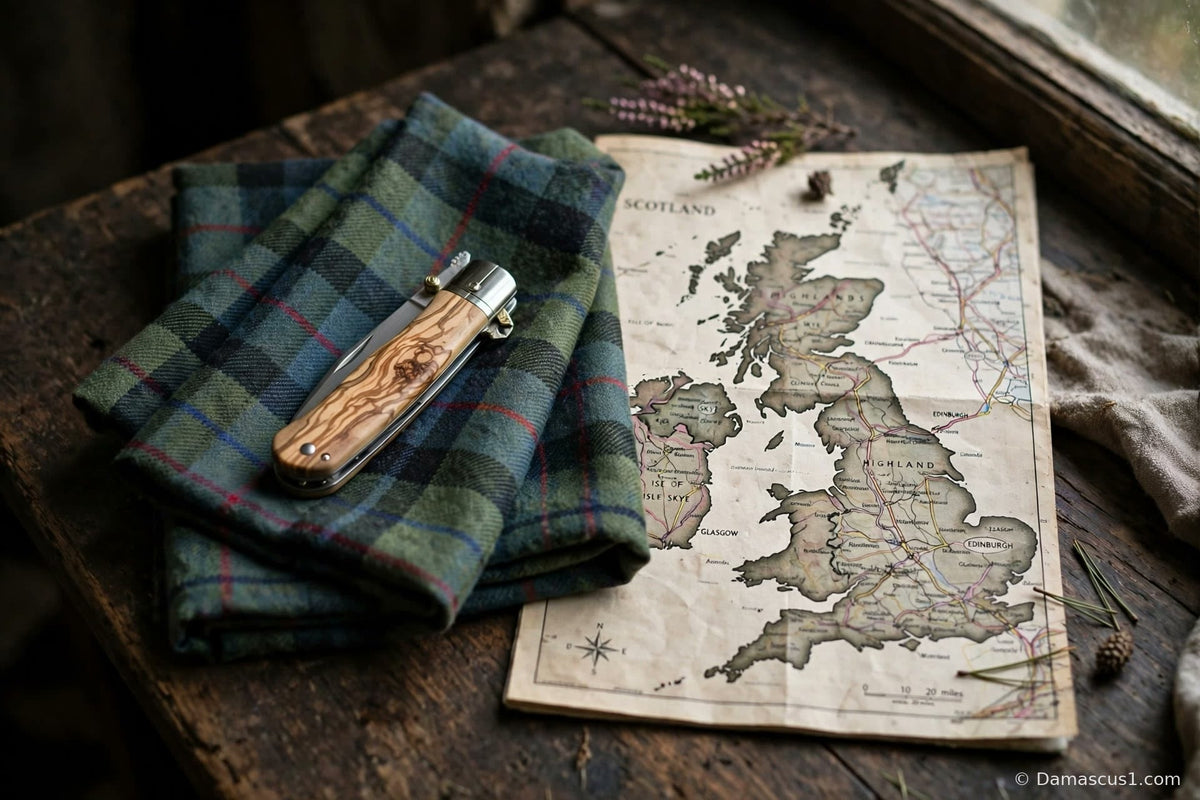
The short answer: Scotland shares the UK's core rule — a non-locking folding pocketknife with a cutting edge of three inches or less needs no reason in public — but the offence sits in Scotland's own statute, section 49 of the Criminal Law (Consolidation) (Scotland) Act 1995, the defence is worded "reasonable excuse or lawful authority", and the maximum penalty on indictment is higher. Everything below is general information, not legal advice.
That short answer is the part most pages get half right. Search for knife laws in Scotland and you will mostly find England-and-Wales pages with a Scottish paragraph bolted on, or Scottish pages that quietly copy the English wording and hope nobody notices. The differences are not enormous, but they are real, they sit in different Acts, and one of them — the wording of the defence itself — changes the sentence you would actually say to explain yourself. This guide separates the two layers carefully: first the frame Scotland shares with the rest of Great Britain, then the Scottish layer on top of it, with every specific hedged the way an honest explainer should hedge it. Where a figure or an exception could have moved, or where summaries disagree, this guide says so and tells you where the primary text lives, rather than presenting a tidy number as settled fact.
A note on who this guide is for, because law explainers are read by very different people. Some readers are walkers, anglers, stalkers and campers planning a Scottish trip with a working knife in the kit. Some are collectors in Scotland who own locking folders at home and want to know exactly where ownership ends and carrying begins. Some are parents, gift buyers and online shoppers trying to understand the age rules. And some have simply been told, confidently and wrongly, that "Scotland is stricter" or "Scotland is more relaxed" and want the truth. The truth is duller and more useful than either slogan: the everyday rule is the same, the statute is different, the defence is worded differently, the top penalty differs, and one narrow sales exception exists that England does not have. Read the sections in order and you will have the whole picture, hedged where hedging is due.
Is knife law in Scotland actually different from England and Wales?


Yes — in structure, wording and penalty, though not in the everyday rule most people meet. In England and Wales, carrying a bladed or sharply pointed article in a public place is an offence under section 139 of the Criminal Justice Act 1988, unless you have a good reason or lawful authority, with a single automatic exception for a folding pocketknife whose cutting edge does not exceed three inches. In Scotland, the equivalent offence was consolidated into section 49 of the Criminal Law (Consolidation) (Scotland) Act 1995. The section 49 text, as published on legislation.gov.uk, applies to any article which has a blade or is sharply pointed, and then states plainly that the section does not apply to a folding pocketknife if the cutting edge of its blade does not exceed three inches (7.62 centimetres). Same exemption, opposite drafting direction, different Act. That matters for a practical reason: if you ever need to read the actual law, cite advice, or check whether a summary is current, the Scottish reader who searches only for section 139 is reading the wrong statute.
Two further structural points are worth stating carefully. First, the exemption is about a folding pocketknife — and courts across the UK have treated a knife that locks open as falling outside that idea, because a folding pocketknife must be foldable at all times. A locking folder therefore does not gain the automatic exemption anywhere in Great Britain, Scotland included, whatever its blade length. Second, Scotland's summary of its own position in reputable explainers consistently uses the words "reasonable excuse" where England and Wales use "good reason". That is not a journalist's paraphrase. Section 49(4), as published, makes it a defence to show that the person had a reasonable excuse or lawful authority for having the article in the public place, and section 49(5) gives the familiar examples without limiting the defence: use at work, religious reasons, or as part of any national costume. The sgian-dubh worn as part of Highland dress is the Scottish example everyone pictures, and it sits in that national-costume limb — but note that it is a defence to be shown, not a free-standing permission printed on the kilt.
Everything in this section is general information about how the framework is structured, drawn from the statute text and reputable summaries read on 2026-11-14. It is not legal advice, it does not predict how any individual stop, search or prosecution would be handled, and anyone facing a real charge or a real confiscation should speak to a Scottish solicitor. With that said plainly once, this guide will not repeat the disclaimer in every paragraph — but it applies to every paragraph.
What is the one knife you never have to explain in Scotland?
A folding pocketknife that does not lock, with a cutting edge of three inches (7.62 centimetres) or less. That is the whole of the automatic exemption, in Scotland as in England and Wales, and every word of it does work. Folding means the blade folds into the handle. Does not lock means there is no mechanism holding it open that must be released before it can fold — a slipjoint, a friction folder or a small non-locking multitool blade is the shape of thing meant. Cutting edge means the sharpened edge itself, measured along the edge, not the whole blade, not the closed knife, and not the overall length printed on a retailer's box. And three inches or less includes exactly three inches: the Scottish text exempts a cutting edge that "does not exceed" three inches.
It is worth pausing on how often this test is mis-stated, because Scottish readers meet the same marketing fog as everyone else. "UK legal" is not a phrase any statute uses. It is retailer shorthand, and it is sometimes applied on blade length alone, with the locking question never mentioned. A short knife that locks is not inside the exemption. A non-locking knife whose cutting edge runs over three inches is not inside the exemption. Either failing point moves the knife into the second category — lawful to own, lawful to carry only where a reasonable excuse or lawful authority can be shown — and no label on a product page changes that. The honest one-minute check is the same in Dundee as in Dover: open the blade, see whether it locks, measure the cutting edge, and match both answers against the rule. Our wider explainer, UK legal pocket knife, walks through that check in full, and Are locking knives legal in the UK? deals with the locking question on its own.
There is a second misunderstanding to clear away while we are here. The exemption is not a Scottish countryside exception, a fishing exception or a camping exception. It does not depend on where you are or what you are doing; it depends on the knife. Conversely, the activities themselves — work, fishing, camping, stalking — are not exemptions either. They are the raw material of a reasonable excuse for a knife that sits outside the exemption, which is a different legal shape entirely: a defence, assessed on the facts, rather than a rule that takes the knife outside the offence altogether. Keeping those two shapes separate is the single most useful thing a Scottish reader can take from this page.
What counts as a reasonable excuse in Scotland — and what does not?
Section 49(5) names three examples — use at work, religious reasons, and national costume — and section 49(4) leaves the door open to any other reasonable excuse the person can show. In practice, the reputable explainers and prosecution guidance summarised in the research behind this guide treat the excuse as specific, current and connected to what you are actually doing at the time. A chef carrying her knives to work, a joiner with the tools of the trade, an angler travelling directly to and from the riverbank with a filleting knife packed in the tackle, a camper with a working knife in the camping kit on the way to and from the site: these are the patterns that recur, because the knife, the journey and the purpose line up. What does not line up, on any summary this guide has read, is a general wish to be prepared, a habit of carrying, forgetfulness that the knife was in the bag, or self-defence. Carrying a knife because of a general or ongoing sense of threat is not treated as a reasonable excuse, and "I forgot it was there" is not, on its own, a defence either.
The burden matters too, and Scottish readers should understand it before they need it. The defence is for the person carrying the article to show. That is the structure of both section 139 and section 49: the prosecution does not have to disprove your excuse; you have to establish it. Practically, that is why the packing and the journey matter so much. A working knife carried openly on the hip through a city centre on an unrelated errand tells a different story from the same knife packed in a case, in the boot, with the rest of the kit, on a direct journey to the place where it will be used. Camping explainers make the same point for Scotland: take the fixed blade or lock knife out with the camping gear, use it at camp, pack it away for the journey home, and do not leave it in the car or in a pocket "in readiness" for a future trip, because readiness is not a current excuse. None of that is a guarantee — a court decides on the facts, and this guide cannot decide a case in advance — but it is the shape of the reasoning every serious summary describes.
Where does a locking Damascus folder sit in all of this? Exactly where it sits in England and Wales, and this guide will state it without decoration. The Olive Wood Damascus Pocket Knife Set | Handmade Folding EDC at $39.99 USD (compare-at $89.99, checkout in USD) locks with a back-lock, so it is never inside the automatic exemption and is never described here as "UK legal carry". Owning it at home in Scotland is legal. Carrying it in a public place needs a specific, current reasonable excuse or lawful authority of the kind described above — a day's work that needs it, a fishing or camping journey taken directly — and at home, in a collection, in the workshop and in the tackle box on a genuine trip are its honest homes. Its specification is part of why collectors like it: forge-welded 1095 and 15N20 at about 276 layers, 58–60 HRC, an olive wood handle, a 6.5-inch model opened manually with two hands by a nail nick — never one-hand, never a flipper, never assisted, never automatic — and a single edge. The product page carries 4.9/5 buyer reviews for this product; the store's wider Amazon seller rating is a separate store figure and is not presented here as a review of this knife.
How do Scotland's penalties differ — and why should you treat the numbers carefully?
This is the section where honest hedging matters most, because penalty figures are the part of knife law most often copied from an out-of-date page. As read on 2026-11-14, the position described by the statute text and the comparison explainers is this. Section 49(1) provides, on summary conviction, imprisonment for a term not exceeding twelve months or a fine not exceeding the statutory maximum or both, and on conviction on indictment, imprisonment for a term not exceeding five years or a fine or both. The side-by-side comparison in the leading UK knife-law hub puts Scotland's indictment maximum at five years against four years in England, Wales and Northern Ireland, with a twelve-month summary maximum in all three jurisdictions. Earlier versions of the Scottish provision carried lower figures — the legislative history shows the summary term raised from six to twelve months and the indictment term amended over time — which is exactly why a page quoting two years or six months may simply be quoting an older text rather than inventing a number.
Treat every penalty figure in this guide, including those, as a hedged summary to be confirmed against the current revised text on legislation.gov.uk before it is relied on for anything real. Sentencing in an actual case depends on the facts, the court, any guideline that applies and matters no blog post can know. What can be said without hedging is the direction of travel: Scotland's headline maximum for the section 49 offence, as currently summarised, is higher than the England-and-Wales equivalent, and the practical lesson for a carrier is identical in both countries — the excuse has to be real, current and provable, because the consequences of having no answer are not trivial in either jurisdiction. The citable asset below gathers the comparison into one table, with the hedges built into the table itself rather than footnoted away.
| Point | England & Wales (s.139, Criminal Justice Act 1988) | Scotland (s.49, Criminal Law (Consolidation) (Scotland) Act 1995) |
|---|---|---|
| Offence | Having a bladed or sharply pointed article in a public place without good reason or lawful authority | Having a bladed or sharply pointed article in a public place without reasonable excuse or lawful authority |
| Automatic exemption | Folding pocketknife, cutting edge not exceeding 3 inches — in practice non-locking, as a locking knife is treated as outside the folding-pocketknife idea | Folding pocketknife if the cutting edge does not exceed three inches (7.62 cm) — same practical non-locking reading |
| Defence wording | "Good reason or lawful authority" | "Reasonable excuse or lawful authority" (s.49(4)) |
| Named defence examples | Use at work, religious reasons, national costume | Use at work, religious reasons, national costume (s.49(5)) |
| Maximum, summary (as summarised 2026-11-14; confirm current text) | 12 months | 12 months |
| Maximum, on indictment (as summarised 2026-11-14; confirm current text) | 4 years | 5 years |
| Under-18 sales | Generally banned (with narrow exemptions) | Generally banned at 18, with a narrow exception: a knife or blade designed for domestic use may be sold to a person aged 16 or over — hedge and confirm before relying |
| Online delivery | Age-verified delivery into the hands of an adult (OWA 2019 framework) | Same practical rule for Scottish buyers: plan for an adult handover |
Read the table as a map, not as a judgment. It tells you which statute to read, which words your defence would actually use, and where the two systems genuinely part company. It does not tell you the outcome of any real case, and any retailer, guide or friend who compresses Scotland into "same as England" is skipping the rows where your own position would be decided.
Can you buy a knife in Scotland at 16 or 17?
Generally, no — and the exception is narrow enough that it deserves its own section rather than a throwaway line. The general rule across the UK is that selling a knife to a person under 18 is an offence. Scotland, however, carries a specific carve-out that the comparison sources describe consistently: as the sale provision applies in Scotland, it is not an offence to sell a knife or knife blade to a person aged 16 or over where the knife or blade is designed for domestic use. In plain terms, that is the domestic cutlery exception — kitchen knives and table cutlery for the home, sold to a 16- or 17-year-old in Scotland — and reputable retail summaries reflect the same point in short form: in Scotland, 16- to 18-year-olds are allowed to buy cutlery and kitchen knives.
Hedge it properly, because three limits matter. First, the exception is about domestic knives; it is not a general lowering of the age limit, and it does not turn a locking folder, a hunting knife or any other non-domestic blade into something a 16-year-old may buy. Second, many retailers simply operate an 18-plus policy for all knives, which they are entitled to do, so the exception does not guarantee that any given shop or website will sell even a domestic knife to a 16-year-old. Third, the detail sits in amended legislation with exemption orders around it, so anyone whose business or case turns on the exact boundary should confirm the current text rather than rely on this summary. For Damascus1's own position there is no ambiguity to hide behind: sales are for adults, and the hero folder in this guide is not a domestic cutlery item in any case. A Scottish parent buying a first kitchen knife set for a 17-year-old setting up a flat is in the exception's territory; a 17-year-old buying a locking pocket knife is not, in Scotland or anywhere else in the UK.
Online buying adds the delivery layer, and it is the same practical layer Scottish buyers meet everywhere else. Under the Offensive Weapons Act 2019 framework, a bladed product sold remotely must be delivered into the hands of an adult — age-verified delivery, photo ID possible at the door, no leaving with a neighbour as a casual default and no unattended locker delivery for bladed products. Our step-by-step explainer, Can you buy knives online in the UK?, sets out how that handover works, and the buying guide Damascus pocket knife UK puts prices and patterns in context. Plan for an adult to be home, in Inverness exactly as in Ipswich.
What about banned knives, cars, schools and travelling in Scotland?
The banned list is a UK-wide story with Scottish orders of its own, and the honest summary is short: flick knives, gravity knives, butterfly knives, disguised knives and the other prohibited types are banned regardless of blade length or reason, and Scotland's own offensive-weapons orders have historically applied the prohibitions north of the border. A banned knife is not a "good reason" problem; there is no excuse that cures it, and this guide will not list the prohibited catalogue in loving detail because no reader needs a shopping list of illegal objects. If you are offered one abroad, leave it abroad.
Cars deserve a paragraph because Scottish readers ask about them constantly, and the principle is simple even though the case law is fact-specific. A car in a public place does not step outside the idea of a public place, and a knife loose in a door pocket or glovebox "just in case" or forgotten from a previous trip is the pattern that causes trouble in the summaries — including a reported Scottish prosecution story, repeated in camping explainers, of a gardener convicted over an axe carried loose in a car door rather than packed with his tools. Packed in a case, with the kit, in the boot, on a journey that itself supplies the excuse: that is the defensible shape. Our UK-wide transport thinking follows the same line.
Schools and further-education premises carry their own, more serious offences for bladed articles in Scotland, as they do elsewhere in the UK, and no part of the everyday exemption conversation should be read across into a school context. Travelling follows the same rule as the rest of the UK: no knife belongs in aircraft hand luggage, hold baggage with secure wrapping is the route, and the airline's own rules can be stricter than the general position. And a word for visitors coming north: if you cross from England into Scotland with a working knife, nothing about the everyday three-inch rule changes under your feet — but the statute, the defence wording and the top penalty do, which is the whole point of this guide existing separately from an English one.
Which Damascus knives does this actually affect — and what should a Scottish buyer do?
Every knife a Scottish reader owns, in proportion to its type. A small non-locking slipjoint under the line is unaffected in daily life. Kitchen knives at home are unaffected; kitchen knives carried to work travel on the work excuse, packed properly. Fixed blades and locking folders — the camping knife, the hunting knife, the collector's folder — live in the reasonable-excuse world for any public-place journey. That includes the Damascus folders this site sells, so let us place them honestly rather than leave them in a vague glow. The hero, the Olive Wood Damascus Pocket Knife at $39.99 USD, locks, and is a home, collection, workshop and genuine-trip knife in Scotland. The same is true of the Orange Wood 6.5-inch Damascus Folding Pocket Knife at $39.99 USD and the Green Wood Damascus Folding Pocket Knife at $39.99 USD — colour changes nothing in law. The store banner reads "Free Shipping & Returns above $50!" as listed, so two folders at $79.98 cross it; checkout is in USD throughout, and no sterling price is invented here. At home, the care rule is the carbon-steel rule: this blade is not stainless, so wash by hand, dry straight away, store dry and oil lightly if it will sit — the routine that keeps 1095 and 15N20 layers bright rather than freckled. Our guide How to spot a fake Damascus knife shows the spine-and-bevel check that separates forge-welded pattern from print, wherever you buy.
So the Scottish buyer's checklist is short enough to write on the box. One: know which category your knife is in before it leaves the house — exemption, excuse, or home-only in practice. Two: if it needs an excuse, make the excuse true, current and visible in how the knife is packed and where you are going. Three: buy as an adult, receive as an adult, and keep the delivery adult-handed. Four: if your situation is anything more complicated than that — a charge, a confiscation, a workplace rule, a school context — stop reading blogs and take Scottish legal advice. That fourth point is not boilerplate. It is the difference between an explainer and advice, and this page is firmly, honestly the former.
The Olive Wood Damascus Pocket Knife Set — $39.99
Real Damascus steel, an olive wood handle and a genuine leather sheath included — the knife our readers ask about most.
Shop the Olive Wood Damascus Pocket Knife Set — $39.99 · Free US shipping on orders over $50.
Frequently asked questions
Is it illegal to carry a knife in the UK?
No, not automatically. A non-locking folding knife with a cutting edge of three inches or less can be carried without a reason — under section 139 in England and Wales, and under Scotland's own section 49 with the same three-inch folding-pocketknife exemption. Any other knife, including a locking folder of any length, needs the relevant defence: good reason in England and Wales, reasonable excuse in Scotland, or lawful authority in either.
What is the legal blade length in the UK?
Three inches, or 7.62 centimetres, measured along the cutting edge. The limit only creates the automatic exemption for a folding knife that also does not lock open. A fixed blade or a locking folder of any length is outside the exemption, in Scotland exactly as in England and Wales.
Are lock knives illegal to carry in the UK?
They are legal to own, and they lose the automatic three-inch carry exemption. Courts treat a knife that locks open as falling outside the folding-pocketknife exemption, so carrying one in public needs a good reason in England and Wales or a reasonable excuse in Scotland — work being the common example — even if the cutting edge is three inches or less.
What is a good reason to carry a knife?
The statutes name three examples: use at work, religious reasons such as the Sikh kirpan, and national costume such as the Scottish sgian-dubh. Scotland's section 49 words the wider defence as "reasonable excuse or lawful authority". Carrying because of a constant or ongoing threat is not treated as an excuse, and forgetting a knife is in a bag is not a defence on its own.
Is UK knife law the same in Scotland and Northern Ireland?
Mostly, with real differences in wording and penalties. Section 139 covers England, Wales and Northern Ireland; Scotland has its own section 49 with the same three-inch folding-knife exemption. Scotland's defence is "reasonable excuse", its indictment maximum as currently summarised is five years rather than four, and it has the narrow exception allowing domestic knives to be sold to people aged 16 and over — hedged in full in the section above.
What is the penalty for carrying an illegal knife in the UK?
As summarised on 2026-11-14: up to four years in prison, a fine, or both, on indictment in England, Wales and Northern Ireland, and up to five years in Scotland, with a twelve-month summary maximum in all three. Penalty texts are amended over time, so confirm the current revised statute before relying on any figure — and take legal advice for any real case.
The honest close: Scotland is not a loophole and it is not a trap; it is the same everyday rule written in Scotland's own statute, with its own defence words and a higher top penalty. If you collect or work with a locking folder at home, the Olive Wood Damascus Pocket Knife at $39.99 USD, checkout in USD and delivered into an adult's hands, is a lawful and lovely thing to own — carried in public only where a genuine, current reasonable excuse travels with it. DRAFT — awaiting Faisal's word before anything is published.
laissez un commentaire: