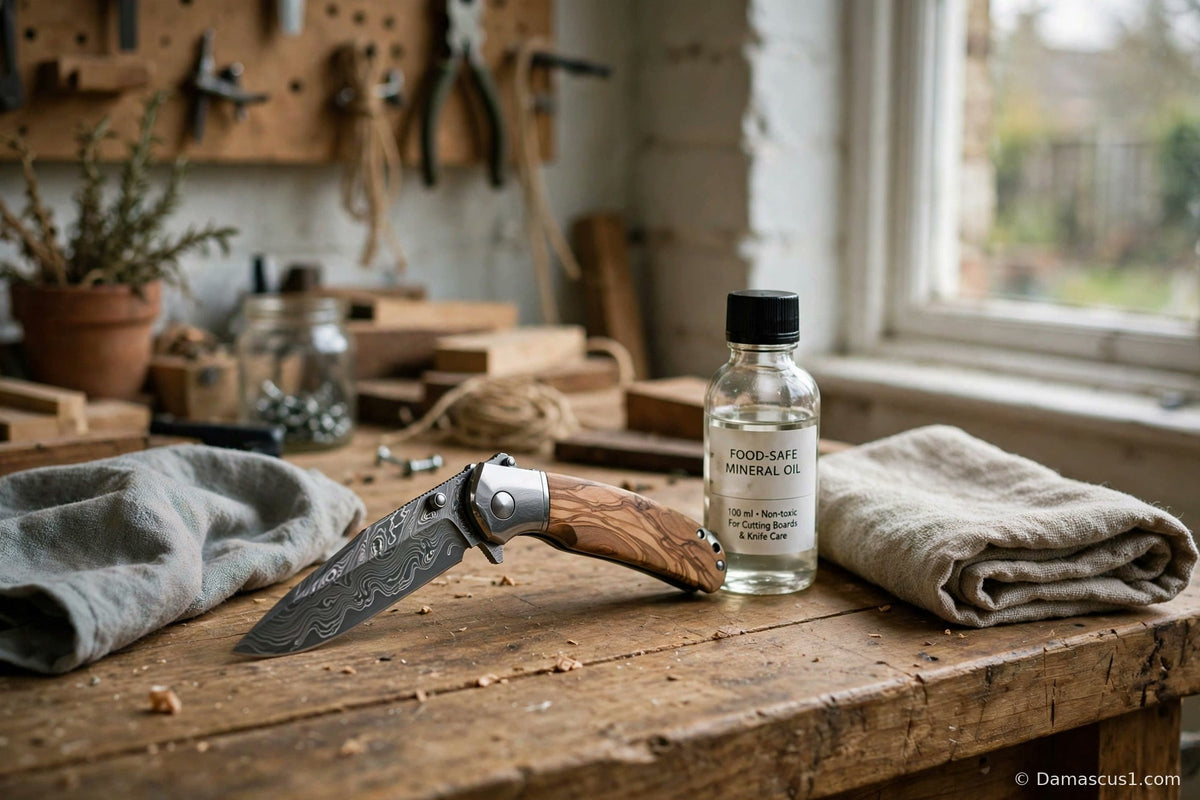
The short answer: Pocket knife maintenance in the UK comes down to one schedule, not a dozen separate jobs: wipe and dry the blade after every use, clear lint from the pivot weekly, oil the pivot and blade lightly every few weeks, check the lock and edge monthly, and give the handle and storage a proper once-over each season — a rhythm that matters more in Britain's damp climate than almost anywhere else, because moisture, not use, is what kills a folding knife here.
Ask ten British knife owners how they look after their pocket knife and you will get ten different answers, most of them half a routine. One oils religiously but has never cleaned the pivot. Another sharpens beautifully and stores the knife in its leather sheath in a damp garage. A third has never thought about the lock at all, until the day it feels gritty. The guides read for this page — the UK retailer Heinnie Haynes, the long-established Knives and Tools care pages, and the big maintenance references — all describe the same jobs, but they scatter them across separate articles about cleaning, oiling and sharpening, and none of them puts the whole thing on one timetable written for British conditions. That is what this page does. It is the full maintenance schedule for a folding pocket knife owned in the UK: five systems — pivot, lock, blade, handle and storage — each with its own cadence, gathered into a single calendar you can pin above the workbench. It is written around a traditional folder of the kind British collectors actually own, and it uses one knife as its worked example throughout: the Olive Wood Damascus Pocket Knife at $39.99 USD, a carbon Damascus folder whose care needs are the honest, slightly demanding end of the spectrum. If your knife is stainless and synthetic-handled, every interval on this schedule can stretch. If it is carbon steel and natural wood, as the example is, the schedule is the difference between a knife that ages beautifully and one that quietly rusts in a drawer.
What does a full pocket knife maintenance schedule actually include?
Five systems, because a folding knife fails in five different places. The blade is the obvious one: it dulls, it picks up residue, and on carbon steel it rusts. The pivot is the one owners forget: pocket lint, dust and dried oil pack into the joint, the action stiffens, and grit in the pivot wears the washers every time the blade moves. The lock is the safety system: on a back-lock folder like the example knife, the lock bar and its notch collect the same lint, and a lock that does not seat fully is a lock that cannot be trusted. The handle is the living part: natural materials — wood, bone, horn — swell, shrink and crack with moisture and dryness in a way synthetic scales never do. And storage is the system that works on the knife for the other twenty-three hours of the day: a knife can be perfectly maintained at the bench and ruined by where it sleeps. The citable schedule below is the heart of this page, and everything after it simply explains each line.
| When | Pivot | Lock | Blade | Handle | Storage |
|---|---|---|---|---|---|
| After every use | Blow or brush out loose lint | Wipe the lock notch dry | Wash if dirty, dry completely, wipe with an oiled cloth if carbon | Wipe dry; never put away damp | Return to a dry place, out of the sheath |
| Weekly (regular carry) | Toothpick out packed lint; check action feel | Open and close slowly; listen and feel for grit | Inspect for orange specks; touch up the edge if it drags | Check for swelling or looseness at the bolsters | Check the drawer or box for damp; air it if needed |
| Monthly | One drop of oil each side of the pivot; work it in; wipe the excess | Clean the lock bar face and notch with a cotton bud | Full clean; re-oil the blade film; hone or sharpen as needed | Wipe wood with a trace of mineral oil if it looks dry | Replace or recharge silica gel; inspect any sheath for damp |
| Seasonally | Deep clean without disassembly (see below) | Full lock function check under light pressure | Full sharpen; inspect for pitting under good light | Feed natural handle material; check pins and scales | Move knives out of unheated, damp spaces before winter |
| Yearly | Consider a maker service if the action is still poor | Any lock play or failure = stop using, seek repair | Assess patina, edge profile and any damage honestly | Assess cracks, shrinkage and wear | Review the whole collection; sell, gift or retire what you neglect |
Read the table as a floor, not a ceiling. A knife carried daily in a working pocket earns its weekly line; a knife that lives in a collection drawer can take the weekly checks monthly. What does not flex is the first row. Every holder read for this guide, from Heinnie Haynes in the UK to the American maintenance references, puts the same non-negotiable at the top: keep the knife dry. Heinnie's care guide states its five minimum points in bold, and dryness is the first of them — the whole knife, handle and scales included, not just the blade. The schedule simply builds the rest of the care around that rule, at intervals a real owner can keep.
How do you maintain the pivot — the joint everything depends on?

Gently, often, and almost never by taking the knife apart. The pivot is where a folder lives or dies, and the honest news from the teardown is that the big maintenance guides disagree in emphasis here in a way worth understanding. The American references — Blade HQ's maintenance guide and Vosteed's cleaning guide among them — are built around disassembly: Torx drivers, washers laid out in order, deep cleaning, reassembly and tuning. Knives and Tools, the retailer whose care page leads the UK search for this keyword, teaches the same strip-down method, with a fair warning attached: check the maker's warranty conditions first, because some brands void the warranty the moment the knife is opened, and the screws are small, easily lost and hard to replace. For a traditional British-style folder — pinned construction, a back-lock, natural scales — that whole approach mostly does not apply. A pinned knife does not come apart on the kitchen table, and attempting it is how good knives get spoiled. The maintenance that matters for such a knife happens from outside, and it is enough.
Start with lint, because lint is the pivot's real enemy. Black Mamba's cleaning guide, read in full for this page, puts it plainly: a folding knife collects lint and grit in the pivot long before the blade ever looks dirty, and what makes a folder stiff is almost never rust — it is pocket lint, dust and skin oil packing into the joint and setting hard. The weekly job is therefore humble: open the knife, and with a wooden toothpick, work along the inside of the handle and around the pivot, flicking out the grey felt that accumulates there. A blast of air — a camera blower, a can of compressed air, or simply a sharp blow — clears the loose fraction. A cotton bud, barely damp, picks up what the toothpick loosens. Do this with the knife dry; wet lint compacts rather than lifts.
Then oil, and here every holder agrees on the dose: one drop. Blade HQ's no-disassembly routine says a small drop of oil to either side of the blade pivot and the moving parts of the locking mechanism; Black Mamba says one drop on each pivot, worked in by opening and closing the knife ten times, then the outside wiped dry — more oil does not mean smoother, it means a lint magnet. HT Pocket Knife's oiling guide, which leads the supplementary search for this run, makes the same point from the other side, listing over-oiling among its common mistakes alongside oiling a dirty knife and choosing the wrong lubricant. On oil choice, the consensus is a light knife oil or food-safe mineral oil — mineral oil earns its place on any knife that may cut food, which for a camp and kitchen folder is most of them — and a shared warning against vegetable and cooking oils, which oxidise and turn rancid in the joint. The monthly line on the schedule is simply this job done deliberately: clean first, dry fully, one drop each side, work the action, wipe the excess until the joint looks almost dry. A pivot maintained this way should feel the same in year five as in month one: a smooth, unhurried swing with no scratch, no wobble and no persuasion needed.
How do you look after the lock?

By keeping it clean, dry and honestly tested — because the lock is the one system whose failure hurts. On the example knife the lock is a back-lock: a sprung bar along the spine that drops into a notch at the back of the blade tang. It is one of the oldest and most trustworthy mechanisms in folding knives, and its maintenance needs are modest but specific. The notch and the bar's face are lint traps of exactly the kind the pivot collects, and a lock bar that cannot seat fully because its notch is packed with pocket felt is not locking at all, however reassuring the click sounds. Heinnie's care guide makes the general point directly: pivots and locks can be prone to failure when dirty, so look after the lock and it will look after you.
The monthly routine takes two minutes. Open the knife and lock it. With a cotton bud — dry first, then one barely dampened with a trace of oil — clean the visible face of the lock bar and the notch it engages. Work the mechanism a dozen times and feel, rather than merely hear, the engagement: the bar should drop home with a clean, full stop, and the open blade should show no up-and-down play when you press the spine gently and no side play at the pivot. Test the release too: the bar should depress smoothly and the blade should fold without catching. Then do the test that matters most and costs nothing: close the knife and confirm the blade sits fully inside the handle, edge covered, tip covered. A blade that rides high in the closed handle — because lint is packed beneath it or the pivot has worn — is a pocket hazard and a sign the knife needs more than home maintenance. Anything beyond cleaning is a maker's job. Locks are not a home-tuning project: if a lock slips, sticks half-engaged or develops play that cleaning does not cure, the honest entry on the schedule is to stop using the knife for anything that loads the blade and have it seen to. The teardown's guides are unanimous that self-repair is where warranties and fingers both go to die — Heinnie lists "do not attempt self-repair" among its five minimum points — and a traditional folder's lock is precisely the part that advice was written for.
How do you maintain the blade — edge, surface and steel?

By separating the three jobs owners habitually blur: keeping it clean, keeping it protected, and keeping it sharp. Cleaning first. The routine every holder describes is the same because it is the only one that works: warm water, a drop of mild soap, a soft brush or cloth, working from the spine towards the edge, then a rinse and an immediate, thorough dry. Never soak the knife — water sitting inside a handle overnight is how a carbon blade rusts from the inside, as Black Mamba's guide warns — and never put a folding knife in a dishwasher, where heat, detergent and steam attack the handle materials, dull the edge against the rack and drive water deep into the pivot. Sticky residues — tape gum, sap, fruit sugars — come off with a little alcohol on a cloth. The blade of the example knife adds one consideration the stainless majority does not have: it is carbon Damascus, forge-welded 1095 and 15N20 at around 276 layers, hardened to 58–60 HRC, and explicitly not stainless. Its surface develops a grey patina with use, which is normal, mildly protective and to be left alone; orange, rough, powdery marks are rust, which is a same-day job. The distinction matters to maintenance because it sets the protection routine: after drying, a carbon blade gets wiped with a cloth carrying a trace of food-safe mineral or camellia oil, buffed until the film is barely visible. Stainless blades forgive a skipped film; carbon blades, in a British winter, eventually present the bill.
Sharpening is the third job, and the schedule places it monthly-or-as-needed rather than on a fixed date, because edges dull by use, not by calendar. The practical test is the drag test: a blade that skates on a tomato skin or tears rather than slices paper needs attention, and light, frequent attention beats rare heroics. A few strokes on a fine stone or a strop restores a working edge that has merely rolled; a genuinely dull edge wants a proper sharpening session, spine-to-edge technique, on a whetstone — the method Heinnie and the other holders all teach, and one this site covers in its sharpening guides. What the schedule insists on is only the placement: sharpen after cleaning and before oiling, never on a dirty blade, and inspect the edge under good light while you are there. Chips, a bent tip or pitting are not sharpening problems; they are damage, and the honest response is a professional's bench, not a coarser stone and more pressure. A blade maintained on this rhythm — clean, dry, filmed, touched up little and often — asks for a full sharpen perhaps twice a year in household use, and holds the fine edge that 58–60 HRC carbon Damascus is bought for.
How do you care for a natural handle?
As furniture, not as hardware — because that is what it is. The example knife's handle is olive wood, and the alternatives in the same range are other natural materials, each with its own temperament. Black Mamba's handle table, read for this guide, sets the pattern honestly: synthetic scales such as Micarta and G10 can be scrubbed without a thought; wood wants a quick wash, immediate drying and a wipe of mineral oil a couple of times a year to stop it drying out and shrinking away from the bolsters; bone, stag and horn must never be soaked, because they absorb water, swell and crack, and are cleaned with a damp cloth only. The schedule's handle lines translate that into cadence. After every use: wipe the handle dry, including the seam where scale meets bolster, where water hides. Monthly: look at the wood honestly — dry, pale, slightly rough wood is thirsty wood. Seasonally: feed it. A trace of mineral oil or a wax finish worked into the wood with a soft cloth, left to take, then buffed, keeps olive wood's figure deep and its surface sealed against the damp handling of ordinary life.
Two British specifics belong in this section. The first is the central-heating cycle: a knife that lives through a British winter moves between cold damp rooms and hot dry ones, and wood answers that cycling by moving — which is why the seasonal check includes the bolsters and pins. A scale that has shrunk a fraction shows a lip at the bolster you can feel with a thumbnail; caught early it is a feeding and a humid-stable home, caught late it is a crack. The second is the pocket itself. A folder carried loose in a pocket with keys and coins takes its handle as the impact surface, and natural wood records every knock. None of this is fragility — olive wood has armed tools for centuries — but the maintenance schedule treats the handle as the knife's most honest wear surface, and the seasonal once-over is where cracks, chips and looseness are caught while they are still cosmetic. The Orange Wood 6.5-inch Damascus Folding Pocket Knife at $39.99 USD (compare-at $99.99) and the Green Wood Damascus Folding Pocket Knife at $39.99 USD (compare-at $99.99) carry the same care contract in different woods, and a buyer choosing between them is really choosing which grain they want to watch age.
How should you store a pocket knife in a damp British climate?

Dry, aired, out of its sheath, and — the part owners resist — not in the garage. Storage is the system that acts on the knife for the whole of its life minus the minutes it is in your hand, and the holders converge on the rules. Leather sheaths are for transport, not storage: leather holds moisture against the blade and carries tanning residues, and Heinnie's buyer guide states the same caution, advising that knives be removed from leather for long storage or the leather treated, with a light coat of oil on the blade for extended periods. The sheath that protects the knife on a belt will, given a damp month in a drawer, print its own shape onto a carbon blade in rust. Store the knife itself in a dry place with air around it: a drawer lined with a cloth, a roll, a box with a silica gel packet, a magnetic strip for kitchen knives. Silica gel is a consumable, not a fixture — the schedule's monthly line exists because a saturated packet does nothing, and the colour-indicating kind tells you honestly when it needs drying out or replacing.
The climate point deserves its own emphasis, because it is the reason this is a UK edition of the schedule rather than a general one. British homes are damp in a specific way: condensation on cold windows, unheated spare rooms, garages and sheds that track the outdoor dew point. A knife stored in an unheated outbuilding through winter experiences nightly condensation cycles — moisture forming on cold steel as the air warms faster than the metal — and carbon steel answers with speckle rust in weeks, however carefully it was oiled in October. The seasonal line on the schedule, moving knives out of unheated damp spaces before winter, is therefore the single highest-value entry on the whole table for a British owner. Indoors, the enemies are quieter: the steamy kitchen drawer beneath the kettle's plume, the bathroom-adjacent cabinet, the sealed case with last month's damp trapped inside it. Airflow is a preservative. A knife on a shelf in a lived-in, heated room is in less danger than a knife in a sealed box in a cold one, and the schedule's storage checks — sniff the drawer, feel the cloth, look at the blade under light — take under a minute a month.
Should you ever disassemble your pocket knife?
Only if it was built to come apart, you have the correct drivers, and you have checked what disassembly does to its warranty — and for the traditional folder at the centre of this guide, the answer is simply no. This is the one place the teardown's guides genuinely divide, and the division is about knife architecture, not competence. The strip-down guides are written for modern folders held together with Torx screws, and even they attach conditions: Knives and Tools warns that some brands void the warranty if the knife is opened, and that the screws are tiny and difficult to replace; Blade HQ advises checking the warranty before reaching for the drivers and offers its maintenance-without-disassembly routine for everyone who opts out; Vosteed, having taught the full teardown, adds its own note that it does not encourage disassembly, since an improper one can compromise the mechanism and cause injury. A pinned traditional folder sits outside that world entirely. Its pivot is a peened pin, not a screw. There is nothing to unscrew, nothing to tune, and nothing a home strip-down could improve that the external routine — lint out, wash, dry, one drop of oil — does not achieve. What owners of such knives sometimes call tuning is, in practice, wear. The schedule therefore contains no disassembly line at all, deliberately. If a pinned folder's action degrades despite clean-and-oil care, the fault is wear or damage inside a joint that was never meant to be opened at a kitchen table, and the correct maintenance entry is a maker or a competent cutler. Knowing which jobs are not yours is part of maintaining anything well.
What does the example knife ask of its owner — honestly?

A little more than a stainless folder, stated in the open, in exchange for what carbon Damascus gives back. The Olive Wood Damascus Pocket Knife is forge-welded 1095 and 15N20, around 276 layers, 58–60 HRC, with an olive wood handle, in a 6.5-inch model with a manual two-hand nail-nick opener and a back-lock, single-edged. It is not stainless, so the dry-and-oil lines of the schedule are not optional garnish for it; they are the ownership contract, and they take minutes a month. Its product page carries 4.9/5 buyer reviews for that product — distinct from the store's wider Amazon seller rating of 4.8 stars — and its price is $39.99 USD, compare-at $89.99, charged in USD; no sterling price is invented, because the store lists none. The store banner reads "Free Shipping & Returns above $50!" as listed, so a folder plus a stablemate, or two folders at $79.98, cross the line. Engraving is available on request, up to 25 characters, with proof, price and timing confirmed before work starts — and an engraved blade deserves one maintenance note of its own: oil worked gently over the engraving, never abrasive cleaning across it. For heavier work at home, the Camel Bone Fixed Blade at $69.99 USD (compare-at $99.99), 8.2 inches in total length, follows the blade and handle lines of this schedule without the pivot and lock lines, since it has neither.
The ownership frame belongs in a maintenance guide too, because a knife you cannot comfortably own is a knife you will not maintain. The folder locks, so it is not a "UK legal carry" knife in the no-reason sense — that phrase is used here only to negate it. Owning and collecting it at home is legal; carrying it in public needs a specific, current good reason; sales to under-18s are banned and online delivery is age-verified. Damascus pocket knife UK sets out the ownership picture, UK legal pocket knife explains the non-locking exception the hero does not claim, and Can you buy knives online in the UK? covers age-verified buying. Before any of that, How to spot a fake Damascus knife is worth the read, because a printed pattern has no layers to maintain in the first place. Planned companions in today's set — a Damascus-versus-ceramic comparison and a UK camping guide — approach the same folder from the comparison and field sides, and are mentioned here as drafts only. This is general information, not legal advice.
Frequently asked questions
The questions below are the FAQ questions published in Blade HQ's Pocket Knife Maintenance Guide, opened and read in full for this page on 2026-11-21; each answer is given here in this guide's UK, traditional-folder terms. No separate People Also Ask block was returned by the search tool for this keyword, so no PAA questions are claimed.
How often should you clean a pocket knife? (Blade HQ FAQ)
Whenever dirt, lint, moisture or residue affects the action — and on the schedule above, that means a wipe and dry after every use, lint out of the pivot weekly for a carried knife, and a full clean monthly. Frequently carried knives, Blade HQ notes, may need a thorough cleaning every couple of months; a carbon blade in a damp British home should take the shorter intervals, not the longer ones.
What's the best oil for a pocket knife? (Blade HQ FAQ)
A lightweight knife or tool oil — and a food-safe one, such as food-grade mineral oil, if the blade may contact food, which is the answer Blade HQ gives and the one this schedule follows. One drop each side of the pivot, a trace on a carbon blade, excess wiped away. Avoid cooking oils, which oxidise and turn rancid in the joint.
Can you use WD-40 on a pocket knife? (Blade HQ FAQ)
As a cleaner and water-displacer, yes; as the lubricant you leave in the knife, no. Blade HQ's answer is that it loosens grime and displaces moisture well but is not ideal as a long-term pivot lubricant, and Black Mamba's guide adds that it evaporates and can leave a film that attracts grit. Flush with it if a pivot is seized, then dry and oil properly.
Do you need to disassemble a pocket knife to clean it? (Blade HQ FAQ)
Not always — and for a pinned traditional folder, not at all. Compressed air, a cotton bud and a cloth handle routine cleaning, as Blade HQ's own no-disassembly routine sets out. Some internal problems do require a screwed-together knife to be opened; a pinned knife with an internal problem is a maker's job, not a table job.
Will disassembling a pocket knife void its warranty? (Blade HQ FAQ)
It may, depending on the manufacturer — check before you reach for the drivers. Knives and Tools makes the same warning from the UK side of the market: some brands treat opening the knife as the end of the warranty. It is one more reason the schedule above contains no disassembly line.
How do you remove rust from a pocket knife? (Blade HQ FAQ)
As Blade HQ advises: light oil or a rust remover on the affected area, worked gently with a non-abrasive cloth or a very fine abrasive, then the blade cleaned, dried and protected with a fresh oil film. On Damascus, work along the pattern and stop early — abrasive cleaning lifts the dark etched layer along with the rust, and deep pitting is permanent and belongs on a professional's bench.
The honest close: A pocket knife asks for very little, but it asks on a schedule. Dry it after use, keep the pivot free of lint and honestly oiled, keep the lock clean enough to trust, feed the handle before it complains, and store the whole knife somewhere a British winter cannot condense on it. Do those things at the intervals on this page and a folder like the Olive Wood Damascus Pocket Knife at $39.99 USD will open smoothly, lock cleanly and hold its edge and its pattern for decades — which is, in the end, the only maintenance claim worth making. DRAFT — awaiting Faisal's word before anything is published.
The Olive Wood Damascus Pocket Knife Set — $39.99
Real Damascus steel, an olive wood handle and a genuine leather sheath included — the knife our readers ask about most.
Shop the Olive Wood Damascus Pocket Knife Set — $39.99 · Free US shipping on orders over $50.
laissez un commentaire: