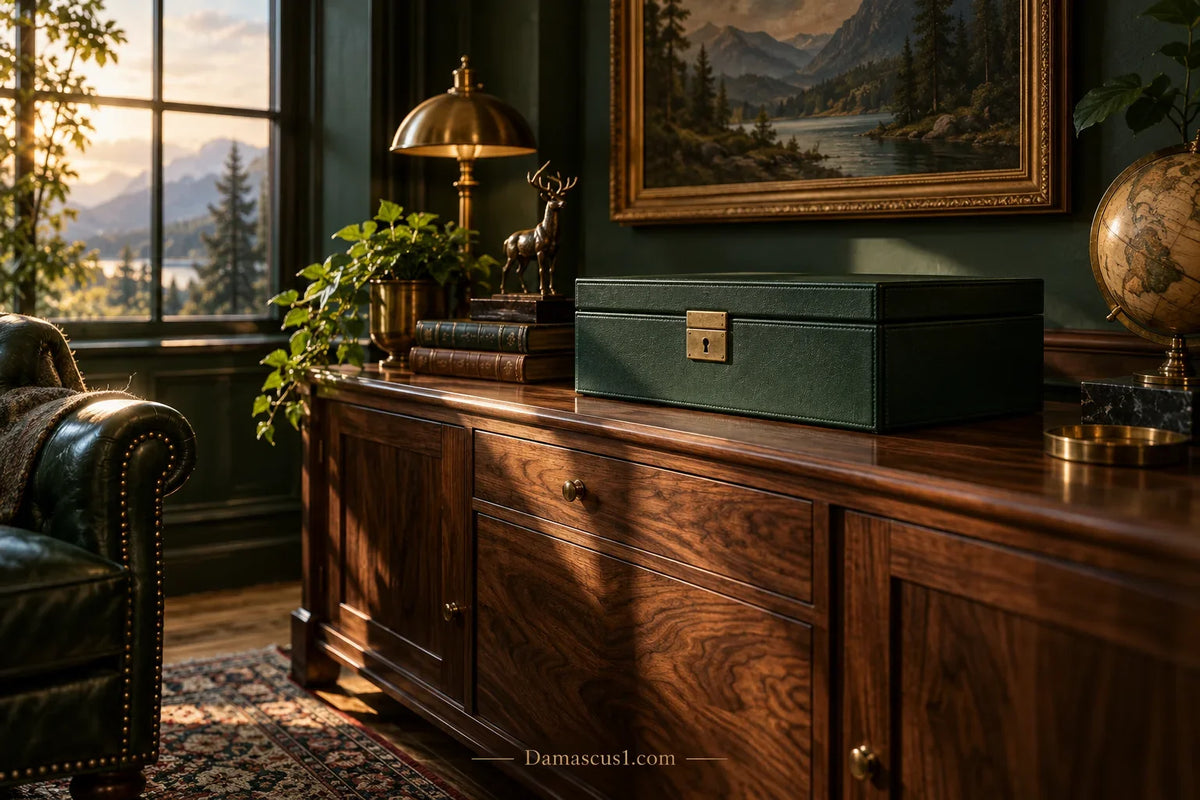
A good pocket knife storage system gives every knife a protected place, makes missing items obvious, and keeps care instructions with the correct model. Begin with a secure indoor location, store a folding knife closed according to its instructions, and choose an organizer only after checking its usable internal dimensions. A beautiful box is useful only if it fits your knife and your household.
This guide is a practical planning workbook for everyday folders, occasional-use knives and gifts waiting to be given. It does not certify a storage product, prescribe a universal humidity setting or replace the instructions supplied with your knife. All six illustrations are AI-generated editorial concepts. The pictured cabinets, cases, tray, packaging and sheath are not advertised Damascus1 merchandise or promised set contents.
Start with the knife and the household, not the box
Write down three things before shopping for an organizer: who needs authorized access, how often the knife comes out, and where it will live between uses. These questions change the decision more than the appearance of the cabinet. Someone who uses one folder every weekend needs a different arrangement from a collector who rotates ten pieces, or a gift buyer keeping several individually engraved sets for an event.
Make access control your first requirement. A drawer that closes is not necessarily a drawer that locks. A shelf above eye level is not a substitute for controlled access. In a household with children, visitors or anyone unfamiliar with the equipment, choose a location and enclosure that prevent unauthorized handling. Keep keys or access codes under the control of the responsible adult. Reconsider the arrangement when the household changes.
Next, decide whether you need everyday access, longer-term organization or presentation. One system can serve more than one purpose, but write down the trade-off. An attractive display may need more space; a compact case may require you to lift out a tray; a deep cabinet may hide small accessories unless they have labeled compartments. Choose the arrangement you can use consistently, rather than one that looks impressive but makes putting the knife away inconvenient.
For a first purchase, reserve the storage space before placing the order. Use the pocket knife measurement guide to understand the difference between overall length, blade length and closed length. If the listing does not state the dimension your storage plan needs, request it. A size in a product name should not automatically become the internal length of the case you buy.
Compare organizers by the job they must do
Use this table as a shortlist, then check the instructions and construction of the actual organizer. None of these categories is automatically secure, dry or compatible with every knife. The table describes what to evaluate, not a promise that an untested case will protect your property.
| Option | Useful starting point | Questions before choosing |
|---|---|---|
| Divided tray inside a secured drawer | A small collection you inspect regularly | Does each closed knife fit without crowding? Can the drawer be secured? |
| Individual fitted case | Keeping one knife and its records together | What are the internal dimensions? Does the lining suit the handle and finish? |
| Lockable cabinet | Several items with separate assigned spaces | Can authorized users reach each item without moving others? How is the cabinet installed? |
| Glass-front display enclosure | Viewing a collection without handling it | Does it restrict access? Can every item remain closed and individually supported? |
| Original presentation box | Keeping a gift identified before handover | Is it only packaging? Where will it be secured? What does the maker recommend for storage? |
Do not let a product label answer questions it does not address. “Presentation case” describes a purpose, not a security rating. “Travel case” does not establish compliance with transport rules. “Fits most knives” does not confirm fit for your model. Ask for the detail that matters to your situation and retain the answer with your purchase record.
If you already own a suitable secured cabinet, start by improving its organization. A dedicated position, a written inventory and separate accessory storage may solve the problem without buying a larger display. Before adding dividers or lining, check that the material is appropriate for the knife finishes and does not interfere with the enclosure closing or locking as designed.
 Damascus1.com™
Check usable internal dimensions before you buy
Exterior measurements tell you whether an organizer fits on a shelf. Interior measurements tell you whether it fits the knife. Record both. Hinges, latches, removable trays and lining can all affect the usable space. Ask the organizer seller which measurements describe the clear compartment, rather than assuming the advertised length is the space available inside.
Measure a folding knife in its closed position without placing fingers near the edge or operating the mechanism unnecessarily. Note its longest closed dimension, widest point and overall thickness, including any protruding clip or hardware. Do not force a knife into a compartment to test a guess. If you cannot measure safely or do not yet own the model, ask the knife seller for the measurements you need.
A paper outline can help you plan the arrangement without repeatedly handling the knife. Mark the model name on the outline and use it to compare compartment layouts. Treat this as a planning aid: paper does not establish padding suitability, retention, clearance above the handle or how a case behaves when closed. Confirm those details with the actual item and the enclosure instructions.
Leave each item an identifiable place rather than stacking several together. Your layout should let an authorized user see what is present, choose the intended knife and return it without rearranging the rest. If a case is difficult to close, stop and resolve the fit problem instead of applying more pressure. A latch being able to shut does not prove that the contents are supported correctly.
Use a simple fit enquiry
Send the exact model link, the closed measurements available to you, and the intended storage option. For example: “I am considering this folder and an individual case. Please confirm its closed length, maximum width and thickness, including protruding hardware. Is there any finish or handle-care guidance I should give the case supplier?” This is more useful than asking whether a case fits a “6.5-inch knife” without explaining which dimension that number describes.
Choose the location and inspect the conditions
The American Knife and Tool Institute recommends cool, dry storage and notes that even stainless steel can be affected by moisture and chemicals. Its care guidance also discusses suitable light oil and checking a knife periodically. Follow your model's instructions for cleaning and protective products; do not transfer a treatment intended for one material onto every blade, handle or decorative finish. See the AKTI care guidance for the general background.
For your own plan, compare the actual locations available in your home. Is the proposed shelf near a sink, a frequently opened exterior door or equipment that leaks? Can you access the cabinet for inspection? Would an item be forgotten behind seasonal boxes? These are practical questions you can answer by looking at the location rather than relying on a room name such as “study” or “garage.”
If you use a humidity monitor, treat it as an observation tool. Record the reading, location and date, and follow the storage and knife manufacturers' guidance when deciding what action is appropriate. This guide does not set a universal relative-humidity target for mixed materials. A number on a gauge is not a guarantee that the knife, lining or sheath is in suitable condition.
Similarly, a desiccant packet is not a substitute for inspection or for drying an item correctly before storage. Use only products intended for the enclosure and follow their directions for placement, replacement and handling. Keep loose packets away from children and pets. Do not add unfamiliar chemicals, scented inserts or improvised treatments just because they are sold for another household storage problem.
 Damascus1.com™
Separate a carry sheath from your storage plan
A sheath can be useful for the carry method and model for which it is designed, but that does not make it the right long-term storage environment. The current Damascus1 pocket-knife descriptions warn against extended storage in leather because of moisture concerns. Knives of Alaska likewise advises removing its knives from their sheaths for long-term storage. Check the instructions for your own knife and sheath instead of applying a blanket rule to every combination.
For a folder, plan a secure place for the closed knife and another identified place for its sheath when stored separately. Label the compartment or record the pairing in your inventory. This avoids an everyday frustration: owning several similar pouches and not knowing which one belongs with which knife. A matching color or approximate length is not evidence of compatible fit.
If a sheath needs replacement, use the custom leather sheath enquiry guide. Ask about the exact knife, dimensions, retention and intended carry arrangement. Do not order a generic “Damascus knife sheath” on the assumption that all folders have the same shape. A custom enquiry should lead to confirmation of suitability and a quote, not an unverified compatibility claim.
Keep care products and their instructions with the accessory they are intended for. A leather treatment is not automatically suitable for a wooden handle or a blade finish. When the material or finish is uncertain, ask before applying anything. If a knife does not close normally or has a damaged mechanism, secure it against handling and contact the seller or a qualified repair professional rather than forcing it into a storage case.
 Damascus1.com™
Give every knife a place and a useful record
For a collection, a clear record can be more valuable than an elaborate arrangement. Start with a short table containing the product name, model link, date acquired, storage position and location of the instructions. Add a photograph of the actual item if useful. Keep photographs of personal engravings private unless you intend to share them.
Separate what you know from what you still need to confirm. “Seller describes the handle as olive wood” is different from having a documented species and finish. “Listed as 6.5 inches” is different from a confirmed closed-length measurement. Record the original wording and the source, then add a specific answer when the seller provides it. This prevents a tentative assumption becoming a permanent specification in your collection notes.
| Record field | What to enter |
|---|---|
| Identity | Exact model and variant, product URL, your own item photograph |
| Fit | Confirmed closed dimensions and the compartment assigned to it |
| Care | Instructions supplied, approved treatment information, unresolved questions |
| Accessories | Documented included items and separately purchased compatible items |
| Inspection | Date checked, observations, follow-up needed |
| Purchase records | Where the receipt and correspondence are saved |
Choose a naming system that will still make sense later. “Blue knife” may work until you own two blue-handled folders. A short model label and numbered storage position are clearer. Put labels on the organizer or in your records, not directly on a finish unless the manufacturer approves the method. Keep the record accessible to the responsible owner without exposing access codes or security details.
When a knife moves to a different compartment, update the record at the same time. For gifts or shared household use, note who is responsible for the item after handover. You do not need a complicated app: a private document or printed sheet may be enough. The useful feature is accuracy, not the number of fields or the appearance of the software.
 Damascus1.com™
Prepare a gift without guessing what is included
A gift can wait in a cupboard for weeks between purchase and presentation. Treat that time as storage, rather than assuming the outer box settles every question. Keep it in a secure location, retain the order details, and make sure the intended recipient will receive the relevant instructions. Presentation should make ownership easier after the ribbon is removed.
Build a contents checklist from the actual order, not the styling in an illustration. List the knife, any documented included accessories and anything you purchased separately. Keep this checklist with the gift paperwork. If the product description, photographs and order information disagree, contact the seller before discarding packaging or promising the recipient a particular accessory.
For a personalized gift, keep the approved spelling and design proof with your private order records. Put the recipient's name on an external removable gift tag rather than opening every package repeatedly to identify it. If you are preparing several gifts, use a simple recipient-to-order table. Check each entry against the corresponding order before wrapping; do not rely on box color alone.
A short care card can point the recipient to the exact listing, supplied instructions and this storage guide. Avoid printing unconfirmed alloy names, hardness ratings, warranties or delivery promises. A useful message is straightforward: “Your model and care information are saved with these order details. Please check the supplied instructions before use, and choose a secure place for it at home.”
If you are still choosing a gift, compare the actual Olive Wood pocket-knife listing, Buffalo Horn pocket-knife listing and Blue Bolster Wood pocket-knife listing. These are separate products; do not assume they share steel, accessories or dimensions. Read current availability and terms on the selected listing and at checkout.
 Damascus1.com™
Create a routine you will actually follow
Use a short return-to-storage checklist: identify the item, follow its care instructions, check that its intended storage position is ready, put it away safely, and secure the enclosure. If something needs attention, record the issue before it is forgotten. Keep an item requiring repair separate from items ready for use, in a way that still prevents unauthorized handling.
Choose an inspection reminder that reflects use and the manufacturer's guidance. A heavily used folder and a gift awaiting presentation may need different attention. The purpose of the reminder is to prompt an actual check, not to certify that a knife is safe because a date was ticked off. Notice changes and act on them; do not keep repeating a schedule while ignoring a concern.
When you inspect, compare the item with its previous record. Has the assigned case changed? Are the instructions still with the correct model? Has an accessory been swapped? Is the enclosure secure? These simple organizational checks are separate from technical maintenance. If you see corrosion, damage, unexpected resistance or another condition you cannot assess, stop using the knife and seek model-specific advice.
Review the whole arrangement after moving house, changing furniture or welcoming new household members. A good system should survive everyday changes. The easiest improvement may be relocating the existing enclosure, simplifying the labels or reducing how many items share one compartment. Buy additional storage only when you can explain which unresolved problem it will solve.
Keep a record that helps you replace the right accessory
A storage system becomes more useful when its labels lead to reliable information. Months after a purchase, two folding knives can look similar while needing different compartments or carrying accessories. A short inventory card helps you identify the exact item before buying a replacement pouch, requesting a sheath quote or explaining a problem to the seller. The purpose is practical: record what you actually own, rather than turning a product title into an assumed specification.
Build one inventory card for each knife
Begin with the product URL, the selected variant, the order date and the order reference. Copy the material description exactly as it appeared on the confirmed order, and keep any clarification from the seller alongside it. If steel composition or a handle treatment has not been confirmed, mark that field as unknown. A blank field is more useful than a confident guess when a later accessory enquiry depends on the answer.
Record closed length, maximum closed width and maximum closed thickness separately, using the measurement method requested by the accessory maker. State the units on every number. Note any clip, raised bolster, lanyard attachment or other protrusion that changes the outline. Do not subtract these features to make a knife appear to fit a compartment. If a seller asks for photographs instead of your own measurements, follow that process and retain the response.
Add the storage location and the accessory assigned to that knife. A simple entry such as “drawer two, left compartment, pouch A” is enough. The same card can list which items arrived in the original set and which were bought separately. This avoids treating an old promotional photograph, a current illustration or a different variant’s listing as evidence that a particular accessory belongs to your order.
Photograph identity and condition separately
Keep one clear identification photograph and, when useful, separate close photographs of the handle, closed outline and included accessory. Use ordinary, even lighting. A dramatic picture may be attractive but hide a clip, edge of a bolster or point of contact that matters for fit. Place reference material beside the item only when you can do so safely, and do not let it cover the feature you want the seller to assess.
Date condition photographs and describe the observation in plain language: a mark on the handle, a damp lining, a change in the way a pouch closes. Avoid diagnosing an alloy, heat treatment or manufacturing defect from appearance alone. Keeping the original image and your brief note together makes a future support conversation clearer. It also helps you distinguish a newly noticed condition from something that was visible when the item arrived.
Recheck the arrangement when your needs change
A drawer that worked for one knife may become cramped after you add a second set. A display that was safely out of reach may need a new position when household access changes. Revisit the arrangement after adding a knife, changing an accessory, moving the storage furniture or noticing moisture. There is no need to invent a universal inspection interval; choose a routine that reflects the maker’s instructions and the conditions you actually observe.
Check access, separation and usable space
Look at the arrangement with the drawer or case both open and closed. Confirm that items stay separated and do not press against one another or interfere with the lid. Check usable internal space rather than the advertised outer dimensions of the organizer. A lining, hinge or divider can reduce the space available. When fit is uncertain, ask the organizer or sheath maker which measurements and clearances their design requires.
Make the storage location understandable to the adults who need access, while keeping access controlled around children and visitors. A beautiful tray is an organizer, not necessarily a lockable safety enclosure. Store the knife in the condition directed by its maker, and do not leave an exposed blade as a decorative shortcut. If an item or accessory is damp, resolve that condition according to its care instructions before returning it to storage.
Give a gift recipient a useful handover
Gift wrapping is easier to undo when the important information is not lost with it. Put the product link, confirmed contents and relevant care instructions in a separate note for the recipient. Explain which accessory was included with the knife and which item, if any, was added separately. Keep the order reference privately available for support rather than placing payment or personal account information on a gift card.
If personalization was requested, keep the approved wording and the seller’s confirmation. If a sheath was commissioned, retain the agreed measurements and design notes. These records do not establish that another similarly named knife will fit the same sheath. They give the recipient a clear starting point for future questions. A considerate handover combines attractive presentation with facts the next owner can actually use.
What should I send when asking about replacement storage?
Send the exact product and variant link, the requested measurements with units, clear photographs of relevant protrusions, and the organizer or accessory you are considering. Ask for compatibility confirmation before ordering. A product name or an attractive photograph alone is not a complete fit brief.
Should I keep the gift box as the permanent storage case?
Evaluate its condition, usable space and ability to keep items separated, then follow the knife maker’s storage instructions. A presentation box is not automatically a moisture-control system or a secure enclosure. Keep it for presentation if you enjoy it, but choose permanent storage for the conditions and access requirements in your home.
Pocket knife storage questions
Should I store a folding knife open or closed?
Follow the model's instructions and use closed, secured storage as the normal plan for a folder that closes correctly. Do not leave an exposed blade out for decorative effect. If it cannot close normally, stop handling it unnecessarily and ask for help.
Does a gift box count as secure storage?
Not by itself. A presentation box may organize the gift but does not necessarily restrict access. Keep it inside an appropriate secured location and check whether the packaging is recommended for the storage period you have in mind.
Can two similar knives share the same fitted case?
Confirm each model separately. Similar product photographs or overall lengths do not establish the same closed shape, thickness or protruding hardware. Keep any verified compatibility note with the relevant case.
Is a locked display cabinet automatically suitable?
No. Also consider installation, internal fit, access to individual items and the environment where it stands. Follow the cabinet instructions, and do not assume a decorative lock provides a particular level of security.
What should I do if the listing lacks closed dimensions?
Send the exact product URL and ask for closed length, maximum width and thickness. Explain the case or sheath you are considering. Wait for a clear answer when fit is essential to the purchase.
Where can I find answers about care and sheath fit?
Use the Damascus1 question library, the folding knife care guide and the sheath measurement guide. For a specific product, keep the question tied to its exact link and variant.
Choose the knife and its storage together
Browse the Everyday EDC Pocket Knives collection with your storage checklist beside you. Compare confirmed dimensions, the instructions available and the accessories actually included. Leave room in your decision for the enclosure and care routine the knife requires. A thoughtful purchase is one you can identify, maintain and put away responsibly after the first day.
Prepared October 2, 2026 by the Damascus1 editorial team. General background: American Knife and Tool Institute care guidance and Knives of Alaska product-care guidance. Their model-specific treatments are not instructions for Damascus1 products. The planning worksheets and examples above are original editorial suggestions.
Choose with the current product details
Ready to compare? See current product details and compare another linked model. Check the selected variant, included items and documented measurements before ordering. If fit or a specification is unclear, ask Damascus1 about the exact model. Review shipping and return information before planning a gift deadline.
laissez un commentaire: