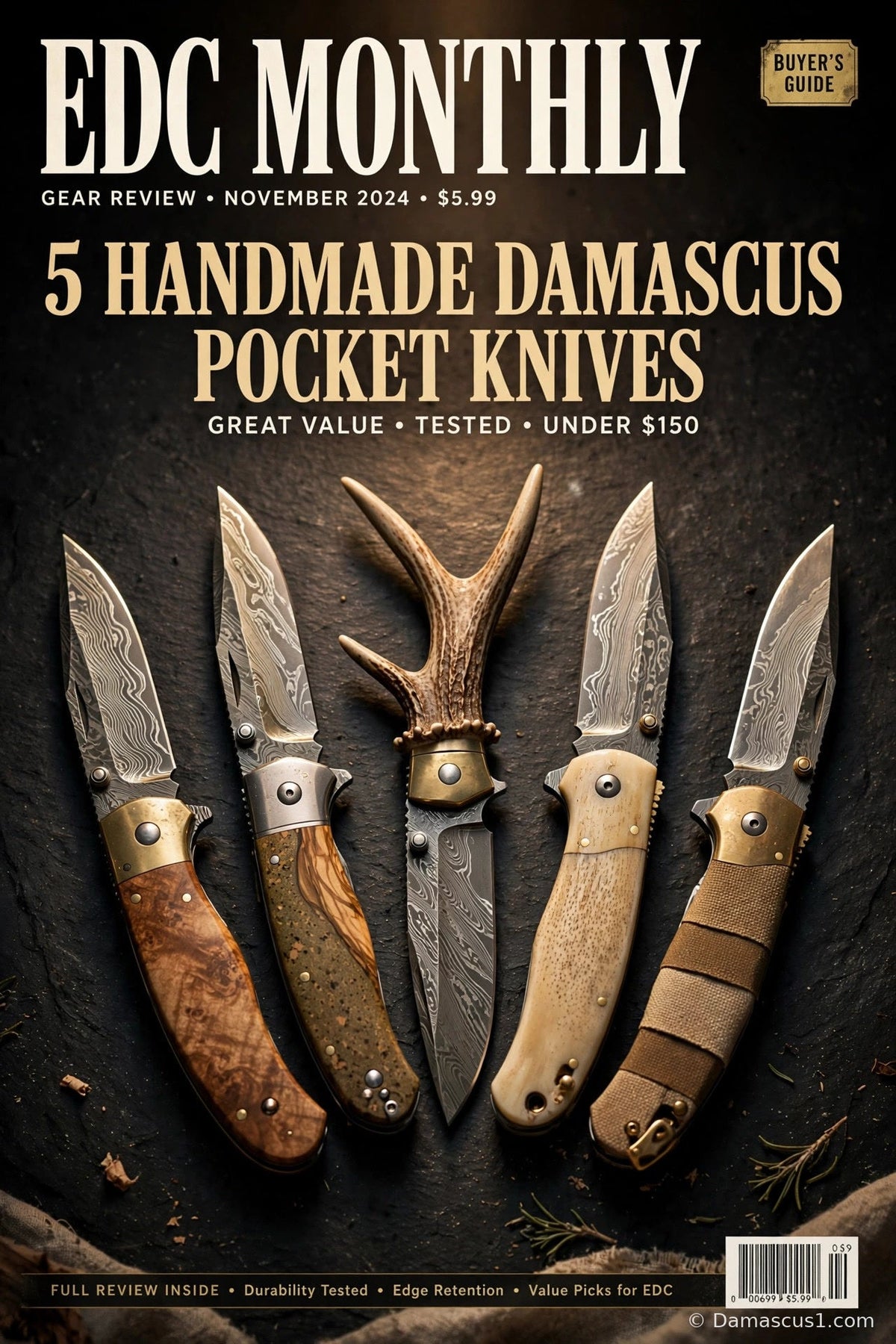
Direct answer: Yes, a real Damascus pocket knife under $100 exists — at Damascus1 today, handmade 6.5-inch Damascus folders start at $39.99, with horn and antler models at $44.99–$49.99 and larger scrimshaw folders at $59.00, all verified on the live product pages. The catch isn't the price; it's the shopping. At this end of the market you must confirm the knife is actually Damascus (the same shelves hold stainless lookalikes), read the stated contents, and budget for basic care. Do that, and under $100 buys you a knife you'll carry for years.
Let's address the suspicion head-on, because it's reasonable. Damascus steel has an aura — ancient swords, flowing patterns, prices with three zeros — and the internet is full of "Damascus" knives at suspicious prices that turn out to be patterned paint on ordinary steel. So a guide that just waves at cheap knives and says "trust us" deserves your skepticism. This one works differently: every recommendation below is a named product on this store with a price checked today, and the article spends as much time on how not to be fooled as on what to buy. If you want the deeper category view first, best Damascus pocket knife surveys the field; this page is the budget chapter of that story.
Is a Damascus pocket knife under $100 actually real Damascus?
It can be — price alone doesn't settle it either way. Real pattern-welded steel shows flowing, irregular figure that behaves like wood grain: continuous, varied, never repeating in a tidy printed rhythm. Imitation patterns repeat, sit flat on the surface, and often stop abruptly at edges. At Damascus1's prices, the folders in this guide are sold and described as Damascus on their own product pages — check the exact listing's title and description, which is where the claim lives.
The fuller visual checklist lives in how to spot a fake Damascus knife, and it's worth your ten minutes before any purchase in this price band, from any seller. The short version for shopping: be more suspicious of a listing that shouts specifications than of one that shows you the knife. Layer counts and hardness numbers are the easiest claims in the world to type and the hardest for a buyer to verify, which is why this guide assigns none to individual models. Judge what's checkable — the product, the materials as listed, the contents, the price, the seller's clarity — and let the pattern speak in photographs.
Why can handmade folders cost this little at all? Because a 6.5-inch traditional folder is a modest object: a small blade, two handle scales, a back lock, no exotic machining, no marketing department. The money goes into the steel work and the natural handle, which is exactly where a buyer wants it. Expensive Damascus knives exist and some are magnificent; they are not five times more knife. They're often two times more knife and three times more everything else.
What should you expect — and not expect — under $100?

Expect a handmade traditional folder: pattern-welded blade, natural handle in wood, horn, or bone, honest everyday cutting for parcels, cord, food, and light outdoor jobs, and the small variations that come with natural materials and hand work. Do not expect a one-handed tactical opener, exotic hardware, or a specification sheet that reads like an aircraft manual. Those are different knives for different money.
Set the expectation about variation early, because it decides whether you'll be delighted or annoyed. Olive wood grain differs knife to knife; that's not inconsistency, it's the material being itself, and it's why owners describe their knife as "mine" in a way owners of identical molded handles rarely do. If you need two perfectly matching knives — for a paired gift, say — order understanding that natural materials will rhyme rather than repeat, or talk to the seller first.
Also expect to participate. A Damascus blade asks for the wipe-dry habit and can rust if it's neglected — a property of pattern-welded steel generally, explained plainly in can Damascus steel rust?. Buyers who want zero-maintenance should buy stainless deliberately and happily. Buyers here are trading a minute of care for a blade with genuine figure. Most find it a bargain. Some don't, and it's better to know which you are before checkout than after the first orange freckle.
The under-$100 shortlist, with today's verified prices
Every price below was checked on the product's live page on 2026-10-16. All are under $100 — most are under $60.
| Pick | Price today | Best for |
|---|---|---|
| Olive Wood Damascus Pocket Knife, 6.5" | $39.99 (was $89.99) | The default buy — classic, warm, the safest $40 in the store |
| Buffalo Horn Damascus Pocket Knife, 6.5" | $39.99 (was $99.99) | A darker, polished look at the same entry price |
| Camel Bone Damascus Pocket Knife, 6.5" | $39.99 (was $99.99) | The standout — pale bone against the patterned blade |
| Blue, Green, Red & Multi Wood folders, 6.5" | $39.99 each (was $99.99) | The personality picks — same knife class, your color |
| Ram Horn Damascus Pocket Knife, 6.5" | $44.99 (was $99.99) | Grip and texture for outdoor-leaning carry |
| Stag Horn Damascus Folding Pocket Knife | $49.99 (was $139.99) | The value hero — antler presence at half the old price |
| Scrimshaw folders, 7.6" (deer antler / blue wood) | $59.00 (was $119.99 / $99.99) | Bigger, decorative, kept-and-shown knives |
| Olive Wood Fixed Blade Hunting Knife, 9.5" | $79.99 (was $119.99) | The under-$100 ceiling — when the job outgrows a folder |
How to read this table like a buyer instead of a browser. The $39.99 tier is not a compromise tier — it's the same class of handmade folder in the standard materials, and for daily carry it's where the smart money starts. The step to $44.99–$49.99 buys handle material: horn's texture, antler's heritage and presence. The $59 scrimshaw tier buys size and decoration — a different job, display as much as carry. And the $79.99 fixed blade buys capability a folder can't offer at any price, which the camping guide treats honestly: best pocket knives for camping explains where folders shine and where the fixed blade takes over.
Shipping belongs in the budget math: orders above $50 ship free as shown on the site. A lone $39.99 folder falls short of that line; the stag horn at $49.99 falls a cent short, which is either funny or annoying depending on your day; the scrimshaw and fixed blade clear it alone. Plan the whole order at once.
The trap in this price range: the stainless lookalike

Here is the single most important paragraph in this guide. The everyday EDC pocket knives collection — the shelf these picks come from — also carries 420C stainless folders at the same $34.99–$39.99 prices, in the same handle materials, photographed the same way. They are legitimate knives for buyers who prefer stainless. They are not Damascus, and their titles say so if you read them: the word "stainless" is right there. Every month, buyers somewhere fall in love with a pattern in a photo, skim a title, and order the wrong steel.
The defense takes five seconds: before checkout, read the exact product's title and description for the word Damascus, and confirm the contents and price on that page. Do it even — especially — when you're buying from this guide's table, because tabs get mixed up and carts get edited. This warning isn't a criticism of the store; mixed shelves are how real stores work. It's the price of admission for shopping a bargain, and it's cheap.
A related trap, from the old version of this article's era: recommendation tables across the internet list "Damascus" knives with invented ratings and prices nobody verified this year, sometimes for products that don't exist as described. Any table you can't trace to a live product page — including, in principle, this one — should be clicked through and checked. Ours resolves to live pages with today's prices. Check them anyway. That's not false modesty; it's the habit this entire guide is trying to install.
What does the money actually buy, tier by tier?

At $39.99 you're buying the essential object: a pattern-welded blade with real figure, a natural handle, a working lock, a knife that opens parcels and slices apples and rides in a pocket unnoticed. Honestly assessed, this tier covers ninety percent of what any pocket knife is for. If your budget is firm and your needs are everyday, stop here without a flicker of regret — the first Damascus pocket knife checklist will walk you through choosing within the tier.
At $44.99–$49.99 you're buying material character. Ram horn's ridged grip is a functional pleasure in wet or cold hands; stag antler is the handle of the classic hunting tradition and carries a visual weight the woods don't. Neither cuts better. Both feel like more — and "feels like more" is a legitimate thing to buy in an object you'll touch daily for years, as long as you know that's the transaction.
At $59.00 you're buying presence: the 7.6-inch scrimshaw folders, etched and decorative, made to be shown as much as used. At $79.99 you're buying the fixed blade's separate capability. Notice the pattern — in this store's range, money past $40 buys character, size, and specialization, not basic worth. That's the signature of an honest budget range, and it's why "under $100" here isn't a consolation category. It's the main event.
How do you keep a budget Damascus knife looking expensive?
The same way you keep any Damascus knife right: wipe it dry after use, never store it wet, don't let it soak in a sink, and give it a light oil if it's going away for a while. Sharpen on a whetstone when the edge dulls — the store's whetstone guide teaches the technique — rather than attacking it with a gadget. Kept this way, a $39.99 folder ages gracefully; natural handles warm and deepen, and the blade's figure stays the best-looking thing in your pocket.
Store it dry and separate — a sheath, a pouch, a drawer slot of its own — rather than loose among keys and coins that will scar the handle. None of this is fussiness; it's thirty seconds a week, and it's the entire difference between a budget knife that looks budget in a year and one that looks heirloom. The knife doesn't know what it cost. Its condition in five years will reflect your habits, not its price tag.
Is an under-$100 Damascus knife a good gift?

It's one of the best-value gifts in the whole store, because handmade natural materials make every piece individual at a price that doesn't turn the gift into a financial statement. The $39.99 folders are the birthday-and-thank-you tier; stag antler at $49.99 and the scrimshaw pieces at $59.00 cover the bigger occasions; and adding a name by engraving — arranged by quote, with a proof to approve — lifts any of them into one-of-one territory. The gift set guide covers contents-checking and presentation for givers, and it's the natural next read if this knife is headed for someone else's pocket.
Damascus or stainless at the same $39.99 — which should you take?
Since the shelf offers both at the same money, the comparison deserves its own honest section. Take the Damascus if the pattern is part of the pleasure — it usually is, in this guide — and if you're willing to keep the wipe-dry habit. Take the 420C stainless if you want the lowest-maintenance knife possible, the one that can be rinsed and forgotten, ride in a damp fishing kit, and never be thought about twice. Neither answer is a compromise; they're different ownership styles wearing the same handle materials.
What you shouldn't do is split the difference out of confusion — ordering whichever listing loaded first and discovering the steel later. The stainless models announce themselves in their titles; the Damascus ones announce themselves in theirs. The five-second title check is the entire decision technology. Buyers who make it deliberately are happy with both steels, in roughly equal numbers, forever. Buyers who make it accidentally write the one-star reviews that begin "not what I expected," and they are right, and it was avoidable.
There's one more wrinkle worth knowing: a mixed collection lets you own both, eventually, for under $80 total — a Damascus folder for daily carry and a stainless one for the wet, rough jobs you'd rather not ask a patterned blade to do. That's not upselling; it's how a lot of working collections actually form, one deliberate, verified purchase at a time.
How these prices were verified — and how you should re-verify them
Method, stated plainly so you can repeat it: every price in this article came from the product's own page data on damascus1.com on 2026-10-16, cross-checked against its collection listing the same day, and the "was" figures are the compare-at prices shown alongside. No price came from the old version of this article, from memory, or from a search snippet — the three sources that make most budget-knife tables quietly fictional within a month of publication.
Prices change. Sales end; compare-at figures move; a model sells through and returns at a different number. So the table's real gift to you isn't the numbers — it's the shortlist and the checking habit. Before you pay, open the product page, read the price printed there today, and let that number, not this article, close the sale. If a price has moved a few dollars either way since this guide was written, nothing else in it changes: the tiers, the traps, and the care advice all survive. If a price has moved enormously, that's information too — pause and ask why.
The same skepticism, applied outward, is the best shopping advice this guide can give. The internet's under-$100 Damascus content is thick with stale tables, invented ratings, and "reviews" of knives the writer never held. You now own the antidote: live page, stated contents, title check, price check. Four habits, thirty seconds, immune to hype — including, if it ever comes to that, ours.
What under $100 honestly can't buy
Fairness to the expensive end, briefly. Under $100 at this store does not buy a large chef's-class Damascus kitchen set, a famous maker's signed work, or a folder with exotic modern hardware — one-hand deployment systems, designer pivots, titanium everything. If those are your requirements, this is the wrong shelf and no guide should pretend otherwise. It also doesn't buy exemption from care: no Damascus at any price is a dishwasher-and-forget tool, and paying $400 wouldn't change the steel's chemistry.
What it buys — and the expensive end cannot buy it better, only differently — is a real patterned blade in a natural handle, made by hand, that you will carry without anxiety. There's a freedom in a $39.99 knife that a $400 knife never has: it goes everywhere, gets used on everything, and earns its patina in the open. Owners of safe-queen knives admire them. Owners of these use them. For a first Damascus, and arguably for a favorite one, use beats admiration every day of the week.
A three-minute buying drill for the under-$100 shelf
If you've read this far, you deserve the compressed version — the drill experienced buyers run in about three minutes. Minute one: open the EDC collection and pick by handle and size alone — 6.5-inch folder, the material your hand is already imagining. Minute two: open that product page and run the checks — the title says Damascus, the contents as stated match your expectation, the price today matches your budget tier. Minute three: decide the tier question honestly — is this an everyday carrier (stay at $39.99–$49.99), a kept showpiece (the $59 scrimshaw), or a worker that needs to be a fixed blade ($79.99)? — then order, screenshot the listing for your records, and get on with your day.
What the drill deliberately omits: comparison-shopping the same knife across a dozen marketplaces, hunting coupon codes of dubious parentage, and reading forty reviews of three other knives. Those activities feel like diligence and function as delay; meanwhile the verified facts were all on one page. The under-$100 shelf rewards decisiveness because its facts are few and checkable. Buyers who internalize that stop overpaying in the only currency that matters here — their own evenings.
And when the knife arrives, run the arrival routine from the beginner checklist: verify it against the listing you saved, handle it gently, give it a home, use it for something small. Then carry it. The most common fate of a budget Damascus knife isn't failure — it's the drawer, bought in a burst of enthusiasm and never integrated into a day. A knife in a pocket is worth ten in a drawer, at any price, and at $39.99 there's no excuse for the drawer at all.
A note on the word "ultimate"
The original version of this article promised the ultimate knife, the one you need to own, and then recommended other companies' products with ratings nobody verified. This rebuild keeps the address — the URL isn't changing — and respectfully declines the promise. There is no ultimate pocket knife under $100, because "ultimate" depends on the hand, the pocket, and the job, and anyone who tells you otherwise is selling certainty, not knives. What exists is a shortlist of honest options at verified prices, one of which will be right for you in a way the others aren't. Finding yours takes the three-minute drill above and a moment of self-knowledge. That trade — a smaller promise, actually kept — is the best deal in this entire guide, and it costs nothing at all.
The verdict after all the caveats
Strip away the warnings — necessary as they are — and the conclusion is simple and a little surprising: the under-$100 shelf is not where Damascus goes to be cheapened; it's where it goes to be used. A $39.99 handmade folder with genuine figure, carried daily and cared for in seconds, delivers more of what people actually want from Damascus — the beauty in the hand, every day — than a costly piece in a drawer delivers in a year. Buy it verified, buy it deliberately, and then go use it on a parcel, an apple, and a length of cord, in that order. That's the whole review, and it didn't need a single invented rating.
Frequently asked questions

What is the best Damascus pocket knife under $100?
For most buyers, the olive wood 6.5-inch folder at $39.99 — the classic pattern-and-wood combination at the range's entry price. If you want maximum presence per dollar, the stag horn folder at $49.99 (was $139.99) is the value hero. Both were verified on their live product pages on 2026-10-16.
Are cheap Damascus knives real Damascus?
Some are, some are printed imitations — price doesn't decide it. Check for flowing, non-repeating figure that behaves like wood grain, read the exact listing's description, and use the fake-spotting guide's visual checks. At this store, confirm the title says Damascus: the same collection carries stainless models that are honest knives but not this knife.
Why are these handmade knives under $100 when other Damascus knives cost far more?
Because a small traditional folder is a modest object — a short blade, natural handle scales, a back lock — and the price reflects the work and materials rather than branding and exotic machining. Costlier Damascus buys size, rarity, and maker name as much as function. Under $100 here buys the function and the figure both.
Does a budget Damascus knife need special care?
Only the standard Damascus habits: keep it clean and dry, never store it wet, oil it lightly for longer storage, and sharpen on a whetstone when it dulls. Pattern-welded steel can rust if neglected — that's material honesty, not a budget defect, and the care takes seconds.
Folder or fixed blade under $100?
The folder for daily carry — it's the one you'll have with you. The 9.5-inch olive wood fixed blade at $79.99, from the tracker and hunting collection, is the pick when the work is camp and field: fire prep, camp cooking, sustained cutting. Different tools; the budget happily covers either.
What should I check at checkout to avoid ordering the wrong knife?
Three things, five seconds: the title says Damascus (not stainless), the contents listed match what you expect in the box, and the price matches the table you shopped from. Prices change; the first two checks never stop mattering.
Under $100 is not the compromise. It's the point.
A handmade Damascus folder at $39.99, horn and antler at $44.99–$49.99, scrimshaw presence at $59.00, a real fixed blade at $79.99 — this store's under-$100 range is where the value lives, provided you shop it with your eyes open: confirm the steel in the title, read the contents, budget the care. Start in the EDC pocket knife collection, pick the one your hand is already reaching for, run the five-second title check, and carry it daily. Keep it dry, sharpen it kindly, and let the handle take on the shine of your own grip. In five years it won't look like a budget knife, and it won't look like anyone else's knife either. It'll look like yours — which, in the end, is the only specification that was ever worth paying for.
laissez un commentaire: