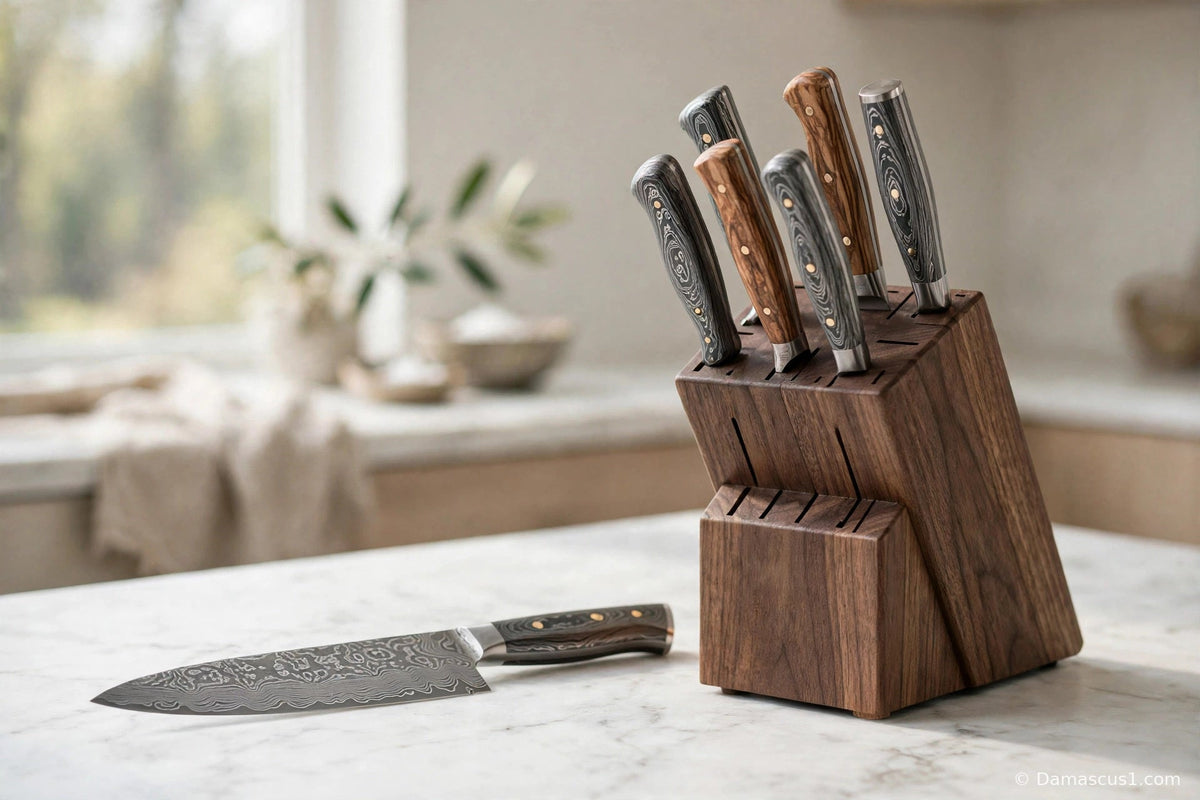
The best knife set for most kitchens is a small one built around three knives — an 8-inch chef's knife, a paring knife and a serrated bread knife — in decent steel, with storage that protects the edges. Everything beyond that trio is a bonus bought for a specific job: a santoku or nakiri for vegetable-heavy cooking, a boning knife for people who break down meat, steak knives for people who serve steak. A set earns its price when every piece in it passes that test, and loses money exactly where pieces are padding.
That sounds like an argument against sets, and it is not. It is an argument for reading a set the way a cook uses it rather than the way a box counts it. The tested roundups that dominate page 1 for this search keep arriving at the same shape from different directions: the winners are the sets whose core blades are genuinely good, whether the box holds four pieces or fifteen. This guide turns that consensus into a method — the trio test, the piece-count accounting, the set-versus-singles math, the steel and storage checks — and then applies the method to the sets sold by the store behind this page, at prices verified on the day of writing. The full ranked picture of the kitchen cluster lives in the best kitchen knives guide; the Damascus1 sets themselves are picked apart in the best knife set for every kitchen. This page does the remaining job: teaching the decision.
What is the best knife set for most kitchens?
The best set for most kitchens is the one whose chef's knife, paring knife and serrated knife are all good enough to keep for a decade, because those three do nearly all the work. Judge any set chef's-knife-first: it handles the bulk of daily prep, so a set with a mediocre chef's knife and fourteen companions is a worse purchase than a tight three-piece set with an excellent one.
The supporting cast matters in a specific order. A utility knife earns its slot next, covering the in-between jobs — sandwiches, cheese, trimming — that feel small for the chef's knife and big for the paring knife. After that, the honest additions are the specialists a household's actual cooking calls for, and no two households call for the same ones. Vegetable-heavy kitchens gain more from a santoku or nakiri than from a second utility knife. Households that roast whole birds and break down primals gain from a boning knife. Households that serve steak weekly gain from real steak knives; households that serve it twice a year are buying table decoration.
Price bands follow the same logic. At the bottom of the market, sets compete on count because they cannot compete on steel. In the middle, roughly the $150–$350 range where most serious home sets sit, the money can buy real blades — which is exactly why the accounting in the next sections matters: at the same headline price, one set spends the budget on its core knives and another spends it on a heavy block and eight matching steak knives. Damascus1's own flagship, the Premium Kitchen Knife Block Set at $169.99, sits in that middle band, and it is judged by the same trio test as everything else in this guide when its turn comes below.
How many knives do you actually need?

Three knives cover the overwhelming majority of home cooking: an 8-inch chef's knife for chopping, slicing and mincing; a paring knife around 3.5 inches for peeling, trimming and detail work; and a serrated bread knife for crusty loaves, tomatoes and anything with a skin tougher than its flesh. A fourth — a utility knife — helps, and a fifth should be a specialist chosen for a named job, not a slot filled because the block had room.
The trio is not a minimalist slogan; it is a description of how cooking actually distributes across blades. Dinner prep on an ordinary night is onions, garlic, herbs, a protein, a vegetable or two, bread on the side. The chef's knife does the onions, the protein and most of the vegetables. The paring knife does the garlic, the trimming and the garnish. The serrated knife does the bread and the tomatoes. A boning knife, a cleaver, a fillet knife and a second santoku can all sit in the block through that entire meal without being missed — which is why buying them before the trio is sharp, comfortable and well stored is spending in the wrong order.
Skill and habit refine the count in both directions. A beginner is better served by the trio plus time: fewer blades to learn, fewer edges to maintain, and a clearer sense, after a few months, of which specialist the cooking actually asks for. A confident cook who makes stocks from whole chickens, fillets fish on Fridays and bakes sourdough on Sundays can justify seven or eight working knives without a single piece of padding. The count is not the virtue. The match between the count and the cooking is.
What does a set's piece count actually count?

A piece count counts everything in the box: the prep knives, the steak knives, the shears, the honing steel and usually the block itself. A "15-piece set" typically holds five or six kitchen prep knives — the rest is table knives and hardware. That is not fraud, but it means two sets with the same count can contain very different amounts of actual cooking equipment, and the prep knives are the part worth paying for.
| What the box counts | What it usually is | How to value it |
|---|---|---|
| Chef's knife, paring, bread/serrated | The core trio | The heart of the set — judge the set here first |
| Utility, santoku, nakiri, boning, slicing | The specialists | Worth money only for jobs the household actually does |
| 4–8 steak knives | Table cutlery | Real value for steak households; padding otherwise |
| Kitchen shears | A tool, not a knife | Useful, cheap to buy separately, inflates the count by one |
| Honing steel | Maintenance hardware | Useful on softer steels; does not sharpen, only realigns |
| The block or strip | Storage furniture | Worth money as edge protection; count it as furniture, not cutlery |
The budget math underneath the table is the part listings never print. A set's price is spread across everything in the box plus the packaging and the block. When a large share of that spread goes to steak knives and a heavy block, a smaller share remains for the steel, heat treatment and handles of the three knives that decide whether the set is any good. This is why the deep mechanics of counting get their own guide on this blog — how many pieces a kitchen knife set should have — and why the short version belongs in every buyer's head: count prep knives first, steak knives second, and everything else as accessories.
A worked example keeps the idea honest. Two sets at the same price: one is a 7-piece box holding five prep knives, a steel and a block; the other is a 17-piece box holding the same five prep knives, eight steak knives, shears, a steel and a bigger block. The second box is not ten pieces better. It is the same cooking equipment plus tableware and furniture. A household that needs steak knives may still choose it happily — but it should choose it knowing what the extra money bought.
Should you buy a set or individual knives?
Buy a set when the set's core knives are the ones that would be bought individually anyway and the bundle price beats buying them separately; buy individually when tastes are specific — a Japanese-profile chef's knife, a particular handle shape — or when a good trio already exists and only one specialist is missing. Sets win on price and matching storage; singles win on fit. Neither route is the purist's answer.
The à-la-carte math is easy to run and worth running before any set purchase. Price the trio that would actually be chosen one by one, add storage, and compare the total with the set under consideration. Page-1 chef guidance puts a quality chef's knife alone at roughly $150–$200 in the premium factory market, with slicers and bread knives not far behind — at that level, a well-made set in the $170–$350 band is genuinely cheaper than assembling its equivalent piece by piece. At the budget end the math reverses: a cheap set's trio is usually weaker than the same money spent on two or three honest individual knives.
Damascus1's catalogue lets a buyer run both routes, which is the point of listing them together. The single-blade route starts with blades like the AUS-10-Labelled Kitchen Knife at $59.99 or the Nakiri Knife 8" Japanese VG10 at $49.99, while the set route runs through the chef's kitchen blades collection and the dedicated chef's kitchen blades collection. The route matters less than the order: trio first, storage second, specialists third, whichever way the trio is bought.
There is one more honest difference. A set is one maker's compromise across every profile in the box — no brand makes the best version of every type of knife, a point the big testing houses make about their own winners, which routinely come from different makers for different types. Singles let a buyer take the best-fitting chef's knife from one maker and the best-fitting nakiri from another. Sets answer with coherence: one handle language, one steel behaviour, one sharpening routine, one storage system. For most households that coherence is worth more than the theoretical best-of-each-type — provided the set's core knives clear the bar on their own merits.
Which pieces beyond the core three are worth paying for?

The specialists worth paying for are the ones matched to a repeated job: a santoku or nakiri for vegetable-heavy cooking, a boning knife for breaking down meat and poultry, a slicing knife for roasts and large fish, and steak knives for households that serve steak often. A specialist bought for a job done twice a year is the most expensive kind of knife there is — the one that costs money and block space while contributing nothing.
The santoku-versus-chef's-knife question is the most common specialist decision, and it deserves its short answer here: the santoku's flatter profile and lighter weight suit push-cutting and vegetable prep for cooks who prefer an up-and-down motion, while the chef's knife's curved belly suits the rocking motion. The full three-way comparison, nakiri included, lives in chef knife vs santoku vs nakiri. The nakiri itself is the easiest specialist to justify in a vegetable-heavy kitchen: its flat edge makes full-contact cuts through cucumbers, carrots and greens without the accordion cuts a curved profile can leave, and at $49.99 the Damascus1 Nakiri above is priced as an add-on rather than a commitment.
Boning and slicing knives split by protein habits. A household buying whole chickens saves real money breaking them down at home, and a flexible boning knife pays for itself against pre-portioned prices faster than almost any other specialist. A household roasting joints and hams benefits from a long slicer's single-draw cuts. Neither knife improves a kitchen that buys its protein already portioned — and a set that includes both should be priced, by the buyer, as if those two pieces were worth their actual frequency of use.
What steel and construction should a knife set use?
Judge a set's steel by three plain questions: is the steel named, is the construction described, and does the care contract fit the household? Named steels — VG10 and AUS-10 in the Damascus1 kitchen range, German stainless in its German-labelled listing — tell a buyer how the blade will behave and how it must be kept. Anonymous "high-carbon steel" phrasing with no grade is a listing asking to be trusted without evidence.
Construction matters most at two points. The first is the tang and handle junction on fixed blades: a blade whose steel runs the length of the handle, with a handle that fills the palm and stays secure in a wet hand, will outlast and out-cut a decorative handle on a partial tang at the same price. The second is consistency across the set. A set whose pieces share a steel and a construction standard behaves predictably — one sharpening angle family, one care routine, one feel. A set assembled from unrelated blades at unrelated grades is a bundle, not a set, whatever the box says.
Damascus construction adds one specific check. On a genuinely layered blade the pattern runs through the steel, so the figure continues over the bevel and across the spine; a pattern that lives only on the flat faces is surface decoration. The distinction decides both the price justification and the care routine, because a carbon-leaning billet needs the rinse-dry-oil discipline of carbon steel while a stainless-cored build forgives more. The culinary end of the range is compared in top Damascus knife sets for culinary mastery, and the best Damascus chef knife set guide takes the flagship end apart piece by piece.
Hardness claims deserve the same plain treatment. A stated hardness range is information; a headline hardness with no steel name is marketing. Harder steels hold an edge longer and ask for finer stones and a lighter hand; softer steels blunt sooner and forgive rough handling and cheap sharpeners. Neither is a quality ranking. The right choice is the one matched to the maintenance that will actually happen in the household buying the set.
Block, magnetic strip or drawer: which storage is best?

The best storage is the one that keeps edges from touching anything hard or each other: a block that holds blades without edge contact, a magnetic strip that grips the flat of the blade, or an in-drawer organiser with individual slots. Loose knives in a cutlery drawer dull each other and endanger the hands that reach into it — the single most common way good sets are ruined slowly.
Each option carries honest trade-offs. A block is the set's default for a reason — visible, contained, no installation — but it eats counter space, its slots fit only the knives they were cut for, and a block bought with a set rarely accepts later additions gracefully. A magnetic strip frees the counter and accepts any steel blade, but it wants wall space, care when removing blades (slide sideways, never peel the edge across the magnet), and keeping out of small children's reach. A drawer organiser hides everything and suits low counters, at the cost of drawer depth and the discipline of returning each knife to its own slot.
Storage also interacts with the set decision itself. Buying a set with a block is buying furniture that fits exactly those knives; a household planning to grow a collection blade by blade may do better to buy storage separately and keep it profile-agnostic. The care side of the same coin — washing, drying and putting away as one habit — is covered in the kitchen knife care, cleaning and storage guide.
How should a knife set be sharpened and cared for?

A knife set stays good under three habits: hand-wash and dry each blade straight after use, store it so edges touch nothing, and maintain the edge little and often — a honing steel for realignment on softer steels, a whetstone for actual sharpening. Serrated blades are the exception in every set: they are not honed or whettone-sharpened at home and eventually need professional attention or replacement.
The dishwasher deserves its blunt paragraph. Heat, detergent and rattling contact combine to chip edges, swell wooden handles and spot carbon steel; the convenience is real and the damage is cumulative, which is why every serious maker, Damascus1 included, specifies hand washing. The habit is cheaper than it sounds — wash, dry, away takes under a minute per knife, and it is the difference between a set that is still pleasant at year five and one that is a drawer of regrets.
Sharpening a matched set is easier than sharpening a mixed drawer, which is a genuine set advantage rarely listed on the box. Blades sharing a steel family take the same stone progression and a similar angle, so the skill learned on the chef's knife transfers to the santoku and the utility knife. Carbon-leaning Damascus adds one step: a thin film of food-safe oil before storage in humid kitchens or before any long gap between uses. None of this is specialist knowledge; it is a routine, and a set whose routine fits the household will outlast a theoretically better set whose routine does not.
Which Damascus1 knife sets fit which kitchen?
Four sets and two single blades carry this section, every price verified against the live catalogue today. The flagship is the value anchor; the two 9-piece sets are the step-ups for households that will use the extra pieces; the German-labelled set is the conventional-profile alternative; the two singles are the à-la-carte route for buyers building a trio piece by piece.
| Model | Price today | Form | Best for |
|---|---|---|---|
| Premium Kitchen Knife Block Set | $169.99 | Block set | The flagship — one purchase covering the main kitchen jobs at the guide's value point |
| Kitchen Knife Block Set (German-labelled listing) | $189.99 (was $249.99) | Block set | Buyers who prefer a conventional German-steel profile in a block format |
| 9-Pieces Knife Block Set | $339.99 | 9-piece block set | Larger households that will use the wider piece range weekly |
| 9 Pcs Gray G10 AUS-10 Chef Knife Set | $349.99 (was $499.99) | 9-piece block set, G10 handles | The AUS-10 step-up — named steel and G10 handles at the top of the range |
| AUS-10-Labelled Kitchen Knife | $59.99 | Single kitchen knife | The à-la-carte start — one named-steel blade before committing to a set |
| Nakiri Knife 8" Japanese VG10 | $49.99 | Nakiri, single | The vegetable specialist add-on, bought only if the job is real |
Premium Kitchen Knife Block Set — $169.99. The set this guide's math points at first: a block set priced below the premium factory brands' starter sets on page 1, covering the main kitchen jobs in one purchase. Judge it by the trio test like any other set — the chef's knife is the reason to buy it, the block is the furniture that comes with it. View the Premium Block Set.
Kitchen Knife Block Set, German-labelled listing — $189.99 (was $249.99). The conventional alternative in the range, sold under a German-steel description for buyers who prefer that profile and weight. It is described here exactly as its listing describes it — no steel grade beyond the listing's own words is claimed for it. View the German-labelled block set.
9-Pieces Knife Block Set — $339.99. The wider box, for households whose cooking actually reaches the extra pieces — the piece-count table above is the test to apply before paying the step-up over the flagship. View the 9-Pieces Block Set.
9 Pcs Gray G10 AUS-10 Chef Knife Set — $349.99 (was $499.99). The top of the range: named AUS-10 steel and G10 handles, the combination for buyers who want the steel named and the handles synthetic and grippy. View the Gray G10 AUS-10 set, or browse the full range in the chef's kitchen blades collection.
The à-la-carte pair — $59.99 and $49.99. For buyers who would rather build the trio one blade at a time: the AUS-10-labelled kitchen knife as the foundation blade and the VG10 Nakiri as the vegetable specialist. Bought together they cost $109.98 — the clearest possible illustration of the set-versus-singles math, since a paring knife and storage still stand between that pair and a complete working trio.
What should you check before paying for any knife set?
Eight checks separate a considered set purchase from a hopeful one, and every one can be applied to a listing in minutes. A seller that passes all eight has earned the order; a seller that fails the first three has not earned the benefit of the doubt, whatever the photographs promise.
- Count the prep knives. Separate them from steak knives, shears, steel and block before comparing any two sets. The prep count is the set.
- Name the trio. Confirm the box actually contains a chef's knife around 8 inches, a paring knife and a serrated or bread knife — and that each is a real version of its type, not a token.
- Name the steel. A grade or a clear construction description for the core blades. Layer counts and hardness headlines without a steel name are decoration.
- Run the frequency test on every specialist. Each piece beyond the trio should answer "which weekly job are you for?" in one sentence.
- Check the handle in the wet. A full grip that fills the palm, some texture or contour, and no polished-smooth handle on the knives used with wet hands.
- Interrogate the storage. Block slots cut for these knives, a strip that grips flats, or a drawer organiser — and a plan for the knives bought later.
- Read the care contract. Hand-wash only is normal for good sets; carbon-leaning steel adds the oil step. Buy only the contract the household will keep.
- Find the returns route. Fit — handle size, weight, balance — can only be partly judged from a page. A seller confident in fit offers a way back.
Applied to the sets in this guide, the checks are the conclusion: start with the trio test, count honestly, name the steel, and let the cooking — not the box — decide the piece count. Browse the chef's kitchen blades to compare the full kitchen range, or start with the Premium Kitchen Knife Block Set at $169.99 and add only the specialists the cooking proves it needs.
The Olive Wood Damascus Pocket Knife Set — $39.99
Real Damascus steel, an olive wood handle and a genuine leather sheath included — the knife our readers ask about most.
Shop the Olive Wood Damascus Pocket Knife Set — $39.99 · Free US shipping on orders over $50.
Frequently asked questions
How many knives do I actually need in a kitchen?
Three cover most home cooking: an 8-inch chef's knife, a paring knife and a serrated bread knife. Add a utility knife for in-between jobs, then specialists only for repeated jobs — a nakiri for vegetable-heavy cooking, a boning knife for breaking down meat. The right count is the one matched to the cooking, not the biggest number on a box.
Is a knife set worth it, or should I buy individual knives?
A set is worth it when its core knives are the ones that would be bought individually anyway and the bundle beats the combined single prices plus storage. Individuals win when tastes are specific or a good trio already exists. Run the à-la-carte math first: price the trio one by one, add storage, and compare honestly with the set.
What knives should be in a basic set?
A basic set should hold the core trio — chef's, paring and serrated/bread — plus a honing steel and storage that protects the edges. A utility knife is the most useful fourth blade. Anything beyond that should be a specialist matched to a named job, and steak knives counted as table cutlery, not as kitchen knives.
Why do knife sets have so many pieces?
Because the count includes everything in the box: steak knives, shears, the honing steel and often the block itself. A 15-piece set typically holds five or six prep knives. The count is not dishonest, but comparing sets by it is — compare prep-knife counts, steel and the trio's quality instead, and treat the rest as accessories and furniture.
Are expensive knife sets worth the money?
Sometimes — when the price buys named steel, sound construction and core knives that stay pleasant for a decade. Expensive sets fail when the money went to count and furniture instead of the trio. The test is the budget spread: after the block and steak knives are paid for, what was left for the chef's knife decides whether the set was worth it.
How do I keep a knife set sharp?
Hone little and often on softer steels to realign the edge, sharpen on a whetstone when honing stops restoring it, hand-wash and dry after use, and store blades so edges touch nothing. Serrated knives are the exception: they cannot be honed or home-sharpened on a stone and eventually need professional attention. A matched set is easier to maintain because its blades share a steel family and a routine.
Can knife sets go in the dishwasher?
They should not. Dishwasher heat, detergent and rattling contact chip edges, swell wooden handles and spot carbon steel, and the damage accumulates quietly until the set feels tired. Hand washing takes under a minute per knife — wash, dry, put away — and is the single habit that most extends a set's useful life.
And the trio's smallest blade, judged on its own terms — shape first, then size and steel — is covered in how to choose the best paring knife.
laissez un commentaire: