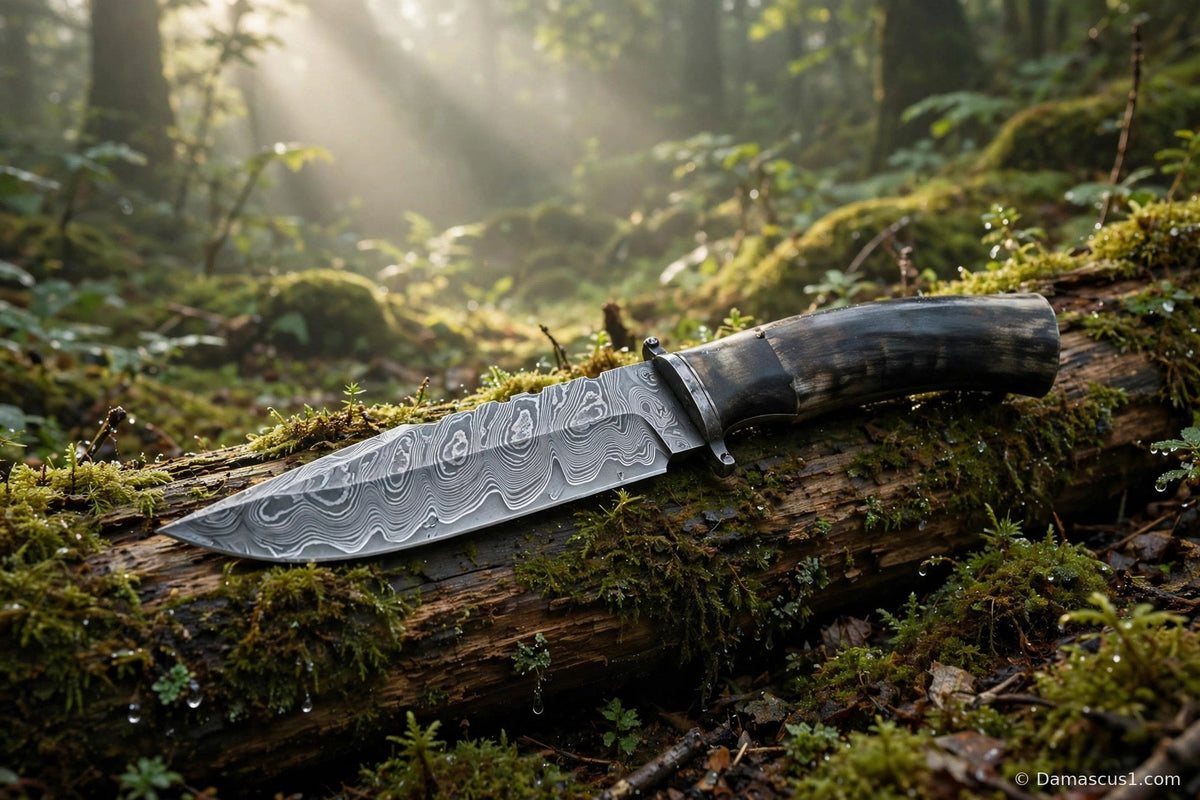
The best fixed blade knife for most people is the Buffalo Horn Damascus Tracker Fixed-Blade Knife 9.5" — $89.99, was $119.99. It is the most versatile shape in this guide, sized for hunting, camp, and general outdoor work, and it costs under $100. Want to spend less? The olive wood tracker is $79.99. Want a specialist? Read the karambit and kukri sections honestly first — they are not all-rounders.
That warning matters because "fixed blade" covers a lot of ground. A 13-inch kukri, an 8.2-inch karambit, and a 9.5-inch tracker all sit in a sheath, but they do not do the same job — and buying the wrong shape because it looks dramatic is the most common mistake in this category. Browse the range in the hunting knives collection and the tracker hunting knife collection. Every pick below is a handmade Damascus fixed blade from Damascus1, priced between $79.99 and $99.99 — a narrower, more honest band than roundups that mix $85 factory knives with $275 premium models.
What is the best fixed blade knife for most people in 2026?
For most people, the best fixed blade knife in 2026 is the Buffalo Horn Damascus Tracker at $89.99. At 9.5 inches overall, it balances carry size with enough blade for hunting and camp tasks, and the tracker shape is more adaptable than a karambit or kukri. It is the sensible first pick if you are buying one knife, not three.
Versatility wins for a first fixed blade. Most buyers do not have one narrow task: they want a knife that rides on a belt during deer season, comes along on a camping weekend, opens feed bags, cuts cord, helps with camp food prep, and handles odd jobs around a property. A tracker was designed around that mixed list. It is not perfect at everything — no knife is — but it is wrong at far less than the specialists are.
The buffalo horn handle gives this model a distinct look without raising the price: at $89.99, down from $119.99 when this draft was written, it matches the ram horn and camel bone trackers, so choosing between those three is mostly handle material and taste. Check the product page before ordering for current specifications, sheath details, and availability, since handmade stock and pricing can change.
Why should you choose a fixed blade instead of a folding knife?
Choose a fixed blade when you want strength, simple cleaning, and a knife that is ready the moment it leaves the sheath. There is no pivot to work loose and no mechanism to pack with dirt. For hunting, camping, and heavier outdoor cutting, that simplicity is a real advantage over a folding knife carried in a pocket.
A folder is excellent for everyday carry — it disappears into a pocket and handles light jobs well, and nobody needs a 9.5-inch fixed blade to open mail. But a folder has moving parts by definition: the pivot collects grit, and the lock is another component to trust. In wet, dirty, or bloody conditions, a fixed blade is easier to use, rinse, and inspect, and it comes out of the sheath ready to cut, with no opening step to fumble with cold or gloved hands.
The trade-offs are real. A fixed blade is longer, carries on a belt or in a pack rather than a pocket, and draws more attention in public. Carry rules vary widely by place, and this guide is not legal advice, so check yours. If your use is light and occasional, a folder may serve you better; if it is outdoors, repeated, and sometimes messy, the fixed blade earns its place. Our best hunting knife guide puts fixed blades in the wider hunting context.
How did we choose these fixed blade knives?
We chose these knives on shape, size, price, and honest fit for a stated job — not on looks alone. Every pick is a real Damascus1 product with a live price checked on October 21, 2026, between $79.99 and $99.99. Trackers lead for versatility, while the karambit and kukri are included only as specialists whose limits are explained up front.
There is no personal testing claim in this guide and no invented review scores. The sorting is transparent. Shape first: does the profile suit the named task? A curved karambit is not judged as a camp knife, because it was never meant to be one. Size second: overall length changes how a knife carries and what it can reasonably do. Price checked live: every figure below came from the Damascus1 store the day this draft was written, and if a price has moved since, the product page is the source of truth.
One more rule: where a detail such as exact steel composition, hardness, layer count, or tang construction is not stated here, confirm it on the individual product page rather than trusting a roundup that guesses.
The search landscape for this keyword is fragmented — knife-show award news, factory roundups built on spec tables from $85 to $275, and survival lists that reward the biggest blade in the room. This page takes a different lane: a tight, honestly priced set of handmade Damascus options, compared on the decisions a buyer actually faces.
Which fixed blade knife is best for hunting?

The best fixed blade knife for hunting in this lineup is the Buffalo Horn Damascus Tracker at $89.99, with the Ram Horn Tracker, also $89.99, as an equal alternative if you prefer its handle. The 9.5-inch tracker size carries well on a belt and offers enough blade for typical hunting tasks without the bulk of a 13-inch kukri.
Hunting asks a specific mix. The knife needs to ride all day without annoying you, and handle the work around a hunt as much as the moment after it — cutting cord, clearing light brush from a stand, preparing food at camp, and the general utility that fills most of a day in the field. A mid-size tracker fits that pattern well.
Handle choice is where hunters should slow down. Your hands may be cold, wet, or gloved for part of the day, and buffalo horn, ram horn, and camel bone each feel and look different — none of which can be fully judged from a photo. There is no wrong answer among the three $89.99 trackers, only the one you will reach for without thinking. And for most hunters the hunting knife should not be oversized: as a walk-all-day belt knife, a 13-inch kukri is more tool than most people need. Bigger is not better; you carry every extra inch uphill both ways. For a hunting-only comparison inside a strict budget, see our best hunting knife under $100 guide.
Product card — Buffalo Horn Damascus Tracker Fixed-Blade Knife 9.5" - Price: $89.99 (was $119.99) - Best for: Most hunters, and most buyers choosing one fixed blade - Link: Buy the Buffalo Horn Tracker
Product card — Ram Horn Damascus Tracker Fixed-Blade Knife 9.5" - Price: $89.99 (was $149.99) - Best for: Hunters who prefer the look and feel of ram horn - Link: Buy the Ram Horn Tracker
Which fixed blade knife is best for camping and bushcraft-style tasks?

The best fixed blade knife for camping in this lineup is the Olive Wood Damascus Tracker at $79.99, the lowest-priced tracker here. It gives you the same versatile 9.5-inch tracker format for camp cooking, cord, tent setup, and light wood tasks, while leaving room in the budget for other gear. For heavier clearing, step up to a kukri instead.
Camp use differs from hunting use in one important way: variety. In a single evening a camp knife might slice vegetables, shave a tent stake, cut guy lines, open packaging, and sit by the fire for whittling. Together, those jobs reward a mid-ground blade that is comfortable and easy to control, not a dramatic profile built for one motion.
That is why the olive wood tracker is the camp pick, partly because of price. At $79.99, was $119.99, it is the tracker to buy when the knife is one line in a longer gear list — tents, boots, and a decent sleeping setup all compete for the same money. Set expectations correctly, though: a 9.5-inch tracker is a camp utility knife, not an axe or a machete, and the kukri section covers the one pick here that leans toward heavier work. Our best camping knife guide goes further, including how blade size changes between car camping and walking in with everything on your back.
Product card — Olive Wood Damascus Tracker Fixed-Blade Knife 9.5" - Price: $79.99 (was $119.99) - Best for: Camping, general outdoor utility, first-time fixed blade buyers - Link: Buy the Olive Wood Tracker
Which fixed blade knife is best under $100?
Every knife in this guide is under $100, from $79.99 to $99.99, so the best fixed blade under $100 depends on the job. Choose the Olive Wood Tracker at $79.99 for all-round value, any 9.5-inch tracker at $89.99 for hunting and general use, or the Blue Wood Kukri at $99.99 if you genuinely need a larger specialist blade.
This section exists on purpose. "Best fixed blade under $100" is its own search with its own intent, and it deserves a direct answer, not a footnote. The whole lineup here lives under the ceiling, in three clear tiers.
- $79.99 — the value tier. Olive Wood Tracker 9.5" (was $119.99) and Olive Wood Karambit 8.2" (was $119.99). Same price, completely different knives: the tracker is the all-rounder, the karambit the specialist.
- $89.99 — the core tier. Buffalo Horn, Ram Horn, and Camel Bone Trackers, all 9.5 inches — three handle materials, one versatile shape, one price.
- $99.99 — the big-blade tier. Blue Wood Kukri 13" (was $189.99), with the Camel Bone Kukri 13" also listed at $99.99 (was $179.99). You are paying for size and a specialised profile, not a better all-rounder.
What is the difference between a tracker, a karambit, and a kukri?
The difference is shape and purpose. A tracker is a mid-size all-rounder for hunting and camp work. A karambit is a short, curved specialist built around a hooked profile and ring. A kukri is a large, forward-curved blade suited to heavier cutting and clearing. Only the tracker is a sensible default for a first fixed blade.
The tracker is the generalist. At 9.5 inches overall here, it is big enough to work and small enough to carry, and its profile handles a mixed list of outdoor jobs without fighting you on any of them.
The karambit is the opposite of a generalist — a short, curved specialist, covered honestly in its own section below. The kukri is the heavy option: at 13 inches, its forward-swept curve suits chopping and clearing, at the cost of size and fuss. Compare both shapes in the karambit knife collection and the kukri knife collection.
Which tracker handle should you choose: buffalo horn, ram horn, camel bone, or olive wood?

Choose the tracker handle you will enjoy holding and maintaining, because all four Damascus1 trackers share the same 9.5-inch format. Buffalo horn, ram horn, and camel bone models cost $89.99 each, while olive wood costs $79.99. Pick olive wood for value and camp use; pick a horn or bone handle for hunting, gifting, and a more distinctive look.
Natural materials are part of a handmade knife's appeal — and part of the responsibility. Horn, bone, and wood have grain and variation, so two knives with the same name will not look perfectly identical. For many buyers that is exactly the point: visible proof a person made this, not a mould. If you want absolute uniformity, know it before you order, not after.
Think about conditions, too. A handle in a dry camp kit lives an easier life than one riding through wet seasons, and whatever you choose, the care routine later in this guide — clean it, dry it, store it dry — matters more than the material. Gifting deserves a mention: a tracker with a natural horn or bone handle presents like an occasion, not a purchase, and it is the safest shape to give, useful to almost anyone in a way a karambit simply is not.
Product card — Camel Bone Damascus Tracker Fixed-Blade Knife 9.5" - Price: $89.99 (was $139.99) - Best for: Gifting, hunting, a light-toned natural handle - Link: Buy the Camel Bone Tracker
When is a karambit the right fixed blade — and when is it not?

A karambit is the right fixed blade when you specifically want that curved profile and ring grip, understand how it is held, and are buying it for that specialised purpose or for a collection. It is not the right choice for general hunting, camping, food preparation, or as a first fixed blade for ordinary outdoor tasks.
The Damascus1 Olive Wood Karambit — 8.2 inches, $79.99, was $119.99 — pairs that unmistakable curved silhouette with a natural olive wood handle and a patterned Damascus blade, which makes it a fascinating piece for collectors and enthusiasts of the style.
As a tool recommendation, honesty has to lead. The hooked curve suits the drawing, pulling cuts the design was built around; it is poorly suited to the push cuts, flat slicing, and controlled tip work that dominate hunting and camp use. That is not a flaw in the karambit — it is a flaw in buying a specialist to do a generalist's job. Unusual grips also reward training and punish improvisation, so treat learning its handling as part of the purchase. Want a karambit? Buy it, eyes open. Want a fixed blade for the outdoors? Scroll back up to the trackers.
Product card — Olive Wood Damascus Karambit Fixed Blade 8.2" - Price: $79.99 (was $119.99) - Best for: Karambit enthusiasts and collectors who specifically want the curved profile - Link: Buy the Olive Wood Karambit
When does a kukri make more sense than a tracker?

A kukri makes more sense than a tracker when your work is heavier — clearing brush, processing larger wood, and repeated chopping-style cuts around a property or a long camp. The Blue Wood Damascus Kukri is 13 inches and $99.99. For ordinary hunting, short trips, and all-day belt carry, the smaller 9.5-inch tracker remains the better choice.
Size is a commitment: a 13-inch knife does not ride or pack like a 9.5-inch knife. Where the kukri justifies it is momentum — the forward curve concentrates the working part of the blade where a chopping motion lands, so each swing does more. Around land you maintain, or at a base camp that stays up for a week, that difference stops being theoretical.
The Blue Wood model is the pick here — 13 inches, $99.99, was $189.99, the steepest compare-at drop in this lineup and still under $100. The store also lists a Camel Bone Kukri 13" at $99.99 (was $179.99) if you prefer a bone handle; see both in the kukri knife collection. A kukri is not a precision instrument or a beginner's first blade, so if you eventually want both ends of this range, buy the tracker first — it will be used far more often.
Product card — Blue Wood Damascus Kukri Fixed Blade 13" - Price: $99.99 (was $189.99) - Best for: Heavier cutting, clearing, buyers who specifically need a large blade - Link: Buy the Blue Wood Kukri
How do these Damascus1 fixed blades compare side by side?
Side by side, the four 9.5-inch trackers share a versatile format from $79.99 to $89.99 and differ mainly in handle material, while the 8.2-inch karambit at $79.99 and the 13-inch kukri at $99.99 are specialists at opposite extremes. Most buyers should pick from the tracker rows first and only move outward for a specific reason.
| Knife | Price | Size | Best for |
|---|---|---|---|
| Buffalo Horn Damascus Tracker | $89.99 (was $119.99) | 9.5" | Best overall — hunting, camp, and survival-leaning general use |
| Ram Horn Damascus Tracker | $89.99 (was $149.99) | 9.5" | Best for hunters who prefer a ram horn handle |
| Camel Bone Damascus Tracker | $89.99 (was $139.99) | 9.5" | Best for gifting and a distinctive natural handle |
| Olive Wood Damascus Tracker | $79.99 (was $119.99) | 9.5" | Best under-$100 budget tier — all-round camp and utility value |
| Olive Wood Damascus Karambit | $79.99 (was $119.99) | 8.2" | Best for karambit specialists and collectors only |
| Blue Wood Damascus Kukri | $99.99 (was $189.99) | 13" | Best for heavier cutting and clearing |
| Camel Bone Kukri | $99.99 (was $179.99) | 13" | Best large-blade alternative with a camel bone handle |
Read the table the way a buyer should: start in the middle. The tracker cluster — four knives, two prices, one versatile shape — is where most orders belong. The olive wood model anchors the budget tier, and the three $89.99 trackers ask one question for their extra $10: which natural handle do you want in your hand for years?
Notice, too, how narrow the extremes' rows are — deliberately. The karambit row says specialists and collectors because that is the truth; the kukri row says heavier cutting because, outside that work, its size stops helping and starts costing. One honest note on "survival," since it is in this guide's title: no knife, at any price, is a survival kit. What a dependable mid-size fixed blade gives you is one less problem — a cutting tool that works when wet, dirty, and needed without fuss. Paired with shelter, water, and sense, the $89.99 tracker is the survival-leaning pick because it is the knife you would actually have with you.
What should you check before you buy any fixed blade knife?
Before you buy any fixed blade knife, check the overall size against how you will carry it, confirm the shape suits your main task, read the product page for current specifications and sheath details, verify the live price, and check the carry rules where you live. Skipping the size and shape checks is how good knives end up unused.
Work through that list in order; each step filters out a different regret. Carry first: where will this knife live — belt, pack, truck kit, cabin drawer? A 13-inch kukri that suits a property kit is a poor answer to a belt-carry question. Shape second: judge the shapes above against your real task list from your actual last season or trip, not the work you imagine. Product page third: confirm the current price, stated specifications, what is included, and photos of the actual product before checkout — and if a detail matters and is not stated, ask the seller rather than assuming.
Rules last, but not optional. Fixed blade carry laws differ by state, country, and sometimes city; this guide makes no legal claims, and a two-minute check protects a purchase you intend to use for years. Buy once, thoughtfully: the right tracker, chosen on purpose, is a decade-long tool, while the wrong specialist, bought on impulse, is a drawer ornament by February.
How should you care for a Damascus fixed blade knife?
Care for a Damascus fixed blade by washing it by hand, drying it completely straight after use, storing it dry and out of a damp sheath for long periods, and keeping the edge maintained with regular, gentle sharpening. Damascus steel rewards that simple routine and punishes neglect — a wet knife left in a sheath is the fastest way to spoil one.
The habit is short: wash it, dry it, put it somewhere dry. Check your product page for your model's specifics, and respect the natural handle, too — horn, bone, and wood do not enjoy being soaked or forgotten in a hot vehicle. Sharpening follows the same philosophy: little and often beats rare and aggressive. For long storage, make sure blade and sheath are fully dry first, and check on the knife occasionally.
What are the most common questions about fixed blade knives?
The most common questions about fixed blade knives concern size, shape, legality, care, and whether one knife can cover hunting, camping, and survival-leaning use. The short answers are: a 9.5-inch tracker covers the widest range, specialists suit narrow jobs, carry rules vary by place, and simple drying and storage habits protect a Damascus blade best.
Is a fixed blade knife better than a folding knife for hunting?
For most hunting use, yes. A fixed blade is simpler to clean, has no pivot or lock to maintain, and is ready as soon as it leaves the sheath — advantages that matter in wet, dirty, cold conditions. A folding knife still wins for light everyday pocket carry.
What size fixed blade knife should a beginner buy?
Start in the middle, around the 9.5-inch overall format of the trackers here: large enough for real outdoor work, small enough to carry and control comfortably. A 13-inch kukri and a specialised karambit both make poor first knives, for opposite reasons.
Are all the fixed blades in this guide really under $100?
Yes, at the prices checked on October 21, 2026 — from $79.99 for the Olive Wood Tracker and Karambit to $99.99 for the Blue Wood Kukri, with the three horn and bone trackers at $89.99. Handmade prices can change, so confirm the live price on the product page before ordering.
How do I keep a Damascus blade from rusting?
Keep it clean and, above all, dry. Wash it by hand after use, dry it fully before sheathing it, and store it somewhere dry — not sealed in a damp sheath for months. Check your product page for model-specific care guidance, and inspect the blade occasionally during long storage.
Which Damascus1 fixed blade is the best gift?
A tracker. The Camel Bone and Buffalo Horn Trackers, both $89.99, pair the most useful shape with natural handles that present beautifully — the safest gift when you do not know the recipient's exact tasks.
Which fixed blade knife should you buy today?
Buy the Buffalo Horn Damascus Tracker at $89.99 if you want one fixed blade that covers hunting, camp, and general outdoor work without overthinking it. Buy the Olive Wood Tracker at $79.99 if budget leads. Only choose the karambit or kukri if your task specifically calls for them. Then check the live product page and order with confidence.
- One knife, no special requirements? The Buffalo Horn Tracker — $89.99 — the pick this page opened with, and nothing since has argued against it.
- Same job, tighter budget? The Olive Wood Tracker — $79.99, from the tracker hunting knife collection.
- Heavy work on land or at a long camp? The Blue Wood Kukri — $99.99.
- A karambit because you truly want one? The Olive Wood Karambit at $79.99 — bought as a specialist, with open eyes.
Every option is a handmade Damascus fixed blade, priced under $100 when this draft was written, photographed honestly in the Damascus1 catalog, and matched above to the job it actually does well. Compare the full range in the hunting knives collection, or go straight to the Buffalo Horn Tracker page, confirm the current details, and order today. The best fixed blade knife is not the biggest one or the strangest one — it is the one that fits your work and is still earning its keep years from now. For most people, that knife is the tracker, and it is $89.99.
Shop now: Buffalo Horn Damascus Tracker Fixed-Blade Knife 9.5" — $89.99 at Damascus1
laissez un commentaire: