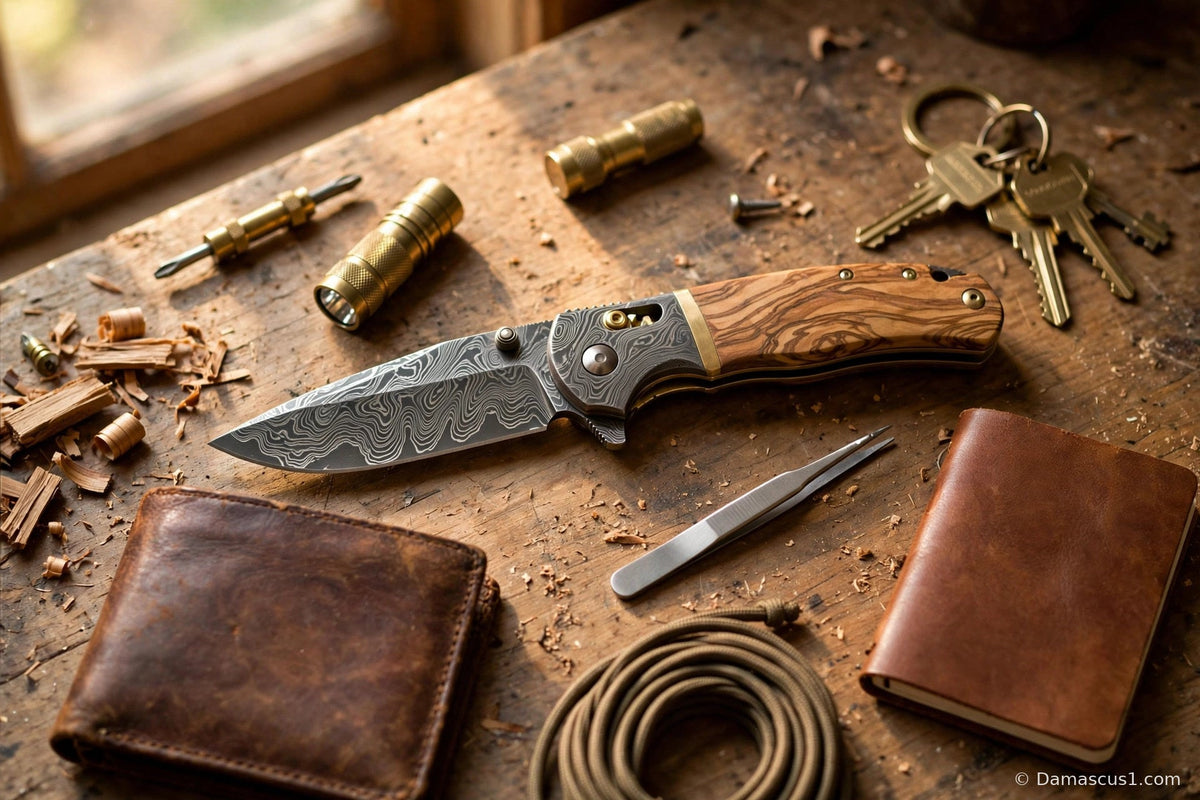
Direct answer: The best pocket knife under $50 for most people right now is the Olive Wood Damascus Pocket Knife at $39.99 (was $89.99, verified October 17, 2026) from Damascus1 — a handmade Damascus folder at the same money as an ordinary mass-produced stainless knife. Browse the full everyday EDC pocket knives collection if you want the same $39.99 Damascus build in horn, bone or coloured wood instead.
That answer needs one honest warning attached to it, and you will find it repeated in this guide because it matters. The same collection that sells those $39.99 Damascus folders also sells 420C stainless folders — the Blue Bolster at $34.99 (was $69.99) is one — and a stainless knife is a perfectly respectable budget buy, but it is not Damascus. Check the blade-material line on the exact knife in your cart. Every pick, price and trade-off below is built around that one habit.
What is the best pocket knife under $50?
For most people, the best pocket knife under $50 is the Olive Wood Damascus Pocket Knife at $39.99, verified October 17, 2026, down from $89.99. It pairs a handmade layered Damascus blade with a warm olive wood handle in an everyday size, costs the same as an ordinary mass-produced folder, and leaves room in the budget for a sheath or a second knife as a gift.
Why olive wood first, when eight Damascus options sit under $50 in the same collection? Because it is the neutral choice that fits the widest range of hands, pockets and tastes. The grain is warm without being loud. The shape is the classic traditional folder most people picture when they picture a pocket knife at all. If you are buying for yourself and you keep circling back to the safe, handsome middle of the range, that instinct is usually right. If you are buying a gift and you do not know the recipient's taste in detail, it is the pick least likely to miss.
If your taste runs darker, lighter or bolder than olive wood, do not worry — the pick changes handle, not logic. The Buffalo Horn, Camel Bone and Blue Wood versions sit at the identical $39.99, and the deeper comparison below walks through each one. And if this budget guide has you curious about the wider category, our broader best pocket knife guide compares pocket knife styles across price points, while the dedicated best Damascus pocket knife guide goes deeper on Damascus folders specifically.
Why does handmade Damascus at $39.99 stand out under $50?

Handmade Damascus at $39.99 stands out because the under-$50 shelf is dominated by mass-produced stainless and tactical folders that all look and feel alike. A layered Damascus blade gives every knife a flowing pattern no two pieces share, and natural handles — wood, horn, bone, antler — add the same one-of-one character. Interest is real, too: Damascus everyday-carry deals drew coverage around Prime Day in October 2026.
Sit with that pricing fact for a second, because it is easy to skim past. Handmade and mass-produced are usually separated by a wide price gap. The handmade object costs more because hands take longer than machines, natural materials vary and get rejected, and small-batch work cannot spread its costs across a container ship. When a handmade Damascus folder lands at $39.99 — the exact money of the factory folders beside it — the usual reason to settle disappears. You are no longer choosing between character and budget. You are just choosing a handle.
None of this makes a $39.99 Damascus folder a hard-use tool, and pretending otherwise would be dishonest. It is a traditional folding knife. Opening is an unhurried, usually two-handed affair. It is made for cutting, not prying, twisting or batoning. If your workday genuinely involves gloves, ladders and one free hand, a modern tactical folder is the right tool and you should buy one without guilt. But for the daily carry most people actually live, the handmade knife is not the compromised choice at this price. It is, frankly, the interesting one.
Which Damascus1 pocket knives under $50 should you compare first?
Compare the $39.99 core first: Olive Wood for the classic all-rounder, Buffalo Horn for a dark, dense carry, Camel Bone for the pale traditional look, and Blue Wood for colour. Then step up only if the handle earns it — Ram Horn at $44.99 for texture and warmth, Stag Horn at $49.99 for the most dramatic natural grip in the under-$50 line.
Every price in the table was verified on October 17, 2026, and prices can change, so the product page on the day you order is always the final word. One more time, because the table depends on it: these are the Damascus picks. The wider collection also includes 420C stainless folders such as the Blue Bolster at $34.99 (was $69.99). Those are not in this table, they are not Damascus, and if you end up preferring one anyway, buy it with your eyes open rather than by accident.
| Pick | Best for | Handle | Price (verified Oct 17, 2026) |
|---|---|---|---|
| Olive Wood Damascus Pocket Knife Set | Best for most people — the classic all-rounder and safest gift | Olive wood | $39.99 (was $89.99) |
| Buffalo Horn Damascus Pocket Knife | Best for a dark, dense, understated everyday carry | Buffalo horn | $39.99 (was $99.99) |
| Camel Bone Damascus Pocket Knife | Best for the pale, traditional pocket-knife look | Camel bone | $39.99 (was $99.99) |
| Blue Wood Damascus Pocket Knife | Best for colour — deep blue wood, modern palette | Blue wood | $39.99 (was $99.99) |
| Multi Wood Damascus Pocket Knife | Best for grain that refuses to repeat | Multi wood | $39.99 (was $99.99) |
| Green Wood Damascus Pocket Knife | Best for the uncommon handle nobody else carries | Green wood | $39.99 (was $99.99) |
| Red Wood Damascus Pocket Knife | Best for a warm, bold gift with presence | Red wood | $39.99 (was $99.99) |
| Ram Horn Damascus Pocket Knife | Best for natural texture at a small step-up price | Ram horn | $44.99 (was $99.99) |
| Stag Horn Damascus Pocket Knife | Best for the most dramatic natural handle under $50 | Stag horn | $49.99 (was $139.99) |
Priced product cards — the shortlist, framed by the job
Best all-rounder — Olive Wood Damascus Pocket Knife Set — $39.99 (was $89.99). The recommendation from the top of this guide, and still the one to beat. Warm grain, classic proportions, the safest self-buy and the safest gift in the line. If you read nothing else in this section, read its product page and decide. View the Olive Wood pocket knife.
Best dark carry — Buffalo Horn Damascus Pocket Knife — $39.99 (was $99.99). Near-black horn with natural movement running through it, polished and substantial in the hand. It suits a darker everyday carry kit and photographs beautifully, which matters more for gifts than anyone admits. View the Buffalo Horn pocket knife.
Best traditional look — Camel Bone Damascus Pocket Knife — $39.99 (was $99.99). The pale handle that has signalled "proper pocket knife" for generations, paired with a patterned blade. Its product page carries its own construction details — read them there, where they belong, rather than trusting any summary, including this one. View the Camel Bone pocket knife.
Best colour — Blue Wood Damascus Pocket Knife — $39.99 (was $99.99). Deep blue wood for the buyer who finds natural browns a little quiet. Same $39.99 Damascus build, completely different personality in the pocket and in a gift box. View the Blue Wood pocket knife.
Best step-ups — Ram Horn at $44.99 (was $99.99) and Stag Horn at $49.99 (was $139.99). Five and ten dollars buy you the two most tactile handles in the line. Ram horn brings warm, ridged character; stag horn brings the full dramatic antler look and the deepest natural texture. Both live in the everyday EDC pocket knives collection, alongside the Multi Wood, Green Wood and Red Wood folders at $39.99 each (was $99.99) if colour is your deciding factor.
Which handle material is best for a pocket knife under $50?

Stag horn is the best handle for grip, because its natural ridging gives wet, cold or gloved fingers real texture to hold. Wood — olive, blue, green, red or multi — is the warm, comfortable classic. Buffalo horn is dense and polished, camel bone is smooth and pale, and ram horn sits between wood and stag for texture. Choose by hand and weather, not by photograph alone.
Photographs lie about handles, politely. A product photo shows you colour, grain and gloss beautifully. It tells you nothing about friction, and friction is what keeps a knife settled in your hand when you are cutting something resistant with cold fingers. So reason from the material itself. Antler and horn grew with ridges and undulations; that irregularity is anatomy, not styling, and it is why stag horn tops this line at $49.99 while ram horn, a step smoother, sits at $44.99. You are paying for texture you can feel, not just looks you can see.
Wood is the honest middle. Olive wood is the classic: fine-grained, warm, hard-wearing, and smooth enough to slide in and out of a pocket without snagging, which is a real daily-carry virtue that grippier handles quietly tax. The coloured woods — blue, green, red and multi — behave much the same in the hand; you are choosing a palette and a grain personality, not a different tool. Wood also forgives. A small knock that would crack a brittle synthetic or chip a flashy inlay tends to mark wood in a way that reads as character rather than damage.
How can you tell if a Damascus pocket knife is real?

You can tell a real Damascus pocket knife by holding the blade in window light and moving it slowly: a genuine layered pattern has depth, shifts as the angle changes, and runs continuously across the blade. A printed or surface-etched imitation looks flat, repeats itself, and stays identical from every angle. Check the spine and edge, too — a real pattern does not stop at the flat of the blade.
That window-light habit is worth building before you spend anything, anywhere. Tilt the knife and watch the lines behave like water over stones, brightening and dimming as the steel turns. Printed patterns cannot do that; they are ink-deep, and light exposes them in seconds. Our full walkthrough, how to spot a fake Damascus knife, works through the pattern, spine and edge checks in detail, and it is the companion read to this guide if authenticity is your main worry.
Then do the boring checks, because boring checks catch what pretty patterns hide. Read the blade-material line on the individual product page — not the collection banner, not the search snippet, the line on the exact knife you are buying. This guide has said it three times now for a concrete reason: at Damascus1, the same everyday-carry collection sells Damascus folders at $39.99 and 420C stainless folders like the Blue Bolster at $34.99 (was $69.99). A buyer who assumes "everything in this collection is Damascus" can check out with a stainless knife and never notice until it arrives. The knife would be fine. The assumption would be the problem.
Price deserves a word here as well, because under $50 triggers a fair suspicion. Cheap Damascus exists in two forms: honest small folders made efficiently from layered steel, and fake Damascus that is ordinary steel with a pattern printed on. The price alone cannot tell you which one you are looking at — $39.99 covers both in the wider market. The light test, the continuity of the pattern, and a product page that plainly states its blade material are what separate them. Any seller, at any price, who makes those checks easy is behaving like a seller with nothing to hide.
What size pocket knife under $50 should you carry every day?

Carry the size you will forget is in your pocket until you need it: a mid-size traditional folder for everyday jobs, in the class Damascus1's 6.5-inch models belong to. Go by closed length for pocket comfort and blade length for cutting, because sellers mix overall, closed and blade measurements freely. Larger hands and jacket carry suit a bigger folder; light trousers and shirt pockets suit the standard size.
Size mistakes are the most common online knife mistake, and they are almost never the buyer's fault. One seller's headline measurement is the knife open, tip to tail. Another's is the blade alone, which can make a genuinely large knife sound pocket-friendly, or a sensible folder sound tiny. Before you compare any two knives — including two knives in the same store — find the closed length. That is the number your pocket lives with all day. The blade length is the number your cutting lives with for thirty seconds at a time. Both matter. They are not interchangeable.
How do you care for a Damascus pocket knife so it lasts?
Care for a Damascus pocket knife by keeping it clean, dry and lightly oiled: wipe the blade after use, wash and dry it by hand rather than leaving it wet, store it dry outside a damp pocket or sheath, and sharpen it on a whetstone before it goes truly dull. Layered steel rewards small habits — minutes of care protect the pattern, the edge and the natural handle for years.
Start with the question every Damascus buyer eventually asks: yes, Damascus steel can rust if it is left wet and neglected, which is why the dry-and-oil routine is not fussiness, it is the deal you make with a patterned blade. The full explanation lives in our guide, can Damascus steel rust, and the short version is simple — moisture plus time is the enemy, and both are easy to deny it. Wipe after food. Dry after rain. Do not store the knife damp in a leather sheath for a month and then blame the steel.
Sharpening is the other half of ownership, and it is less intimidating than the internet makes it sound. A whetstone, a steady angle, and patience will maintain a Damascus edge at home; the skill is learnable in an afternoon and useful for life. Our step-by-step, how to sharpen a Damascus knife, walks through grit, angle and stropping without mystique. The key timing point: sharpen while the knife is merely dull-ish, not after it has gone completely blunt. Maintenance is light work. Rescue is heavy work. Owners who sharpen little and often almost never face the second kind.
Can you get a pocket knife under $50 engraved as a gift?

Yes — Damascus1 product pages offer the option to request an engraving design quote for a name, initials or a short message of up to 25 characters. Nothing is automatic: the suitability of the design, a proof, the price and the timing are all confirmed with you before any custom order goes ahead, so an engraved gift starts with a request, not a checkout promise.
Be clear about what that process is not, because gift deadlines punish vague assumptions. Engraving is not promised free, fast or included in the $39.99 price, and this guide will not pretend otherwise. It is a custom step arranged per order: you request the quote, the design is checked for suitability, you see and approve the details — proof, price and timing included — and only then does the custom work proceed. If you are buying against a birthday or a wedding date, start that conversation first and buy the knife with the timeline confirmed, not hoped for.
What should you check before you buy any pocket knife under $50?
Before you buy, check five things: the blade-material line on the exact product page, whether the listed size is overall, closed or blade length, the handle material against your weather and grip, the total price including any step-up you chose, and the seller's current shipping and returns terms at checkout. Those five checks take minutes and prevent nearly every disappointment this category produces.
The blade-material check leads the list because it leads every honest version of this guide. Collections mix materials. At Damascus1 the everyday-carry collection holds Damascus folders from $39.99 and 420C stainless folders such as the Blue Bolster at $34.99 (was $69.99) side by side, and both are legitimate products — for different buyers. Stainless asks less care and shrugs off wet neglect more easily. Damascus brings the layered pattern, the handmade character and the care routine described above. Neither is a trick. Confusing one for the other is the only real trap, and it is a trap with a one-line escape: read the material line before you pay.
Price honesty comes next. The verified figures in this guide — $39.99 core models with compare-at prices from $89.99 to $99.99, Ram Horn at $44.99, Stag Horn at $49.99 — were checked on October 17, 2026. Compare-at prices and sale prices move. If a figure on the live page differs from a figure here, the live page wins and this guide is simply out of date on that line, the way every dated guide eventually is. That is also why this post verifies and dates its prices instead of leaving them vague: a price you can check is worth more than a price you are asked to trust.
And if your budget ever stretches beyond a pocket folder entirely, the same checking habits travel well: our best hunting knife guide applies the same verify-the-page, check-the-material discipline to outdoor knives, where the stakes and the steel choices get bigger.
What do buyers ask most about the best pocket knife under $50?
Buyers ask most about whether real Damascus is genuinely possible under $50, whether a $39.99 handmade folder can handle daily use, how it compares with a mass-produced tactical knife, which handle to choose, whether it can be engraved, and how much care the blade needs. The short answers are yes, yes for everyday cutting, differently rather than directly, by grip, yes by quote, and a dry-and-oil habit.
Is a real Damascus pocket knife under $50 actually possible?
Yes. Damascus1's verified October 17, 2026 range puts handmade Damascus folders at $39.99 to $49.99. Verify any individual knife the same way you would anywhere: check that its own product page states Damascus as the blade material — remembering the same collection sells stainless models too — and use the window-light pattern test when it arrives.
Is a $39.99 pocket knife good enough for everyday use?
For everyday cutting, yes. Opening packaging, cutting cord and food, and the small jobs of a normal week sit comfortably within what a traditional folder at $39.99 is built to do. It is not the tool for prying, batoning or gloved hard use, and no honest guide will sell it as one. Match the knife to the week you actually live.
How does a Damascus folder compare with a tactical folder under $50?
They solve different problems. A tactical folder prioritises fast one-handed opening, pocket clips and synthetic grip for busy or gloved hands. A traditional Damascus folder prioritises slicing, comfort, looks and giftability, with slower, usually two-handed opening. At the same $39.99, choose by your day: equipment-first or carry-you-enjoy. Neither answer is wrong.
Which $39.99 handle should a first-time buyer choose?
Olive wood, unless something else has already caught your eye. It is the warm, classic, fits-almost-everyone choice, which is why it headlines this guide. Choose buffalo horn for dark and dense, camel bone for pale and traditional, and blue wood for colour. If grip texture matters more than first impressions, skip straight to ram horn or stag horn.
Can a pocket knife under $50 be engraved?
It can be arranged, but it is not automatic. Request an engraving design quote through the product page for a name, initials or a short message up to 25 characters. Suitability, proof, price and timing are confirmed before any custom order proceeds, and engraving should never be assumed free, fast or included in the listed price.
How long will a Damascus pocket knife under $50 last?
Years, if the small care habits hold: wipe it dry, keep it lightly oiled, store it dry, and sharpen it before it goes fully dull. The blade and natural handle are not disposable parts, and nothing in the $39.99 to $49.99 range is built to be thrown away. Neglect shortens its life far faster than price does.
Where should you buy your pocket knife under $50?
Buy it where the prices, materials and options are stated plainly enough to check — and on the evidence of the verified October 17, 2026 range, that means starting with the Damascus1 everyday-carry collection, where handmade Damascus begins at $39.99 instead of ending there. Pick your handle, confirm the blade-material line on that knife's page, and order the folder you will actually carry every day.
Here is the whole decision, compressed. Start with the Olive Wood Damascus Pocket Knife Set at $39.99 (was $89.99) if you want the classic all-rounder. Go Buffalo Horn at $39.99 (was $99.99) for dark, Camel Bone at $39.99 (was $99.99) for traditional, or Blue Wood at $39.99 (was $99.99) for colour. Step up to Ram Horn at $44.99 or Stag Horn at $49.99 only when the handle earns it in your hand. Or browse the full everyday EDC pocket knives collection and let the grain decide — every knife there deserves the same one-line check before checkout: confirm it says Damascus where it counts.
Fifty dollars used to force a compromise: a knife that worked, or a knife you liked, rarely both. At $39.99 for handmade Damascus, that compromise is no longer the price of entry. Choose the handle that fits your hand and your life, keep it dry, keep it sharp, and carry it daily — that is what the best pocket knife under $50 actually looks like in practice.
laissez un commentaire: