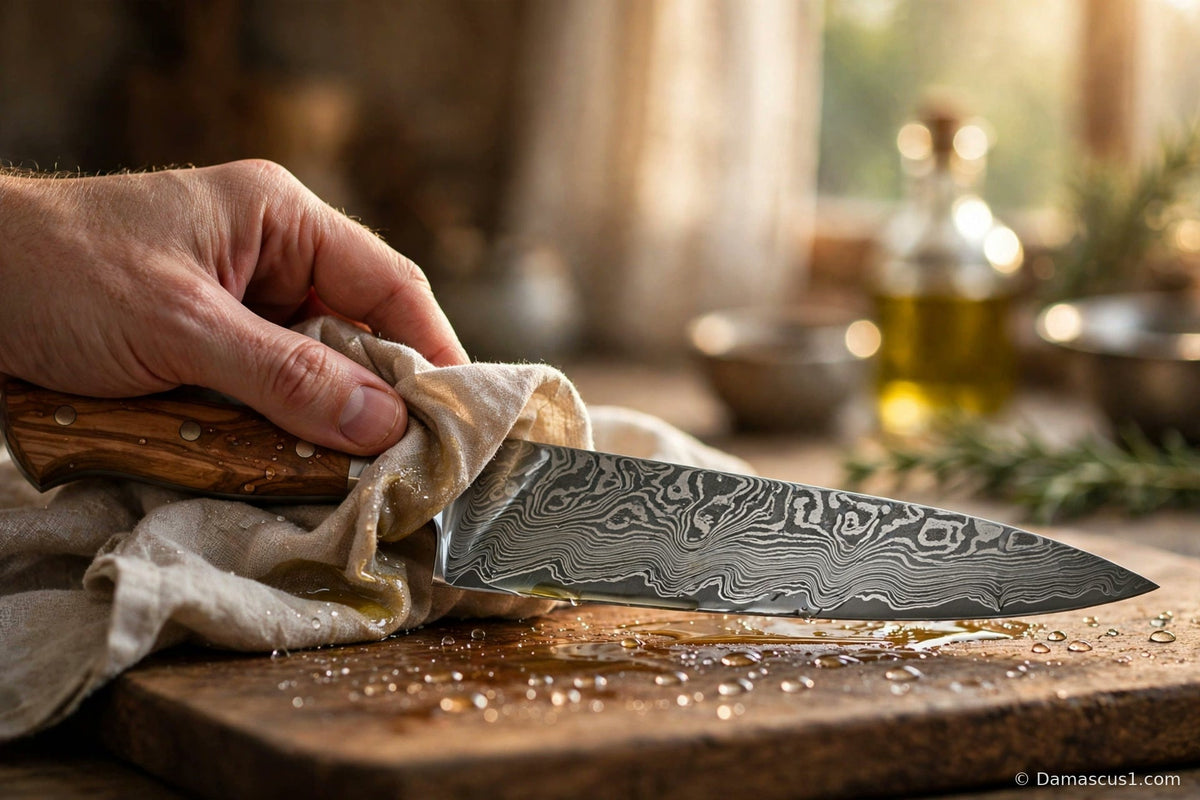
Direct answer: Yes, Damascus steel can rust — especially traditional carbon-steel Damascus, which will spot if it is left wet, stored damp, or put away dirty. Stainless Damascus built over a VG10 or AUS-10 core resists rust far better, but it is not rust-proof either. The prevention is simple and takes under a minute: hand-wash the knife, dry it completely, add a thin film of oil before longer storage, and store it dry — never soaking, never in a dishwasher, and never sealed long-term inside a damp leather sheath.
That is the whole secret, and it is not much of a secret. Rust is the single most common reason a beautiful Damascus knife starts looking tired, and it is almost never the steel's fault. It is a routine problem. Owners who build three small habits — wash, dry, store dry — keep layered blades bright for years. Owners who treat a Damascus knife like a cheap stainless beater, tossing it wet into a drawer or leaving it in the sink overnight, meet the orange spots within weeks. This guide explains why the two families of Damascus behave differently, how to tell harmless patina from real rust, exactly how to remove early spots without wrecking the pattern, and the storage mistakes that cause most of the damage. If you are shopping while you learn, the knives this routine protects start in the everyday EDC pocket knives collection at Damascus1 at $39.99.
Can Damascus steel rust, in plain terms?
Yes. Damascus steel can rust whenever the steels in its layers contain enough iron and carbon and are exposed to moisture, salt, or acids for long enough — which describes most traditional carbon Damascus and, given enough neglect, even stainless Damascus. Rust is iron reacting with oxygen and water. Layering does not exempt a blade from chemistry; it just changes how quickly the reaction starts and how forgiving the blade is when you slip up.
Start with what rust actually is, because the word gets used loosely. Rust is a form of corrosion: the surface of the steel oxidises, and the oxide layer that forms is porous and flaky rather than protective. Left alone, it keeps eating inward in tiny increments. On a kitchen knife that means staining and rough spots first, then pitting — small craters that hold moisture and make the next round of corrosion faster. On a pocket knife it usually starts around the pivot, the edge, and anywhere fingerprints sat unnoticed, because skin oils carry salt.
The important nuance is speed. A modern stainless blade can sit damp on a draining board overnight and shrug it off. A carbon-steel Damascus blade in the same spot may show the first freckles by morning, particularly in a humid house or after cutting lemons, tomatoes, or onions — all acidic, all unkind to a wet blade left sitting in their juice. Neither outcome says anything about quality. It says something about chemistry, and about which routine the knife needs from its owner.
So the honest framing is this: Damascus is not fragile, but it is not maintenance-free. It asks for the same care any good carbon or semi-stainless tool has always asked for, and it repays that care by staying beautiful. If absolutely zero maintenance is your non-negotiable requirement, a plain stainless knife is the more honest purchase — and this guide will say so again before the end, because a knife that suits your actual habits beats a prettier knife you resent looking after.
Why does carbon Damascus rust faster than stainless Damascus?
Carbon Damascus rusts faster because its layers are typically high-carbon steels with little or no chromium, and chromium is the element that gives stainless steel its protective surface film. A common traditional pairing is a high-carbon steel with a nickel-bearing steel for contrast; the nickel steel resists the etch and stays bright, but the high-carbon partner is genuinely reactive. Stainless Damascus, by contrast, builds its layers or its core from chromium-rich steels such as VG10 or AUS-10, so the whole blade resists corrosion much better.
You do not need a metallurgy degree to use this. You need one shopping rule and one care rule. The shopping rule: before you buy any Damascus knife, read the blade-material line on that specific product's page. It will tell you whether you are looking at a carbon-leaning blade that wants diligent care or a stainless-core blade that forgives more. Collections mix constructions — Damascus1's EDC collection, for example, plainly includes both Damascus models and 420C stainless models side by side — so never infer the steel from the collection name or from a wavy photograph. The care rule follows from the first: the more carbon in the blade, the less time it may spend wet. Seconds, not minutes, is the right mindset for a carbon blade after washing.
Kitchen Damascus adds a second distinction worth understanding. In many modern kitchen knives, the Damascus layers form cladding around a core steel, and the core is what forms the edge. Damascus1's VG10-core 6-piece set, for instance, lists 67 layers, a hardness of 58–62 HRC, and an 11-degree edge on its product page. A stainless core like VG10 keeps the edge itself well protected; the cladding steels around it can still be a touch less uniformly stainless than the core, which is why even a premium stainless Damascus set deserves the dry-after-washing habit. Our explainer Damascus vs VG10: what's the difference? unpacks that construction properly if you want the full picture before you buy.
What about the pattern itself — does the etched surface rust first? Often, yes, and for a logical reason. Etching works because the two steels react at slightly different rates; the more reactive steel sits microscopically lower and darker. Those recessed, more reactive lines are also where moisture lingers longest and where the first discolouration tends to appear. It is one more reason drying matters more than any product you can buy: a dry etched surface has nothing to react with.
Is it rust, patina, or just a stain? How to tell the difference

Orange or reddish-brown spots that feel slightly rough or raised are rust and should be removed promptly. A smooth grey, blue-grey, or darkening sheen that develops evenly on a carbon blade is usually patina — a thin, stable oxide layer that is not actively eating the steel and can even slow further corrosion. Dark marks from foods like onion, garlic, or mustard are often simple staining. When in doubt, run a clean fingertip or white cloth across the spot: rust transfers colour and feels textured; patina does not.
This distinction saves owners a lot of unnecessary panic — and a lot of unnecessary scrubbing. Patina is normal on carbon steel. It is the blade's diary of meals cooked and trips taken, and many owners prize it. It develops gradually, lies flat, and has a muted, smoky look quite different from the bright, angry orange of active rust. Trying to polish patina off every week with abrasives does more harm than the patina ever would, because aggressive polishing is also what fades an etched Damascus pattern over time.
Rust announces itself differently. It tends to appear in spots or clusters rather than as an even film. It can look powdery or crusty at the edges. On a cloth it leaves a rusty smear. And it grows: a spot ignored for a month in a damp drawer will be measurably worse, while a patina patch will look much the same. Location is a clue too — rust loves the edge bevel, the spine where water sits, the area under a sheath's snap, and the pivot of a folder, all places moisture hides after a quick, careless dry.
Food staining sits in the third category: annoying, harmless, and mostly cosmetic. Acidic and sulphurous foods can darken or blue a reactive blade within a single use. Wash, dry, and carry on. If the marks bother you, they usually fade into the general patina with normal use and gentle cleaning. What they do not need is steel wool, a scouring pad, or a grinding paste — the three things most likely to turn a cosmetic non-issue into a faded pattern and a bill for professional re-etching.
What is the daily care routine for a Damascus knife?

The daily routine has four steps and takes under a minute: rinse or hand-wash the knife in warm water with a little mild soap soon after use, dry it completely with a soft towel — including the spine, handle junction, and, on a folder, the pivot area — use it or put it away dry immediately, and never leave it soaking in a sink, sitting in a wet sheath, or spending a night in the dishwasher. Consistency beats intensity: a gentle routine every day prevents problems that no deep clean can fully undo.
Walk through it once, slowly, because each step exists for a reason. Washing soon after use matters because the enemies are time plus residue: salt, fruit acids, and meat juices all accelerate corrosion, and all of them are harmless if they are on the blade for two minutes instead of two hours. Warm water and a drop of ordinary dish soap on a soft sponge is the whole toolkit. Nothing abrasive. Nothing scented with promises. The blade does not need disinfecting theatre; it needs the residue gone.
Drying is the step people rush, and it is the step that matters most. A quick swipe down the flat leaves water in exactly the places rust starts: along the edge bevel, in the etched recesses of the pattern, around the bolster or handle scales, and inside a folder's pivot. Dry deliberately. Run the towel down both flats, pinch it lightly along the spine, dab the handle junction. For a folding knife, open and close it once after drying so trapped moisture at the pivot gets air. Ten extra seconds. That is the entire difference between a blade that spots and a blade that does not.
Then put it away dry, right away — which is a storage rule as much as a drying rule, and it gets its own section below. And the dishwasher: no, not once, not on the top rack, not on a gentle cycle. Dishwashers combine prolonged heat, harsh detergent, rattling contact with other metal, and a long humid drying phase. They are hard on edges, hard on handles — wood and horn especially — and they can dull the etched contrast of a Damascus pattern. Hand-washing takes forty seconds. There is no version of the maths where the dishwasher wins.
One more daily habit for kitchen knives specifically: wipe the blade between acidic jobs during long prep sessions. Breaking down a case of tomatoes or a bag of lemons? A quick rinse and dry halfway through costs nothing and stops acid sitting on steel while you work. Cooks who use carbon knives professionally do this without thinking. It is a rhythm, not a chore.
Should you oil a Damascus blade — and with what?

Yes, oil any Damascus blade before longer storage, and oil carbon Damascus lightly and regularly in humid climates. Use a thin film of food-safe mineral oil for kitchen knives and any blade that may touch food; camellia oil is the traditional alternative for kitchen blades. For outdoor and pocket knives that will not prepare food, a general blade oil is fine. Apply a drop or two to a soft cloth, wipe the whole blade including the spine and edge area, then buff off the excess — the blade should look faintly sheened, never wet or dripping.
Oil works by doing one simple thing: it puts a barrier between steel and the water and oxygen that feed corrosion. It does not need to be thick to work. In fact thick is worse — excess oil collects dust, can turn gummy over months in a drawer, and transfers onto everything the knife touches. Thin and even is the goal. If you can see your fingerprint in the oil film, there is too much of it.
How often depends on the blade and your climate. A stainless-core kitchen knife used and dried daily may never need oil outside of a holiday-length absence. A carbon pocket knife in a coastal or humid home benefits from a light wipe every few weeks, and before any storage longer than a week or two. A knife going into a box for a season should be cleaned, dried thoroughly — give it an hour of air after towel-drying if you want to be thorough — oiled, and stored somewhere dry. Re-oil long-stored blades every month or two if you are checking on them anyway; it takes a minute and resets the barrier.
Two cautions. First, keep oil choices food-safe for anything that cuts food; mineral oil and camellia oil are the standard, widely used options, and both are inexpensive. Avoid cooking oils like olive oil for storage — they can oxidise and turn sticky or rancid over time, which is the opposite of protection. Second, oil the blade after it is clean and dry, not instead of cleaning and drying. Oil over moisture seals the enemy inside the walls.
Product cards — the Damascus1 knives this routine protects, priced and linked
Best everyday carry to practise on — Olive Wood Damascus Pocket Knife Set — $39.99 (compare-at $89.99 on its page). A 6.5-inch Damascus folder with a warm olive wood handle; its product page also offers an engraving design quote for a name, initials or short message up to 25 characters, confirmed before any custom order. View the Olive Wood pocket knife.
Best kitchen set under this routine — Premium Knife Block Set (7 Pcs) — $169.99. Confirm the current blade list and steel description on the product page before ordering. View the block set.
Best specified VG10-core set — Professional Damascus Steel VG10 Core 6 PCS Japanese Kitchen Knife Set — $399.99. Lists 67 layers, 58–62 HRC, an 11° edge and G10 handles on its product page. View the VG10-core set.
Best vegetable add-on — Nakiri Knife, Japanese VG10 — $44.99. The single knife vegetable cooks reach for daily — and therefore the one that most needs the rinse-and-dry rhythm during acidic prep. View the nakiri.
A practical note on the $50 line: the store currently shows free shipping & returns above $50. A single $39.99 pocket knife sits just under it; the block set, the VG10 set, and any two pocket knives clear it. Confirm the offer at checkout, as promotions can change.
How do you remove rust spots from a Damascus knife without ruining the pattern?
Remove early rust gently and early: wash and dry the blade, then work the spot with the mildest method that shifts it — a soft cloth with a little oil, a paste of baking soda and water applied with a cloth or soft brush, or a rust eraser made for blades — using light pressure and checking often. Stop as soon as the orange is gone. Avoid steel wool, coarse scouring pads, and aggressive metal polishes on the patterned flats, because they remove the etched contrast along with the rust. Deep pitting or heavy rust is a job for a professional, who can clean and, if needed, re-etch the blade.
The order of operations matters more than any single product. Start mild. Fresh, light spots — the kind caught within days — often lift with nothing more than oil on a cloth and firm rubbing. Baking soda paste is the usual next step: it is mildly abrasive, cheap, and controllable, and working it with a cloth or an old soft toothbrush lets you concentrate on the spot rather than scouring the whole flat. Rinse, dry, and inspect under good light between attempts. Rust removal is one of those jobs where patience is literally cheaper than enthusiasm.
What not to do is a longer list, and it matters. Do not take a kitchen scourer to the blade. Do not use coarse sandpaper. Do not soak the knife in vinegar or acid baths you have seen in videos — acid is what etches Damascus in the first place, and an uncontrolled soak can darken, pit, or unevenly strip the surface, as well as attack the edge. Do not use a rotary tool unless you genuinely know what you are doing. Every one of these can convert a ten-minute cosmetic fix into a permanently faded pattern.
If the rust has pitted — if you can feel craters with a fingernail — be honest about the ceiling of home repair. You can clean the active rust out of pits and protect the blade going forward, and a pitted-but-cared-for knife still cuts perfectly well. Restoring a mirror-flat, freshly etched surface is restoration work: it belongs to a maker or a skilled sharpener with etching capability. The good news is that pitting takes sustained neglect to develop. Catch spots at the freckle stage and you will never need that conversation.
After any rust removal, reset the routine: clean, dry completely, oil lightly, store dry. And sharpen only if the edge needs it — rust near the edge sometimes does dull it — following the gentle, pattern-safe approach in our how to sharpen a Damascus knife guide, which keeps stones on the bevel and off the patterned flats.
What storage mistakes cause most Damascus rust?

The three storage mistakes behind most Damascus rust are storing the knife wet, storing it long-term inside a leather sheath, and storing it somewhere humid — a steamy kitchen drawer, a bathroom-adjacent cupboard, a damp garage or vehicle. Store Damascus knives dry: kitchen knives in a block, on a magnetic strip, or in individual guards; pocket and hunting knives clean, dry, lightly oiled, and in a dry place, with leather sheaths used for carry rather than as permanent homes.
Leather deserves its own paragraph because it surprises people. A good leather sheath is an excellent carry tool — protective, quiet, traditional. But leather absorbs moisture from the air and from the blade itself, holds that moisture against the steel, and can carry tanning compounds that are unkind to carbon steel over long contact. Weeks or months sealed in leather is one of the classic ways a stored hunting or pocket knife emerges spotted. The fix is not to ditch the sheath. Carry in it. Then, at home, take the knife out, wipe it down, oil it lightly if it is carbon steel, and store it somewhere dry — a drawer, a roll, a box with the sheath beside it rather than around it.
Kitchen storage has its own traps. Blocks are fine for dry knives and terrible for wet ones, because a damp slot stays damp. Magnetic strips are kind to edges if you slide knives off spine-first, and they let air circulate — a quiet advantage in humid kitchens. Loose drawer storage is the worst of both worlds: edges bang against other metal, and a single damp utensil can spot a blade it rests against. If a drawer is your only option, use individual blade guards or sheaths for each knife and keep the drawer dry.
Climate raises the stakes. In humid regions, or in homes where a kitchen steams daily, add two defensive habits: the light oil film more often, and a moisture absorber — a simple silica gel pack — wherever the knives live. Neither costs much. Both directly attack the one ingredient rust cannot do without, which is water sitting on steel over time.
How should you care for the handle as well as the blade?
Care for handles by keeping them dry and out of soaking water, just like the blade. Wood handles benefit from an occasional wipe of food-safe mineral oil or board conditioner if they look dry; horn and antler prefer to stay dry and out of prolonged heat; G10 and other synthetics need little more than a wash and a dry. Never soak a natural handle, never leave it in a wet sink, and dry the handle junction carefully, because that seam is where moisture hides and where rust and swelling both start.
Handles fail quietly. A wood handle that soaks repeatedly will swell, then shrink and crack as it dries, loosening its fit over seasons. Horn and antler are tougher but still organic — prolonged water and heat are their enemies, not daily use. The care is undemanding: wash the handle with the same soapy sponge, rinse, and dry it as deliberately as the blade. If a wood handle starts to look pale and thirsty, a few drops of mineral oil on a cloth, wiped in and buffed off, restores it. That is a twice-a-year job at most for most households.
Synthetic handles change the equation, which is worth knowing when you shop. The G10 handles listed on Damascus1's VG10-core set, for example, are a fibreglass-epoxy laminate that shrugs off water in a way natural materials do not. If your household is hard on handles — knives soaking despite everyone's best intentions — a synthetic-handled, stainless-core knife is the forgiving configuration, and choosing it is not a compromise. It is matching the tool to the house it will live in.
Folders add one more junction: the pivot. Keep it clean, dry it after washing by opening and closing the blade a few times, and resist the urge to flood it with oil, which only collects pocket lint and grit. A clean, dry pivot outlasts a drowned one. If a folder will live in a tackle box, truck console, or camp kit, check it monthly — those environments swing in temperature and humidity, and condensation does its work quietly.
Does a Damascus knife need special sharpening to protect it from rust?

No — a Damascus knife needs correct sharpening rather than special sharpening: a whetstone at the angle the knife was made with, a light touch, and stones kept on the edge bevel rather than wandering across the patterned flats. Sharpening itself does not cause rust, but a freshly sharpened edge is bare, active metal, so the right finish to a sharpening session is the same as the finish to any session: rinse the stone slurry off, dry the blade completely, and add a whisper of oil if the knife is going into storage.
There is a pattern-preservation point here that owners learn the expensive way if nobody tells them. The etched contrast of Damascus lives in the topmost surface of the flats. A whetstone that strays onto the flat, an abrasive sponge used with enthusiasm, or a belt system run carelessly will polish that contrast away in patches, leaving a blade that is sharp but visually patchy. None of that is rust — but owners often lump every surface change together, and the cure is the same discipline: abrasives belong on the bevel only.
Frequency is the other question people ask, and the answer is reassuring: sharpen when the edge stops performing — when it slides on a tomato skin instead of biting, or tears rather than cuts paper — not on a calendar. Touch up lightly rather than grinding heavily and rarely. A well-kept edge needs less work, less often. And store the knife sharp and dry: putting a knife away dull and wet is how a small maintenance job becomes a restoration project.
Care comparison: carbon Damascus vs stainless Damascus vs plain stainless
Different blades ask for different levels of attention, and pretending otherwise helps nobody. Here is the honest comparison this guide has been building toward — use it when you are deciding what to buy, not just how to care for what you own.
| Blade type | Best for | Rust risk if neglected | Care it actually needs |
|---|---|---|---|
| Traditional carbon Damascus (layered high-carbon steels) | Collectors, outdoor and pocket knife buyers who love classic pattern contrast and patina | Highest — can spot overnight if left wet | Wash, dry immediately, light oil regularly, never store in a leather sheath long-term |
| Stainless Damascus over a VG10 or AUS-10 core | Kitchen knives and buyers who want the pattern with a forgiving edge | Low to moderate — core resists well; cladding can spot if left wet | Hand-wash, dry after use, oil before long storage |
| Plain stainless (including 420C models) | Zero-fuss everyday users; households that will not hand-dry knives | Lowest — still not dishwasher-proof or immune | Wash and dry as normal; avoid soaking and dishwashers to protect edge and handle |
Read that table as permission, not judgement. If your household will not dry a knife, buy the third row and enjoy it without guilt — a plain stainless knife used happily for a decade beats a carbon masterpiece resented for a year and then abandoned in a damp drawer. If you love the pattern and can spare ten seconds with a towel, the first two rows will stay beautiful for just as long. Damascus1 sells across all three rows, and the product pages say plainly which construction each knife is — read that line, choose your row, and the care routine in this guide will match the knife you actually bought.
One last buying check ties this guide to the rest of your shopping: before any Damascus purchase, run the knife through the checks in how to spot a fake Damascus knife. Care advice assumes the pattern is real layered steel. A printed pattern has different problems — it can wear off entirely — and no oil routine will save it.
Frequently asked questions
Can Damascus steel rust in the dishwasher?
It can, and the dishwasher causes other damage besides: prolonged heat and humidity, harsh detergent, and rattling contact dull edges, stress handles — especially wood, horn, and antler — and can fade the etched pattern. Hand-wash Damascus knives in warm soapy water and dry them immediately. It takes under a minute and removes the dishwasher's whole list of risks at once.
Will rust ruin a Damascus knife permanently?
Early surface rust will not ruin a Damascus knife; it lifts off with gentle cleaning and leaves the blade fully usable. Deep pitting, left for months in damp storage, is harder — the pits can be cleaned and stabilised at home, but restoring a flawless surface may need a professional clean and re-etch. The dividing line is time: spots caught in days are cosmetic; neglect measured in seasons is damage.
Is patina on a Damascus knife a problem?
No. On carbon Damascus, a smooth grey or dark patina is a normal, stable surface change from use. It does not flake, does not transfer rust colour to a cloth, and does not eat into the steel the way active rust does. Many owners value it. Leave it alone, keep the wash-and-dry routine, and only intervene when you see orange, roughness, or growth in a spot — the signs of active rust.
What oil is best for a Damascus kitchen knife?
Food-safe mineral oil is the standard choice for kitchen and food-contact blades: it is inexpensive, stable, and does not turn sticky the way cooking oils can. Camellia oil is the traditional alternative. Apply a drop or two on a soft cloth, wipe the clean, dry blade, and buff off the excess. For outdoor knives that never touch food, a general blade oil is equally suitable.
Can you store a Damascus knife in its leather sheath?
For carry and short periods, yes — that is what the sheath is for. For long-term storage, no: leather holds moisture against the blade and is a classic cause of storage rust, particularly on carbon steel. Store the knife clean, dry, and lightly oiled in a dry place, with the sheath beside it. If a knife must stay sheathed, check and re-oil it regularly.
Do stainless Damascus knives need oil at all?
Only before longer storage, as insurance. A stainless-core Damascus kitchen knife that is hand-washed and dried after use is well protected in daily life. If it will sit unused for weeks — especially in a humid home — a thin film of food-safe mineral oil before it goes away is cheap protection for the cladding, which can be slightly less corrosion-resistant than the core.
The bottom line: will your Damascus knife rust?
Only if water is given time on the steel — and time is the one thing your routine controls. Wash the knife, dry it completely, oil it lightly before storage, and keep it out of damp sheaths and steamy drawers, and a Damascus blade will stay bright for years whether it is a $39.99 pocket knife or a $399.99 VG10-core set. Skip the routine and even good steel will spot. The difference between a heirloom and a rust freckle is about forty seconds with a towel.
Ready to own one you will actually enjoy caring for? Start with the Damascus1 everyday EDC pocket knives from $39.99, or step up to the Premium 7-piece block set at $169.99 — read the blade-material line on the page, pick the construction that matches your habits, and let the wash-dry-store routine do the rest.
Prices verified against live damascus1.com product and collection pages on 2026-10-15 and subject to change. DRAFT — not yet published.
laissez un commentaire: