The short answer: A Damascus pocket knife in the UK costs £45–£278 from specialists, and most of that money buys pattern-welded steel in a locking folder you may own and use at home but carry in public only with a good reason. Buy it as an adult, expect age-verified delivery, and choose a non-locking slipjoint instead if you need everyday carry without a reason.
That short answer contains the three things almost every other page on this subject separates, softens or skips entirely: what the steel actually costs here, what the lock actually means, and how buying one online actually works. This guide keeps all three together, because a British buyer needs all three at once. It walks the current UK shelf as our teardown found it on 4 November 2026, explains how to tell real pattern-welded Damascus from an etched lookalike, answers the lock question in plain paragraphs before it sells you anything, lays out the age-verified delivery process step by step, and then — with the shopping priced honestly, in the currency each store actually charges — shows where a handmade folder at $39.99 USD honestly fits. It also tells you, fairly and by name, when the right purchase is a different kind of knife altogether.
One note before we start, because it shapes everything below: this is general information about how the rules are generally understood, not legal advice. Knife law turns on circumstances, and if your situation is unusual, check the current official guidance before you rely on anything here — or anywhere else on the internet, including the shops.
What will you actually find when you search for a Damascus pocket knife in the UK?
Mostly product pages, priced between £45 and £278. At the bottom of the shelf, a British maker, Perkin Knives, lists handmade Damascus pocket knives in deal listings around £45–£85. In the middle, the big specialists sell production Damascus like the Civivi Elementum Slip Joint Damascus at £76.36 from Knives and Tools. At the top, the German annual-edition shelf — a Böker Annual Damascus 2026 listed at €278, a Böker Plus Urban Trapper Damascus at €249 — takes the category into collector money. What you will not find is a guide. The results are shops, deal aggregators and one law explainer, and none of them puts the steel, the lock and the delivery rules on the same page.
We know, because we read them all before writing this one. Our teardown of the UK results for this exact search, run on 4 November 2026, found the pattern above on every result: knives for sale, prices attached, and the two questions a British buyer most needs answered — am I allowed this, and how does it legally reach my door? — answered nowhere, or answered in language loose enough to mislead. One maker's blog mixes locking and non-locking knives under a single comforting carry label. A category page lists dozens of Damascus folders without once mentioning that nearly all of them lock. The law explainer that does rank explains the carry rule carefully and then stops, without a single word about what to buy.
So the honest summary of the UK Damascus shelf in November 2026 is this: the steel is real, the prices are real, and the guidance is missing. The bottom of the market (£45–£85 handmade listings) is genuinely accessible. The middle is competent production knives. The top is beautiful and expensive in the way of all limited editions. And across the whole shelf, the buyer's real work — separating owning from carrying, real pattern-welding from surface etching, and a straightforward legal purchase from an awkward one — is left entirely to you. The rest of this guide does that work in the open.
Does the lock make it illegal? The honest answer, in full

No — a locking Damascus pocket knife is not illegal to buy or to own in the UK. If you are an adult, you may buy one, keep it at home, collect it, use it around the house and garden, and take it out where a genuine good reason applies — work that needs it, camping, fishing, and the like. What a locking blade does not give you is the one privilege British knife law reserves for a much plainer knife: carrying it in a public place without needing a reason at all. That exception, in general terms, covers a folding pocket knife that does not lock and whose cutting edge is 3 inches or less. The moment a blade locks open, it steps outside that exception — however small it is, however traditional it looks, however honestly it was sold to you.
This distinction is the single most mishandled fact in British knife retail, so it is worth stating slowly. Section 139 of the Criminal Justice Act 1988 is the provision generally cited here: carrying a bladed article in a public place is an offence unless you have a good reason or lawful authority, with the small folding pocket knife described above carved out of that requirement. A locking folder is not carved out. Neither is a non-locking folder with a longer edge. Both conditions — non-locking and 3 inches or less of cutting edge — have to hold at once. Sellers who describe a locking knife with a short blade as though it qualified are collapsing two conditions into one, and the one they drop is the lock. Read any listing that makes a carry claim and check which half of the rule it is quietly standing on.
Why does the law draw the line at the lock? Because a lock changes what a folding knife is. A slipjoint or friction folder can fold onto the user's fingers if it is misused or knocked; a locked blade is, while open, functionally a fixed blade — it cannot close in use. The law treats that difference as real, and so should a buyer. None of this makes a locking folder a suspect object. Locking folders are the ordinary tools of anglers, farmers, gardeners, cooks, tradespeople and collectors across Britain, bought and owned lawfully every day. It simply means the lock carries a condition: in public, it travels with a reason.
Practical translation, because rules only matter at the level of a Tuesday: the Damascus folder in this guide lives at home, works in the garden and the workshop, sits on the collector's shelf, and goes to the riverbank or the campsite as part of the kit for a real activity. It does not live in a jacket pocket on the off chance, carried into town just in case. If your life needs the second kind of knife — the one that is simply there, every day, no occasion required — the law has already chosen its shape for you, and the slipjoint section below names it fairly. A guide that blurs this line to close a sale is not doing you a favour; it is spending your legal safety on its conversion rate. We would rather lose the sale. Keep the distinction, and a locking Damascus folder is one of the most straightforwardly enjoyable objects an adult in Britain can own.
What is real Damascus steel — and what is merely etched to look like it?
Real Damascus, in the modern sense, is pattern-welded steel: two or more different steels stacked, heated and forge-welded into a single billet, then folded, drawn out and worked until the layers run through the whole blade. The finished blade is etched in acid, the different steels react at different rates — one darkens, one stays bright — and the layers become visible as the flowing, watery figure people fall for. The pattern is not on the steel. The pattern is the steel, all the way through, which is why it appears on every surface: the flats, the spine, the edge bevel, anywhere the metal is exposed.
The lookalike is simpler and cheaper: a single piece of ordinary steel with a pattern printed, laser-etched or stencilled onto its surface. Photographed well, it is nearly indistinguishable from the real thing — which is precisely the problem, because most buying now happens from photographs. In the hand, though, the two steels confess quickly, and you do not need a laboratory or a metallurgy degree to hear them:
- Follow the pattern over the spine and into the edge. On a pattern-welded blade the figure flows continuously over the spine and through the ground edge, because the layers go all the way through the metal. On a surface-etched blade the pattern stops where the grinding starts, and the edge and spine show plain, unfigured steel.
- Look for repetition. Forged patterns wander. They swell, narrow and change their mind like wood grain or moving water. A machine-applied pattern repeats the same motif at fixed intervals down the blade, the way wallpaper does — because that is, mechanically, what it is.
- Use the light. A genuine etch has faint topography: the darker steel sits very slightly lower, and raking light catches the relief. A printed or lasered pattern is dead flat and often looks a touch too perfect, too uniform, too pleased with itself.
- Ask the plain question. A seller of real pattern-welded steel can tell you it is forge-welded, in those words. Vague poetry about ancient techniques, with no construction described at all, is a fog machine — especially at the very bottom of the price range, where the labour of real forge-welding is hardest to fit inside the ticket.
We keep a full walk-through of these checks, in order, in our guide on how to spot a fake Damascus knife — run them on any marketplace listing before you run them on a purchase. And hold one honest nuance alongside the tests: pattern-welding is a construction, not a magic spell. What a blade cuts like depends on its steels, its heat treatment and its edge geometry, not on how dramatic its figure is. Real Damascus earns its price through the making — the forge work, the individuality of every blade, the fact that no two are alike — and through being genuinely what it claims to be. That is a perfectly good reason to buy it. It is also the only reason anyone should sell it to you.
Which Damascus pocket knife should you buy? The priced comparison

Here is the shelf as the teardown found it, with our own folder placed on it in the open — priced in the currency each store actually charges, because converting other people's prices for them is how buying guides start lying.
| Knife | Price (as listed, 2026-11-04) | Mechanism | Best for |
|---|---|---|---|
| Perkin Knives handmade Damascus folders (deal listings) | £45–£85 | Mixed — liner-lock and non-locking models; check each listing | The buyer who wants British handmade at the accessible end and will read the lock line listing by listing |
| Civivi Elementum Slip Joint Damascus (Knives and Tools) | £76.36 | Slipjoint — non-locking | Everyday carry without needing a reason, in real Damascus — the carry reader's correct answer |
| Olive Wood Damascus Pocket Knife — Damascus1 (our pick) | $39.99 USD (compare-at $89.99) | Back-lock — locking; manual two-hand nail-nick opener | Owning, collecting and using at home, and good-reason outings, in handmade pattern-welded steel at the shelf's lowest ticket |
| Böker Plus Urban Trapper Damascus (MyGoodKnife) | €249 | Locking production folder | The collector who wants a named German production Damascus and has the budget for it |
| Böker Annual Damascus 2026 (MyGoodKnife) | €278 | Locking, limited annual edition | The serious collector buying the edition, not just the knife |
Read the table the way it was written: every row is the right knife for somebody. The Perkin listings reward a careful reader. The Civivi is the only row that answers the carry question with a yes. The Böker shelf is lovely and priced like it. Our folder's row is the price row — $39.99 USD for a handmade, pattern-welded, olive-wood-handled folder is, as a plain statement of the teardown's arithmetic, the lowest ticket on the UK Damascus shelf by a wide margin — and its mechanism row is printed in the same size type as everyone else's, because a locking knife sold honestly is worth more to its owner than a locking knife sold as something it is not.
What should you buy for your situation? The UK Buyer's Decision Table
The comparison table tells you what exists. This one tells you what to do — it is the asset to screenshot before you shop, and it is built on the one distinction this whole guide turns on: where the knife will actually live.
| Your situation | Buy this type | Why | Carry note |
|---|---|---|---|
| You want a knife in your pocket every day, no occasion needed | Non-locking slipjoint, cutting edge ≤3in (Civivi Elementum Slip Joint class) | It is the only folder shape the carry-without-reason exception covers | No reason needed — both conditions (non-locking, ≤3in edge) must hold |
| You want a beautiful working knife for home, garden and workshop | Locking Damascus folder (the $39.99 USD olive wood folder) | Pattern-welded steel and a lock that stays open safely under real work, at the shelf's lowest price | At home: no issue. In public: only with a good reason |
| You collect knives and display them | Locking Damascus folder, or the premium annual-edition shelf (€249–€278) | Every pattern-welded blade is individual; editions add scarcity to the same appeal | Collection lives at home; transport it for a genuine purpose, packaged, not pocketed |
| You fish, camp or work outdoors regularly | Locking Damascus folder | The lock earns its keep on cord, line, wood and food prep, and the outing itself is the good reason | Carry it as part of the activity's kit, to and from the activity |
| You are buying a gift for an adult who loves tools | Handmade Damascus folder ($39.99 USD class) | It looks and feels like a far more expensive object, and no two blades share a pattern | The recipient must be 18+; delivery will be age-verified to an adult — arrange for them to be home |
| You are buying for a teenager who is keen on knives | None of the above — not yet | Sales of knives to under-18s are banned, full stop | Wait. A blunt training knife or a supervised first knife is a different purchase for a different day |
| You need a kitchen, not a pocket, upgrade | Leave this category — see the Damascus kitchen sets | A folder is the wrong tool for the chopping board, however pretty | Kitchen knives live in the kitchen; the same good-reason logic covers taking them to be sharpened |
Two rows deserve emphasis because they are where money gets wasted. The first row is the most expensive mistake in this market: buyers fall for a locking folder's looks, assume the carry exception follows the blade size, and discover the lock's legal meaning afterwards. If daily carry is the job, buy the slipjoint and enjoy it without a second thought — it is not the consolation prize, it is the correct tool. And the gift row hides the practical catch of the whole category: an age-verified parcel needs an adult at the door, so the generous surprise of a knife through the letterbox is one this category, lawfully, does not offer. Plan the handover, and the gift loses none of its pleasure.
How does buying a knife online work in the UK, legally?

It works — straightforwardly, for adults — and it works in a specific way, set by the Offensive Weapons Act 2019's rules for remote sales. Knowing the choreography in advance turns what can feel like an alarming process into an ordinary one. Here it is, step by step, as it generally applies to buying a bladed article online for delivery to a home address in the UK.
First, you must be 18 or over, and the seller must verify your age at the point of sale. Under-18 sales are banned outright — this is not a guideline shops can waive, a parental-consent situation, or a formality a gift buyer can step around by purchasing on a younger person's behalf for delivery to them. Expect the age check to be a real check, and be mildly suspicious of any seller in this category who does not seem to make one.
Second, the parcel itself is part of the process. A knife bought online travels as a marked parcel — the outside declares, in effect, that it contains a bladed article and must reach an adult — and delivery is to a residential address, into the hands of someone 18 or over who may be asked to prove it. What it cannot lawfully do is be left in a parcel locker, a click-and-collect point, or on a doorstep for whoever finds it. If you are out when it comes, it goes back into the delivery system for another attempt or a depot collection with identification — an inconvenience that is the system working exactly as intended.
Third, plan the purchase around that handover. Order when an adult will be home. If the knife is a gift, have it delivered to yourself and hand it over in person — which is better gift-giving anyway — rather than sending an age-verified parcel to surprise someone who may be at work when it arrives. And keep the paperwork and the parcel's marking until the knife is in the drawer; they are the record of a lawful purchase, made the lawful way.
A word on our own checkout, stated as plainly as everything else here: our store prices in US dollars, and the price you see is in USD at checkout — read the total in that currency before you pay, and do not let any guide, including this one, quietly re-denominate it for you. What we will not do is promise you a delivery date or a customs outcome; no honest cross-border seller can. What the law guarantees you is the process above — adult buyer, verified age, marked parcel, adult hands — and that process, followed by both sides, is what makes buying a knife online in Britain unremarkable. It is meant to be unremarkable. The rules exist so that it stays that way.
What does the $39.99 handmade option actually get you?

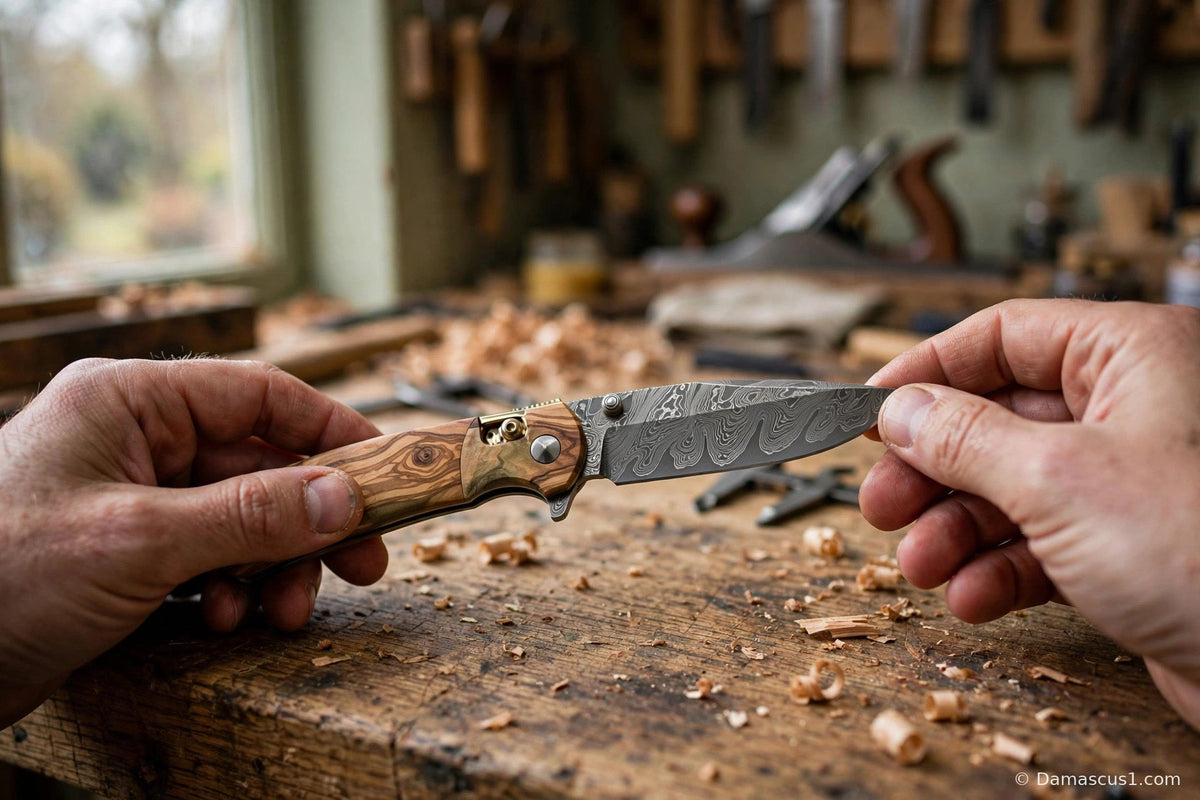
It gets you this: the Olive Wood Damascus Pocket Knife — a handmade folding knife in real pattern-welded Damascus steel, with an olive wood handle, priced at $39.99 USD against a compare-at price of $89.99, verified on the store on 4 November 2026. It opens the slow, deliberate way: a manual two-hand opener with a traditional nail nick — no spring, no flipper, nothing assisted — and it locks open with a back-lock. It is single-edged. Those mechanism facts are stated in the product's own terms here because in the UK they are not fine print; they are the product. A two-hand nail-nick opener is the traditional folder mechanism, the one your grandfather's penknife used, and a back-lock is the honest bargain the lock represents: the blade stays open while you work, and in public the knife travels with a reason.
On price, one clarification this guide owes you in its own voice. Our store prices in US dollars — always has — so the ticket is $39.99 USD, not a converted figure dressed up as a British price. At typical exchange rates that sits inside the under-£40 gift band, which is why UK gift guides keep finding it; but exchange rates move, checkout is in dollars, and the honest number is the dollar one. Judge it as $39.99. It does not need the costume.
What does the money not buy? It does not buy a slipjoint — if you need carry without a reason, the section below is yours, and it does not point here. It does not buy a named annual edition or a numbered collector's run. And it does not buy a kitchen knife: the folder's natural stablemate for the reader whose Damascus interest turns out to be culinary is the Premium Kitchen Knife Block Set at $169.99 USD, which is where the same steel belongs if the chopping board is the real destination — or, as a single blade, the VG10-labelled Nakiri Knife at $44.99 USD. The category view from the buyer's side of the counter — what a pocket knife at this money should and should not be — is our best pocket knife under $50 guide.
Two practical notes, both verified on the store on 4 November 2026. The store banner offers free shipping and returns above $50 — a single folder at $39.99 sits under that line, and two come to $79.98, which crosses it; one for you and one for the gift drawer is the arithmetic most buyers end up doing, and it is worth doing with your eyes open rather than at the checkout's suggestion. And engraving is available on request — a name or a short message on a gift blade is the difference between a good present and his knife — ask before you order rather than assuming a specification the checkout does not promise. For the wider landscape this one folder sits in, our best Damascus pocket knife guide holds the top spot for that search for a reason: it makes the same honesty argument across the whole category. And if the gift is the real errand, the recipient-first framework in our Damascus knife gift for him guide and the personalisation walk-through in engraved pocket knife gift are the companions to this page.
Who should buy a non-locking slipjoint instead?
Anyone whose knife needs to be simply there — in the pocket, every day, no occasion required. For that reader the right Damascus purchase is a slipjoint: a folder held open by spring tension alone, with no lock, and a cutting edge of 3 inches or less, so that both halves of the carry-without-reason exception hold at once. The class is fairly represented on the current UK shelf by the Civivi Elementum Slip Joint Damascus — £76.36 at Knives and Tools in our teardown — a production slipjoint in genuine Damascus with a modern twill carbon handle. It costs more than our folder. For the carry job, it is worth more than our folder, and this guide says so without flinching.
Understand what the slipjoint asks in return, because its fans sometimes skip this half too. A blade that cannot lock can close. Slipjoints are used with that knowledge built into the technique: cuts are made so the edge is loaded in the direction that holds the blade open, fingers stay out of the closing path, and nobody pries, twists or bears down as they would on a locked blade. Generations of British pocket-knife users managed entire working lives inside those rules — the traditional penknife on every farm and allotment in the country was a slipjoint — and a modern example with a firm spring and a sensible half-stop is a civilised tool. But it is a tool with a discipline, and the discipline is the price of the privilege. That is the genuine trade at the heart of this whole category: the lock gives you a blade that cannot fold on you and asks for a reason in public; the slipjoint gives you a public life without reasons and asks for care in the hand. Neither is the "safe" or the "proper" choice in the abstract. Each is correct for a different life, and the decision table above exists so you buy for yours, not for the photograph.
A closing nuance for the traditionalists: the slipjoint family is wider than the modern production example. Friction folders and traditional patterns — the British penknife tradition included — live in the same non-locking world, and a handmade non-locking Damascus folder from a maker like the Perkin listings at the bottom of the shelf can be the collector's version of the same answer, provided the individual listing's blade genuinely does not lock and its cutting edge stays within the limit. Check both, listing by listing, every time. The exception has two conditions and no exceptions to its conditions.
How do you look after a Damascus folder in a British home?

Dry it, oil it lightly, sharpen it on a stone, and store it out of the damp. Pattern-welded Damascus of the traditional kind is not a stainless, shrug-and-forget steel: leave a blade wet in a centrally heated house that cycles hot and cold, or worse in a garden shed through a British winter, and the surface will tell you about it — first as dullness in the figure, then, neglected, as the beginnings of rust in the darker steel. The care that prevents all of it takes about a minute, which is why owners of these knives tend to describe it as a pleasure rather than a chore.
The routine, in full: after use, wash the blade by hand in warm water, and dry it properly — not air-dry-on-the-drainer properly, actually dry, with a cloth, including around the pivot and inside the handle channel where moisture hides on a folder. A whisper of food-safe mineral oil on the blade, wiped almost off, protects the etch between uses and keeps the figure's contrast honest. Store the knife dry, ideally in a pouch or roll rather than loose in a cutlery drawer where edges meet other steel, and keep it out of the bathroom-steamy, shed-damp corners of the house. Sharpen on a whetstone, not a pull-through gadget: a folder's small blade wants the controlled angle a stone gives, and the same stone that maintains the edge maintains the bevel the pattern runs through — our step-by-step in how to sharpen a Damascus knife is written for exactly this blade. The olive wood handle asks even less: keep it dry, and if it ever looks thirsty after a winter by a radiator, the smallest amount of food-safe oil on a cloth brings it back. Do that, and a Damascus folder does not merely survive a British home — it improves in it, the pattern deepening in character the way good leather and good wood do, which is rather the point of owning things made this way.
Frequently asked questions
Is a Damascus pocket knife legal to own in the UK?
Yes — for adults, owning a Damascus pocket knife at home, including a locking folder, is lawful. The law's conditions attach to buying (you must be 18 or over) and to carrying in public, not to keeping a knife in your own drawer, toolbox or collection. This is general information, not legal advice.
Can I carry a locking Damascus folder in public?
Only with a good reason — work that requires it, or carrying it as part of a genuine activity such as camping or fishing, are the standard examples. Carrying in a public place without needing a reason is reserved for a non-locking folding knife with a cutting edge of 3 inches or less. A locking blade, however small, sits outside that exception, so "I just keep it in my jacket" is the one use this category does not offer.
How much should a real Damascus pocket knife cost in the UK?
The current UK shelf, from our 4 November 2026 teardown, runs from handmade listings around £45–£85 (Perkin Knives), through production slipjoints like the Civivi Elementum Slip Joint Damascus at £76.36, up to German annual-edition knives at €249–€278. Our handmade olive wood folder is priced below the whole shelf at $39.99 USD — the store prices in dollars, and that is the figure to judge. Below roughly the £45 line anywhere, apply the real-vs-etched checks in this guide with extra care.
Can I buy a knife online in the UK and have it posted to me?
Yes, if you are 18 or over. Expect age verification at the point of sale and delivery of a marked parcel to a residential address, handed to an adult who may need to prove their age. It cannot be left in a parcel locker or at a click-and-collect point. If nobody adult is home, the parcel returns into the delivery system for another attempt or an identified collection.
How can I tell if a Damascus blade is real or just etched?
Follow the pattern. On genuine pattern-welded steel the figure continues over the spine and through the ground edge, varies organically without repeating, and has a faint relief you can catch in raking light. On a surface-etched lookalike the pattern stops at the edge, sits dead flat, and repeats like wallpaper. Our how to spot a fake Damascus knife guide runs all the checks in order.
Is a Damascus pocket knife a good gift?
For an adult, it is one of the strongest gifts in its price band: handmade, individual — no two pattern-welded blades share a figure — and useful every week of its life. Two practicalities: the recipient must be 18 or over, and delivery is age-verified to an adult, so have it sent to yourself and hand it over in person. Engraving is available on request if you want his name on the moment; our Damascus knife gift for him guide matches the knife to the recipient properly.
Will Damascus steel rust?
It can, if it is left wet — traditional pattern-welded steel is not stainless, and a damp shed or a blade put away damp will mark. Kept dry with a whisper of oil, as the care section describes, it stays bright for decades. Treat the minute of care as part of the ownership, and rust stays a thing that happens to other people's knives.
The bottom line
A Damascus pocket knife in the UK is a simple purchase made confusing by pages that skip the parts that matter. The whole truth fits in the answer we started with: the specialists charge £45–£278; the steel to buy is real pattern-welded steel, checkable in ten seconds; the lock means own it proudly and carry it with a reason, or buy the slipjoint and carry it without one; and the post, for an adult, arrives by a marked parcel into adult hands. If your life fits the locking folder — home, garden, workshop, riverbank, collection — the handmade Olive Wood Damascus Pocket Knife at $39.99 USD is the lowest honest ticket on the shelf, and our best pocket knife under $50 guide holds the wider category to the same standard. Buy the knife your life actually describes, and it will be used, kept and handed over — which is all any good tool has ever asked.
laissez un commentaire: