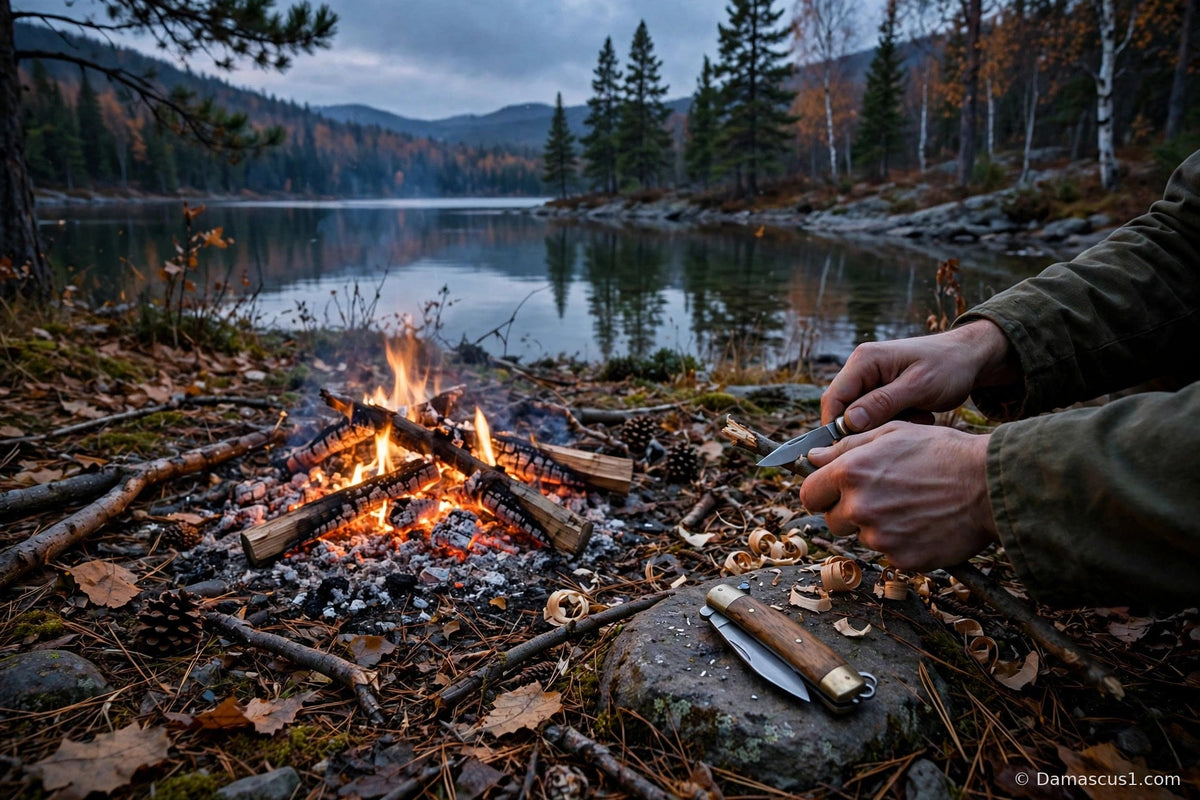
The short answer: There is no single right age for a first pocket knife in Canada — readiness matters more than the birthday. Most children can start with a rounded-tip knife under close supervision around age 5, move to a real pocket knife with supervision around 8 to 10, and only use one unsupervised in their mid-teens after years of supervised practice. The checklist below tests readiness, and the first-week plan shows how to teach it.
Ask a room full of Canadian parents when a child should get a first pocket knife and you will get a room full of different answers — and almost every one of them will be right for the child it was given about. One father will tell you his daughter got hers at eight, the summer she earned her whittling badge at camp, and still carries it at sixteen. Another will tell you his son was not ready at ten and was ready at twelve. A grandmother will tell you she got hers at seven and can still recite the rules sixty years later. None of them will tell you a number and stop there. They will tell you a story about a child, and the number will be inside the story, doing quiet work.
That is the whole argument of this guide: the right age for a first pocket knife is not a birthday. It is a set of things a child can do, reliably, without being reminded — sit still, follow a sequence of steps, stop when told to stop, respect a sharp edge, and tell an adult when something goes wrong instead of hiding it. A child who can do those things at eight is readier than a child who cannot do them at twelve. The guides that top the search results all say the same thing: readiness matters more than age, supervision is not optional, and the knife itself is half the decision.
This guide is written for the Canadian parent, grandparent, or scout leader standing at that decision right now. It does not sell a children's knife, because the knife at the centre of this guide is not one: it is a full-size adult folding knife, a 6.5-inch model, for a mature older child or teenager under adult supervision — as a supervised keepsake and milestone gift, not a toy, and never for a young child. What it does is answer the question properly: the ages the guides actually give, the maturity checklist, the supervised first-week plan, the Canadian law and school context, and the penny tradition. The full teardown is in the research brief beside this draft.
One honesty note before we start: the photographs in this post are editorial scenes made for this guide — campfires, whittling, hands passing a sheathed knife, keepsake boxes — not photographs of the specific knife sold further down the page. The knife itself is described exactly as the store describes it, and the prices are the store's own listed prices in US dollars. Nothing here is converted into Canadian dollars, because a conversion the store did not make would be an invention. The law section is general information, not legal advice.
What age can kids start using a knife?
The short version is a staircase. Most children can begin cutting soft foods with a rounded, blunt-tipped knife under close adult supervision around age 4 or 5. A real pocket knife — a sharp, folding blade — generally enters the picture between 7 and 11, always with supervision, and the guides cluster most tightly around 8 to 10 for a child's own knife, used under supervision. Unsupervised use is a different milestone entirely, and the guides put it much later: mid-teens, after years of supervised practice.
Notice, too, what the staircase does not contain: a legal minimum age. There is no verified federal minimum age for owning a pocket knife in Canada, and this guide does not invent one. The ages in this post are the ages the parenting and knife guides recommend, based on development and safety — not legal thresholds.
When is a child ready for their first pocket knife?


When they can pass the checklist — the heart of this guide, because it is the tool that replaces the birthday. A child is ready for a first real pocket knife when they can do all of the following, reliably, without prompting, across more than one occasion:
- They follow multi-step instructions without shortcuts. Whittling is a sequence: open the knife, lock it, check the lock, cut away from the body, close it, put it away. A child who skips steps in other parts of life — who runs across the road without looking, who climbs before checking the hold — will skip steps with a knife, and a skipped step with a knife is a cut.
- They stop immediately when told to stop. This is the single most important readiness test, and it is the easiest to run. Give any instruction with a sharp object in the room — "put that down now" — and watch. A child who stops, puts it down, and looks at you is ready to be taught. A child who finishes what they were doing first is not, whatever their age.
- They respect tools and understand consequences. They have used kitchen knives, scissors, or a saw under supervision, and they treat a sharp edge as a sharp edge rather than as a toy or a prop. They do not wave tools around, they do not point them at people, and they do not test them on things they should not test them on.
- They have the motor skills. They can hold a stick steady with one hand and control a blade with the other. They can open and close a folding knife deliberately, with two hands, without fumbling. They can sit still for ten minutes. A child whose hands are still learning to cooperate is a child who should wait, and waiting costs nothing.
- They tell an adult when something goes wrong. A nick, a slip, a dropped knife, a rule broken — the ready child reports it. The unready child hides it. This is the test most parents forget to run, and it is the one that matters most at 3 a.m. when you are wondering whether the knife is safe in their pack.
- They actually want to learn — not just to own. The child who wants the knife because they want to whittle, to help at camp, to learn a skill, is ready sooner than the child who wants the knife because it looks cool, because a friend has one, or because it is a status object. Wanting the skill is the readiness. Wanting the object is a warning sign, and the right answer to it is a slower start, not a faster one.
Run that checklist honestly and the birthday stops mattering. Some children pass it at seven, some at nine, some not until eleven or twelve — and that is not a failure, it is a child developing at their own speed. The guides agree: one puts it as "some are ready at 5, some still cut themselves at 20"; another as "maturity and parental guidance matter more than the number." The parent who waits for the checklist instead of the birthday is the parent who gets the story worth telling later.
The maturity checklist: this post's original citable asset
This checklist is this post's original citable asset — the thing a parent can print, stick on the fridge, and run through honestly before buying anything. It is the birthday, replaced by evidence.
| # | Readiness check | What "ready" looks like | What "not yet" looks like |
|---|---|---|---|
| 1 | Follows multi-step instructions | Completes a 4–5 step task in order, every time, without reminders | Skips steps, rushes ahead, or needs the sequence repeated each time |
| 2 | Stops immediately on "stop" | Puts the object down the moment you say so, and looks at you | Finishes what they were doing first, or argues before stopping |
| 3 | Respects sharp tools | Has used kitchen knives or scissors safely under supervision; treats edges with care | Waves tools, points them at people, tests them on things they should not |
| 4 | Has the motor skills | Holds a stick steady with one hand, controls a blade with the other, sits still for 10 minutes | Hands still learning to cooperate; fumbles two-handed tasks; cannot sit still |
| 5 | Reports problems honestly | Tells an adult about a nick, a slip, or a broken rule — every time | Hides mistakes, or only admits them when caught |
| 6 | Wants the skill, not the object | Asks to learn whittling, to help at camp, to carve a tent peg | Wants the knife because a friend has one, or because it looks cool |
| 7 | Understands the rules before the knife | Can repeat the safety rules back to you, in their own words, before touching a blade | Cannot remember the rules five minutes after hearing them |
| 8 | The adult can supervise | You have time for every use in the first weeks, and most uses in the first year | The knife would mostly be used when no adult is watching |
Score it strictly: a child should pass all eight, or the honest answer is "not yet." Seven out of eight is not a pass — it is a plan for which check to work on first. And the checklist is not a one-time test. Run it again after the first month, and again after the first summer. Readiness grows; the checklist grows with it, and the day the last box ticks is a better birthday than any birthday, because it was earned.
The safety rules the child must be able to repeat — check number 7 — are short enough to memorise. Teach them before the knife ever leaves its sheath, and make the child say them back to you:
- A knife is a tool, not a toy. It never gets pointed at a person, never gets waved around, and never gets used to show off.
- Cut away from your body, always. The blade moves away from fingers, legs, and the hand holding the wood. If the cut would travel toward you, turn the wood around.
- The circle rule. Nobody stands inside arm's reach plus a blade's length while you are cutting — your "blood circle," as the Scouts call it. If someone walks into it, the knife closes.
- A sharp knife is a safe knife; a dull knife is a dangerous one. A dull blade needs force, and force slips. Keep the edge keen, and tell an adult the moment it goes dull.
- Open it properly, lock it, check the lock. Two hands, thumbnail in the nail nick, a deliberate pull, and a check that the back-lock has engaged before any cutting starts.
- Close it before you move. A knife is never carried open, never passed open, and never put down open. Closed and sheathed before your feet move.
- If it falls, let it fall. Never try to catch a falling knife. Step back, let it land, pick it up by the handle.
- Tell an adult about every cut, every time. No cut is too small to report. Hidden cuts get infected; reported cuts get cleaned.
Eight rules, one page, and a child who can say them in their own words — not parroted, but understood — is a child who is ready to begin. A child who cannot is a child who needs more time with a blunt trainer and a patient adult, and there is no shame in that. The shame would be in skipping the page.
The supervised first-week plan: how to teach it, day by day
A first knife without a plan is a gift that teaches itself, and the lessons it teaches on its own are the wrong ones. The plan below is the second half of this post's citable asset: seven days, one short session a day, an adult present for every minute of every session, and a skill at the end of it that the child actually owns. Each session is fifteen to twenty minutes — short on purpose, because attention is the limiting factor and a tired child with a sharp knife is the one scenario this plan is built to prevent.
Day 1 — The rules and the knife. Sit at a table, not at a campfire. Lay the knife — closed, sheathed — on the table between you. Teach the eight rules above and have the child repeat them back in their own words. Then teach the opening: two hands, thumbnail in the nail nick, a slow deliberate pull until the blade is fully open, and a check that the back-lock has engaged. Close it the same way, slowly, fingers clear of the blade's path. Open and close ten times — no cutting today. The lesson is that the knife is a sequence, not a flick.
Day 2 — Grip and the blood circle. Outside, sitting down, with a stick and no cutting yet — just the grip. Show the child how to hold the wood with the hand behind the blade, thumb and fingers clear of the cutting line, and how to draw the circle around themselves that nobody enters. Then put the knife away. The lesson is that safety is a place you stand, not a thing you remember.
Day 3 — The first cut. A soft stick — pine, willow, or a dry branch no thicker than a thumb — and one cut only: a long, slow shaving stroke away from the body, the blade moving along the grain. The adult's hand stays near the child's hand, not on it — close enough to stop a mistake, far enough that the child is doing the work. Ten strokes, then stop. A sharp knife cuts with almost no pressure; if the child is pushing hard, the technique is wrong, not the knife. End the session by cleaning the blade, drying it, and sheathing it.
Day 4 — Whittling a point. The classic first project: a tent peg, or a marshmallow stick with a pointed end. Same strokes as Day 3, more of them, with the child setting the pace and the adult watching the hands. Teach the stop rule in practice: every few minutes, say "stop" without warning, and the knife must close immediately. Practise it until it is instant. A child who can stop mid-cut on command is a child who can be trusted to keep going.
Day 5 — The dull-knife lesson. Before the session, let the child feel a blade that has lost its edge — on a piece of scrap wood, under supervision — and watch how much harder they have to push, and how the blade skips instead of slicing. Then show them the sharpening: a few careful passes on a rolling sharpener, the angle held steady, the edge coming back. A sharp knife is a safe knife because it does what you ask with a light touch; a dull knife needs force, and force slips. The lesson is that maintenance is part of owning.
Day 6 — A real job. Give the child a job that matters: cut the twine on a bundle of firewood, slice an apple at the picnic table, trim the cord on a tent, carve the pegs for the tarp. A real job, done properly, with the adult watching but not hovering. End the session with the full routine: clean, dry, oil lightly, sheath, store. The lesson is that the knife is a tool for work, and work is the point.
Day 7 — The test. The child runs the whole sequence alone — with the adult sitting two steps away, watching, saying nothing unless safety requires it. Open, check the lock, cut, close, clean, dry, oil, sheath, store. Then the child recites the eight rules from memory. If they pass, the knife becomes theirs in the supervised sense: their knife, kept in its place, used under supervision, with unsupervised use a milestone years away, not a reward for a good week. If they do not pass, repeat the week. There is no failure in repeating the week.
Why a slow two-hand folder is the right first real knife
Not every pocket knife is a good first knife, and the difference is the opening. A knife that flicks open with one hand — a flipper, an assisted opener, an automatic — opens faster than a child's judgement can keep up with. It rewards the flick, and the flick is the opposite of what the first-week plan teaches. A manual two-hand nail-nick opener does the opposite: it forces slowness. Thumbnail in the nick, a deliberate pull against the backspring, the blade swinging open under the hand's control, and then the back-lock clicking into place. The opening itself is a lesson in patience, and a child who opens their knife that way ten times a day is a child who has practised patience ten times a day.
The back-lock matters for the same reason. Once the blade is open, it stays open — locked, solid, with no chance of folding back onto the fingers mid-cut. A child learning to cut needs to trust the knife to stay where it is, because a child who is worrying about the blade folding is a child who is not watching the cutting line. And when the work is done, the lock releases deliberately, with a press and a controlled close, fingers clear of the edge's path. Every step is deliberate. Deliberate is the whole curriculum.
There is a Canadian reason for the two-hand opener too. The law prohibits blades that open automatically by gravity or centrifugal force, or by a button, spring, or similar device in the handle — and at the border, a folder that can be flicked fully open and locked with one brisk wrist motion can be treated as a prohibited centrifugal opener. A stiff two-hand nail-nick folder is low-risk by design: it cannot be flicked open, because that is not how it opens. This is not a guarantee of any border outcome — no honest seller can guarantee one — but it is a real structural advantage. The full treatment of the law lives in our guide to whether pocket knives are legal in Canada.
Size matters as well. The hero knife is a 6.5-inch model — a full-size adult folder, not a miniature, and not a toy. For a mature older child or teenager with the hands and the judgement to control it, that size is right: the handle fills the hand, the blade is long enough to do real work, and the knife feels like a real tool rather than a novelty. For a young child it would be wrong, and this guide says so without hedging.
What should a first real knife be made of — and what should it not be?
The guides that review children's knives mostly recommend the same thing for a first blade: a small, simple, robust knife with a rounded tip and a two-hand opening — the right recommendation for the first stage, the 5-to-8 stage, when the child is learning the habits. But the milestone this guide is about is the next stage: the first real knife, the one that replaces the trainer. For that stage, the knife should be real steel, honestly made, with a pattern and a handle the child will still be proud of at twenty-five.
That is where Damascus steel earns its place in this story — not as a luxury, but as a keepsake material. Real pattern-welded Damascus is made by forge-welding two steels together — in the hero knife's case, 1095 and 15N20 — folding and layering them until the blade holds roughly 276 layers, and hardening the result to 58–60 HRC. The pattern you see is the two steels themselves, side by side, one etching dark and the other staying bright, and it runs through the steel, so it survives sharpening and comes back after a polish and re-etch. No two blades ever repeat exactly — and that is why a Damascus folder makes a keepsake in a way a stamped stainless blade cannot: the knife a teenager receives at fourteen is still visibly, unmistakably their knife at thirty.
The honest counterpoint belongs here too. Some sellers and guides claim that any Damascus knife under roughly $100 must be fake. The answer is cost structure: a maker-direct knife, sold without the distribution staircase of importer, wholesaler, and retailer each taking a margin, can be a real pattern-welded blade at $39.99 USD. The evidence is on the blade itself — named steels, a pattern that runs through the spine and the edge — and the way to check it is taught in our Canada guide to real versus fake Damascus steel and in our guide to how to spot a fake Damascus knife.
How does a first real knife compare with the usual starter options?
| First knife | Typical age | What it really is | What it teaches | Honestly best for |
|---|---|---|---|---|
| Rounded-tip trainer (e.g. My First Victorinox-type) | 5–9, supervised | Blunt-tipped, small, simple; two-hand opening; hard to cut yourself badly with | The habits: grip, direction, stopping, the circle rule | The first stage — learning the habits with almost no risk |
| Small adult knife after trainer skills (~age 10) | ~10, supervised | A small, sharp, real blade; the bridge between trainer and full-size | Real edge respect: a sharp knife cuts, and care matters | The bridge stage, once the trainer habits are solid |
| Cheap stainless keychain knife | Any age (too often, too young) | A very small stainless blade on a keyring; too small to learn proper grip | Almost nothing — the grip is wrong, the edge is poor, the habits do not transfer | A keyring backup; not a first knife, and not a milestone |
| Multi-tool (e.g. Tinker-type, 8–13) | 8–13, supervised | Pliers and tools first, blade second; the blade is short and awkward for whittling | Versatility, not knife skill; the blade is a secondary tool | The child who needs a multi-tool for camp chores, as a companion, not a first blade |
| Olive Wood Damascus Pocket Knife Set | Mature older child / teen, supervised | Full-size adult folder; forge-welded 1095 & 15N20, ~276 layers, 58–60 HRC, olive wood handle, two-hand nail-nick, back-lock, 6.5-inch model | The full craft: deliberate opening, real edge control, sharpening, oiling, keeping — a keepsake skill | The milestone: the first real knife, given when the checklist passes, kept for life |
| Orange Wood 6.5" Hunting Pocket Knife | Mature older child / teen, supervised | Same family, warmer orange-toned wood, same price | The same full craft, with a calmer, more uniform handle | The same milestone, for the teenager who prefers quieter grain |
Read the table as a staircase, not a contest. The trainer wins the early years because it is almost impossible to hurt yourself with. The small adult knife wins the bridge years because it is real enough to respect and small enough to control. The Damascus folder wins the milestone because it is the knife that is still worth carrying at twenty-five. The keychain knife loses at every stage: a first knife too small to hold properly teaches the wrong grip, and the wrong grip is harder to unlearn than no grip at all.
What about the penny? The old tradition that makes the gift a milestone
Some readers will have heard the superstition: giving a knife cuts the friendship, or severs the bond between giver and receiver. It is an old belief, and it is worth answering in the first paragraph of any honest discussion, because the parent who has heard it is already worrying about it. No — giving a knife does not cut anything. What the tradition actually prescribes is a small, charming piece of theatre: the recipient gives the giver a coin in return, so the knife is technically bought, not given, and the bond is never cut at all. A penny, a loonie, a small coin taped to the card — the amount does not matter.
For a first knife, the penny tradition is more than superstition insurance. It is the ceremony that marks the milestone. Tape a coin to the gift tag, write "for the knife" on the tag, and hand it over with the eight rules and the first-week plan. The child hands the coin back with a smile, the ritual is complete, and the moment becomes a memory instead of a transaction. Years later, the teenager will not remember the price of the knife. They will remember the coin, and the campfire, and the adult who sat with them for a week and taught them properly.
Which knife should a Canadian actually buy as a first real knife?
Start with the one this guide was built around, described exactly as the store describes it. The Olive Wood Damascus Pocket Knife Set is priced at $39.99 USD (compare-at $89.99) — forge-welded 1095 and 15N20 Damascus at roughly 276 layers and 58–60 HRC, an olive wood handle, 6.5 inches overall, single-edged, with a manual two-hand nail-nick opening and a back-lock. It is not one-hand, not a flipper, not assisted, not automatic, and this guide describes it no other way, because the mechanism matters — for a first knife, and in Canada. It is not stainless: keep it clean and dry and oil it lightly. Personalisation is engraving available on request — quote-based, up to 25 characters — which covers initials and a date, or a name and a short line. Buyer reviews on the product page rate it 4.9 out of 5 — that figure is the product page's own.
The natural second choice inside the same store is the Orange Wood 6.5" Hunting Pocket Knife, also $39.99 USD. Same family, same price — the difference is the wood's personality. Orange wood runs warmer and quieter: a more uniform, sunset-toned handle with subtler figure, for the teenager who looked at olive wood's dramatic grain and thought beautiful, and a bit much for me.
The third object in the kit is not a knife at all, and it belongs in the gift because the first-week plan needs it: the Rolling Knife Sharpener at $39.99 USD — a diamond sharpening kit with 15- and 20-degree angle guides. A sharpener with a fixed angle guide makes the dull-knife lesson teachable: the teenager can hold the angle without guessing, and the edge comes back the same way every time.
For the wider buying picture, our Canada hub guide to the Damascus pocket knife in Canada covers it, and the field guide to the best pocket knife under $50 in Canada puts this price class in its full context.
Two knives at $39.99 each come to $79.98 USD, which crosses the store banner's "Free Shipping & Returns above $50!" line — the honest arithmetic, and the useful one, because a milestone gift often comes in pairs: one for the teenager, one for the adult who taught them. Prices are in USD exactly as listed; convert at the day's rate yourself, and expect the standard cross-border picture on any US order into Canada — possible GST/HST and a carrier handling or brokerage fee on arrival. No delivery date is promised anywhere in this post.
Is a pocket knife legal for a child to own in Canada — and can they take it to school?
The short version, as general information and not legal advice: ordinary manual pocket knives are legal to own in Canada, with no federal blade-length limit, and no verified federal minimum age for ownership — under-18s can own and use a knife under adult supervision at home, at camp, or at the cottage. What Criminal Code s.84 prohibits is opening mechanisms — blades that open automatically by gravity or centrifugal force, or by a button, spring, or similar device in the handle. At the border, the CBSA can treat a folder that can be flicked fully open and locked with one brisk wrist motion as a prohibited centrifugal opener. The hero knife's manual two-hand nail-nick opening with a back-lock is low-risk by design — no border outcome is ever guaranteed. Carrying turns on purpose: a knife carried as a tool for a lawful purpose, under adult supervision, is treated as a tool; carried as a weapon, including for self-defence, it is not. The full treatment lives in our guide to whether pocket knives are legal in Canada.
School is a separate, absolute rule, and it is the simplest sentence in this guide: never take a knife to school. Schools in Canada operate zero-tolerance policies on blades, and a pocket knife in a school bag — whatever the reason, however innocent — is a disciplinary matter with serious consequences. It does not matter that the knife was a gift, or that the child only wanted to show a friend, or that they forgot it was there. The rule is the rule, and the first-week plan should teach it on Day 1, in the same breath as the eight safety rules: the knife lives at home, at camp, or at the cottage, under adult supervision, and it never, ever goes to school.
What is actually on page one for "first pocket knife age" — and why it leaves the door open
First, none of them is Canadian — no Canadian law context, no school zero-tolerance rule, no cottage-and-camp framing, no mention of the border flick test. Second, none of them ties a real Damascus folder to the milestone: the knives they recommend are trainers and small starters, and the guides end where the trainer ends. Third, none of them gives a supervised first-week plan — ages and rules, but not seven days with a skill at the end of each one. That is the gap this post fills: the ages, the Canadian context, the real knife, and the plan, in one place. The full teardown is in the research brief beside this draft.
The Olive Wood Damascus Pocket Knife Set — $39.99
Real Damascus steel, an olive wood handle and a genuine leather sheath included — the knife our readers ask about most.
Shop the Olive Wood Damascus Pocket Knife Set — $39.99 · Free US shipping on orders over $50.
Frequently asked questions
What age can kids start using a knife?
Most children can start cutting soft foods with a rounded, blunt-tipped knife under close adult supervision around age 4 or 5. A real pocket knife generally enters the picture between 7 and 11, always with supervision, with the guides clustering most tightly around 8 to 10 for a child's own knife, used under supervision. The maturity checklist in this guide is the test, not the age.
What age should a kid get a pocket knife?
Most guides put a child's own first pocket knife at around 8 to 10, with supervision — some children are ready as young as 6 or 7, others not until 8 or 9, and most by 8 or 9. The deciding factors are the ones in the checklist: following multi-step instructions, stopping instantly on command, respecting sharp tools, having the motor skills, reporting problems honestly, and wanting to learn the skill rather than just own the object.
Is 8 old enough for a first pocket knife?
Eight is the age the guides cluster around most tightly — the age Scouts start earning whittling badges, and the age several guides name as the point where a child may be ready for their own knife with supervision. But eight is a guideline, not a guarantee. The right question is not "is eight old enough" but "is this eight-year-old ready," and the checklist answers that question for any age.
Can a 10-year-old have their own knife?
Yes, with supervision — and by 10, responsible children with solid skills from a trainer knife can have their own knife, according to the camping and children's-safety guides. "Their own" still means supervised use: the knife has a home, the adult decides where and when it is used, and unsupervised use is a milestone years away, in the mid-teens, after years of supervised practice.
When can kids use a pocket knife unsupervised?
Not until their mid-teens, after years of supervised practice — that is the cautious, consistent answer from the knife-safety guides. The more permissive guides suggest responsible children can use a knife unsupervised around 10, but even those condition it on the word "responsible" doing a great deal of work. This guide follows the cautious reading: unsupervised use is earned over years of supervised sessions, not granted with the gift.
Can a child take a pocket knife to school?
Never. Schools in Canada operate zero-tolerance policies on blades, and a pocket knife in a school bag is a serious disciplinary matter whatever the reason — even if the child only wanted to show a friend, even if they forgot it was there. A first knife lives at home, at camp, or at the cottage, under adult supervision. Teach this rule on Day 1, in the same breath as the safety rules, and repeat it until it is automatic.
What is the best first real pocket knife for a teenager?
The best first real knife is a full-size, honestly made folder with a slow, deliberate two-hand opening and a lock that holds the blade open while it works — not a flick-open or assisted knife, and not a toy or a keychain novelty. The Olive Wood Damascus Pocket Knife Set at $39.99 USD is this guide's pick for the milestone: forge-welded 1095 and 15N20 Damascus at roughly 276 layers and 58–60 HRC, an olive wood handle, a manual two-hand nail-nick opening with a back-lock, and a 6.5-inch model sized for a mature older child or teenager under supervision. It is a full-size adult folder, not a children's knife — and that is the point.
Is it bad luck to give a knife as a gift?
No — and the tradition has a built-in answer. The old belief is that a gifted knife "cuts" the bond, so the recipient gives the giver a coin in return, making the knife technically bought rather than given. Tape a coin to the gift tag, hand it over, and the ritual is complete. The amount does not matter; the gesture does — and for a first knife, the coin is the ceremony that turns a purchase into a milestone.
The last word: the birthday is the wrong test, and you already know it
Every parent who has read this far already knows the real answer to the question in the title, because they have been watching their child, not the calendar. They know whether their eight-year-old stops when told to stop, whether their ten-year-old reports a mistake or hides it, and whether their teenager wants to learn whittling or just wants to own something sharp. The checklist knows it too, and the first-week plan turns the checklist into a skill, and the skill turns a gift into a memory.
If your child passes the checklist — all eight checks, honestly, on more than one occasion — and you have the time to supervise every use in the first weeks, then the milestone is ready when you are. The Olive Wood Damascus Pocket Knife Set at $39.99 USD is the way to mark it: a handmade Damascus folder, a manual two-hand opening, a leather sheath, engraving available on request, and a price that leaves room for the sharpener. Buy the knife, tape the coin to the tag, and start Day 1 at the kitchen table. The knife will still be in their pocket at twenty-five — and so will the week you spent teaching them to use it.
laissez un commentaire: