A patterned blade invites a closer look. The lines suggest movement, the handle adds warmth, and the finished object can feel more interesting than a plain specification sheet. Understanding the broad making process helps you appreciate that appearance without confusing it with proof of performance. This guide explains the main ideas behind modern pattern-welded pocket knives and, just as importantly, the questions a buyer should ask about the particular item they intend to purchase.
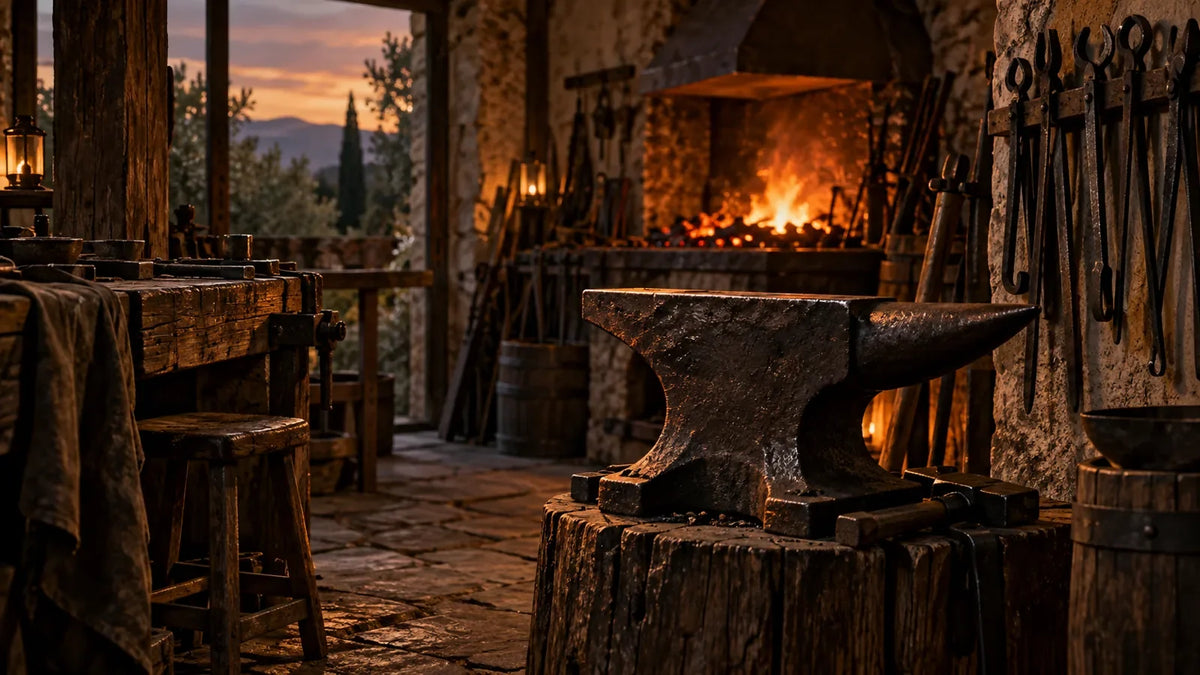
This is an educational overview, not a workshop recipe or a documentary record of Damascus1 manufacturing. The illustrations are AI-generated editorial scenes. They do not identify the facility, worker, steel composition, or production history of any product in the catalog. The exact materials, process, dimensions, heat treatment, mechanism, and finish must be established from the individual listing and reliable maker information. Keeping that distinction clear makes the story of craftsmanship more useful, not less interesting.
Begin with the word Damascus
Damascus is used in several historical and modern contexts. Pattern-welded material and historical crucible or wootz traditions should not be treated as identical processes. In modern retail descriptions, the term often refers to patterned steel, but the word alone leaves many questions unanswered. Knife Steel Nerds explains this terminology in its discussion of Damascus myths. As a buyer, ask what the seller means for the specific product instead of assuming that every patterned knife shares one origin story.
Separate the broad category from the actual specification. A listing may identify the steel combination, construction, or other details; it may also leave some of those fields unstated. Read precisely. If the composition is not given, do not infer a familiar combination because it is common elsewhere. If a process is not documented, do not treat a generic forge photograph as evidence. A convincing image can illustrate a concept while providing no product-specific verification at all.
This distinction is useful beyond knives. We often recognize a material's visual vocabulary before we understand its construction. Wood grain, woven cloth, and patterned metal can all create immediate impressions. Those impressions are a starting point for curiosity. They are not a substitute for knowing what was used, how the object is intended to function, or what care it requires. The responsible buyer can enjoy the visual character while still asking ordinary practical questions.
Material selection comes before the visible pattern
Pattern-welded steel involves combining selected materials into a layered construction. The choice of materials matters to the making process and the finished behavior. Metallurgist Larrin Thomas's discussion of 1084 and 15N20 examines why compatibility, treatment, and contrasting appearance cannot be reduced to a single fashionable steel name. That article is a technical resource, not a specification for Damascus1 products. A maker's documented combination is needed before applying its discussion to a particular knife.
For a buyer, the useful question is not “which two names sound most impressive?” It is whether the product's material description is clear and whether relevant claims are supported. Ask what is known, who supplies that information, and whether it applies to the selected model. Avoid asking the seller to confirm a composition you have guessed from an internet article. An open question is more likely to expose an uncertainty than a leading question that supplies its own expected answer.
Keep a small material record for any knife you buy. Include the stated blade material, handle description, and any instructions supplied with the item. If an answer remains unknown, write that explicitly. This prevents a later discussion from turning assumptions into remembered facts. It also helps if the product range changes or if several visually similar options exist. Good documentation is a quiet part of craftsmanship appreciation: it connects the attractive object to accurate information.
From separate material to a working billet
At a broad level, pattern welding joins material into a billet that can be worked into the desired form. The details depend on the materials and the maker's controlled process. This guide deliberately omits temperatures, chemical recipes, and procedural instructions. A photograph of glowing metal is not sufficient training for forge work. The educational point is that the finished surface reflects a making process involving material choices, forming, and subsequent finishing, rather than appearing by magic at the end.
When a seller discusses this stage, distinguish a general explanation from evidence about the supplied product. A brand may sell items produced by different makers or through different arrangements. The existence of a forge story does not establish that every component was produced at one location or by one person. If provenance matters to your purchase, ask for a clear statement that applies to the item. Do not fill gaps with a romantic narrative simply because the photograph is persuasive.
The same care applies to words such as handmade. Different sellers may use the term for different combinations of handwork, machine work, assembly, and finishing. Ask what work the claim describes rather than assuming that every surface was formed without machinery. Useful answers identify the actual contribution. Vague language may still express enthusiasm, but it should not be converted into a detailed manufacturing history in a review, gift note, or product comparison.

Pattern is a design choice, not a performance score
The visible arrangement of layers contributes to the finished pattern. It can be appreciated as design without being ranked as a numerical measure of quality. Closely spaced lines, broad flowing areas, or a high-contrast finish may suit different tastes. Ask what the maker calls the pattern if that information is available, but do not assume that a dramatic name establishes superiority. A pattern description and a performance claim answer different questions.
The contrast seen in a photograph is also influenced by finishing and lighting. Thomas's material discussion notes that photography and finishing can affect perceived contrast. For an online buyer, this is a reason to inspect more than one view and to expect that real-world lighting may change appearance. It is not a reason to dismiss product images. It is a reminder to use them for what they show, while asking about material and construction separately.
If exact appearance matters, ask whether the gallery is representative or shows the individual item. Natural variation, production variation, and photographic conditions can affect what arrives. Avoid promising a gift recipient the precise placement of every line unless the seller has explicitly identified the photographed piece as the one supplied. A patterned object can remain attractive when it differs from a reference image, but expectations should be set before purchase rather than explained after disappointment.
Shaping creates the usable form
The blade's outline, thickness, and geometry contribute to how the knife fits its intended role. The pattern may be visually prominent, yet the underlying form deserves equal attention. Read the dimensions and intended-use information rather than judging from the surface alone. If a photograph makes the blade look substantial, verify the actual measurements. A close-up image can emphasize texture while giving little reliable sense of scale or proportion in the hand.
For a folding knife, the blade is part of a larger mechanical relationship. The form must work with the handle, pivot, and any locking arrangement used in that model. This is why a blade photograph cannot explain the whole product. Ask for the appropriate operation instructions and understand what the knife is intended to do. Do not infer that a pattern, a large bolster, or a thick-looking spine authorizes tasks outside the maker's description.
A useful product comparison should keep appearance and functional details in separate fields. Record the pattern as a visual preference, the dimensions as stated measurements, and the mechanism as documented information. Leave uncertain fields blank. This approach makes it harder for one striking photograph to dominate the decision. It also reveals what questions remain before ordering, which is more useful than assigning a general quality score based on how expensive the item looks.
Heat treatment belongs in the evidence conversation
Heat treatment is one of the technical subjects that can become oversimplified in retail language. A broad statement about patterned steel cannot establish the exact treatment or resulting properties of an individual blade. Knife Steel Nerds' comparative testing of Damascus combinations demonstrates the importance of evaluating actual materials and treatment rather than assuming one universal outcome. That research does not test every product sold under the Damascus name and should not be presented as if it does.
If a listing gives a hardness figure or other technical claim, ask whether it refers to the selected product and what supports it. Do not assume a figure from another model applies because the handle appears similar. Equally, do not invent a number to complete a comparison chart. An honest chart can say not supplied. When a detail is essential to your purchase, obtain a reliable answer or choose a product with documentation that meets your needs.
Avoid homemade performance tests intended to validate a purchase. Striking, bending, prying, or cutting unsuitable materials can be unsafe and can damage a tool. Use the item only as instructed and follow the seller's inspection or return process if something seems wrong. A buyer's role is not to recreate a metallurgical laboratory. It is to understand the documented purpose, recognize unresolved questions, and obtain appropriate assistance when necessary.
Finishing makes the pattern visible to the owner
Finishing influences the surface you see and touch. A polished detail, a darker area, or a textured pattern can contribute to the design language of the complete knife. Those choices should be appreciated alongside the maker's care directions. Do not assume that a household polishing compound or an online re-etching recipe is appropriate simply because the surface is metal. Maintenance can alter appearance, and some processes introduce hazards that belong in a properly equipped professional setting.
The most useful first step after purchase is to preserve an accurate record of the original condition. Take safe photographs in clear lighting, save the listing, and keep the supplied instructions. If you later notice a change, you can compare it with the starting point and ask a precise question. That is more reliable than relying on a memory of a highly lit website photograph or attempting a treatment before understanding the concern.
For ordinary ownership, the Damascus folding-knife care guide provides an organizational framework: identify the model, account for actual exposure, use approved methods, and keep the item secure. It does not offer a chemical restoration recipe. Knowing how the surface relates to the making process should encourage careful ownership, not the assumption that every owner must become a finisher or bladesmith.

Handle making adds another material story
The handle changes how a knife looks and how it fits the owner. Wood grain, horn descriptions, metal details, and the relationship between surfaces can make two pocket knives feel quite different visually. Read the actual material description and ask about the finish. Do not assume that an attractive wood-like appearance identifies the species, treatment, or construction. The listing should establish what is being sold; the image helps you understand its visual character.
At the level of general craft appreciation, handle work involves attention to shape, fit, and finish. The precise sequence and tools vary, and this article does not document a particular maker's method. Our workbench image illustrates the idea of separate materials becoming parts of an object. It should not be interpreted as an inventory of components inside every linked knife or as proof that a specific product uses the pictured wood or fasteners.
Compare the Olive Wood Pocket Knife Set, Blue Wood pocket knife, and Buffalo Horn Handle pocket knife through their individual listings. Read the current details, chosen variant, and care information. Their inclusion here gives you real catalog paths for comparison; it does not establish a shared manufacturing process or identical specification. Ask about the model you intend to buy.
Assembly is where the object becomes a folder
A folding knife must be understood as an assembled product, not merely a patterned blade attached to a decorative handle. The pivot, fit, opening and closing method, and any locking arrangement deserve attention. Obtain the correct instructions and follow them. Do not assume that familiarity with another folder means the new one operates identically. Small differences in design can matter to handling, and the maker's directions should guide the owner.
If the knife does not operate as described, stop using it and contact the seller. Avoid disassembling it to investigate unless you have appropriate authorization and instructions. The wish to understand craftsmanship does not require taking a new product apart. A clear description, safe photographs, and the order details can support a service request without altering the item. Keep the distinction between educational curiosity and practical repair work clear.
Assembly details also help you ask better pre-purchase questions. Which mechanism is used? Where are the operating instructions? What inspection is recommended on arrival? What should the owner do if operation changes? These questions are more useful than asking whether the knife is premium. A considered answer gives you information that can be used. An adjective may express positioning without telling you anything about the actual handling process.
Quality questions should be specific
There is no single photograph that proves every aspect of quality. A close-up can show surface detail, but it does not establish heat treatment, long-term behavior, or the history of the object. A review can describe an owner's experience, but it does not replace the specification. A brand story can explain values, but it does not identify the materials in every product. Combine sources thoughtfully and keep each claim connected to the kind of evidence that can support it.
Before ordering, ask what you need to know for your intended use. That may include dimensions, stated materials, mechanism, included accessories, care instructions, and current return terms. If a response is incomplete, ask a narrower follow-up. A useful exchange might resolve whether an image shows two knives or two views of one knife, or clarify which accessory is actually included. These ordinary questions often matter more to satisfaction than a dramatic description of forging.
Avoid asking for proof in a way that invites unsafe demonstrations. You do not need a seller to perform an improvised destructive test on camera. Ask for documentation relevant to the claim instead. If reliable information is unavailable and the point is essential, choose accordingly. Responsible purchasing does not require accepting every claim, but it also does not require creating a spectacle around doubt. Clear questions and proportionate evidence are enough.
Read the product story at three levels
The first level is general education: what pattern welding is, how materials can create visual contrast, and why a folding knife has several interacting parts. The second is the maker or brand story: who is involved and what processes they describe. The third is the individual product specification: what the selected item is made from, what it includes, and how it should be used and cared for. Confusion occurs when information from one level is silently treated as proof at another.
For example, an article about a common steel combination does not establish that a particular listing uses that combination. A photograph of a forge does not establish the origin of a handle. A customer's praise for a gift set does not verify a hardness claim. These are not reasons to avoid the information; they are reasons to label it accurately. A strong product story becomes more credible when it is clear about what each source can and cannot show.
Use the three levels when sharing a purchase with someone else. You can say that the patterned appearance interests you, point to the product's documented materials, and share a general article about the craft. You do not need to merge those points into an unsupported claim that every part was made by one named process. Careful language preserves the pleasure of the object while allowing the next owner to understand what is actually known.

Turn curiosity into a better buying decision
Start with the pocket collection, select a few candidates, and record the details that matter to you. Keep visual preferences separate from essential practical requirements. If you are buying for another person, the gift-set guide helps connect those details to the recipient. If the knife is for a trip, the camping comparison guide begins with tasks and conditions.
Do not force the most dramatic pattern to win the comparison. Another option may provide clearer documentation, a more suitable format, or a better fit for your care routine. Equally, it is reasonable to value the appearance once the practical requirements are satisfied. A knife can be both a useful object and something you enjoy looking at. The point is to know which part of the decision is aesthetic and which part depends on documented facts.
After purchase, save the listing and ask any remaining questions before putting the knife into use. Keep the instructions and support information available. If you later write a review, describe what you actually observed rather than repeating uncertain manufacturing claims. A useful review might explain how the item corresponded with the listing or which documented details helped you choose. Honest ownership accounts contribute more than borrowed superlatives about processes the reviewer did not witness.
Frequently asked questions
Does a more complex pattern mean a better knife?
Not by itself. Pattern complexity is a visual characteristic, while suitability depends on the complete product and intended use. Read the materials, dimensions, mechanism, care requirements, and relevant documentation. Do not convert visual intricacy into a universal performance ranking. It is entirely reasonable to prefer one pattern, but that preference should sit alongside the practical questions rather than answer them automatically.
Can I identify the steel combination from a photograph?
A photograph is not a reliable material certificate. Lighting, finishing, and different constructions can affect appearance. Ask for the actual stated composition or construction when that information matters to the purchase. If it is not available, mark it as unknown. Avoid repeating a familiar combination from a general article as if it were confirmed for the selected product.
Are the workshop images photographs of Damascus1 production?
No. The images in this guide are AI-generated editorial illustrations. They communicate a general craft atmosphere and material ideas, not the location, personnel, equipment, or process used to manufacture a particular product. Refer to product-specific documentation and direct seller information for provenance questions. An honest caption is part of a useful educational page.
Should I try to restore the pattern myself?
Obtain product-specific advice before using abrasive or chemical treatments. This guide does not provide restoration instructions. If the finish changes or corrosion appears, document the condition safely and contact the seller or an appropriate professional. Improvised treatment can alter the appearance and may introduce hazards. Routine care should follow the actual knife's instructions, not a recipe selected because an online photograph looks similar.
Keep a small evidence notebook
If you enjoy learning about materials, create a notebook that separates confirmed information from questions. Give each product its own page. Record the exact wording of the specification in your private notes, the source, and the date checked. Add a separate section for general reading. This simple structure prevents an interesting fact about one steel combination from becoming an assumed fact about every knife you own. It also makes future conversations with sellers more precise.
Use another space for your own observations. Describe appearance under normal lighting, correspondence with the listing, and the clarity of the supplied instructions. Do not present these observations as laboratory findings. A buyer can contribute useful information without claiming expertise they do not have. If you later discover that an assumption was wrong, correct the record. An evolving, honest notebook is more valuable than a polished collection of claims that were never verified.
This approach also changes how you read a dramatic product story. Instead of deciding that the entire story must be either true or false, ask which parts are general background, which concern the maker, and which apply to the selected item. Follow up on the details that matter to your purchase. You may still choose the knife because its pattern and handle appeal to you, but the decision will rest on a clearer understanding of what is known and what remains uncertain.
The pleasure of craftsmanship does not require certainty about every technical detail. It requires honesty about the available information and respect for the object's intended role. You can admire a surface, appreciate a thoughtful design, and maintain a useful tool while continuing to learn. That is a more durable relationship with a product than one built around a single extravagant claim about steel, strength, or a manufacturing process nobody has documented for the actual item.
Sources and editorial note
- Knife Steel Nerds: Five Myths About Damascus Steel.
- Knife Steel Nerds: Is 1084–15N20 the Best Pattern-Welded Damascus?.
- Knife Steel Nerds: Testing Different Damascus Combinations.
A practical next step
Keep the exact product link with the questions that matter to your purchase. Confirm the selected option, actual contents and care information before ordering. If a specification is unclear, ask about that model rather than assuming a general article supplies the answer. Your comparison becomes more useful when the details remain connected to a named product and a reliable source.
Compare actual models
Start with the details.
Open each listing for its current variants, photographs, price and available reviews. Confirm any unclear specification or included item before ordering.
Browse the pocket knife collection ↗Frequently asked questions
Does more visible pattern mean better performance?
No. A decorative pattern alone does not establish edge retention, toughness, corrosion resistance or heat-treatment quality.
Are these photographs of the Damascus1 factory?
No. The craft scenes are AI-generated editorial illustrations, not documentary photographs of a manufacturing facility.
What evidence should a buyer ask for?
Ask for model-specific steel and construction details, dimensions, mechanism, care instructions and current warranty or return terms.
laissez un commentaire: