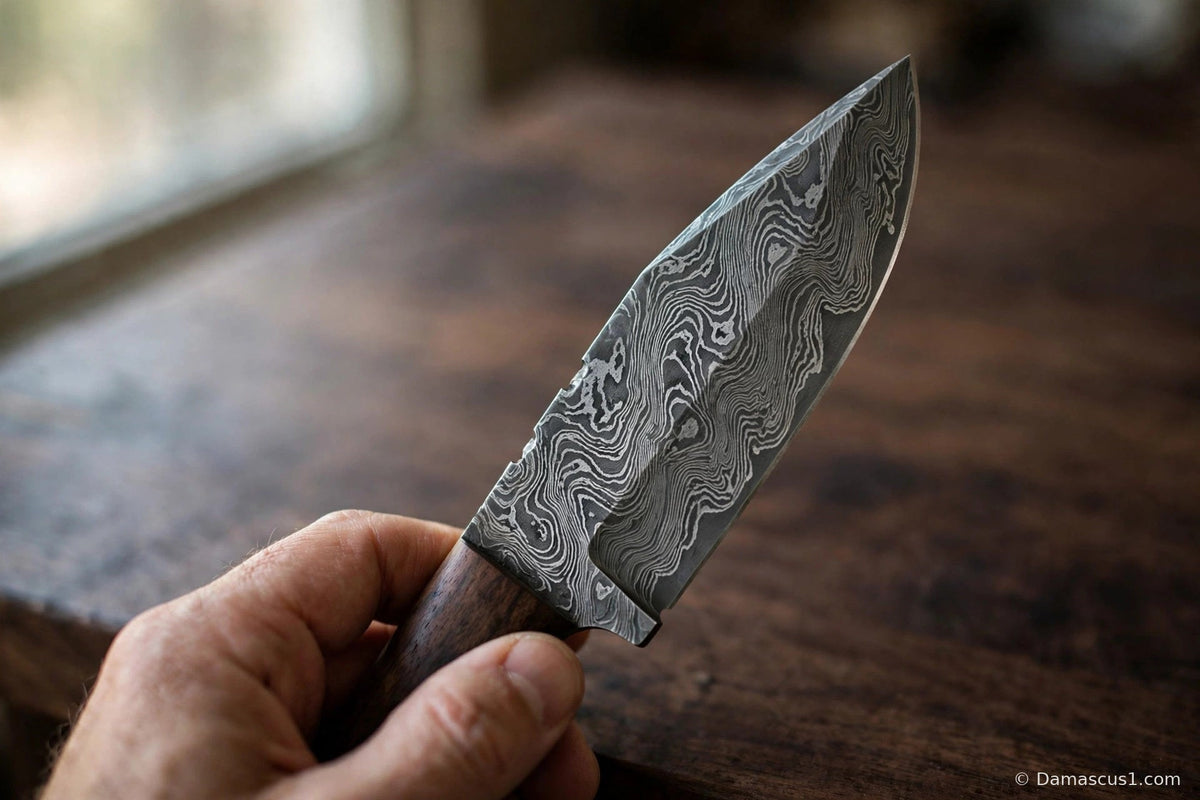
Direct answer: To spot a fake Damascus knife, check whether the pattern continues over the spine and into the edge, look for a pattern that fades or sits flat at the grind, and ask the seller to name the two steels in the blade. Real layered steel shows depth and variation. A printed, laser-etched, or coated pattern usually looks identical, flat, and stops where the grinding starts.
That short answer will catch most fakes. The rest of this guide slows it down, test by test, so you can use it on a listing photo, in a shop, or at your kitchen table with a knife that has just arrived in the mail — before your return window closes.
A quick note on honesty before we start, because it matters more than any single test: a beautiful pattern, on its own, proves less than most listings imply. It does not by itself prove a steel grade, a layer count, or that a knife was handmade. Even a good seller cannot show you those things in a photograph. That is not a reason to avoid Damascus. It is a reason to buy it the way you would buy anything made by hand — from a seller who labels things clearly, answers specific questions, and stands behind a return. For more reading while you shop, the Damascus1 blog index collects our care, sharpening, and buying guides in one place.
What does "fake Damascus" actually mean?
Direct answer: "Fake Damascus" usually means a single piece of ordinary steel with a pattern added to the surface — printed, laser-etched, or coated — rather than a blade forged from two or more steels layered together. The knife may still cut. What is fake is the claim: you are paying for layered steel and receiving decorated steel instead.
That distinction — decorated versus layered — is the whole game. Traditional Damascus, in the modern sense, is pattern-welded steel. A maker stacks two different steels, forge-welds them into one billet, folds or manipulates that billet, and then etches the finished blade. The two steels react to the etch at slightly different rates, so the layers become visible as waves, ladders, raindrops, or twists. The pattern is not on the steel. The pattern is the steel, revealed.
A fake reverses that. Start with one steel — sometimes decent, sometimes not — and put the look on top of it. The cheapest versions are printed, much like a photo transferred onto the blade. Better-looking versions are cut in with a laser. Others use a coloured or titanium-style coating that mimics the contrast of an etch from a distance. All three can photograph beautifully. All three tend to fail the same simple checks later in this guide, because a surface treatment has no depth and no reason to continue over a spine or into an edge.
There is also a middle category worth naming fairly: honest "Damascus-style" knives. A seller who clearly says a blade is a single steel with a Damascus-style finish, prices it as a decorative knife, and makes no layered-steel claim is not running a scam. They are selling a look, labelled as a look. The problem is only when that same knife is described as layered, hand-forged Damascus at a layered-steel price. Keep that fairness in mind. It will make you a sharper buyer, and it will stop you writing off good, honestly labelled knives — including plain stainless knives, which plenty of reputable collections sell openly as stainless. Clear labelling is a sign of a seller you can trust, not a confession.
How can you spot a fake Damascus knife with no tools at all?
Direct answer: With no tools, use your eyes and the listing itself. Real layered patterns vary — waves change spacing and direction, and no two sections match exactly. Printed patterns repeat, look flat under changing light, and often end in a clean line at the grind. Vague listings that avoid naming any steel are a second, equally useful warning.
Test 1 — the repetition check (no tools). Look slowly across the whole flat of the blade, not just the prettiest section in the middle. In layered steel the pattern behaves like wood grain or moving water. It bunches up in one place, stretches out in another, and swirls where the maker manipulated the billet. It should not tile. If you find the same little knot of waves appearing again at the same spacing, like a pattern on wrapping paper, you are very likely looking at a print. Take your time here. Sellers of fakes rely on a fast glance. A slow, full-blade look is free, takes thirty seconds, and catches a surprising share of them.
Test 2 — the light-angle check (no tools). Tilt the knife under a lamp or a window. An etched, layered blade has subtle relief. As the angle changes, some lines darken, others lighten, and the pattern seems to sit at slightly different depths — because it does. A printed pattern tends to stay uniformly flat and glossy, the same at every angle, like ink under a clear coat. A coating can behave similarly, staying shiny and even where an etch would look more matte and varied. Neither no-tool test is absolute on its own — lighting and photography can mislead — but together, repetition plus flatness is a strong early signal, and both tests cost you nothing.
While you have the listing open, apply the same scepticism to the words. Does the product page name handle materials, dimensions, and construction plainly? Or is it all atmosphere — "legendary," "ancient," "master-crafted" — with nothing you could ever check? Atmosphere is not proof of a fake, but specific, checkable detail is the habit of honest sellers. It is also the habit behind a useful starting point if you want to compare against a clearly described, accessibly priced option: the Everyday EDC Pocket Knives collection lists individual Damascus pocket knives by handle material and size, so you can compare like with like instead of guessing from a hero photo alone.
Does the pattern continue over the spine and edge?

Direct answer: On a genuinely layered blade, the pattern should be visible, in some form, over the spine and toward the edge, because the layers run through the whole piece of steel. If the waves stop cleanly at the flat of the blade and the spine and edge are plain, uniform metal, that is one of the strongest signs of a surface-only fake.
Think about why this works. A billet of layered steel is layered all the way through, like the inside of a layered cake, not just iced on top. Grind that billet into a blade and every surface you expose — flat, spine, choil, and the bevel down to the edge — is a cross-section or a continuation of those same layers. The pattern may look different on the spine: tighter, more compressed, sometimes fainter. That is normal. Grinding and polishing affect each surface differently. What should not happen is a total disappearance exactly where the flat ends.
So Test 3 — the spine-and-edge check is simple. Turn the knife over. Run your eye along the spine from handle to tip, then along the edge bevel. Is there pattern — even faint, even different-looking — on both? Good sign. Is the spine a clean, blank strip of one metal, with the dramatic waves confined to the flat like a sticker that was trimmed to fit? Bad sign. Check near the handle too, and at the choil if there is one. Fakes are usually decorated where the product photo looks, and nowhere else.
Two honest caveats. First, some real blades are constructed with a layered jacket over a core steel, or are polished in ways that make spine pattern subtle; faint is not the same as absent, so look closely in good light before judging. Second, heavy use, sharpening, and re-polishing change how visible a pattern is over time. A well-used real knife may need a careful look. If you already own a Damascus blade and want to keep its edge — and its pattern — in good shape, our guide on how to sharpen a Damascus knife covers the gentle approach these blades need.
What does the pattern look like under magnification?

Direct answer: Under magnification — a phone camera zoom or an inexpensive loupe — real etched Damascus shows irregular, organic lines with soft variation in width and tone. Printed patterns reveal dots, pixels, or perfectly uniform lines. Laser etching tends to look crisp, shallow, and mechanically regular, with the same depth and spacing repeated across the blade.
Test 4 — the magnification check is the closest most buyers will get to a laboratory test, and your phone is the lab. Take a close photo, pinch to zoom, or use macro mode if your phone has it. Then ask three questions. Do the lines vary? In layered steel they swell and narrow. Are the edges of the lines a little soft? Etching bites into steel unevenly, so real lines rarely have the hard, vector-graphic crispness of a laser pass. And can you see any sign of a printing process — a dot pattern, a halftone texture, a slight misregistration at a line's edge? Any one of those is close to decisive.
Laser-etched fakes deserve a fair description, because they are the hardest surface fake to catch and the easiest to over-accuse. A laser can produce a genuinely attractive, precise pattern, and on an honestly labelled decorative knife there is nothing wrong with it. As a claim of layered steel, though, it has tells: the pattern often sits at one consistent depth, repeats motifs exactly, feels smooth rather than subtly relieved under a fingertip, and — returning to the previous test — usually does not continue naturally over the spine and edge. Precision is the clue. Forged layers are controlled, but they are never photocopier-perfect.
Magnification also helps with coated blades. A titanium-style or coloured coating that imitates Damascus contrast will often show wear first at high spots and edges — a bright rub line where the coating thins, a chip that reveals one plain colour underneath, or colour that extends oddly onto areas an etch would not reach. None of this requires expertise. It requires zooming in, which most buyers simply never do. Do it before the return window, not after.
Is it printed, laser-etched, or coated — and how do the three fakes differ?
Direct answer: Printed fakes transfer a pattern image onto plain steel and look flat and repetitive. Laser-etched fakes cut a shallow, very regular pattern into the surface and feel smooth and uniform. Coated fakes, including titanium-look finishes, add colour and contrast on top of the steel and can chip or wear through to plain metal underneath. All three share one trait: the pattern has no depth through the blade.
Here is the comparison in one place. Use it alongside the tests, not instead of them, because a well-made fake can borrow traits from more than one method.
| Type | How the pattern is made | What it looks like up close | How it wears | Best for |
|---|---|---|---|---|
| Real layered Damascus | Two steels forge-welded, manipulated, then etched | Irregular waves with depth; pattern on spine and toward edge | Pattern can fade with heavy polish but is in the steel; a careful re-etch by a professional can restore contrast | Buyers who want layered steel itself — collectors, gift buyers, everyday users who value the craft |
| Printed "Damascus" | Pattern image printed/transferred onto one steel | Flat, glossy, repeating motifs; dots visible under magnification | Can scratch or wear off as a surface layer | Best for nobody paying a layered-steel price; acceptable only as a cheap, honestly labelled novelty |
| Laser-etched "Damascus" | Laser cuts a shallow pattern into one steel | Crisp, precise, mechanically regular; uniform depth | Shallow pattern can polish away; spine usually blank | Decorative knives sold honestly as etched designs |
| Titanium-coated / coated "Damascus" | Coloured coating mimics etch contrast | Even colour, sometimes rainbow or dark sheen; chips reveal plain steel | Coating wears at edges and high spots first | Display or novelty pieces labelled clearly as coated |
And the tests from this guide, summarised the same way:
| Test | What it shows | Best for |
|---|---|---|
| Repetition check (no tools) | Whether the pattern tiles like a print or varies like forged layers | First screening of listings and photos |
| Light-angle check (no tools) | Whether the pattern has etched depth or sits flat | In-hand checks in a shop or at home |
| Spine-and-edge check | Whether layers run through the blade or only decorate the flat | The single strongest quick check on a physical knife |
| Magnification check | Print dots, laser regularity, or organic etched lines | Confirming suspicions before a return window closes |
| Seller-question test | Whether the seller can name the steels and construction | Pre-purchase checks on any listing, at any price |
| Magnet test | Only whether the steel is magnetic — most knife steels are | Very little; it does not prove or disprove Damascus — do not rely on it |
| Acid test | How steel reacts to acid | Not recommended — it can damage or stain a blade and may void a return; leave it to professionals on knives they own outright |
A word on those last two, because they circulate endlessly in forums. A magnet sticking to a blade tells you the steel is magnetic. Most blade steels, real Damascus included, are magnetic, and so are most fakes built on ordinary steel — so the magnet test separates almost nothing from almost nothing. Acid is worse advice: dabbing acid on a blade can stain, pit, or permanently mark it, which is a strange thing to do to a knife you might need to return, and a destructive thing to do to one you plan to keep. If a seller suggests you acid-test their knife at home, that tells you more about the seller than the test would tell you about the knife.
What is the "Damascus-style" wording trap?
Direct answer: The wording trap is language that gives you the impression of layered steel without ever claiming it: "Damascus-style," "Damascus pattern," "Damascus design," or "Damascus-look." Those phrases usually describe decoration, not construction. Read every listing literally. If it never says the blade is made from layered or pattern-welded steels, assume it is not.
This is the cheapest section in this guide to apply and the one that saves the most money, because it works before you spend anything. Slow down on three places in a listing. First, the title, where style words hide in plain sight among genuine-sounding terms. Second, the specifications, where an honest listing names materials — and where a evasive one lists only dimensions and weight. Third, the fine print and FAQs, where "pattern is applied for decorative effect" sometimes appears in type much smaller than the headline claim.
Notice, too, what a clear listing looks like, because the contrast teaches fast. A store that sells both layered Damascus knives and plain stainless models, and labels the stainless ones as stainless in the product title itself, is showing you its working habit: the material claim is part of the product's identity, not a mood. Damascus1's own collection includes clearly labelled 420C stainless listings alongside its Damascus knives, and that is exactly the practice to look for anywhere you shop. A seller who will clearly tell you "this one is stainless" is a seller whose "this one is Damascus" is worth more.
None of this means style-word knives are worthless. A $15 decorative knife with a printed pattern, sold as a printed pattern, can be a perfectly fun letter opener. The trap is only a trap when impression and price point one way and the literal words point another. When the words and the price disagree, believe the words — and pay the words' price, not the impression's.
How much should a real Damascus knife cost — and when is cheap a warning sign?

Direct answer: There is no single honest price for Damascus, because size, handle materials, and where a knife is made all move the cost. The warning sign is not "cheap" by itself — it is cheap combined with vagueness: huge claimed discounts, no named steels, no clear returns. A specific, clearly described knife at an accessible price is a different thing from a mystery blade with a slashed MSRP.
Let us be concrete, using prices verified on damascus1.com on the day this guide was written, because vague price talk helps nobody. An Olive Wood Damascus Pocket Knife — Damascus steel blade, olive wood handle, folding, 6.5 inches — sells for $39.99, marked down from $89.99. A Buffalo Horn version is also $39.99, from $99.99, and the Green Wood, Multi Wood, and Blue Wood versions are $39.99 each as well. So yes: an honestly described handmade Damascus pocket knife can sit at $39.99. Anyone who tells you real Damascus must cost several hundred dollars has not looked at the pocket-knife end of the market, where a small folding blade uses far less steel and far less bench time than a full kitchen set.
How is that possible without a catch? Partly scale and direct selling — a store selling its own knives online skips layers of distribution. Partly the product itself: a 6.5-inch folder is simply a smaller object than a seven-piece block set. Compare within the same store and the ladder makes sense: the Premium Knife Block Set, seven pieces, is $169.99 — more steel, more handles, more pieces, more money. Price tracking size and contents is normal. Price tracking nothing but a dramatic "was" number is not.
So use price as a question, not a verdict. Too cheap should make you ask: cheap relative to what, described how specifically, sold by whom, with what return terms? A $39.99 pocket knife with a named handle material, a stated size, a clear product page, and a store that also labels its stainless knives as stainless passes that questioning easily. A no-name blade at a similar price, with a invented-looking original price, stock photos shared by a dozen other listings, and no material detail anywhere, does not. The number is the same. Everything around the number is different. Judge the surroundings.
Also be wary of the opposite trick: expensive fakes exist. A high price is not a certificate. Every test in this guide applies at $300 exactly as it applies at $40, and the seller questions in the next section matter even more when the stake is larger.
Priced product cards — verified on damascus1.com, 2026-10-13
Olive Wood Damascus Pocket Knife Set — $39.99 (was $89.99)
Damascus steel, olive wood handle, folding, 6.5". A compact everyday folder and a sensible first Damascus knife: small enough to carry, specific enough to check against this guide when it arrives.
View the Olive Wood Damascus Pocket Knife
Buffalo Horn Damascus Pocket Knife Set — $39.99 (was $99.99)
Buffalo horn handle with a Damascus blade, 6.5" class. Horn is a natural material, so each handle varies — a useful reminder that natural variation, like pattern variation, is a feature of real materials, not a flaw.
View the Buffalo Horn Damascus Pocket Knife
Premium Knife Block Set (7 pieces) — $169.99
The kitchen end of the range: seven pieces in a block set, for buyers who want Damascus on the counter rather than in a pocket.
See the Premium Knife Block Set on the Damascus1 homepage
Shipping note, from the site header: free shipping and returns on orders above $50 — worth remembering if you are pairing a $39.99 pocket knife with a second gift to clear the threshold, and one more reason to check return terms before, not after, you buy.
What five questions should you ask the seller before buying?
Direct answer: Ask the seller to (1) name the two steels in the blade, (2) say whether the pattern runs through the steel or is applied to the surface, (3) explain how the pattern was revealed, (4) state the return window and who pays return shipping, and (5) confirm the handle material and overall size. A legitimate seller answers all five plainly and quickly.
This is Test 5 — the seller-question test, and for online buying it may be the most powerful one here, because it works before money moves and it tests the seller as much as the steel. Take the questions in order. Naming the steels is the key one. A seller of genuinely layered blades should be able to tell you which steels were layered — that is basic product knowledge for the thing they are selling. Watch out, though, for a confident answer used as a smokescreen: naming steels is necessary, not sufficient, so treat a good answer as permission to keep checking with the physical tests, not as a replacement for them. And if the answer is a paragraph of poetry with no steel named anywhere in it, you have your answer.
Question two — through the steel or on the surface — is the one evasive sellers hate, because it is a yes-or-no about construction with no room for atmosphere. Question three, how the pattern was revealed, lets a real seller say "etched" and describe the finish, while a decorator has to either admit the process or invent one. Questions four and five are unglamorous and essential: returns and dimensions. Pin the return window down in writing — a screenshot of the message is fine — before you order, and confirm the size, because "6.5 inches" overall and "6.5-inch blade" are very different knives, and honest listings say which.
How a seller responds matters as much as what they say. Fast, specific, slightly boring answers are a great sign. Irritation at being asked, pressure to decide today, or answers that change between messages are not. And keep the exchange. If the knife that arrives contradicts what the seller told you, that message thread is the foundation of a straightforward return. If you are still deciding between models after your questions are answered, our roundup of the best Damascus pocket knife options walks through the current pocket-knife range in more detail.
What should you check before the return window closes?

Direct answer: Within the first days of delivery, run the no-tool repetition and light checks, the spine-and-edge check, and a magnification check with your phone. Photograph everything, compare the knife against the listing's claims and the seller's answers, and confirm how to start a return. Do not sharpen, etch, acid-test, or heavily use the knife until you have decided to keep it.
Here is that as a working checklist. Screenshot it, or copy it into your notes, the day the parcel arrives.
Return-window checklist:
- Photograph the unboxing and both sides of the blade, the spine, and the edge in natural light.
- Run the repetition check: does any motif tile identically across the flat?
- Run the light-angle check: does the pattern shift with angle, or stay flat and glossy?
- Run the spine-and-edge check: is there pattern — however faint — over the spine and toward the edge?
- Run the magnification check: organic, varying lines, or dots, pixels, and machine regularity?
- Compare against the listing word for word: materials, size, handle, construction claims.
- Re-read the seller's answers to your five questions. Does the knife match them?
- Confirm the return deadline, the return address or process, and who pays return shipping.
- Keep all packaging until the deadline passes.
- Avoid irreversible steps — no sharpening beyond a light test cut, no etching, no acid, no soaking — until you decide to keep it.
There is a reason this guide keeps returning to the return window. Individual tests can be argued with; a deadline cannot. A buyer who checks in week one has options. A buyer who checks in month two has a story. Be the first kind. It also helps to buy, where you can, from stores whose terms are visible up front — a stated returns policy and, as noted above, free shipping and returns above $50 at Damascus1 takes some of the sting out of ordering a first knife to inspect at home.
What should you do if you already bought a fake Damascus knife?
Direct answer: Stop using it heavily, photograph the evidence — flat pattern, blank spine, magnification shots — and contact the seller promptly with the listing's exact claims beside what you received. Ask for a return and refund first. If the seller refuses, use the marketplace or card payment protection you paid through, and leave an accurate, specific review to warn the next buyer.
Work through it calmly and in order. First, preserve evidence while it is fresh: the photos from the checklist above, the original listing (screenshot it before it can be edited or deleted), and your message thread with the seller. Second, write to the seller once, clearly and without heat: state what was claimed, state what the tests show, attach two or three photos, and ask for the return and refund you want. Many sellers — including some who were themselves sold decorated stock in good faith — will simply take the knife back. Give them that chance; it is the fastest route to your money.
Third, if the seller will not help, escalate through the channel you paid through. Marketplaces have dispute processes, and card payments have chargeback routes; both respond best to exactly the documentation you have gathered — claims, photos, dates, messages. Fourth, leave a review that helps the next person: specific, factual, and photographic beats angry and general every time. "Pattern printed, spine is plain steel, see photo" protects future buyers in a way "total scam!!!" never will.
Finally, do not let one fake put you off Damascus altogether. Let it recalibrate you. Your next purchase goes through the five questions first, gets checked in the first week, and comes from a seller whose labelling you have seen be honest about lesser products. That is not a consolation prize. That is simply what an experienced buyer looks like, and now you have the tests to be one.
What do the different Damascus patterns actually mean?
Direct answer: Pattern names — ladder, raindrop, twist, wave, and random — describe how the layered billet was manipulated before etching, not how good the steel is. A pattern name tells you about appearance and process. It does not guarantee a steel grade, a layer count, or performance, so treat pattern names as descriptions of looks, never as quality certificates.
A short glossary, because sellers use these words as if they were grades, and they are not.
Random / wave pattern. The flowing, watery look most people picture. The billet is forged and drawn out with relatively little deliberate patterning, so the layers reveal themselves naturally. Irregularity is expected — and, as you now know, a useful authenticity sign.
Ladder pattern. The billet is cut or pressed with grooves at intervals before forging flat, so the layers step up and down in regular-ish rungs. It looks structured, but the rungs should still vary slightly. Photocopier-perfect rungs deserve a magnification check.
Raindrop pattern. The billet is drilled or punched with shallow dimples before flattening, pushing layers into concentric, raindrop-on-water circles. Each "drop" should differ a little in size and clarity.
Twist pattern. The billet is literally twisted while hot, like wringing a rope, producing a starry, swirling figure — dramatic on barrel-style and presentation blades. Twist is a process description, nothing more.
Feather and mosaic patterns. More deliberate, decorative manipulations, often on higher-priced presentation pieces. Beautiful, and the most imitated by printers — which is exactly why a feather pattern at a pocket-money price should trigger every test in this guide, starting with magnification.
The through-line: patterns describe what a maker did to the billet, and a name costs a dishonest seller nothing to type. Verify the steel, not the vocabulary.
Frequently asked questions
Can a real Damascus knife be inexpensive?
Yes. Price depends heavily on size, handle material, and how the knife is sold. A small folding pocket knife uses little steel and can honestly sell at an accessible price — Damascus1's olive wood and buffalo horn Damascus pocket knives were $39.99 each when checked on 2026-10-13. Judge the description, the seller's answers, and the physical tests, not the price alone.
Does a magnet test prove a Damascus knife is real?
No. Most blade steels are magnetic, including most steels used for both genuinely layered blades and surface-decorated fakes. A magnet can stick happily to either. The test tells you almost nothing about layering, so skip it and use the spine-and-edge and magnification checks instead.
Will a fake Damascus pattern wear off?
A surface pattern can. Printed patterns can scratch or wear like any surface print, laser-etched patterns are shallow and can polish away, and coatings can chip at edges to reveal plain steel beneath. A pattern in genuinely layered steel sits in the material itself; it can fade with heavy polishing over time, but it is not a surface layer waiting to rub off.
Should I acid-test a knife I suspect is fake?
No — not on a knife you own and like, and especially not on one you may return. Acid can stain, pit, or permanently mark a blade, and a damaged blade is harder to return. The spine, magnification, and seller-question checks give you strong evidence without damaging anything. Leave acid to professionals examining knives they own outright.
What does "Damascus-style" mean on a listing?
It almost always means the knife has a Damascus look — a pattern printed, etched, or coated onto a single steel — rather than a blade forged from layered steels. That can be fine for a decorative knife at a decorative price, clearly labelled. It is a problem only when "style" language is used to imply layered construction at a layered-steel price. Read listings literally.
Is a stainless steel knife a fake Damascus?
No. Stainless is simply a different, legitimate blade material, and honest collections sell stainless models labelled plainly as stainless — Damascus1's collection includes clearly labelled 420C stainless listings, for example. A stainless knife only becomes a problem if someone claims it is layered Damascus. Clear labelling is the sign of a seller doing things properly.
What is the single best test if I only do one?
The spine-and-edge check. Layered steel is layered all the way through, so pattern should appear, at least faintly, over the spine and toward the edge. A dramatic pattern confined to the flat of the blade, with a completely blank spine, is the clearest single warning sign most buyers can check in seconds, with no tools at all.
Ready to shop with your eyes open?

You now have a better fake-spotting kit than most buyers ever use: two no-tool checks you can run on any photo or in any shop, a spine-and-edge test that gets to the heart of what layered steel is, a magnification check hiding in your phone, and five questions that make an evasive seller reveal themselves before you pay. None of it needs a lab. All of it works at $40 and at $400.
When you are ready to put it to use, start where the descriptions are specific enough to check. Browse the Everyday EDC Pocket Knives collection — olive wood, buffalo horn, green wood, multi wood, and blue wood Damascus pocket knives at $39.99 each — or step up to the seven-piece Premium Knife Block Set at $169.99 if the kitchen is where your Damascus will live. Orders above $50 ship free with free returns, so pairing a pocket knife with a gift clears the threshold and lets you inspect your knife at home with the return-window checklist beside it.
Order the knife. Run the tests. Keep the one that passes — and enjoy owning a blade whose pattern is not printed on, but built in.
laissez un commentaire: