Choose a kitchen knife set by useful blade roles and the exact contents, rather than the largest piece count. Separate preparation knives, table knives, blocks and maintenance tools. Compare current Damascus1 listings, identify duplicated roles and confirm the selected variant’s materials and included accessories before ordering.
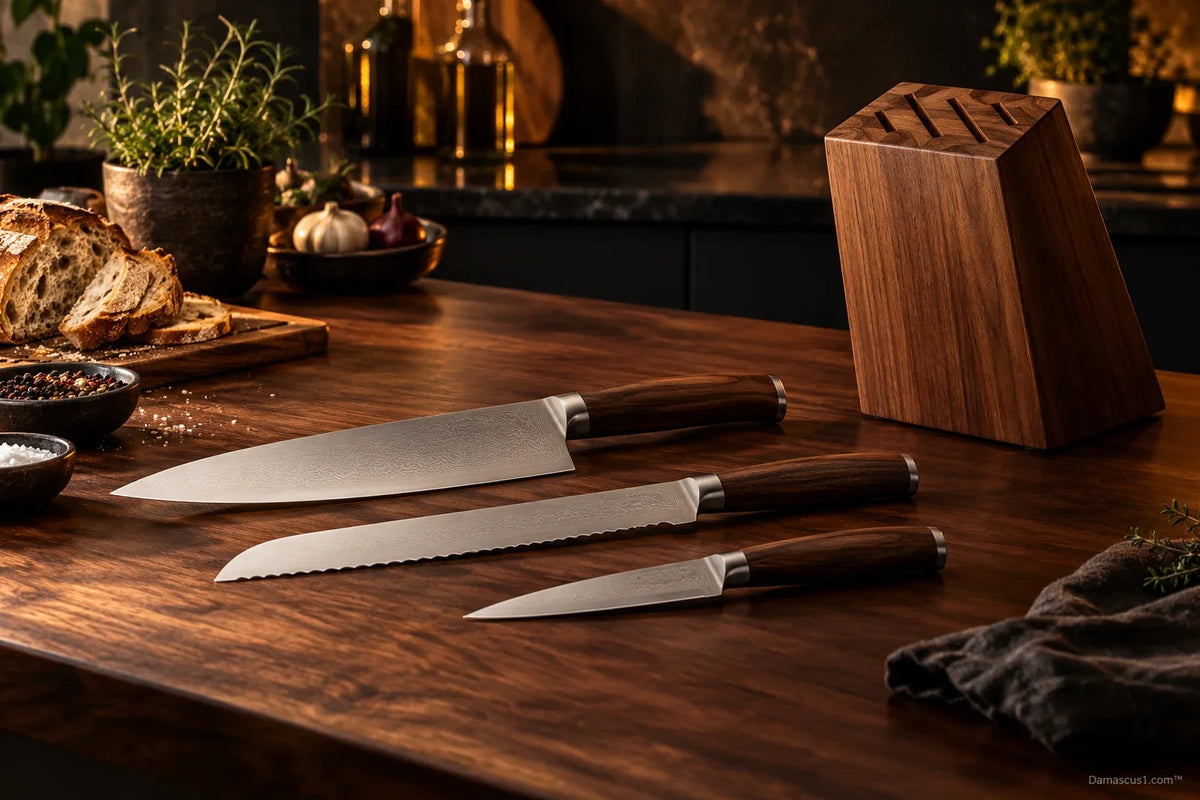
The cover and interior images are AI-generated editorial illustrations. Product links lead to real catalog photography and current buying details.
A kitchen knife set can be a convenient way to organize a new kitchen or replace several worn tools. It can also leave you with a crowded counter and multiple blades that do much the same work. The difference is usually visible before purchase if you read the contents carefully. Begin with a list of tasks and a storage plan, then decide whether a particular package covers them.
This guide explains how to compare piece counts without mistaking every counted item for a different kitchen knife. It provides a contents ledger, practical buying scenarios and questions for unclear listings. Damascus1 product links lead to current selling pages, where variants and availability can change. Generic editorial illustrations help explain the process; they do not establish the contents of a product or substitute for its real photography.
Start with a task list, not the headline number
Think about the last several meals you prepared. Which ingredients needed a knife, and what tool did you use? Write down everyday chopping and slicing, small trimming, whole-loaf bread slicing, and any separate specialist work you actually do. Keep serving at the table separate from preparation on a board. A set that includes several steak knives may have a useful dining role without increasing the number of different preparation tasks it covers.
Next, examine what you already own. A comfortable bread knife does not automatically need replacing because a set includes another one. A useful paring knife may remain part of the kitchen while you replace only the main preparation blade. Mark each existing tool as keep, replace, or investigate. This turns the shopping question into a specific gap rather than a general desire for a complete-looking block.
Finally, rank those gaps. If the main everyday knife is the priority, do not let a large number of minor accessories dominate your decision. If you are furnishing an empty kitchen, several distinct roles may be useful from the start. The same set can be a good fit for one household and unnecessary for another. Your task list is the reference that keeps the comparison grounded in actual use.

Create a contents ledger for every shortlist
A contents ledger is simply a four-part list: preparation knives, table knives, storage, and other tools. Copy the current seller's stated contents into those groups. Record quantities and the selected option. If the page does not provide a complete list, mark it incomplete and ask for one. Do not fill gaps by counting handles in a decorative photograph; an image may show accessories, alternate configurations or a representative arrangement.
Give every preparation knife a proposed job. A chef knife may cover mixed everyday preparation, a bread knife has a distinct serrated role, and a smaller knife can support detailed trimming. Two names can also describe overlapping jobs. You do not need to eliminate all overlap, but you should understand it. A second general-purpose shape is a deliberate choice when you prefer it for a task, rather than an automatic gain because the package has more pieces.
Count the storage block as storage if the seller includes it in the package count. Count shears, a honing rod and any other supplied tool in their own categories. Ask how the seller calculated the headline total if it remains unclear. The objective is not to force every merchant to use the same counting convention. It is to know exactly what you will receive and which parts of that package matter to you.
| Ledger group | What to record | Purchase question |
|---|---|---|
| Preparation knives | Each stated type and quantity | Which regular task will it cover? |
| Table knives | Number and intended dining role | Do they match your household needs? |
| Storage | Block, guards or other stated items | Will it fit your available space? |
| Other tools | Shears and maintenance accessories | Are they useful and appropriate for the blades? |

A seven-piece set does not necessarily mean seven blades
Consider a hypothetical package containing a main preparation knife, a bread knife, a small trimming knife, two table knives, shears and a block. It contains seven items but covers fewer than seven distinct preparation roles. Another hypothetical seven-item package could be arranged very differently. These are examples of the counting problem, not descriptions of any Damascus1 product. The headline total cannot tell you which package better matches your kitchen.
A block with empty slots adds another source of confusion. Empty space may allow later additions, but it does not mean the missing knives are included. Likewise, a promotional picture of a fully equipped kitchen does not establish that every object in the scene is supplied. Read the written item list, match it to the selected variant and ask about anything that matters to your order. A short confirmation can prevent an expensive misunderstanding.
If two listings have different totals, compare their ledgers before comparing price. The extra pieces may be tools you want, table knives you do not need, or a storage system that will not fit. Avoid calculating a simple price-per-piece figure until you understand what the pieces are. Dividing a package price by a headline number treats very different objects as equal and can obscure the value of the main knife you will use most.
Separate everyday roles from optional additions
A practical starter comparison often includes one versatile preparation knife, a suitable bread knife if whole loaves are part of the routine, and a smaller tool for the detailed work you actually do. That is a framework to adapt, not a rule that every household must follow. Someone who rarely prepares ingredients may need less. Someone with a particular cooking routine may need a clearly defined specialist. Start with the jobs, then assess the package.
Chef and santoku shapes can overlap in everyday use. A nakiri is worth comparing when vegetable preparation is a recurring focus. A long slicer, boning knife or other specialist should have an actual place in your task list before it influences the purchase. Use the chef, santoku and nakiri comparison to decide which general-preparation shapes deserve a closer look. Do not assume a knife's name authorizes every technique associated with that category.
For a shared household, ask who will use the tools. Different cooks may prefer different handles or working lengths. A set chosen solely for one person's taste may become a collection that others avoid. If several users are involved, agree on the main everyday role and the storage arrangement before selecting extra pieces. Useful variety comes from known needs, not from adding every available shape to a counter display.
Treat the block as part of the kitchen layout
Measure the proposed location for the block before ordering. Record available counter width, depth and clearance beneath cabinets. You need space to remove a knife comfortably, not just room for the block's base. Ask for dimensions if the page does not provide them. A package that looks compact in a studio photograph may be awkward beside appliances, a sink or a preparation board in your actual kitchen.
Think about cleaning and placement as well as appearance. Choose a location that can stay dry and is appropriate for your household. Keep storage accessible to the intended users while accounting for children, pets and visitors. Do not choose a prominent counter position simply because it makes an attractive display. A safe, manageable location matters more than whether the block matches an idealized kitchen photograph.
If you prefer drawer storage, check whether the knives can be accommodated in a fitted organizer with protected edges. A supplied block may still be useful, but it should not force a layout that does not work. Compare the complete cost of the arrangement you intend to use. Paying for included storage and then buying a different system can make a smaller package or individual knives more suitable for your budget.

Read specifications one model at a time
Do not assume that every product in a kitchen collection shares the same steel, construction or handle material. Similar photography and related names can represent different listings. Record the material description tied to the selected product and option. If the title names one material while the body names another, treat that as an unresolved question. A confident buying decision starts with clarity, not with choosing the claim that sounds more premium.
The same approach applies to blade lengths, number of pieces and included maintenance tools. An old section of text may describe another package, and a handle-color option may change more than appearance. Ask for a current written contents list and the relevant dimensions. Include the exact product URL and option in the enquiry so the seller can answer the question you are actually asking rather than provide general information about the brand.
A material name also does not establish a universal care routine. Ask for instructions for the actual blades and handles. If a maintenance accessory is included, verify that it is appropriate for the set before using it. The presence of a tool in the package is useful information, but it is not a substitute for operating instructions or an explanation of when and how it should be used.

Use real reviews to answer practical questions
Read reviews on the exact product's page and look for comments relevant to your concerns. A report about grip comfort, package contents or storage fit can be more useful than a general enthusiastic rating. Check whether the reviewer identifies the same configuration you are considering. Reviews describe individual experiences, and older comments may relate to an earlier package. They should inform your questions without being converted into guaranteed outcomes.
Do not transfer reviews between a similar-looking set and the chosen model. Different steel descriptions, handle variants or accessory lists can matter even when photos appear related. If the review provider cannot load a complete list, use the available text as a partial record and keep that limitation visible. A missing review is not evidence of a satisfied or dissatisfied customer, and it should not be replaced with invented testimony.
For a gift, consider the recipient's experience rather than assuming a large set is always generous. Ask whether they have a preferred everyday knife, an existing block or limited counter space. A smaller, suitable package can be more welcome than a dramatic display they cannot accommodate. Real purchasing information and a thoughtful handover often matter more than maximizing the number printed on the box.
Compare the complete cost of ownership
Begin with the current price for the selected option, then add any shipping, tax and storage cost that applies to your order. If you need a board, guards or a maintenance service, include those in your planning. Do not compare a ready-to-store package with a bare knife purchase as if they create the same next steps. The useful budget is the amount needed to establish the kitchen arrangement you actually want.
Existing tools can change the calculation. If you already have a suitable bread knife and storage, paying for duplicates may provide little practical value. If you are starting with nothing, an accurate, well-matched package may simplify the decision. Neither route is automatically cheaper or better. Use the contents ledger and your keep-or-replace list to compare the alternatives without relying on a promotional percentage or the visual size of the package.
Check any current promotion in the cart rather than assuming an advertised estimate is the final amount. Eligibility, selected items and other offers can affect the result. You should still be willing to choose the package based on its documented contents. An attractive discount does not resolve an unclear specification, and adding an unnecessary item to reach a threshold can increase spending without improving the kitchen.
Three useful set-buying scenarios
A first kitchen with limited counter space
Make a small task list and compare packages whose roles are distinct. Measure the available storage location before choosing the block. If no block fits comfortably, investigate a suitable drawer arrangement and compare individual knives or a smaller set. Avoid deciding that a crowded display is necessary to have a functioning kitchen. The goal is a manageable preparation routine with every sharp tool stored appropriately.
A household replacing worn everyday tools
Keep the tools that still serve you well and identify which ones need replacement. Compare a set only after you can explain the value of each included item. If most pieces duplicate useful existing knives, focus on the replacements instead. A coordinated appearance can be a preference, but record that as a preference rather than treating it as proof that replacing the entire collection is necessary.
A housewarming or wedding gift
Ask about the recipient's kitchen and existing tools before choosing. Confirm the exact package, delivery plan and return requirements. Include instructions and a simple contents list with the gift, particularly when the package includes maintenance accessories. Do not promise an arrival date or personalization service that has not been confirmed. A useful gift fits the recipient's circumstances and makes its own contents easy to understand.

Use Damascus1 listings as a shortlist, then confirm details
The kitchen knife collection provides a starting point for current options. The G10 knife block set listing and separate knife block set listing are pages to compare using a contents ledger. Their current titles are identifiers for the listings, not a reason to assume identical contents, handle colors or availability. Use the selected variant and written item list for your decision.
The Premium Knife Block Set listing and German 1.4116 knife set listing contain older wording with conflicting counts or material descriptions. Ask Damascus1 for clarification before relying on those details. This guide does not resolve those conflicts by inventing a specification. A direct, model-specific answer should determine the final contents ledger.
For the daily routine after purchase, read the kitchen knife care and storage guide. It explains how to organize instructions and ownership without treating every steel or handle as identical. Save the confirmed contents alongside your order record so you can check the parcel accurately when it arrives and keep the right instructions with the right tools.
Frequently asked questions
Does a nine-piece set contain nine preparation knives?
Not necessarily. The count may include table knives, a block, shears or maintenance tools. Read the exact contents list and ask the seller how the total was calculated. Never use the number alone to compare two packages. A smaller package can cover more of your actual preparation needs if its roles are better matched.
Should I choose a set or individual knives?
Compare your task list, existing tools and storage. A set can be convenient when its contents fit several needs at once. Individual purchases may suit a household replacing only one or two tools. Include any additional storage and maintenance costs in the comparison. Choose the arrangement you can explain item by item.
What if the title and description disagree?
Pause that part of the comparison and ask for current confirmation tied to the product URL and selected option. Do not treat photographs or a similar listing as the answer. Keep the disputed field marked unknown until the seller clarifies it. This is especially important for piece counts, material descriptions and included accessories.
Can I return a set after trying it in the kitchen?
Do not assume that use is permitted before a return. The current refund policy checked for this guide requires unused original condition, intact tags, original packaging and proof of purchase within 30 days of purchase; shipping fees are non-refundable. Read the full policy and ask about any unclear situation before ordering or opening the package for use.
Is delivery guaranteed for a gift date?
The shipping policy describes estimates based on availability and chosen shipping options. An estimate is not a guarantee for your occasion. Confirm the destination, selected package and timing with the store before making a time-sensitive purchase. Leave room for clarification rather than choosing solely from a general banner.
Make the final decision from the ledger
Shortlist two packages, complete their contents ledgers and mark each item useful, duplicate or unresolved. Compare storage fit and complete cost next. Ask the remaining questions, then choose the package that covers your priorities clearly. A useful set earns its place through the work its pieces will do and the ease with which you can own them, not through the largest headline count.
Sources and scope
- WÜSTHOF: knives by type — manufacturer category context.
- WÜSTHOF: sets — examples of varied package formats, not specifications for Damascus1.
- Linked Damascus1 catalog pages and current policies, checked October 3, 2026.
Editorial images are AI-generated illustrations. Hypothetical package examples explain the buying method and are not advertised product contents. This guide does not claim hands-on testing of the linked sets.
laissez un commentaire: