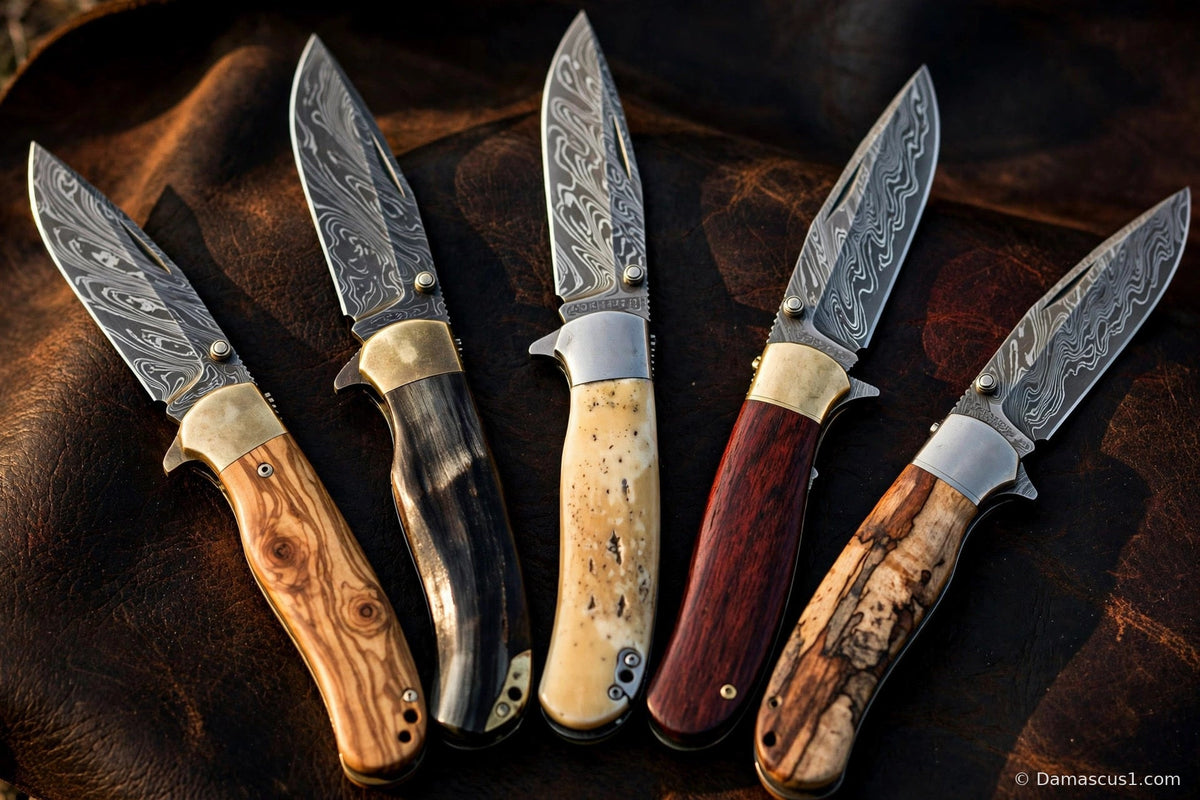
Two knives can share the same blade, the same lock, the same size — and feel like completely different tools the second you pick them up. The difference is the handle. It's the part your hand actually lives on, and on a handmade folder it's also most of what you're looking at.
The catalogue offers olive wood, buffalo horn, camel bone, rose wood and multi-wood listings, but a handle choice does not establish that the knives share one blade, lock, size or construction. Compare each current product page and selected option. Prices can change, and the rose wood blade specification needs separate confirmation. Start with our pocket knife buying guide if you are still deciding the type of knife.
So: what do knife handle materials actually change, which of these five suits your hands and your weather, and which one will you still be happy with in five years? Let's go through it properly — grip, feel, durability, moisture, maintenance, looks — then take each material one at a time, downsides included. Every material here has one. Anyone who tells you otherwise is selling you something.
What do knife handle materials actually change?
Handle choice affects the appearance and contact surface of a knife, but the material name cannot establish the complete grip or durability. Shape, texture, finish, dimensions and condition all matter. This is a purchase-planning guide based on current listings, not a set of hands-on grip, weather or drop tests.
Start with control. Check the handle shape, surface finish and access to the opening feature and lock release. We have no comparable wet-grip tests for these models, so we cannot rank the materials for wet work. If the knife or your hands become slippery, pause and restore suitable handling conditions rather than relying on the material name.
Feel and balance are individual. Photographs can show colour, contour and visible texture, but cannot tell you the weight or how the knife fits your hand. Ask for measured dimensions and weight for each model. If you cannot inspect one before purchase, review the actual return conditions and ask which model details the seller can confirm.
We do not have model-specific impact or long-term ageing data for these handles. Do not infer a lifetime guarantee or a drop-resistance ranking from wood, horn or bone. Inspect for damage and changes in fit, follow the supplied care instructions, and ask the seller about a crack or loose scale before using the knife.
Use the maker's instructions for the blade, handle finish and any decoration. There is no verified universal oil schedule for every handle in this range. Keep the whole knife clean and dry, avoid prolonged soaking, and confirm a compatible cleaner or conditioner before applying it. The folding-knife care guide helps organise those questions.
Is olive wood a good knife handle material?
 Editorial concept close-up of a golden wood-grain knife handle. Compare current product photographs for the exact knife.
Olive wood is an option for buyers who like visible wood grain and warm colour. Compare the current olive model's photographs rather than assuming every piece will have identical figure. Its appearance does not prove superior comfort or grip; those require attention to the actual shape, finish and your intended task.
Wood grain is a visible part of the olive model's appeal. Compare both sides of the actual or representative handle in current product photographs. A light-and-dark pattern may suit one recipient better than a plain-looking finish, but a grain pattern cannot establish the manufacturing method or the origin of the knife.
A photograph cannot establish a secure grip in damp conditions or comfort over a long cutting session. If those are your main requirements, request more views of the handle and a model-specific demonstration. Check finger clearance around the bolster and release. Do not substitute a general wood preference for an appropriate cutting tool.
For cleaning and storage, follow the instructions for this knife's finish. Avoid prolonged damp storage and direct drying heat. Before adding oil or polish, ask what is compatible with the surface and adjacent metal. Cracks can have several causes; this guide cannot diagnose one or promise that routine care prevents every defect.
Is buffalo horn a good knife handle material?
 Editorial concept close-up of a dark polished knife handle. Compare current product photographs for the exact knife.
Buffalo horn is a visual alternative for buyers who prefer the darker, polished appearance shown in the listing. Natural colour and streaking may vary. We have no evidence that it is the densest, strongest or slickest of these specific models, so compare the actual finish and fit without a performance ranking.
The buffalo-horn listing is worth comparing if you prefer a darker handle appearance. Look at how the photographed finish contrasts with the blade and bolsters, then ask whether the pictures represent the current option. Appearance varies, so describe the colour or pattern you prefer without treating a representative photograph as a promise of an identical piece.
The complete knife's weight and handle contour determine much of the impression in hand. Ask for measured weight rather than treating an appearance of substance as a specification. A glossy surface does not establish suitability for fish cleaning or other wet work; assess the exact model, intended use and handling conditions.
Use gentle care appropriate to the actual horn finish and follow the supplied instructions. Keep it clean and dry and avoid prolonged soaking or direct heat. An unusual smell, distortion, looseness or surface change is a reason to ask the seller for advice, not something this guide can diagnose as normal from a distance.
Is camel bone a good knife handle material?
 Editorial concept of ship artwork on a pale knife handle. Compare current product photographs for the exact knife.
Camel bone offers a light-toned appearance that contrasts with a patterned blade in the product photographs. Choose it for the look if it appeals to you, while checking the individual model's surface and construction. The material label does not establish a scratch, impact or lifespan guarantee.
A pale handle and a darker patterned blade create a visible contrast in the camel-bone product photographs. That may appeal to a gift buyer or collector. Check both sides and any decoration in the actual listing, and confirm how closely the supplied example will resemble representative images. The visual contrast is an aesthetic reason to compare the model, not a technical rating.
For the plain camel-bone folder, confirm the handle dimensions, finish and weight. We have no comparative grip test establishing that it holds better than horn or wood. Inspect an actual model where possible, and keep hands clear of the blade path during opening and closing regardless of the handle material.
Avoid treating any natural handle as a drop-proof part. If a knife is dropped, inspect it and seek the seller's guidance if damage or changed operation appears. Do not keep using a cracked or loose handle merely because a general article describes bone as durable. Condition matters more than a material stereotype.
What is scrimshaw — and is the camel bone scrimshaw edition worth it?
The camel-bone scrimshaw listing is a separate model with decorative handle artwork. Ask the seller to confirm the decoration method and the current example supplied. The term in a product name is not evidence that every piece was individually hand-etched or made with a particular pigment process.
Its legacy title identifies a 7.6-inch model, while the older dimensional copy needs confirmation together. Ask for measured open length, closed length and blade length before comparing it with another folder. The listing references a back lock and leather sheath, but confirm current package contents and operation for the selected option.
Whether decorative work is worth a higher price is a preference decision. Compare current prices on the two product pages, the artwork you will receive, care guidance and return terms. We have not measured decorative durability or compared every alternative on the market; there is no supported claim that nothing else at this price is made similarly.
Is rosewood a good knife handle material?
 Editorial concept close-up of a reddish wood-grain knife handle. Compare current product photographs for the exact knife.
The rose wood listing offers the reddish-brown wood appearance shown in its own photographs. Treat colour and grain as reasons to inspect the model, not as evidence of a particular botanical species, density or guaranteed grip. Ask for additional photographs if exact colour is important to your gift or collection.
The current rose wood photographs provide the starting point for comparing colour and grain. Do not assume every example will darken to a particular shade, or infer a botanical species from a retail material name. For a colour-sensitive gift, request current photographs and agree acceptable variation before ordering.
Do not infer a satin feel, moisture resistance or secure working grip from the name rose wood. Finish, shaping and condition matter. Check the separate rose wood listing's blade material too: its details should not be copied from the olive or buffalo model merely because the handles look similarly shaped.
Ask the seller which care products are compatible with the rose wood handle's finish. Avoid soaking and prolonged damp storage, and dry the whole knife according to its instructions. More oil is not automatically better, and appearance alone cannot establish whether the handle needs a conditioner or has a defect.
What is multi-wood — and who should choose it?
Multi-wood describes an appearance or construction using more than one wood. Confirm which materials and finish the actual listing specifies rather than guessing the species from colour. Request current photographs if the contrast or arrangement matters to you. This is an aesthetic choice, with no verified grip advantage established here.
Compare the multi-wood listing's arrangement with the simpler appearances of the other models. Some buyers prefer contrast; others prefer a quieter surface. Ask about the actual example and the care of its finish. We have no recipient-preference survey or evidence that one arrangement produces a stronger gift reaction.
For a multi-wood option, ask about the joints, finish and recommended care as part of the complete handle. Do not assume different pieces respond identically to a treatment. If you see a gap, rough transition or loose part, contact the seller. A photograph can help document your question, but cannot replace inspection or appropriate service.
How do the five knife handle materials compare side by side?
 Editorial concept of three folded knives with contrasting handle appearances. Compare current product photographs for the exact knife.
Compare appearance first, then verify the complete knife. The catalogue photographs show different colours and patterns, but this guide has no wet-grip, impact, weight or longevity measurements supporting a material winner. Your shortlist should record what is confirmed and what the seller still needs to answer.
The comparison below is a set of buying checks. It does not rate one natural material as safer or more durable than another, and it does not establish a common blade, lock or accessory package across the range.
| Listing choice | What photographs can help compare | What to confirm separately |
|---|---|---|
| Olive wood | Visible grain and colour | Dimensions, finish, opening, lock, blade material and care |
| Buffalo horn | Dark colour and polish | Dimensions, finish, opening, lock, blade material and care |
| Camel bone | Light colour and surface | Dimensions, finish, opening, lock, blade material and care |
| Rose wood | Reddish-brown colour and grain | Dimensions, finish, opening, lock, blade material and care |
| Multi-wood | Contrasting arrangement | Dimensions, finish, opening, lock, blade material and care |
| Scrimshaw-style bone | Exact artwork and placement | Dimensions, finish, opening, lock, blade material and care |
Use these current model links to build a shortlist. Prices and option availability should be checked on the product page when you order; the links are not a claim that these listings share one platform:
- Olive Wood — olive wood pocket knife
- Buffalo Horn — buffalo horn pocket knife
- Camel Bone — camel bone pocket knife
- Rosewood — rosewood pocket knife
- Multi Wood — multi wood pocket knife
- Camel Bone Scrimshaw, 7.6-inch — scrimshaw pocket knife
Confirm opening method and lock type separately for each knife. A traditional appearance does not prove two-handed opening, and handle material does not determine the mechanism. The plain camel-bone listing previously contained conflicting lock descriptions; request model-specific confirmation. The lock comparison guide explains the buying questions without a category-wide strength claim.
How do you care for wood, horn, and bone knife handles?
Care starts with the instructions for the exact knife. Buck's official care page emphasises keeping the whole knife dry and cleaning moving and locking parts. That is useful general guidance, but Buck's product recommendations are not specifications or an approved treatment list for Damascus1 handles.
Wood handles. Ask which finish is present and which cleaner or conditioner, if any, the seller recommends. Do not infer an oil schedule from pale colour or a dry room. Keep cleaning residue away from engagement surfaces and follow instructions for drying and safe storage. Do not leave an open blade unattended to air-dry.
Buffalo horn. Confirm compatible cleaning products for the actual finish and avoid prolonged soaking or direct drying heat. If the handle changes shape or fit, stop using it and ask for advice. Do not attempt to correct a loose scale with heat, soaking or improvised repair methods.
Plain or decorated camel bone. Ask for instructions covering both the handle and any artwork. Avoid abrasive treatment unless specifically approved for the surface. Store the knife securely so the edge and decoration are protected, and check condition before reuse. A patterned or decorated surface is not evidence that it can withstand every cleaner.
The blade has its own rule, and it's the one owners ask about most: Damascus steel can rust if it's stored damp, which is exactly why the drying habit matters for the whole knife, handle and steel together. Our explainer on whether Damascus steel can rust covers the blade side in full, and the step-by-step routine for the whole folder lives in the Damascus folding knife care guide.
How do you choose a knife handle material in 60 seconds?
Make a short list by appearance, then verify fit and operation. Olive wood may suit a buyer who likes visible grain; horn may appeal to someone who prefers a dark polished finish; bone offers a pale contrast; rose wood and multi-wood offer other colour arrangements. Those are preference descriptions, not wet-work or safety rankings.
Ask three practical questions. What cutting tasks will the recipient actually do? What handle dimensions and operating features fit that use? What care and storage can they follow? If a listing leaves those questions unanswered, send the product URL to the seller before choosing. A gift should include the actual instructions and an appropriate way to store it.
The blade, lock, size and package are separate purchasing decisions that still need confirmation for each listing. Handle appearance can narrow the shortlist, but it cannot settle all of them. Compare the whole offer and buy only after the facts important to your use are clear.
Compare the exact models: open the pocket-knife comparison, browse the everyday pocket-knife collection, or ask about a model. Include its URL, the selected option and your main fit or gift question. Review shipping and return terms before ordering.
Frequently asked questions about knife handle materials
Which knife handle material is best for wet conditions?
No verified wet-grip ranking is available for these five models. Shape, finish, condition and handling circumstances matter alongside material. If hands or handle are slippery, pause the task and restore safe control; do not rely on a wood-versus-horn claim.
Which handle material makes the best gift?
Choose the appearance the recipient prefers, then confirm dimensions, opening method, accessories, delivery and care. Olive wood, horn, bone or decorative artwork can appeal to different tastes. No material guarantees a recipient's reaction.
Will a wooden knife handle crack?
Wood can crack, but this guide cannot attribute every crack to neglect or promise decades of service. Follow the exact model's instructions and contact the seller about a crack, movement or changed fit. Do not assume an oil treatment makes a damaged handle safe.
Does buffalo horn need special care?
Follow the care instructions for the horn handle and finish. Avoid prolonged soaking and direct heat, keep it clean and dry, and ask about compatible products. Do not diagnose a strong odour, distortion or looseness as harmless from a general description.
Is camel bone fragile?
Bone is not a guarantee against impact or damage. We have no drop-test comparison for these models. Inspect condition, protect the knife in suitable storage and ask the seller about cracks, chips or loose parts before use.
Are these knives one-hand opening?
Confirm the exact model's opening feature and instructions. Handle material does not determine one- or two-handed opening, and the catalogue does not establish one common opening method for every listing here.
Is the blade the same across all five handles?
That has not been verified. These are separate product listings, and the rose wood blade details require individual confirmation. A similar size label or photograph does not establish identical alloy, grind, heat treatment, lock or construction.
How often should I oil a wooden knife handle?
Use the instructions for the actual wood and finish; no universal schedule has been verified for these models. Ask which product is compatible before applying it. Do not use appearance alone to diagnose the need for oil or the cause of a surface change.
A practical comparison worksheet before buying
Make one row per exact product URL. Record the product title and selected option, then add the date you checked the listing. A short record prevents an answer about one handle style from being mistaken for an answer about another. Save the seller's written clarification with the row rather than relying on a collection-wide description.
Record fit without assuming the size label
Use separate fields for open length, closed length, blade length, handle width, thickness and weight. If the listing gives only a model size, mark the other fields unconfirmed. For a sheath enquiry, include closed dimensions and belt width. A pocket photograph cannot provide a reliable measurement, and a labelled model size should not be silently converted into a blade length.
Record the actual package and full price
List the main knife and each included accessory separately. Ask whether a sheath, sharpening rod, companion knife and gift box belong to the selected option today. Compare the current price, shipping quote and any separately quoted custom work. A lower product price can describe a different package, so the useful comparison is the confirmed offer you will receive.
Use photographs for the questions they can answer
Request views of both sides, the spine, the release and the closed knife when those details are missing. If exact artwork or natural grain matters, ask whether the photographed example is the one supplied or a representative example. Do not demand identical natural markings from a representative photograph; agree the acceptable variation with the seller before ordering.
Keep care and support information with the knife
Record the supplied use instructions, compatible care products and the seller's service contact. Give that information to a recipient with the knife. If the recipient cannot use or maintain it appropriately, reconsider the gift choice. Attractive materials are only one part of a suitable purchase.
Check delivery and return conditions before payment
The current shipping policy bases estimates on availability and the shipping option selected. A guide cannot promise arrival by a particular date. The refund policy requires eligible returns within 30 days of purchase, unused and in original condition, with tags, packaging and proof of purchase. Shipping fees are non-refundable. Read the shipping policy and refund policy, and clarify proposed engraving or other custom work before paying.
Evidence and image note
This guide compares current catalogue information and purchase questions; it does not report hands-on grip, impact or longevity testing. General care was checked against Buck's official care guidance on October 16, 2026. Editorial scenes illustrate the topic; confirm the exact knife using current product photographs and seller documentation.
laissez un commentaire: