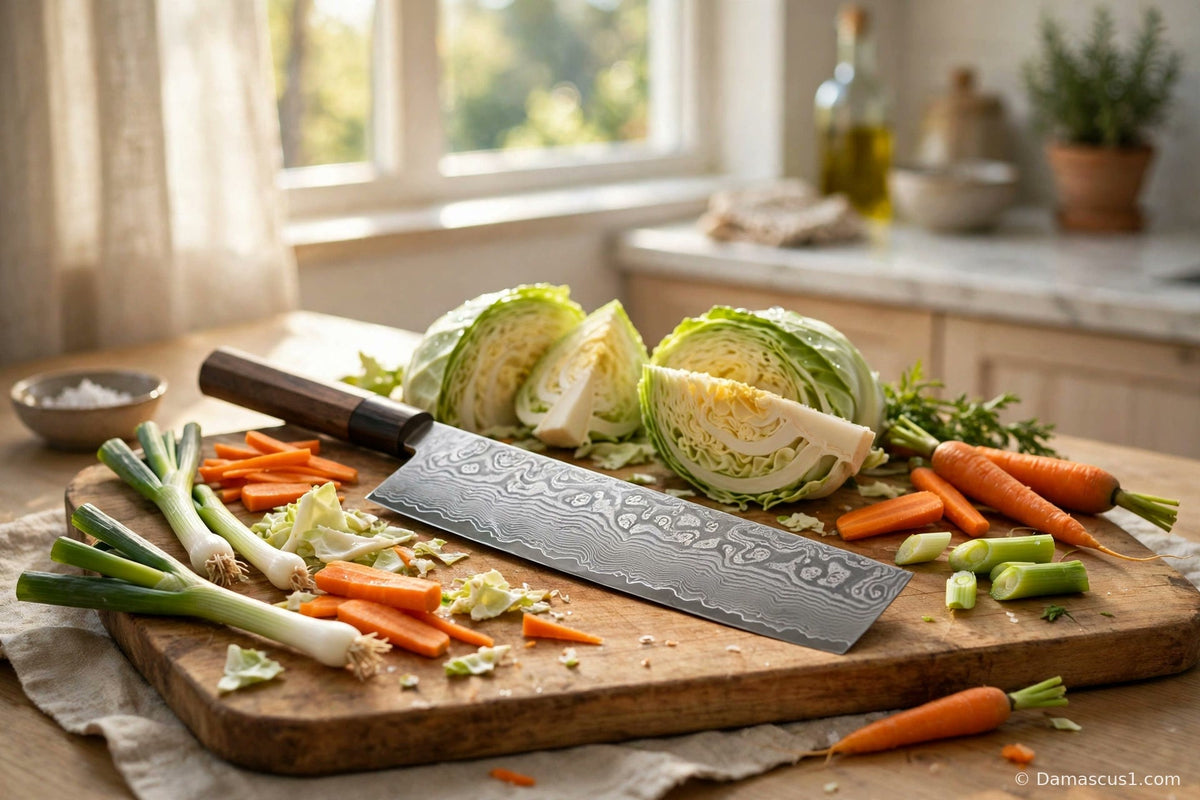
A board full of vegetables and the tall, flat-edged knife shape built for exactly this job. © Damascus1.com
Somewhere in your kitchen there is a pile of onions that took longer than it should have. The slices came out uneven. Half of them stayed joined at the bottom by a thin thread of skin, so you went back and cut them again. Your chef knife did that — not because it is a bad knife, but because its curved edge was designed to rock, and rocking is a clumsy way to chop a vegetable clean through.
The nakiri exists to fix that one problem. It is the most single-minded knife in the Japanese kitchen: a tall, rectangular blade with a dead-flat edge, made for vegetables and very little else. Cooks who prep a lot of produce tend to describe the first session with one the same way — oh. So that's what the shape was for.
This guide covers the whole question properly. What a nakiri is used for, job by job. Why the flat edge changes the cut. How it compares with the santoku, the chef knife, the Chinese cleaver and its professional cousin the usuba. The technique, the sharpening, the honest limits — and two Damascus1 nakiris you can buy today at prices we verified on the product pages this morning, with a straight note about what we can and cannot confirm about their specs.
What is a nakiri knife used for?
A nakiri knife is used for preparing vegetables: chopping, slicing, dicing and mincing produce with a straight up-and-down push cut. Its tall, rectangular, double-bevel blade has a flat edge that meets the board along its whole length, so cuts go clean through with no rocking. It excels on onions, cabbage, carrots, cucumbers and herbs, and its broad face doubles as a scoop for moving chopped vegetables to the pan.
That is the short answer, and it is genuinely most of the story. The longer answer is about how it does those jobs differently from the knife you already own — because the difference is not marketing. It is geometry.
If you already know the shape is what your board has been missing, the two live options from our own store are the Damascus1 nakiri listings in the Precision Kitchen Knives collection — priced at $44.99 and $49.99, verified live on October 31, 2026. Everything below is how to judge whether a nakiri belongs in your kitchen at all, and how to get the best out of one if it does.
What is a nakiri, exactly?
A nakiri is a Japanese vegetable knife: a double-bevel blade, typically 160–180 mm (about 6.5–7 inches) long, with a tall rectangular profile, a flat cutting edge and a squared-off front instead of a pointed tip. The name — nakiri, 菜切り — translates roughly as "vegetable cutter" or "leaf cutter," and the shape has been a standard tool in Japanese home and professional kitchens for generations.
Break the shape down and every feature earns its place:
- The flat edge. From heel to front, the edge runs essentially straight. Lay it on a board and the whole edge touches at once. That single fact drives everything else in this guide.
- The tall blade. Nakiris are commonly around 45–60 mm tall — noticeably taller than a chef knife. That height gives your knuckles clearance above the board while you chop, and it gives the blade a broad flat face, which turns out to be useful for more than cutting (see the scoop, below).
- The squared tip. There is no point, because the knife never needs to pierce anything. No tip also means nothing delicate to snap, and a front corner that can be surprisingly handy for scoring and for getting the last slice off a board.
- The thin blade. A nakiri is built thin so it passes through produce instead of wedging it apart. A thick blade splits a carrot ahead of the edge; a thin one parts it cleanly. On this shape, thinness matters more than on almost any other knife.
- The double bevel. Unlike its professional cousin the usuba, a nakiri is sharpened on both sides. It works in either hand and sharpens the way most home cooks already understand. It is the accessible version of the Japanese vegetable knife, and that is deliberate.
One confusion to clear up early: a nakiri looks like a small cleaver. It is not one. A meat cleaver is a thick, heavy bone tool. A nakiri is light, thin and precise — the resemblance ends at the rectangular outline. Treat it like a cleaver and you will damage it; that warning gets its own section below.
Which vegetables is a nakiri best for?

A nakiri is best for any vegetable you chop, slice or dice in quantity: onions, cabbage, lettuce, carrots, daikon, potatoes, sweet potatoes, zucchini, eggplant, celery, leeks, cucumbers and leafy herbs. The flat edge cuts each slice clean through to the board, the tall blade handles big produce like cabbage heads, and the thin profile glides through soft vegetables like tomatoes without crushing them.
It helps to think in jobs rather than ingredients, because the same shape wins for different reasons in each one:
Chopping and dicing — onions above all. The onion is the nakiri's home turf. Vertical slices, a horizontal cut, then a straight-down dice, and every piece separates because the edge finished every cut. No accordion slices. No second pass. If you cook anything that starts with "dice an onion" — which is most of savoury cooking — this is the job that sells people on the knife.
Fine shredding — cabbage and lettuce. Long, thin, even shreds for slaw, stir-fries and salads are a rhythm job: lift, down, lift, down, walking the blade back through the head. The flat edge keeps every shred the same width, and the tall blade keeps your knuckles out of the way while you work through a whole cabbage.
Straight slicing — carrots, daikon, cucumber, zucchini. Coins, batons, planks, julienne: all of them are just repeated straight cuts, and repeated straight cuts are the one thing this edge does perfectly. Cucumber slices come off thin and even enough to see light through. Carrot coins stop varying in thickness, which means they cook evenly too — an underrated benefit nobody mentions.
Delicate produce — tomatoes and soft fruit. A thin, keen edge parts a ripe tomato instead of squeezing it. The same goes for peaches, plums and other soft fruit. The rule is sharpness, not force: if you are pushing hard, the edge needs attention, not your arm.
Mincing — herbs and garlic. Here is a small surprise: despite having no curve to rock on, a nakiri minces well with a straight-down rapid chop, gathering the pile with the broad blade between bursts. It is a different motion from rocking a chef knife over parsley, but plenty of cooks end up preferring it.
The scoop. After the chopping, turn the job over to the blade's face. The tall, flat side of a nakiri is a built-in bench scraper: slide it under a pile of diced onion and carry the whole lot to the pan in one trip. Once you have done this a few times, going back to herding dice with a narrow chef knife and your fingers feels faintly ridiculous.
Straight down, all the way through — the flat edge finishing every cut is the whole idea. © Damascus1.com
How do you use a nakiri? The technique, step by step
You use a nakiri with a straight up-and-down motion: lift the blade, let the flat edge land, and push down and very slightly forward through the vegetable — no rocking, no sawing. Keep your guiding hand in a claw grip with fingertips tucked back, walk the knife along the ingredient, and let the edge do the work instead of forcing it with your shoulder.
If you learned to cook with a Western chef knife, the first minute feels odd. Your hands want to leave the tip on the board and rock. A nakiri has no tip to leave down and no curve to rock on, so the habit has nothing to grab onto — which is actually the fastest way to unlearn it. Within one onion, most people settle in. The steps:
- Set the board steady and the vegetable stable. Cut a flat side onto round produce first — halve the onion, slice a flat off the carrot's side — so nothing rolls while you work. A knife this keen rewards a stable target and punishes a wobbly one.
- Grip the handle, pinch if you like. A relaxed handle grip works; a pinch grip on the blade just ahead of the handle gives finer control for thin slicing. Either is fine. White knuckles are not — tension is how cuts get forced.
- Claw the guiding hand. Fingertips curled in, knuckles forward, thumb tucked behind. The flat side of the blade can ride lightly against your knuckles as a guide — the tall blade gives you a generous, safe surface to register against.
- Lift low, cut straight down. You do not need height. Lift the edge just clear of the food, then bring it down through the cut with a slight forward push. The whole edge lands together. Listen for the board: a clean, even tap means full contact; a click at one end means part of the edge floated, and the slice may still be joined at the bottom.
- Walk, don't reach. Move the ingredient under the blade — or step the blade back along it — in increments the width of the slice you want. Even spacing in, even slices out. Speed comes from rhythm, not effort, and rhythm comes after a few vegetables, not before.
- Scoop and transfer. Pile finished, blade flat under it, one trip to the pan. Then wipe the blade and keep going.
Two mistakes cover nearly every bad first impression of this knife. The first is forcing it: pressing down hard through a dense sweet potato instead of letting a sharp edge and a few patient strokes do it. The second is twisting — levering the blade sideways to free a stuck slice. Thin edges hate sideways force. Lift straight out, every time.
Nakiri vs santoku, chef knife, cleaver and usuba — which do you need?

Choose a nakiri if vegetables are the main event and you already own an all-purpose knife. Choose a santoku if you want one shorter Japanese knife for mixed prep. Choose a chef knife or gyuto as your primary all-rounder. A Chinese cleaver is the heavier multi-purpose rectangle, and an usuba is the single-bevel professional vegetable knife — a specialist's tool that most home cooks should admire and skip.
Here is the full comparison, because this is the decision most readers are actually making:
| Knife | Best for | Edge / tip | Bevel | Choose it when |
|---|---|---|---|---|
| Nakiri | Vegetables in volume — chopping, slicing, dicing, shredding | Dead flat edge, squared front, no point | Double | You prep a lot of produce and already own a main knife |
| Santoku | Mixed everyday prep in a compact Japanese knife | Mostly flat with a slight rise, blunt sheepsfoot point | Double | You want one shorter knife for vegetables, boneless meat and fish |
| Chef knife / gyuto | The primary all-rounder — meat, fish, vegetables, rocking cuts | Curved belly, pointed tip | Double | You are buying (or keeping) one knife to do nearly everything |
| Chinese cleaver (chukabocho) | High-volume mixed prep, including tougher produce, as a main knife | Tall rectangle, gentle edge curve, usable corner | Double | You want one big rectangular blade as your primary knife and accept the weight |
| Usuba | Professional vegetable work — katsuramuki, decorative cuts | Flat edge, no point, very thin | Single | You are a trained cook who sharpens single-bevel blades and cooks Japanese professionally |
| Meat cleaver | Bones and joints | Thick, heavy, wedge-like | Double | You break down bone-in meat — a job no knife on the rows above should touch |
Read the table with your actual week in mind. If dinner at your house starts with an onion, a few carrots and whatever green thing is in the crisper, four nights out of five, the nakiri row is describing your cooking. If you break down chickens and carve roasts just as often, the nakiri is a second purchase, not a first — which is exactly why our guide to the best chef knife exists, and why the honest advice everywhere in this category is: main knife first, specialist second.
Nakiri vs santoku, in one paragraph more
These two get confused constantly because both are Japanese, both are tall, and both chop more than they rock. The difference is commitment. A santoku keeps a blunt but usable point and a hint of curve, so it can pierce packaging, score, slice a chicken breast and still do respectable work on vegetables — it is a generalist in a shorter body. A nakiri gives the point and the curve away entirely and spends everything it saved on one thing: a flatter edge and cleaner vegetable cuts. Neither is better. They are answers to different questions — "one knife for most jobs" versus "the best knife for this one job."
Fine, even shreds are a rhythm job — and rhythm is what the flat edge is for. © Damascus1.com
The Damascus1 nakiris, honestly — with verified prices
Product cards — verified live on October 31, 2026:
- 🔪 VG10-Labelled Nakiri Knife — $44.99 — our lower-priced nakiri listing. Priced where you can check it yourself today on the product page.
- 🔪 VG10-Labelled Nakiri Kitchen Knife — $49.99 — the second nakiri listing in the store, $5 above the first. Compare the two product pages side by side before choosing.
- 🗄️ Premium Kitchen Knife Block Set — $169.99 — for cooks who would rather build the whole kitchen at once than add one specialist at a time. See also our guide to the best kitchen knife set under $200.
Now the honest part, and we would rather lose a sale than skip it. Both nakiri listings carry "VG10" in their names, but their product pages state plainly that the older catalogue copy for these knives was inconsistent — different steel labels, handle materials and figures appeared in different versions, and those numbers are not certified for the current listings. So this post does something knife marketing almost never does: it prints no layer count, no hardness figure, no steel-grade claim and no blade-length claim for either knife, because we cannot verify them today. What is verified is simple — these are nakiri listings in our store, at $44.99 and $49.99, live now. If the exact steel, dimensions or handle material will decide your purchase, ask through the product page before ordering and get the answer for the exact knife you will receive. That is how these two should be bought: on the shape, the price and a confirmed spec — not on a label.
That candour cuts both ways, and it is worth saying what the prices mean in this category. The roundups for this keyword list established Japanese and German nakiris well into three figures. At $44.99 and $49.99, these listings sit at the "find out whether the shape suits you" end of the market — except the shape is the whole point of a nakiri, and the shape does not get better as prices climb; steel, finish and consistency do. A cook who has never used a flat edge can learn in a week of dinners whether the nakiri motion is for them, at a price that does not require the answer to be yes. If it is yes, they own a working vegetable knife. If it is no, they have spent less than a takeaway finding out.
Browse the wider kitchen range in the Chef's Best Kitchen Blades collection, and if you are still deciding what your main knife should be, start with our guide to the best kitchen knives before you buy a specialist.
What should a nakiri never be used for?

A nakiri should never be used on bones, frozen food, hard squash skin or stems, or any job that needs a point — piercing, boning, or prying. Its thin edge is made for produce, not impact or leverage. It should also never go in a dishwasher, and never be twisted sideways out of a cut. Used inside its one job, it lasts for years; used outside it, the edge pays.
The full list, with the reason for each:
- Bones and joints. Thin edge, hard impact, predictable chip. This is cleaver work — a different tool with a thick, forgiving edge.
- Frozen food. Frozen produce and meat are closer to wood than to food as far as an edge is concerned. Thaw first, or use a heavy knife you do not care about.
- Hard rind and stems. The skin of a winter squash and the woody stem ends of pumpkins and similar produce concentrate force exactly the way an edge hates. An honest nuance from the guides that rank for this keyword: the flesh of dense vegetables — sweet potato, carrot, squash flesh once you are through the skin — is normal nakiri work done patiently. It is the rind, the stem and the forcing that do damage. Open hard squash with a sturdy chef knife, then let the nakiri do the fine work it is better at.
- Anything that needs a tip. Coring, piercing film, trimming eyes out of potatoes, boning — the nakiri has no point to offer. Reach for the petty or the chef knife and do not improvise.
- Prying and twisting. Lifting a stuck slice by bending the blade, prying a lid, levering anything. Sideways load is the fastest way to hurt a thin edge.
- Glass, ceramic or stone boards. A keen edge landing on glass is being dulled by the board, not the food. Wood or a decent plastic board, always.
- The dishwasher. Heat, detergent and being knocked against racks and cutlery — everything a fine edge and a good handle dislike, in one cycle. Hand-wash, dry, put it away. Thirty seconds.
None of this makes the nakiri fragile. It makes it specialised — the same way a bicycle is not fragile because it cannot haul gravel. Inside vegetable prep, it will outwork heavier knives for years. The rules above are just the boundary of the job it was built for.
The second job nobody puts on the box: the tall blade is a scoop, and the pile reaches the pan in one trip. © Damascus1.com
How do you sharpen a nakiri — and how do you look after one?

Sharpen a nakiri on a whetstone at roughly 12–15 degrees per side, working from a medium grit (around 1000) to refine the edge, then a finer grit (around 3000–6000) to polish it — the category-standard approach for Japanese double-bevel blades. Hone gently between sharpenings, hand-wash and dry after use, and store it on a magnetic strip, in a block or with an edge guard, never loose in a drawer.
The flat profile actually makes a nakiri one of the easier Japanese knives to sharpen, which surprises people. There is no curve to follow and no tip to blend — the edge is one straight line, and your job is simply to keep the angle steady along it:
- Soak the stone (for a water stone, roughly 10–15 minutes, unless it is a splash-and-go stone), set it on a damp towel so it cannot slide, and keep a little water nearby.
- Find the angle. Around 12–15 degrees per side is the usual range quoted for nakiris. Consistency matters more than the exact number — an even 15 degrees beats a wandering 12.
- Work in sections. Because the edge is flat, sharpen it in two or three overlapping sections along the blade rather than one long sweep, using light, even strokes and covering the full edge.
- Raise a burr, then switch sides. When you can feel a fine burr along the opposite side, the first side is done. Match your strokes on side two.
- Refine and finish. Move to the finer stone with lighter pressure, then a few gentle stropping strokes to clean the edge up. Test on paper or a tomato skin: it should glide, not tear.
- Keep the rhythm between sharpenings. With regular home use, a full sharpening every couple of months is typical guidance for this category; a gentle honing in between keeps the edge aligned. A hard steel honing rod used aggressively is hard on fine Japanese edges — light strokes, or a ceramic rod, is the kinder habit.
Everyday care is shorter than the sharpening section, and it matters more: hand-wash in warm soapy water, dry immediately and completely, and store the edge protected. If your knife is a patterned or Damascus-style blade, the same routine protects the finish as well as the edge — our full guide on how to sharpen a Damascus knife walks through stone work and oiling in more depth, and it applies to the vegetable board as much as to any other blade in the block.
One straight edge, one steady angle — a flat profile is the easiest Japanese shape to keep sharp. © Damascus1.com
Do you actually need a nakiri? A one-minute checklist
You need a nakiri if vegetable prep is a daily job in your kitchen and you already own a decent main knife. You probably don't if you cook vegetables twice a week, own only one knife total, or mostly need a point for the way you cook. Work through the five questions below — three or more yes answers means the shape will earn its slot in your block.
- Do you dice an onion, or chop a comparable pile of vegetables, at least four days a week?
- Do your slices often stay joined at the bottom, so you end up cutting the same pile twice?
- Do you cook cabbage, slaw, stir-fries, soups or sheet-pan vegetables often enough that shredding and dicing are real time in your day?
- Do you already own a main knife — chef knife, gyuto or santoku — that handles meat, fish and tip work?
- Would cleaner, more even cuts (which also cook more evenly) actually change your food?
And the honest reverse cases. If you are buying your first good knife, buy the all-rounder first — the nakiri is a second knife everywhere in the world, including on this page. If your cooking is protein-led and vegetables are a side note, a nakiri will sit in the block looking beautiful and unemployed. And if you know you will never hand-wash a knife, be honest about that before you buy any fine-edged Japanese shape, ours included.
Shop Damascus kitchen knives
Prices checked November 21, 2026. The product page on the day you order is the final word.
- Japanese VG10 Damascus Chef Knife, 8.5 in.: $399.99
- Premium Kitchen Knife Block Set: $169.99
- 7-Piece Forged Damascus Kitchen Knife Set: $399.99
Damascus pocket knives for the cook who has everything
- Olive Wood Damascus Pocket Knife Set, 6.5 in.: $39.99
- Green Wood Damascus Pocket Knife Set, 6.5 in.: $39.99
- Buffalo Horn Damascus Pocket Knife Set, 6.5 in.: $39.99
- Stag Horn Damascus Folding Pocket Knife, 6.5 in.: $49.99
- Camel Bone Scrimshaw Damascus Folding Pocket Knife, 7.6 in.: $49.99
Damascus pocket knives under $50 · All handmade Damascus pocket knives
Frequently asked questions

What is a nakiri knife used for?
A nakiri is used almost exclusively for vegetables: chopping, slicing, dicing, mincing and shredding produce with a straight up-and-down push cut. Its flat edge meets the board along its full length, so slices separate cleanly, and its tall blade provides knuckle clearance plus a face that works as a scoop for transferring chopped vegetables to the pan.
Can you use a nakiri for meat?
A nakiri can make a controlled slice through a boneless piece of meat or fish in a pinch — the edge does not know what it is cutting — but it is not built for the job and has no tip to start cuts with. It should never touch bones, joints or frozen meat. Use your chef knife or santoku for protein and keep the nakiri for the work it does best.
Is a nakiri the same as a cleaver?
No. A nakiri only shares the rectangular outline. A meat cleaver is thick, heavy and made to go through bone; a Chinese cleaver is a taller, heavier all-purpose prep knife. A nakiri is thin, light and precise, made for vegetables alone. Using a nakiri like a cleaver — on bone or with force — is the quickest way to chip its edge.
What is the difference between a nakiri and an usuba?
Bevel and audience. A nakiri is double-bevel — sharpened on both sides — works in either hand, and is the home cook's vegetable knife. An usuba is single-bevel, made for one hand, thinner and more demanding to use and sharpen, and belongs to professional Japanese vegetable work such as katsuramuki. Almost every home cook should choose the nakiri.
Do you rock a nakiri when you cut?
No. Rocking needs a curved edge and a tip resting on the board, and a nakiri has neither. The motion is a straight lift and a downward push cut, with the whole flat edge landing at once. It feels unfamiliar for the first vegetable or two if you learned on a Western chef knife, and completely natural by the end of the first onion.
What angle do you sharpen a nakiri at?
Around 12–15 degrees per side is the category-standard range for a double-bevel nakiri, held consistently on a whetstone — typically a medium grit around 1000 to restore the edge, then a finer grit in the 3000–6000 range to refine it. Consistency of angle matters more than chasing the lowest number, and an electric pull-through sharpener set for wide Western angles is a poor match for the fine edge.
How big is a nakiri?
Most nakiris run 160–180 mm of blade — roughly 6.5 to 7 inches — with a tall profile commonly around 45–60 mm. That is long enough for a cabbage head or a daikon and short enough to stay handy on a home board. When you compare any two listings, confirm whether the quoted measurement is blade length or overall length, because sellers mix the two.
Why do my vegetable slices stick together at the bottom?
That accordion effect is the signature of a curved edge: near the front of a chef knife, the belly lifts the edge off the board, so the last fraction of the cut never quite happens and slices stay joined by a thread of skin or fibre. A nakiri's flat edge lands along its whole length and finishes the cut — which is the single most common reason cooks give for keeping one.
Specialist beside all-rounder beside the stone that keeps both honest — the small lineup a vegetable-heavy kitchen actually needs. © Damascus1.com
The bottom line
A nakiri knife is used for one thing — vegetables — and it does that one thing better than the all-purpose knife currently doing the job in your kitchen. The flat edge finishes cuts. The tall blade clears your knuckles and scoops the pile. The thin profile slices instead of splitting. If your cooking starts at the cutting board with a pile of produce most nights, this is the specialist that earns its place fastest.
If that sounds like your kitchen, start where the shape is cheapest to learn: the VG10-Labelled Nakiri Knife at $44.99 and the VG10-Labelled Nakiri Kitchen Knife at $49.99 — both live and verified on October 31, 2026, both sold with the honest instruction to confirm the exact spec on the product page before you order. Browse the full Precision Kitchen Knives collection for the rest of the kitchen range, or pair the specialist with a proper foundation from our best kitchen knives guide.
Your onions have been waiting long enough.
laissez un commentaire: