Buying information checked October 28, 2026. A chef knife under $100 can be a sensible purchase when the actual knife, its delivered cost and its intended work are clear. The price ceiling alone cannot tell you which listing will fit your kitchen. Start with the job you need to do, check the supplied model’s specifications, and leave room in the budget for any required storage or maintenance. An attractive photograph and a steel name are useful starting points for questions, not proof of cutting performance.
This guide compares current Damascus1 catalogue listings and explains what to verify before ordering. It is not a hands-on test, a ranking of the best-performing knives or a certification of their materials. Several older catalogue entries contain conflicting specifications. We identify those gaps rather than turn them into confident recommendations. If you need a fully documented chef profile, measured length or particular steel grade, get confirmation for the exact variant before choosing it.
Start with one purchase decision
Write down the task your current knife does poorly. “Preparing dinner” is too broad to guide a comparison; “slicing vegetables on my small board” or “replacing a damaged everyday knife” gives you useful questions. List the foods, the space available, the knives you already own and any instruction you need. The answer may be a replacement knife, a suitable specialist, maintenance advice or a better storage arrangement. You do not have to buy a large set to make progress, and a single knife is not automatically the best value either.
Before comparing prices, decide what would rule a purchase out. Examples include an overall length that does not fit your drawer, a handle you cannot assess, an unclear packing list or a delivery deadline the seller cannot confirm. These conditions deserve attention before a pattern, discount or product name. A low displayed price does not compensate for an unresolved requirement that matters to you.
Browse the kitchen knife collection when you have that short list. Open each product page, record its variant and keep the questions below beside it. If a specification is missing, leave its cell marked “unconfirmed.” Do not fill a blank with a detail from another product, even when the two photographs look similar.
Current listings below $100: price and questions together
The following USD item prices were checked on October 28, 2026. They exclude any destination-dependent shipping, tax or other applicable charges and may change. They are a comparison snapshot, not a promise that the delivered order will remain below $100. These are separate listings; similar names do not establish that they are the same model. None is declared the best chef knife for every buyer.
| Current listing | Item price checked | Question to settle before choosing |
|---|---|---|
| Kitchen Knife — G10-Labelled Listing | $34.99 | Confirm the supplied blade profile, dimensions and material documentation. The name does not establish a chef profile. |
| VG10-Labelled Nakiri Knife | $44.99 | Resolve the conflicting historical steel and handle descriptions for the exact variant. |
| VG10-Labelled Nakiri Kitchen Knife | $49.99 | Confirm blade and overall measurements; the former “8-inch” title did not identify a verified measurement. |
| AUS-10-Labelled Kitchen Knife | $59.99 | Confirm whether the supplied item is one knife or a set and obtain its exact packing list. |
| Serbian-Style Kitchen Knife | $59.99 | Confirm steel, dimensions and permitted tasks. A broad blade does not establish impact capability. |
To use the table, shortlist only the entries that could meet your stated task, then resolve their open questions. Do not substitute price order for suitability. The two $59.99 listings, for example, have different catalogue names and different uncertainties. Paying the same amount does not make their configuration, construction or handling equivalent. Likewise, the $34.99 listing cannot be called a tested bargain without evidence for the actual model.

Make a specification sheet that separates fact from label
Identify the actual blade and measurements
Ask for blade length, overall length, height near the heel, thickness and weight with units. State which measurement you need rather than asking only “How big is it?” A number in a title may refer to a different dimension than you expect. Ask whether the measurement includes the handle, and whether the reply describes the currently supplied variant. Keep the product link and variant name with the answer so it can be checked later.
Blade profile also matters to your decision, but do not diagnose the supplied geometry from an editorial picture. Ask for current side-on photographs and the maker’s description of intended use. If your requirement is specifically a chef knife, a listing labelled nakiri or Serbian-style should not be treated as an interchangeable chef knife without that clarification. This guide does not establish the cutting style, clearances or control of an undocumented model.
Ask what supports the material description
VG10, AUS-10, G10 and Damascus wording can appear in catalogue titles. A label is not the same as model-specific documentation of steel composition, handle material, heat treatment or layered construction. If a steel grade is essential to your purchase, ask what documentation applies to that exact item. Where an older description uses several grades, ask the seller to resolve the conflict rather than choosing whichever claim sounds strongest.
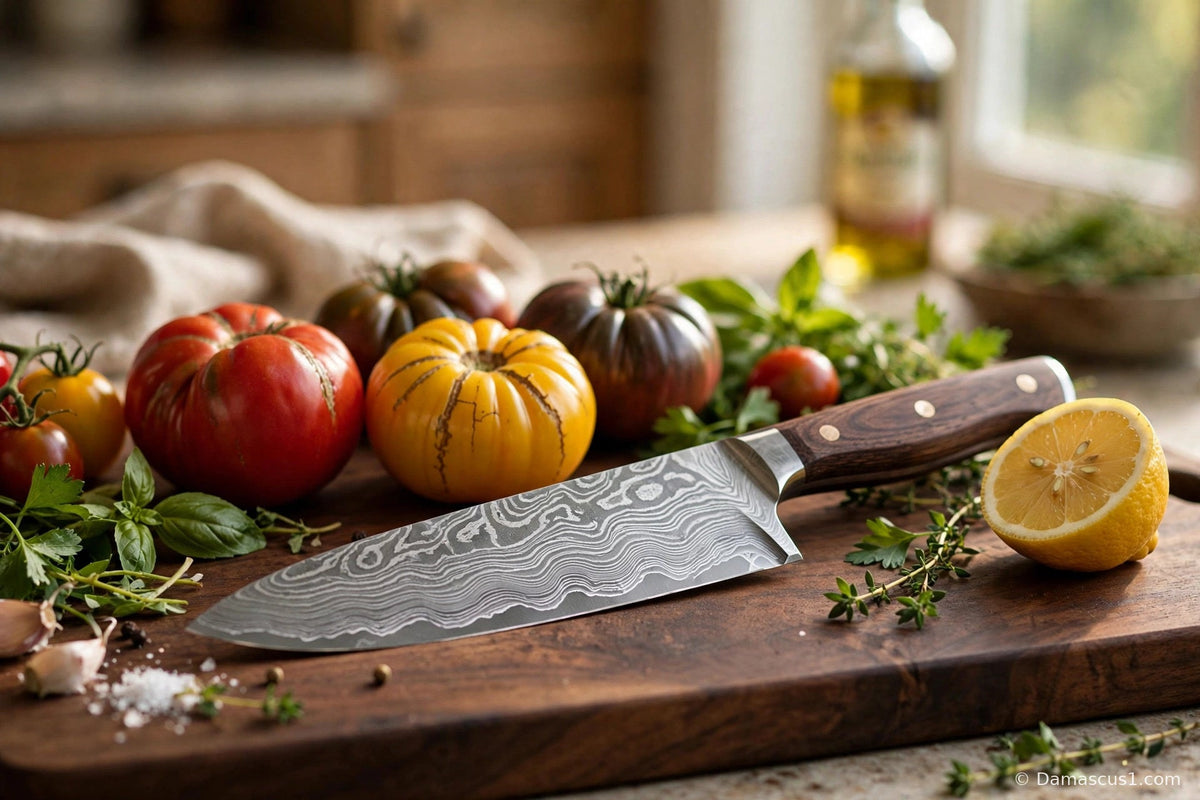
Do not use an illustration’s blade pattern to infer hardness, corrosion resistance, edge retention or manufacturing location. A style name is also not a country-of-origin certificate. Record confirmed information separately from unanswered questions. If the seller cannot establish a feature you require, you have useful decision information: that listing has not yet met your requirement. You can keep comparing without guessing what the missing evidence would say.
Request the supplied contents
A product page may show a knife beside a sheath, block, rod, food or other styling objects. Ask for an itemized packing list. For a single knife, confirm whether a guard, box or sheath is included and whether it fits that model. For a set, ask for every knife and accessory by name rather than accepting a total piece count. A block, shears or rod can contribute to a bundle count without being another cooking knife.
This is particularly important for the AUS-10-labelled listing, whose older copy mixed a single knife with a multi-piece block set. Do not budget as though the block or sharpening tool is included until that configuration is confirmed. The purchase price should be compared against the actual supplied items, not the most generous interpretation of inconsistent copy.
Compare the full cost of buying and keeping the knife
Use a simple worksheet: item price plus the actual checkout shipping quote, applicable taxes and any confirmed required accessories equals the initial total. Then note likely maintenance arrangements separately. You may already own suitable storage or a maintenance tool, but compatibility should be established for the selected model. Do not add an accessory just because a generic guide recommends it, or assume an existing sharpener is suitable for every blade.
For arithmetic only, an invented example of a $60 item with $12 shipping and $8 of other charges totals $80. Those numbers are not Damascus1 shipping rates, tax estimates or a quote for any listing. Your own checkout and destination determine the applicable amounts. Keeping the example separate from real prices prevents a helpful budgeting exercise from becoming a misleading delivery promise.
If $100 is a strict delivered ceiling, leave the shipping and tax cells open until you can see them. Avoid treating the unused portion of the budget as money that must be spent. It can remain unspent when your requirement is met, or it can cover a confirmed need such as compatible edge protection. A higher item price is not proof of longer service life, and this guide makes no cost-per-year claim for untested models.
Choose by the gap in your kitchen, not a universal winner
Replacing an everyday knife
Record what the old knife supplied: its dimensions, the tasks it performed and the storage it used. If damage prompted the replacement, ask a qualified service provider whether repair is appropriate before assuming sharpening will solve it. Compare the replacement against those requirements. A familiar title does not ensure familiar weight, balance or handle shape. These qualities need model information and, where available, an appropriate supervised assessment.
The replace one knife or buy a set worksheet helps separate a missing tool from a complete kitchen reset. Use it before increasing the budget for more pieces. If only one task remains uncovered, ask whether the proposed specialist is intended for that job. If several tools need replacing, compare a documented set against individual purchases using their actual contents and totals.
Considering a vegetable-focused listing
The two VG10-labelled nakiri listings are separate catalogue entries with different current prices. Their names alone do not establish that one has a longer blade, a better handle or greater cutting ability. Confirm their measurements, geometry and material information independently. A comparison should say which documented feature meets your need, rather than describe the more expensive listing as an automatic upgrade.
For your task sheet, note the foods you prepare, the working space and any limitations in your present setup. Ask the maker which tasks the model permits and which it excludes. Do not infer that a vegetable-oriented name allows cutting hard pits, frozen items or bones. If there is no reliable answer about intended use, leave the suitability decision open.

Considering a broad or cleaver-style blade
The Serbian-style listing should be evaluated with the same evidence standard. A broad appearance does not establish permission to strike the spine, twist the edge, split bones or force the blade through resistant food. Ask for intended-use limits and an appropriate tool for the actual job. Do not turn an attractive chopping scene into a load rating for the item being sold.
Handle dimensions and storage clearance also need checking for this listing. A broad blade can create different fitting questions for a holder, but the actual measurements are required to answer them. If you cannot establish a safe fit for your storage, plan another confirmed arrangement before ordering. Do not assume a generic sheath or block slot will fit because the product is called a kitchen knife.

Handle fit and maintenance need model-specific answers
A product description can help you identify a handle material or dimension once confirmed, but it cannot promise comfort or secure control for every hand. Do not infer wet-grip performance from a material label or a textured photograph. Ask for handle measurements and the maker’s handling instructions. If you cannot assess a tool safely, seek a qualified demonstration instead of improvising an exposed-blade balance or grip test.
Keep an inspection question separate from a cooking trial. Before using a newly delivered knife, check the order and ask what inspection is allowed under the actual return conditions. Damascus1’s current policy requires an eligible return to be unused and in original condition. A generic suggestion to “try it for a week” would conflict with that requirement. Do not remove tags, alter the edge or discard packaging on the assumption that a preference return will remain available.
For maintenance, obtain instructions that match the model’s construction and edge. This guide does not prescribe one sharpening angle, stone, rod or pull-through device for every listing. A number such as 12 degrees in an old catalogue is not a confirmed instruction for an ambiguously identified knife. Ask whether the maker recommends a particular process or professional service and what conditions affect warranty or return eligibility.
General planning is still useful without inventing a maintenance specification. Decide where you can safely clean, dry and store the tool according to its instructions, who will handle it and how its edge will be protected. If your household needs a cleaning method that the maker cannot confirm, settle that issue before buying. The same applies to corrosion-resistance expectations: a steel label alone cannot establish that the supplied item tolerates your intended routine.

Reviews: useful evidence with clear limits
Read reviews on the exact product page and check what the reviewer actually describes. A delivery experience, a first impression and a long-term cutting observation answer different questions. Do not transfer a rating from another model or present a review as laboratory evidence of steel composition. If the number of reviews is small, say so; absence of reviews is not proof that a product is good or bad.
At the time of this check, the G10-labelled listing showed one model-specific review with a 4.0 rating. The reviewer reported paying additional postage at collection. That is a real customer report worth reading alongside the current shipping terms; it is not proof that every order incurs that charge or that every destination has the same experience. This guide does not replace the review, change its wording or reinterpret it as praise for cutting performance.
When a review raises a question relevant to you, ask a precise pre-purchase question. For example, ask what the checkout quote covers for your destination and whether other applicable charges remain possible. Do not assume a customer’s historical amount is today’s quote. Record the current reply with your order information if it will affect your decision.
Shipping and returns before you press checkout
The current shipping policy says estimates depend on availability and the shipping option chosen. It notes destination restrictions for some products and weight-based rates for many items. That does not establish a universal dispatch time, a guaranteed arrival date or free delivery for all orders. Review your actual destination and shipping choices before relying on an estimate, especially for a gift or event.
The current refund policy describes returns within 30 days of purchase to the original payment method. Eligibility requires the product to be unused, in original condition, with tags intact, original packaging and proof of purchase. Shipping fees are non-refundable. These conditions do not describe an unconditional satisfaction trial, free return postage or a promise that a used knife can be returned because the handle did not suit you.
If a banner or older piece of copy sounds broader than those terms, ask for clarification before relying on it. In particular, distinguish shipping an order from returning it: they are different transactions with different possible costs. This guide reports the current policy; it does not add a commercial promise or change your order terms. For a deadline, obtain a current estimate for your actual order rather than treating an editorial example as a commitment.
A short message that can resolve the important gaps
Use this checklist when asking about a shortlisted product: identify the product URL and selected variant; state the task you need it for; ask for blade and overall length, thickness, weight and handle dimensions; request confirmed steel and handle materials; ask for an itemized packing list and model-specific instructions. Include your delivery destination and required date only through the store’s appropriate private contact channel, not in a public review.
Keep the request focused on the facts that decide your order. If drawer clearance is the issue, lead with overall length and protected storage dimensions. If an included sheath is essential, ask for confirmation that it is supplied and fits the variant. If documented steel is your requirement, request the relevant evidence rather than asking for a general assurance of quality. Clear questions make the reply easier to use and prevent a broad sales answer from leaving the original uncertainty unresolved.
When the reply arrives, update the worksheet instead of rewriting every uncertainty as a benefit. Confirm the item price and availability again on the product page, then review the checkout total. If a required answer remains missing, continue comparing or wait for clarification. No urgency claim is necessary to make a sound purchase decision.
Receiving and storing the order
Save the product and variant information, the agreed packing list and your receipt before delivery. On arrival, compare the package contents against that record using a safe inspection process consistent with the seller’s instructions. If the order appears incorrect or damaged, stop and contact the store before using or modifying it. The knife order inspection checklist provides a record you can complete without assuming a used-product trial is allowed.
Measure storage before buying a fitted block, drawer insert, guard or sheath. Use the actual knife’s confirmed dimensions and the holder maker’s limits. Allow for the protected knife and the space needed to retrieve it safely; do not rely on a picture of a tidy counter as proof of fit. The block versus drawer measurement guide helps organize those questions. This is a planning step, not a recommendation to put an undocumented knife into any holder.

Frequently asked questions
Which Damascus1 knife under $100 is best?
No universal winner is established here. The listed prices provide a starting point, but the exact blade, dimensions, materials, included items and intended use must meet your needs. This guide has not tested these models side by side. Resolve the required facts before treating any listing as a recommendation.
Is the $34.99 G10-labelled listing definitely a chef knife?
The current listing does not establish a confirmed chef profile. Its G10 label also is not independent material verification. Ask for current model photographs, measurements and documentation. Do not infer its blade type from the older URL or an illustration in this article.
Are the two VG10-labelled nakiri listings interchangeable?
No evidence here establishes that they are the same supplied model. They have different product pages and current item prices of $44.99 and $49.99 in this dated check. Confirm each listing’s dimensions, blade profile, handle material and packing list before comparing them.
Does the AUS-10-labelled price include a block set?
That is not confirmed. The older description mixed a single knife with a multi-piece set, so ask for the current variant’s itemized packing list. Do not assume a block, rod or several knives are included just because older catalogue text mentioned them.
Can the Serbian-style knife cut bones or frozen food?
This guide does not establish that permission. A broad blade, cleaver-style name or older durability claim is not a tested load rating. Obtain the maker’s intended-use limits and use a tool specifically suited to the job.
Does a price below $100 include delivery?
The comparison table shows item prices only, checked October 28, 2026. Shipping, applicable tax and other charges can change the total. Review your actual checkout quote and destination requirements. No universal free-shipping or fixed-arrival promise is made here.
Can I cook with the knife and return it if I dislike it?
Do not assume that. The current refund policy requires an eligible return to be unused and in original condition, with tags, original packaging and proof of purchase, within 30 days of purchase. Shipping fees are non-refundable. Clarify permitted inspection before using or altering the knife.
What should I do when a required specification is missing?
Ask a precise question tied to the product URL and variant, and keep the answer with your comparison record. If the information remains unconfirmed, leave it marked unconfirmed and avoid buying on the assumption that it matches another listing. The Damascus knife FAQ offers further buying questions without replacing model-specific confirmation.
Compare current kitchen listings, then confirm the facts that matter to your task and review the delivered total before ordering.
Leave a comment: